
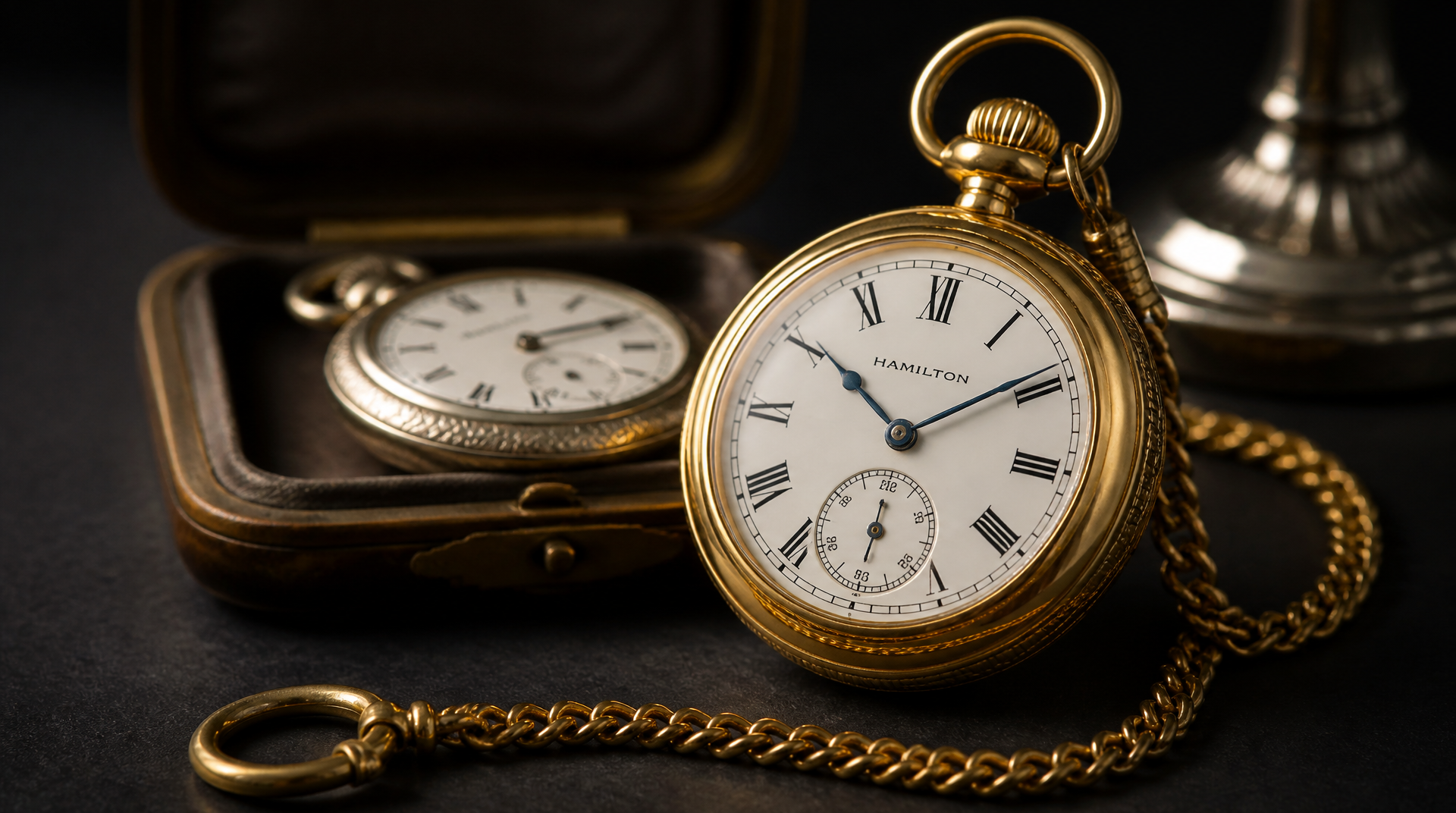
A Hamilton pocket watch’s serial number, stamped on the movement, unlocks the grade, production year, and factory specs in a few minutes when you check it against the Pocket Watch Database. This guide shows you exactly where to find that number, how to decode it, and which mismatched parts can slash value—before you buy or sell.
Locate the Serial Number on the Movement
Hamilton serial numbers are engraved on the movement plates, not the case. A case serial number traces the case maker, not the watch, so don’t rely on it for identification.
Where to Look
- Open the case back. On a hunting-case watch (lid at 3 o’clock), the movement is visible directly. On an open-face watch (crown at 12, lid on the rear), unscrew or gently pry the rear cover.
- Find the serial number. Look for a numeric-only engraving on the top plate, barrel bridge, or train bridge. It’s a six- or seven-digit sequence with no letters.
- Do not confuse the grade stamp with the serial number. Grade marks like “992,” “950,” or “917” are model designations; the serial number is the unique production identifier.
Why Case Numbers Don’t Identify the Watch
Hamilton pocket watches were often cased by jewelers in cases from Keystone, Wadsworth, Fahys, or others. A mismatch between the case serial and the movement is normal and not a red flag by itself—but the case style must be era-appropriate to preserve value.
Decode the Serial Number with the Online Database
Hamilton’s serial numbers are sequential by production date. You decode them by cross-referencing the number against a lookup table, not by deciphering embedded codes.
1. Record the full movement serial number. Use magnification and good light; wipe the plate gently if needed.
2. Go to the Pocket Watch Database (pocketwatchdatabase.com). Enter the serial number and choose “Hamilton” as the manufacturer.
3. Read the result. The database delivers the estimated production year, movement grade, size (usually 16s or 18s), jewel count, and configuration (open-face or hunting).
4. Note the factory jewel count and grade. These two pieces of information become the baseline for your next authentication steps.
Cross-Check Your Findings for Authenticity
Before you assign any dollar value, verify that the physical watch matches the database record. A single mismatch is a warning; two or more usually mean the watch has been tampered with.
The 3-Point Originality Check
1. Grade stamp vs. database. Does the grade stamped on the movement (e.g., “992”) match the grade the database returns for that serial block? If the database says Grade 974 but the movement says 992, something is wrong.
2. Visible jewels vs. factory count. Count the jewels you can see (look for the red synthetic bearings). A 21-jewel movement that shows only 17 jewels was likely downgraded or misrepresented.
3. Dial type vs. production year. Hamilton changed dial signatures over time. A 1920s railroad watch should have a block-letter “Hamilton” with serifs; a late-1930s or 1940s piece may use a flowing script logo. If a 1915 serial number carries a 1940s script dial, the dial is a replacement.
Stop threshold: If any one of these three points fails, pause. A mismatched grade or jewel count means the movement has been swapped or re-engraved. A wrong-era dial reduces collectibility and often indicates the watch was cobbled together. Value the piece below the running-condition ranges in the next section.
Originality Audit: Dial, Hands, and Case
A correct movement-and-case pair does not guarantee originality. Dials and hands are frequently swapped, and that single mistake can cut a watch’s value by 30–40% or more.
The Swapped-Dial Trap
High-grade movements like the 992 or 950 were sometimes married to correct-era cases but fitted with a dial from a lower-grade dress watch (e.g., a 917) when the original was damaged. Check these details early:
- Dial feet and screw marks. Hamilton dials are held by two or three dial feet that fit into holes on the pillar plate. Extra screw marks or ill-fitting feet signal a replacement.
- Dial signature precision. Original Hamilton printing is sharp, with even enamel thickness. Reproduction decals or repainted dials often have fuzzy edges or slightly off-white backgrounds.
- Dial material and era clues. Porcelain-enamel dials from the 1910s–1930s commonly develop hairline cracks; a flawless dial on a century-old watch isn’t impossible, but it demands closer scrutiny. Post-1940 992B watches used melamine dials that resist cracking, so a clean dial there is less suspicious.
Hands: The Fastest Originality Test
Railroad-grade Hamilton watches wore heavy spade-style hands or thick whip hands. Thin, delicate baton hands on a 992 or 950 almost always come from a dress-grade piece like the 917. Match the hand style to the grade: heavy hands for railroad, lighter profiles for everyday 12-size and 16-size dress watches.
Concrete impact: A 1915 Hamilton 992 with an original double-sunk Montgomery marginal-minute dial and correct heavy spade hands typically sells for $300–$400 in running condition. The same watch with a swapped 1940s metal dial and thin baton hands rarely breaks $200—and many collectors pass entirely.
Assess Movement Health Before Assigning Value
All value ranges in this guide assume a running movement. A watch that doesn’t keep time or shows signs of neglect needs a service cost deducted from its price.
A 2-Minute Health Check
- Full wind test. Wind the crown slowly until you feel firm resistance (typically 20–30 half-turns on a 16-size watch). A slipping or gritty feel indicates a damaged mainspring or keyless works.
- Listen to the beat. Hold the watch dial-up to your ear. A healthy 16-size Hamilton produces an even, crisp tick-tock. A sluggish or intermittent beat often means a dirty movement or low balance amplitude.
- Watch the balance. If the back is transparent or you can open the dust cover, check the balance wheel through the case. A properly running watch shows a balance swing of at least 270° in dial-up position. A lazy arc below 180° means the watch needs a full service.
- Check for rust. Look for reddish-brown dust on steel parts and around the regulator. Rust anywhere on the movement reduces value and signals moisture damage.
When to Stop and Get a Watchmaker Involved
If the watch does not run at all after a full wind and you see no obvious rust or broken part, do not force the crown or try to shake it into motion. That can strip the mainspring or break a pivot. Set a value based on “for repair” condition—typically subtract $150–$250 for a standard Hamilton pocket watch service—and have a professional inspect it before you commit.
Hamilton Pocket Watch Values by Grade
Railroad-grade models command the strongest prices because of their build quality, lever-set mechanisms, and documented history. Dress and everyday grades offer affordable entry points.
Railroad-Grade Models (Running, Original Dial/Hands, Correct-Era Case)
| Grade | Size | Jewels | Era | Approx. Value (Gold-Filled Case) | Notes |
|---|---|---|---|---|---|
| 992 | 16s | 21 | 1903–1940s | $150–$400 | Most collected Hamilton grade; original Montgomery dial adds $50–$100 |
| 992B | 16s | 21 | 1940–1969 | $250–$600 | Melamine dials standard; higher finish than 992 |
| 950 | 16s | 23 | 1909–1930s | $300–$700 | Fewer made; 23-jewel premium |
| 950B | 16s | 23 | 1941–1969 | $400–$900 | Top railroad grade; solid gold case adds 20–40% |
| 940 | 18s | 21 | 1900–1920s | $200 |
Explore This Topic
- Back to Hamilton
- Back to Hamilton Pocket Watch Help
Related guides in this cluster:
- Fossil Watch Battery Replacement: Complete Guide for All Models
- Tag Heuer Serial Number Guide: How to Check & Authenticate Your Watch
- How to Authenticate Any Watch: Serial Numbers, Papers, Red Flags & Expert Tips

The We Know Watches editorial team brings together over 40 years of combined watch collecting, trading, and repair experience. Our editors have owned and handled watches from every major brand — from entry-level Seiko 5s to Rolex, Omega, Patek Philippe, and independent Swiss watchmakers. We’ve bought and sold at auction, worked with authorized dealers, visited manufacturing facilities in Switzerland and Japan, and serviced hundreds of movements ranging from the Seiko 7S26 to the Longines L888. Every guide and review we publish is based on hands-on experience, original research, and consultation with professional watchmakers. We do not accept payment for reviews, and we clearly disclose when we use affiliate links.