
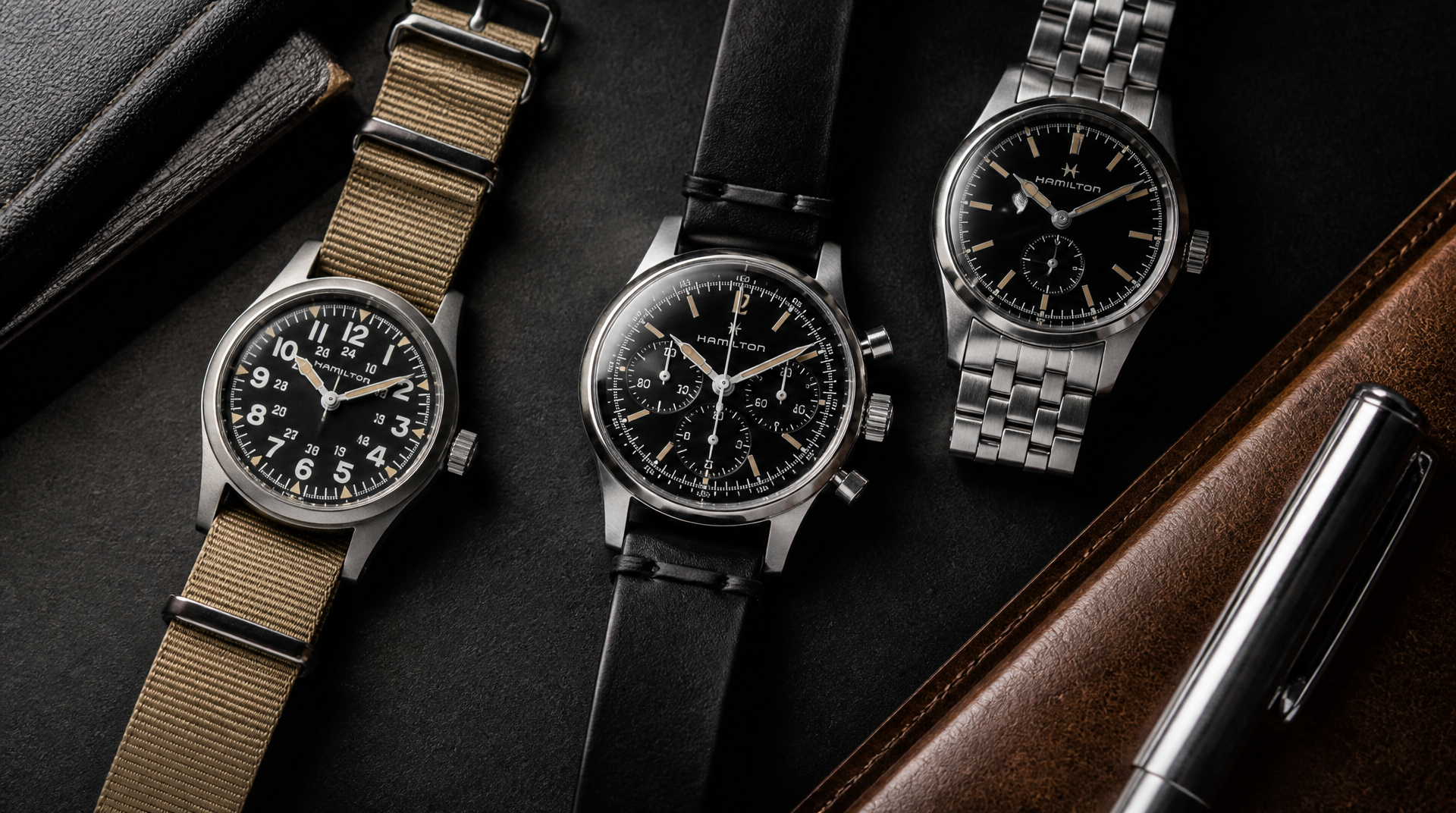
Most collectible vintage Hamilton wristwatches currently sell between $200 and $2,000, with the majority of clean, running examples clustered in the $400–$900 range. Rare military-issue models, early electric watches, and solid-gold cases can push past $5,000, while later quartz pieces and pocket watches often stay under $300. The number that matters for your watch depends far less on a published price guide than on reference, condition, and which buyer is actually paying—not just asking.
Why Many Value Estimates Fail—And How to Spot It Early
The single biggest failure mode when someone researches the value of a Hamilton watch is confusing asking prices with sold prices while ignoring condition grading. A seller lists a Ventura for $2,400, and suddenly the owner of a similar-looking watch believes theirs is worth $2,400. Meanwhile, the same reference in nearly identical shape regularly sells for $800–$1,100. The inflated number sits on a marketplace for months, never gets paid, and distorts every subsequent quick Google search.
Detect this early with one simple habit: filter every value check by completed or sold listings only. If you can’t find at least three paid transactions from the last 90 days that match your model and its condition grade, treat any single asking price as speculation. When you see a spread, throw out the highest outlier and build your range from the cluster of actual sales. That single step eliminates most of the wishful pricing that leads owners to over-insure, overpay, or sit on a watch they think is far more valuable than the open market will bear.
A Practical Workflow for Pricing a Collectible Hamilton
Treat this as a repeatable process, not a single lookup. The order matters because later steps become meaningless if the first step is skipped.
What to gather before you start
- The full model name (if known) or case reference from inside the case back
- Movement calibre and serial number—visible on the movement, often through a display back or after case removal
- Case metal markings (e.g., 14K gold, gold-filled, stainless steel, base metal)
- Any military engravings, ordnance marks, or original paperwork
- High-resolution photos of the dial, case, crown, and movement
Work the pricing steps
1. Lock in the exact reference and production period. A 1960s Thin-o-matic isn’t the same watch as a 1970s Thin-o-matic, and the price differs sharply. Use the serial number chart on enthusiast sites or Hamilton’s vintage records to narrow the year.
2. Grade condition honestly, not hopefully. Apply a standard vintage watch grading scale (mint, excellent, very good, good, fair, or 1–10). Be harsh: a redial, replaced hands, polished case, or non-original crown can cut value by 30–50% even if the watch runs well. A quick field check—run your finger along the case edges; if they feel soft or rounded instead of crisp, the case has likely been polished.
3. Search sold listings first. On eBay, filter by “Sold items.” On auction aggregators like LiveAuctioneers or Invaluable, look at hammer prices, not estimates. On Chrono24, toggle “Sold” results if available, or note that listed prices typically include dealer margin of 20–35%.
4. Match condition, not just the photo thumbnail. If your watch has moderate brassing on the lugs and a faint dial stain, compare it only to others with the same flaws. Pristine examples set a ceiling you can’t expect to hit.
5. Build a realistic range. Take the sold prices that match your condition, discard the extreme high and low, and use the middle 50% as your likely private-sale range. Dealer retail sits roughly 20–40% above that; auction consignment nets you 10–20% below.
6. Cross-check against a few specialist dealer asking prices. This tells you the upper boundary a buyer might pay for a fully serviced, warranted piece—not what your watch is worth in a face-to-face transaction.
Reality-check your range
Before you commit to a final number, test the range against knowledgeable collectors. Post a short, honest description—include the reference, clear movement and dial photos, and a note about any flaws—on a forum like Watchuseek’s vintage section or a Hamilton-specific Facebook group. Ask: “Would $X–$Y be a fair private-party range for this model in this condition?”
A successful verification looks like this: within a day or two, several long-standing members reply with ranges that overlap yours, or no one challenges the figure. If instead you get a wave of corrections citing lower sold prices, adjust your range down and re-test. Avoid the trap of only asking a seller who has a matching watch currently listed; their interest often runs opposite to yours.
When to stop and escalate
Stop the DIY pricing and get a written valuation from a credentialed appraiser (NAWCC or similar) or a reputable vintage watch dealer when:
- The watch has confirmed military provenance, especially British or Canadian broad arrow markings, U.S. ordnance stamps, or original military-issue box and papers.
- The case tests as solid 14K or 18K gold; scrap value alone may exceed typical model pricing, and a correct insurance valuation matters.
- You suspect the watch is a rare variant (prototype dial, early prototype electric, documented celebrity ownership, or a pre-1920 railroad model with provenance).
- You need a valuation for estate settlement, insurance, or divorce proceedings—sold listings are not legally defensible in those contexts.
Collectible Model Groups and Recent Market Ranges
Below are the segments where Hamilton’s strongest collector demand lives. Actual selling prices will sway depending on service history, originality, and whether the watch comes with box and papers.
Military-Issued and Field Watches
American, British, and Canadian forces used Hamilton wristwatches extensively during WWII and into the Vietnam era. U.S. Hamilton military models with fixed bars and hack functions (like the MIL-W-3818B or 46374) regularly sell for $600–$1,200 in good original condition. British “G.S.T.P.” and broad arrow-marked Hamiltons with the calibre 987 or 980 can reach $800–$1,800 if the dial and case remain unpolished. A documented 1960s MIL-W-46374 with intact radium lume and its one-piece nylon strap often trades between $300 and $700—but replicas and service-dial replacements are common, so expect a sharp discount if the lume or hands aren’t original.
Ventura and Early Electric Models
The asymmetrical Ventura (calibre 500 or 505) anchors a cult following. Running examples with an original dial and no major case gouges usually land between $1,200 and $2,500; rare solid 14K versions can break $4,000. The Pacer and Everest electric models offer a similar mid-century design language for $300–$600 in decent working order. A critical warning: many early electrics suffer from fragile contacts and movement wear that make consistent timekeeping tricky. A “running” watch that stops after ten minutes on the wrist falls at the low end of the range or lower, regardless of how it looked in the listing video.
Classic Dress and Gold-Filled Models
Hamilton’s 1950s through late 1960s gold-filled manual-wind dress watches—models like the Boulton, Myron, Rodney, or Sea-Lectric—form the volume backbone of the market. A clean, recently serviced example typically brings $250–$500. Rarer configurations with fancy lugs, two-tone dials, or original bracelets can stretch toward $700. Solid gold models, especially those in 14K or 18K with discreet hallmarks, routinely sell for $800–$2,000 depending on case weight and condition. Be skeptical of any listing that calls a watch “solid gold” without a clear hallmark photo; many Hamilton gold-filled cases are exceptionally thick and wear like solid gold for decades.
Railroad Pocket Watches
The 992B and 992 movements remain staples for collectors of American railroad timepieces. A serviced 992B in a clean case usually sells for $250–$500. Earlier 992 models with Montgomery dials or Canadian 24-hour dial variations can reach $500–$800. Full-boxed sets from the 1940s with original factory paperwork sometimes exceed $1,000. Pocket watches with presentation engravings that tie to a specific railroad or employee add modest interest but rarely double the value unless the name is historically significant.
Where to Check Current Sold Prices (and Which Sources to Ignore)
A source hierarchy matters because different platforms reflect different buyer pools.
- eBay sold listings: Best for the broadest pool of private transactions. Filter by location (North America), and exclude “parts/repair” unless your watch is non-running.
- Hibid and LiveAuctioneers: Useful for regional estate auctions where Hamiltons often sell without dealer markup. Look at live bidding history to see true hammer prices, not the pre-sale estimates.
- Chrono24 and specialist dealer sites: Trust these for retail comps, not for private sale value. Subtract 25–35% to approximate what a dealer might pay when buying outright.
- Forum classifieds and Reddit’s r/Watchexchange: Can surface fast-moving private sales, but condition descriptions vary wildly. Always request timestamped, sharp photos before using them as comps.
The process you run matters as much as the sources. Repeat the workflow, reality-check your range, and escalate when the watch’s value sits outside the boundaries a sold-listing search can handle.
Explore This Topic
- Back to Hamilton
- Back to Hamilton Values
Related guides in this cluster:
- Hamilton Pocket Watch Collector’s Guide: Serial Numbers, Models & Value
- Hamilton Watches: The Complete Brand Guide — Khaki, Jazzmaster & American Heritage
- Breitling Watch Buying Guide: Are They Worth It in 2026?

The We Know Watches editorial team brings together over 40 years of combined watch collecting, trading, and repair experience. Our editors have owned and handled watches from every major brand — from entry-level Seiko 5s to Rolex, Omega, Patek Philippe, and independent Swiss watchmakers. We’ve bought and sold at auction, worked with authorized dealers, visited manufacturing facilities in Switzerland and Japan, and serviced hundreds of movements ranging from the Seiko 7S26 to the Longines L888. Every guide and review we publish is based on hands-on experience, original research, and consultation with professional watchmakers. We do not accept payment for reviews, and we clearly disclose when we use affiliate links.