If your Seiko Kinetic watch has stopped running, runs only briefly, or the seconds hand jumps in two-second intervals, the problem is almost certainly a dead capacitor or a seized rotor. Both are fixable at home with basic tools and the right replacement part—often for under $30. Start with the capacitor; it solves roughly 80% of Kinetic issues. If that doesn’t work, a gummed-up rotor is the next most likely culprit.
Dead Capacitor: The Most Common Cause
The Seiko Kinetic uses a rechargeable capacitor, not a standard watch battery. Over 3–5 years that capacitor degrades and no longer holds a charge. You’ll see the seconds hand skip in two-second jumps (the low-charge warning) or the watch simply stops after a week or two in a drawer.
Evidence: On 5M62 and 5M42 movements, this is the most-reported failure across watch forums. If the watch stops within 24 hours of not wearing it, the capacitor is almost certainly dead. For the 7D48 and 5M43, the same pattern holds, though the capacitor part numbers differ (e.g., SII 3023 for 5M62, SII 3025 for 5M42).
Quick check: Shake the watch vigorously for 30 seconds. If it starts running but stops again within a few hours, replace the capacitor. If the seconds hand moves in smooth one-second steps after shaking but reverts to two-second jumps overnight, the capacitor is failing under load.
How to Replace the Capacitor
What you’ll need:
- A replacement capacitor (check your movement number, usually engraved on the rotor or under the case-back; common parts are SII 3023 for 5M62 and 5M63, SII 3025 for 5M42 and 5M43)
- Case-back opener (a rubber ball works on most screw-down backs; use a case-back wrench with correct pins for tight backs)
- Plastic tweezers (metal can short the circuit)
- Small flathead screwdriver
Step 1: Open the case-back. Use the rubber ball to rotate counterclockwise. If the case-back has multiple notches, a case-back wrench avoids scratching. For snap-on backs, use a case-knife carefully along the seam.
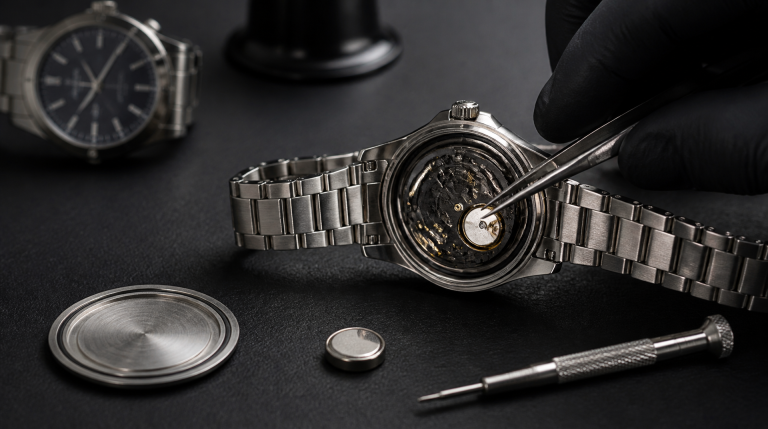
Step 2: Locate the capacitor—a small silver cylinder (about 1/4 inch long) held by a metal clamp. It sits near the movement edge, often next to the circuit board. On 5M62 movements it’s typically marked with the part number on the circuit board silk-screen.
Step 3: Release the clamp by lifting its two fingers with the screwdriver. Slide the old capacitor out with plastic tweezers. Note its orientation—the positive side is usually marked with a “+” on the circuit board, and the capacitor may have a stripe indicating polarity.
Step 4: Insert the new capacitor in the same orientation. Press the clamp back down until it clicks firmly. Double-check that the clamp is fully seated—a loose clamp can cause intermittent connection.
Step 5: Close the case-back, give the watch 30 shakes, set the time, and wear it.
Verification step after replacement: Shake the watch for 30 seconds. The seconds hand should move in smooth one-second steps, not two-second jumps. Set the time. Put the watch down for 48 hours—it should still be running when you pick it up again. If it stops within 24 hours, the capacitor may be faulty (rare) or there is another issue.
What if it doesn’t work? If the new capacitor alone doesn’t restore normal function, the problem is likely a seized rotor. Move to the rotor cleaning section below before buying more parts.
Rotor Not Spinning Freely
If the capacitor is fresh but the watch still won’t hold a charge, check the rotor. The oscillating weight that charges the capacitor can get gummy from dried lubricant. Older Kinetic movements—especially the 7D48 and 5M43—can develop seized rotor pivots entirely. The rotor should spin with moderate resistance and a smooth whir; if it feels rough or barely moves, it’s not generating enough power.
Symptom: You shake the watch and feel very little resistance; the rotor barely spins. The watch runs only while you’re actively moving it, then dies within minutes. Another sign: the seconds hand stops within a few hours even after a long shake session.
Fixing the Rotor
Step 1: Remove the rotor. Unscrew the single center screw (usually Phillips #00) and lift the rotor off the movement. Place it on a soft, lint-free cloth to avoid scratching.
Step 2: Inspect the pivot—the small pin at the rotor’s center. If it’s black, sticky, or has visible dried oil residue, clean it. Dip a lint-free cloth or foam swab in isopropyl alcohol (91% or higher) and gently wipe the pivot. Avoid touching the rotor’s friction ring with the alcohol—it can remove needed lubrication.
Step 3: Apply one tiny drop of light watch oil (Moebius 9010 or equivalent) to the pivot. Use a toothpick or oiler tool; the drop should be barely visible. Too much oil will cause drag instead of freedom.
Step 4: Reinstall the rotor and tighten the screw snugly (but not overtighten—the screw can strip). Give the watch a few shakes. You should feel a smooth whirring sound and moderate resistance, not a grinding or sluggish feel. If it still feels rough, the pivot may be worn; a worn pivot requires replacement of the rotor assembly.
Failure mode to watch for: Over-oiling is the most common mistake. If the rotor spins freely but the watch still doesn’t charge, excess oil may have spread to the friction ring. Wipe the pivot dry with alcohol, reapply a smaller drop, and try again. A drop that’s barely visible on the tip of a toothpick is enough. On some movements (e.g., 5M43), the friction ring is visible as a thin brass disc under the rotor—if oil gets there, clean it with alcohol and let it dry completely.
Success check: After cleaning, shake the watch for 20 seconds. The seconds hand should move in one-second steps. Put the watch down for 48 hours—if it’s still running, the rotor is working correctly. If it stops before 48 hours, move to the deeper electrical issues section.
Deeper Electrical Issues: Coil or Circuit Board Failure
Rarer but possible: the circuit board or the electromagnetic coil beneath the rotor can fail. This usually follows water damage or a sharp impact. The watch stays completely dead even after a new capacitor and a cleaned, oiled rotor.
Evidence on 5M62 movements: A shorted coil reads near zero resistance across the two coil terminals (should be around 1–2 kΩ). If you own a multimeter set to ohms, test the coil by touching the probes to the two small solder pads visible on the circuit board where the coil wires connect. A reading of zero (open circuit) means the coil is broken and must be replaced. A reading far above 2 kΩ (e.g., 10 kΩ) indicates corrosion inside the coil windings.
Realistic failure scenario: Suppose you’ve replaced the capacitor and cleaned the rotor, but the watch still shows a two-second skip immediately after charging, or dies within a few hours. The rotor looks fine, and the capacitor tests okay on a multimeter (steady voltage reading around 1.5V when fully charged). At this point, the coil or circuit board is the likely cause. Another sign: the watch runs erratically—sometimes stopping, sometimes running—even after a full charge.
Stop/escalate threshold: If you’ve done both the capacitor swap and rotor cleaning, but the watch still won’t hold a 48-hour charge, stop further DIY work. Replacing the coil or circuit board requires removing the movement from the case and performing delicate soldering inside tight spaces. Without a movement holder and proper magnification, it’s easy to break the balance spring or damage the circuit traces. A watchmaker can test the coil under load and replace the circuit block without risking other movement parts. Expect $50–$100 for a professional repair. For vintage Kinetic models (e.g., early 5M42 from the 1990s), parts may be harder to find, so a watchmaker can also advise on swap options.
Quick Identification: Finding Your Movement Number
Before buying any parts, confirm your movement number. It’s usually engraved on the rotor (readable through the case-back if open) or stamped on the mainplate near the balance wheel. The most common Seiko Kinetic movements are 5M62, 5M42, 5M43, 7D48, and 7D56. A quick search of your model number (on the case-back) plus “movement” will give you the exact calibre. Capacitors are not interchangeable between all movements—double-check the part number before ordering.
FAQ
How long does a Seiko Kinetic capacitor last?
Typically 3–5 years of regular use, but it can fail earlier if the watch sits for long periods without being worn. The capacitor degrades gradually, so you’ll notice shorter run times before it stops entirely.
Can I use a regular watch battery in a Kinetic?
No. A Kinetic requires a rechargeable capacitor (or in very early models, a rechargeable battery). A standard silver-oxide battery cannot be recharged by the rotor and will damage the circuit.
Why does my Kinetic skip in two-second jumps?
That is a low-charge warning. The seconds hand jumps two seconds at a time to conserve remaining power. It indicates the capacitor is nearly empty. If it persists after shaking, the capacitor is likely dead.
What if the watch still doesn’t work after capacitor and rotor service?
The issue is almost certainly the coil or circuit board. At that point, professional service is recommended. The repair cost is usually less than replacing the entire watch.
Whether you fix it yourself or hand it off, the vast majority of Seiko Kinetic issues are resolved with a simple capacitor swap. The next most common cause—a seized rotor—can be cleaned in under 15 minutes. With the right parts and a little patience, you can keep your Kinetic running for many more years.
Explore This Topic
- Back to Seiko
- Back to Seiko Kinetic Problems
Related guides in this cluster:
- Seiko Automatic Watch Keeps Stopping? Common Causes & How to Fix Them
- Seiko SKX007 & SKX009: The Complete Guide to the Legendary Dive Watch
- Seiko Watch Nicknames Guide: Batman, Willard, Turtle, Samurai & More

The We Know Watches editorial team brings together over 40 years of combined watch collecting, trading, and repair experience. Our editors have owned and handled watches from every major brand — from entry-level Seiko 5s to Rolex, Omega, Patek Philippe, and independent Swiss watchmakers. We’ve bought and sold at auction, worked with authorized dealers, visited manufacturing facilities in Switzerland and Japan, and serviced hundreds of movements ranging from the Seiko 7S26 to the Longines L888. Every guide and review we publish is based on hands-on experience, original research, and consultation with professional watchmakers. We do not accept payment for reviews, and we clearly disclose when we use affiliate links.