Your Cartier’s water resistance rating is not a permanent free pass. Before you swim, shower, or even do the dishes, you need to confirm three things: the actual depth marking on the case, that the crown is fully sealed, and when the watch last passed a pressure test. Even a 100-meter-rated Santos can take on water in a shallow pool if its gaskets are older than 18 months and have stiffened. The rating stamped on the case is only as good as the seals holding it.
The Gasket Age Gap: When a “100M” Watch Leaks in a Hotel Pool
The most common and expensive error is trusting the printed number while ignoring seal age. Crown gaskets, case-back O-rings, and crystal gaskets compress slightly each time you set the time or bump the watch, and they lose elasticity even when the watch sits in a drawer. A Cartier that passed a pressure test three or four years ago can fail in a matter of seconds today because a dry, flattened crown seal no longer forms a watertight barrier.
You can catch this failure before it ruins the movement. The earliest warning sign is almost always a tiny, transient haze inside the crystal. Stop immediately if you see any of these:
- A fogged crystal that clears and returns as the watch warms on your wrist.
- Persistent droplets or a chalky white bloom on the inside of the glass.
- Green or white powdery residue around the crown, pushers, or case-back seam, indicating corrosion.
- A crown that feels rough, gummy, or won’t screw down to a clean stop.
A real-world example makes the point unmissable: a Santos 100 owner wore the watch on vacation without a recent pressure test. The crown was fully tight and the case marking read 100M. After two days of swimming laps, condensation appeared under the crystal. The movement required a full overhaul—not because the rating was wrong, but because the seals had aged. The repair cost far exceeded the price of an annual pressure check.
What to do with this information right now: If your Cartier shows any of the moisture signs above, do not expose it to water. Do not pull out the crown or try to dry it with heat. Take it directly to a Cartier boutique or an authorized service center. The watch is no longer sealed, and every hour moisture sits inside accelerates corrosion.
What Your Cartier’s Depth Marking Actually Permits
Cartier uses standard depth ratings, but the real-world safe use is much more conservative than the number suggests. The table below gives a starting point. After that, your last pressure-test date is the true decider.
| Case Marking | Typical Safe Use | Key Risk |
|---|---|---|
| 30M / 3 ATM | Splashes, handwashing, light rain. | Submersion even for seconds can force water past a push-in crown. Leather straps are instantly ruined. |
| 50M / 5 ATM | Brief accidental surface contact. | Not designed for swimming. Shower spray, pool-edge splashes, or a sink dunk can breach aging seals. |
| 100M / 10 ATM | Surface swimming and snorkeling, provided the crown is completely tight and the watch was pressure-tested within 18 months. | Safe only if the seals are current. No high-dives, no hot tubs. |
| 200M / 20 ATM | Recreational scuba diving (no-decompression limits). | Still requires regular testing. Water resistance is not permanent, and steam remains a threat. |
| 300M / 30 ATM | Professional saturation-level resistance. | Engineered for sustained immersion, but hot water, detergents, and chemicals attack the same polymer gaskets. |
Common model examples put these rules into practice:
- Tank Française, Tank Louis, Panthère: Usually 30M. Never wear into a pool, hot tub, or shower.
- Ballon Bleu: 30M on most steel models. A push-in crown is not a water-tight lock. Limit exposure to light splashes.
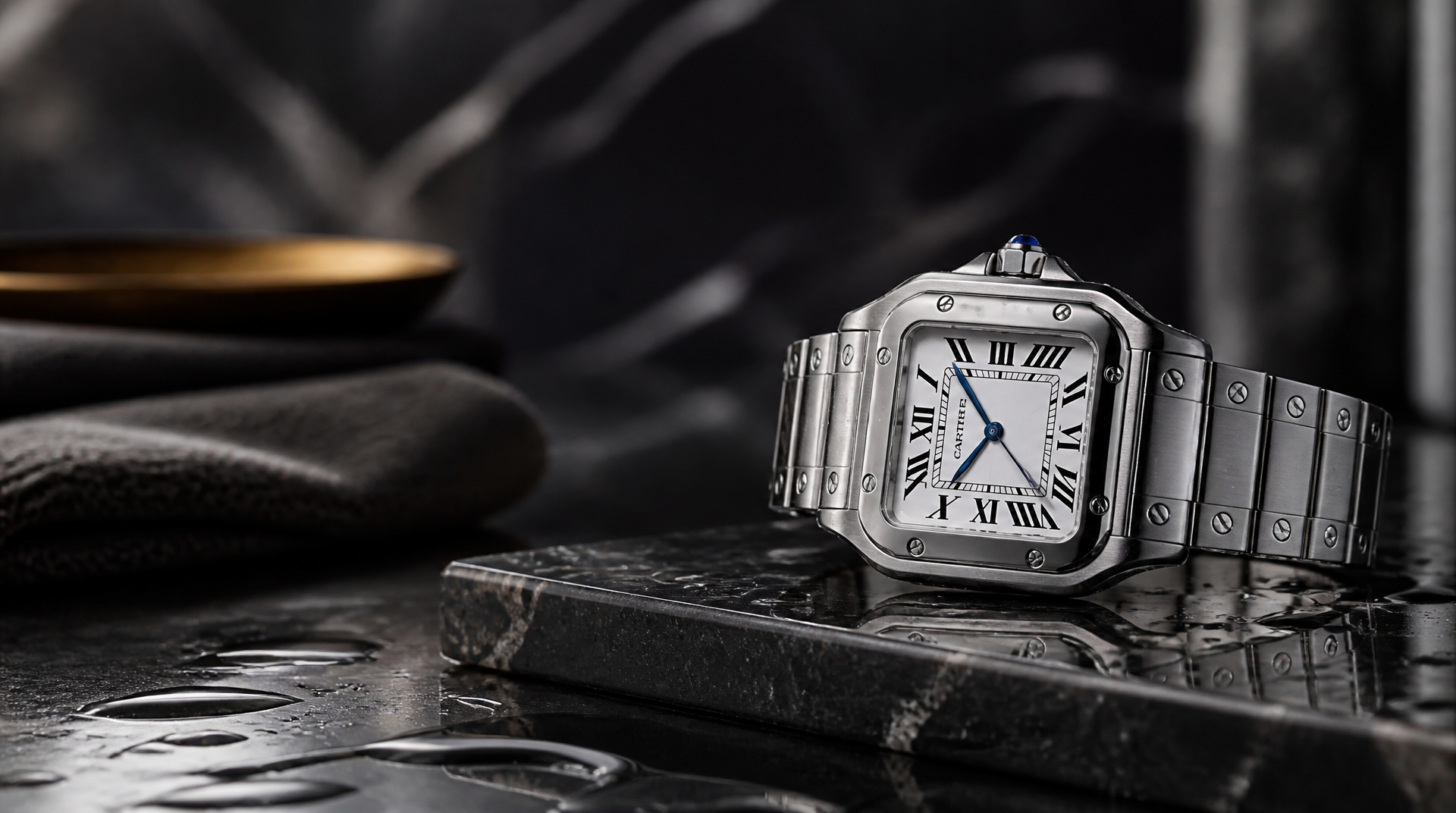
- Santos de Cartier (modern, with QuickSwitch): 100M, screw-down crown. Safe for surface swimming when tested recently.
- Calibre de Cartier Diver: 300M, ISO 6425 compliant dive watch. Built for immersion but not for steam.
Before You Take the Plunge: A Quick Inspection That Prevents Water Damage
This sequence works whether you’re heading to the pool, the beach, or just expecting heavy rain. It catches the gasket-age failure described above before you find out the hard way.
1. Inspect the Crown and Its Seal
- Screw-down crown (Santos, Calibre Diver, Pasha): Turn clockwise gently until you feel a firm, positive stop. The crown should sit flush against the case with no visible gap. If you can slip a fingernail between the crown and case, or if the crown feels gritty and refuses to seat flush even with light pressure, stop here and do not expose the watch to water. Forcing it risks crushing a dried-out gasket or cross-threading the stem. This is a service-center condition, not something to muscle through.
- Push-in crown (Tank, Ballon Bleu, Ronde): Press it home until it’s clearly seated inside the case. A push-in crown can knock out of place with minor contact, so double-check it each time. Never rely on a push-in crown to block water during immersion.
2. Look for Condensation: The Immediate Stop Point
Hold the watch under a bright LED or sunlight and tilt it at multiple angles. If you see any fog, haze, or tiny water beads on the inside of the crystal—even if it fades after wearing—the case seal is already broken. This is an absolute threshold. Do not proceed with any water exposure. Take the watch, dry, straight to an authorized service center. Pulling the crown out or using a hair dryer accelerates corrosion and often voids any remaining warranty coverage.
3. Clear Debris from the Case Back and Crown Neck
Sweat, salt crystals, sunscreen, and dust collect in the seam where the case back meets the case, and around the crown stem. Wipe these areas gently with a dry, lint-free microfiber cloth. Even a thin layer of dried grit can lift a gasket just enough to let water in. Pay extra attention to any tiny ridge under the crown shoulders.
4. Match the Strap to the Activity
Leather straps absorb water instantly. Submersion stains, warps, and weakens the material beyond repair in one outing. If you plan to swim, switch to a Cartier metal bracelet or a rubber strap—many modern Santos and Panthère models have the QuickSwitch system, which lets you change straps tool-free in seconds. Do not count on a leather strap to be the only thing that gets wet; water wicking under the case can still find a weak seal.
5. Pressure-Test Status: Your Real Permission Slip
Cartier recommends pressure testing every 12 to 18 months, and most Cartier boutiques do this test at no charge on the spot. If you cannot remember the test date, assume the seals are aged and act accordingly. When you swim frequently or the watch regularly gets saltwater exposure, shorten the interval to every 12 months.
After Exposure: Rinse, Dry, and Verify
If your Cartier has been in saltwater or chlorinated water, rinse it under cool, flowing fresh water while the crown remains securely closed. Never twist the crown open “to let it dry”: that gives water a direct path into the movement.
Pat the watch dry with a soft, absorbent cloth, concentrating on the junction between the lugs and the bracelet or strap. Remove a leather strap and let it air-dry flat, away from radiators and direct sun.
Verifying your seal held: Wear the watch normally for 30 minutes at room temperature. Then, under a bright light, tilt the crystal in a full circle. A successful outcome is a completely clear, fog-free crystal with no hint of internal moisture. If you spot even the slightest new haze, fog, or droplet, the case has taken on water. Do not attempt to dry it yourself—head straight to an authorized service center. The sooner the movement is disassembled and dried, the lower the repair cost and the less chance of permanent corrosion.
Why Hot Showers Are a Hard No—
Explore This Topic
- Back to Cartier
- Back to Cartier Water Resistance
Related guides in this cluster:
- Cartier Watches: The Complete Brand Guide — Tank, Santos & Buying Advice
- Watch Water Resistance Guide: What 30m, 50m, 100m & 200m Actually Mean
- Breitling Watch Buying Guide: Are They Worth It in 2026?

The We Know Watches editorial team brings together over 40 years of combined watch collecting, trading, and repair experience. Our editors have owned and handled watches from every major brand — from entry-level Seiko 5s to Rolex, Omega, Patek Philippe, and independent Swiss watchmakers. We’ve bought and sold at auction, worked with authorized dealers, visited manufacturing facilities in Switzerland and Japan, and serviced hundreds of movements ranging from the Seiko 7S26 to the Longines L888. Every guide and review we publish is based on hands-on experience, original research, and consultation with professional watchmakers. We do not accept payment for reviews, and we clearly disclose when we use affiliate links.