
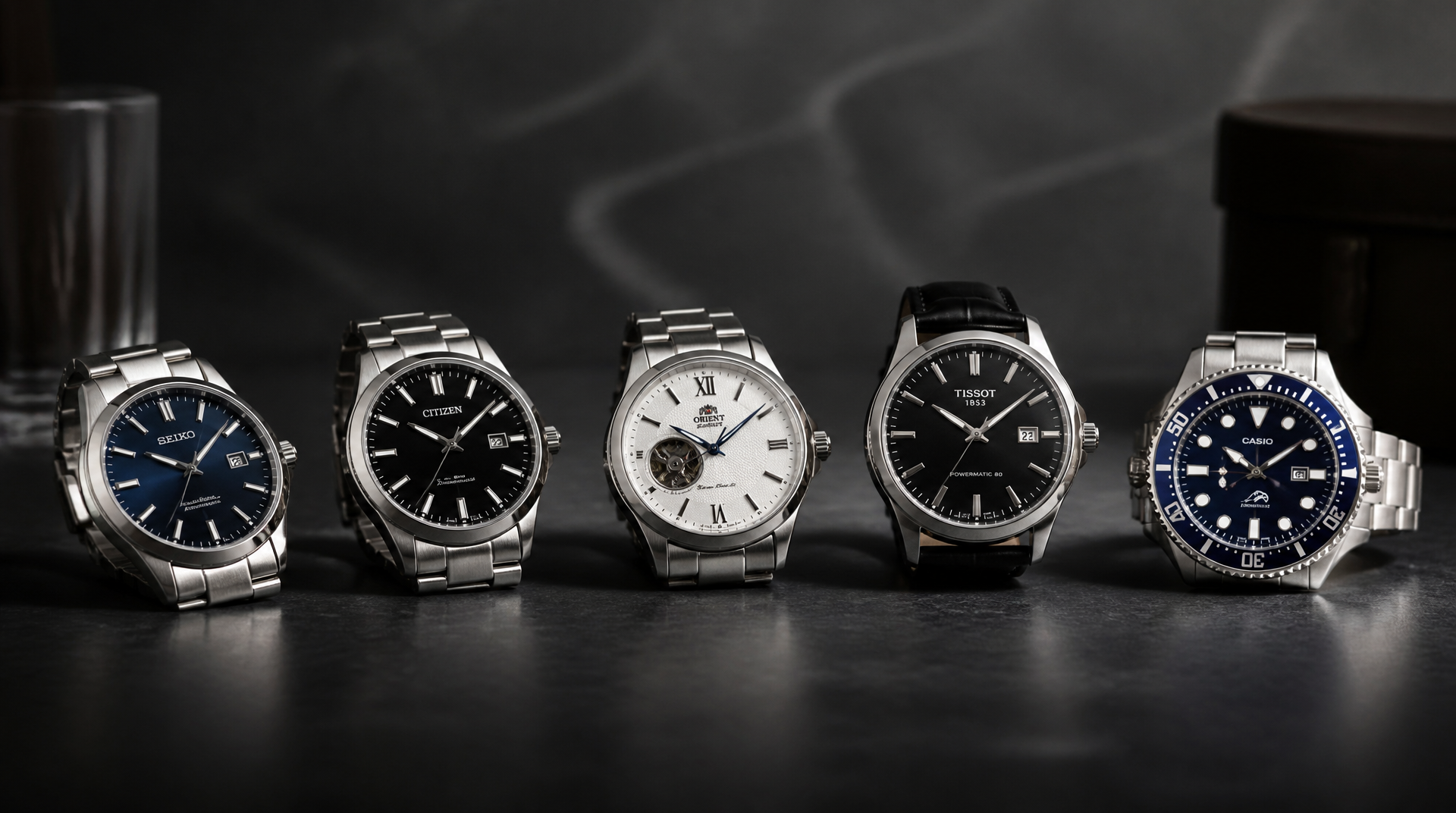
Best Watches Under $500 in 2026: Seiko, Citizen, Orient, Tissot & More
The Orient Kamasu is the best automatic diver under $500 because it gives you sapphire crystal, 200 m water resistance, and an in-house movement for about $300. If you’d rather skip battery changes altogether, the Citizen Promaster Diver Eco-Drive is the grab‑and‑go solar pick, and the Tissot PRX Quartz puts a Swiss badge on your wrist with a sapphire crystal. Your next move is to lock in the non‑negotiable that matters most—crystal scratch resistance, mechanical sweep, or zero maintenance. Once you do, the list collapses to one or two watches, and you can buy with confidence instead of chasing a spec sheet that tries to do everything.
Four checks that separate the keepers from the compromises
Run these checks in order. They eliminate options that will disappoint you in the first month of daily wear, and they keep you from paying extra for a feature your routine never uses.
1. Movement: automatic, solar, or standard quartz
- Automatic (mechanical): A sweep-seconds hand and a movement that runs from wrist motion. Expect ±15–25 seconds per day. Needs a service every 5–7 years. Pick it if the idea of a tiny self‑winding machine matters more than dead‑on accuracy.
- Solar quartz (Eco‑Drive): Charges from any light, drifts maybe 5–10 seconds per month, and avoids battery swaps for decades. The best “grab and go” choice.
- Standard quartz: Battery changes every 2–3 years, ±15 seconds per month. Usually the cheapest up‑front price.
Checkpoint: If you hate battery changes but won’t tolerate a watch that gains a minute a week, solar quartz ends the debate immediately.
2. Crystal: the single spec that changes the shortlist
- Sapphire is nearly scratch‑proof. On a $250–$400 watch, it’s a clear differentiator. Orient, Tissot, and a few microbrands offer it.
- Hardlex (Seiko’s hardened mineral) resists impacts better than sapphire but develops hairline scratches over time.
- Standard mineral scratches more easily and tends to appear on budget dress watches.
What this means for your next purchase: If you work around metal desks, door frames, or tool benches, a scratched mineral or Hardlex crystal will fog dial legibility within months. A sapphire crystal stays clear, preserving resale value and daily readability. If you’d rather replace a crystal someday than risk a shattered sapphire on a hard knock, Hardlex is a valid, cheaper trade‑off. Decide that tension now and your list immediately shrinks to Kamasu, PRX, or a dedicated tool watch with Hardlex.
3. Water resistance number that holds water—literally
- 30–50 m: Rain and handwashing only. No swimming, no showering.
- 100 m with a screw‑down crown: Safe for surface swimming and snorkeling.
- 200 m with screw‑down crown and caseback: True dive‑watch territory.
Consequence of mismatch: The Seiko 5 Sports SRPD (100 m, push‑pull crown) looks like a diver, but repeated pool immersion forces water past the crown stem. You’ll get a fogged crystal first, then rust on the hands and dial. That’s a $150 repair on a $275 watch, and it’s not covered under warranty. The Orient Bambino at 30 m will steam up from a hot shower because the temperature difference pulls moisture inside. Buy a watch with a water rating that matches how wet it will actually get.
Checkpoint: If you swim or snorkel without taking it off, cross off any watch without a screw‑down crown and at least 100 m WR. Make the Promaster or Kamasu the only answers.
4. Fit verification: case size, lug‑to‑lug, and strap limits
Spec sheets emphasize case diameter, but lug‑to‑lug length determines whether a watch overhangs your wrist. Here’s how to confirm fit before you order:
- Measure your wrist flat with a soft tape in inches. If your wrist is under 6.5 inches (165 mm), a lug‑to‑lug over 47 mm will overhang, catch on sleeves, and never sit flat.
- Look up the watch’s lug‑to‑lug on the brand’s product page or a retailer’s specs.
- Check bracelet flexibility: many budget bracelets (Kamasu, Seiko 5) use hollow end links and pressed clasps that rattle but are easily swapped. The Tissot PRX’s integrated bracelet limits strap changes—if you need a NATO or rubber option, the PRX is the wrong pick.
Verification in the real world: If you can’t try it on, tape a piece of paper to your wrist at the lug‑to‑lug length and see how much flat space remains. If the paper overhangs more than 1–2 mm, the watch won’t wear well.
Success signal: After these four checks, you’ll have a one‑model shortlist that fits your wrist, handles your daily moisture exposure, and has the crystal durability you’re willing to live with. If no watch clears all four, the sub‑$500 market can’t solve the problem without a compromise on bracelet or crystal—at that point, either raise your budget by about $100 or deliberately pick the compromise that costs you the least amount of irritation.
Comparison table: key models at a glance
| Watch | Movement | Crystal | Water resistance | Approx. price * | Key trade‑off |
|---|---|---|---|---|---|
| Seiko 5 Sports SRPD | Automatic 4R36 | Hardlex | 100 m (no screw‑down crown) | ~$275 | Not safe for swimming; water damage risk |
| Orient Kamasu | Automatic F6922 | Sapphire | 200 m | ~$300 | Hollow end links rattle; lume fades fast |
| Citizen Promaster Diver BN0151 | Eco‑Drive solar | Mineral | 200 m | ~$250 | Mineral crystal will scratch; bezel action can be stiff |
| Tissot PRX Quartz | ETA quartz | Sapphire | 100 m | ~$375 | Integrated bracelet prevents most strap swaps |
| Seiko Presage Cocktail Time | Automatic 4R35 | Hardlex | 50 m | ~$350 | No water exposure; dress‑only durability |
| Orient Bambino | Automatic F6724 | Mineral | 30 m | ~$150 | Splash only; mineral crystal shows scratches quickly |
*Prices are typical street prices as of early 2026; check current availability.
Best-fit picks by use case
The do‑everything automatic diver: Orient Kamasu
The Kamasu is the only automatic under $500 that pairs sapphire and 200 m WR in a compact 41.8 mm case. The F6922 hacks and hand‑winds, and the bezel clicks with enough precision to time a dive or a commute. The bracelet’s hollow end links produce an audible rattle that bothers some owners within the first week. Swap it for a rubber strap and the watch turns into a near‑silent tool. Crown feel is on the small side—manual winding requires light finger grip. If you need sapphire and true dive depth, this is the answer, but plan on a $25 strap swap to fix the bracelet.
The maintenance‑free solar tank: Citizen Promaster Diver
Eco‑Drive means you can leave it in a drawer for a month, pull it out, and see the exact time. The BN0151 has an ISO‑rated 200 m case, a grippy 60‑click bezel, and a comfortable polyurethane strap. The mineral crystal will pick up fine scratches, especially if you wear it around abrasive surfaces. Underwater, those scratches can scatter light and reduce legibility. If you accept that you’ll eventually spend $20 on a crystal replacement or live with the marks, this is the most hassle‑free watch in the bracket.
The Swiss everyday piece: Tissot PRX Quartz
The PRX quartz gets you a 100 m rating, sapphire crystal, and a 10.4 mm thin case that slides under a dress cuff. The integrated bracelet feels solid and has a butterfly clasp, but aftermarket straps are a headache because of the proprietary end link. Mismatch to avoid: if strap variety matters more than the Swiss finish, skip this one—the integrated design limits you to Tissot’s own strap options. When found at ~$375, it’s the cheapest Swiss‑made sapphire watch that doesn’t feel disposable.
The mod platform with a hard limit: Seiko 5 Sports SRPD
The SRPD runs the reliable 4R36, has a satisfying bezel, and fits the immense Seiko mod ecosystem. You can swap the bezel insert, crystal, and hands with widely available aftermarket parts. The push‑pull crown means it is not a dive watch, despite the 100 m number. If you want a project watch and never submerge it, the SRPD is the best under $300. If you need true water resistance, the Kamasu’s screw‑down crown costs only $25 more and eliminates the risk entirely.
The dress watch trade‑off: Orient Bambino and Seiko Presage
The Bambino delivers a domed crystal, dauphine hands, and a 40 mm vintage profile for as low as $150. The Presage Cocktail Time steps up to an exhibition caseback, textured dials, and applied indices around $350. Both demand a dry life: 30 m or 50 m means no swim, no shower, and caution around rain. A single hot shower with the Bambino can fog the crystal and leave a persistent haze behind the glass. Buy either knowing you’re trading all‑weather practicality for dial presence.
Trade-offs you can’t avoid
Automatic accuracy vs. quartz peace of mind. Every automatic in this class will drift 15–25 seconds a day. A solar quartz like the Citizen may drift 5–10 seconds a month. If you’re the type who resets the time when it’s off by 30 seconds, quartz wins.
Crystal durability vs. impact resistance. Sapphire resists scratches but can shatter under a sharp, focused knock. Hardlex will micro‑scratch but is less likely to crack. Neither is universally safer; the choice depends on whether scratches annoy you more than a rare fracture.
Bracelet quality. At these prices, solid‑link bracelets with milled clasps are rare. The Tissot PRX is the exception, but its integrated design locks you into the look. Other watches come with hollow end links and pressed clasps that rattle—a $30 strap change often solves it.
One criterion that changes the entire pick. If sapphire is your single non‑negotiable, dump the Seiko 5, Promaster, and dress watches; you’re left with the Kamasu and PRX. If never opening a caseback for a battery is your line in the sand, Eco‑Drive puts the Citizen on top. Decide that one priority before comparing dial colors, and the choice stops being a 20‑model comparison.
After you unbox: 3 steps to lock in fit and water safety
Before you strap it on and forget about it, run these checks to avoid bracelet rash, a fogged crystal, or a watch that slides around your wrist all day.
1. Size the bracelet without damaging the links
Use a pin pusher or a small screwdriver to remove links—most budget bracelets use friction pins. Wrap a piece of masking tape over the link side to protect the finish from tool slips. Work on a clean desk; a flying spring bar can disappear in seconds. If the bracelet uses screw pins (common on the Tissot PRX), a 1.2 mm flathead bit works. Remove links evenly from both sides so the clasp stays centered. Checkpoint: after resizing, you should be able to slide one fingertip between the clasp and your wrist. Too loose and the watch will rotate under a shirt cuff; too tight and you’ll feel pressure in hot weather when your wrist swells.
2. Verify water resistance before the first accidental dunk
Don’t trust the dial number alone—test the physical barrier. Confirm the crown is pushed in or screwed down tight (for screw‑down crowns, turn until it stops without forcing). If your watch has a display caseback, visually check that the gasket isn’t pinched or frayed; a misaligned gasket is a warranty claim from day one. For watches rated 100 m or more, a quick 10‑minute submersion in a shallow sink at room temperature—with the crown fully sealed—can reveal a leak before you take it into a pool. Escalation: if you see any condensation inside the crystal after that test, stop using the watch immediately and return it to the seller.
3. Wear it for 48 hours at your desk and in the shower (if rated)
A two‑day shakedown reveals issues that a 5‑minute try‑on hides. Keep an eye on the clasp for sharp edges, the crown for finger irritation, and the crystal for unexpected glare under office lights. For watches with a screw‑down crown and 100 m WR or more, you can safely shower (cool water, no steam) but only if you’re certain the crown is sealed. A hot shower with steam will fog a 30 m watch in minutes, even without submersion. Success signal: after 48 hours, the watch fits securely, the crystal is clear, and you haven’t had to adjust the clasp more than once. If it passes, you’ve confirmed that your new daily wearer won’t let you down on day three.
Frequently asked questions
What is the best automatic watch under $500?
The Orient Kamasu is the strongest automatic diver because it bundles sapphire crystal, 200 m water resistance, and a hacking/hand‑winding movement for about $300. The Seiko 5 Sports SRPD is a close second if you don’t need a screw‑down crown and prefer extensive customization options. For a dress automatic, the Seiko Presage Cocktail Time delivers dial textures that feel far above its price.
What are the best watches under $500?
There is no single best; the right pick depends on your core use. The Orient Kamasu leads for automatic dive capability, the Citizen Promaster Diver for solar reliability, the Tissot PRX quartz for Swiss styling with sapphire, and the Seiko 5 Sports SRPD for modding potential. Picking one without defining your priority first leads to an expensive compromise you’ll want to replace in six months.
What is the best affordable Swiss watch brand?
Tissot is the strongest Swiss brand consistently under $500, with the PRX quartz and Gentleman quartz both offering sapphire crystals, 100 m water resistance, and ETA movements. Hamilton occasionally dips below $500 on sale, but Tissot maintains a wider permanent sub‑$500 collection.
What is a good entry-level luxury watch?
At or under $500, the Seiko Presage series gets closest to an entry‑luxury feel with textured dials, applied markers, and exhibition casebacks. The Tissot Le Locle, when found on sale near the price ceiling, provides a Swiss dress‑watch aesthetic. Neither matches the finishing of a $1,000+ piece, but both reward a close look in natural light and hold their own during a first collection build.

The We Know Watches editorial team brings together over 40 years of combined watch collecting, trading, and repair experience. Our editors have owned and handled watches from every major brand — from entry-level Seiko 5s to Rolex, Omega, Patek Philippe, and independent Swiss watchmakers. We’ve bought and sold at auction, worked with authorized dealers, visited manufacturing facilities in Switzerland and Japan, and serviced hundreds of movements ranging from the Seiko 7S26 to the Longines L888. Every guide and review we publish is based on hands-on experience, original research, and consultation with professional watchmakers. We do not accept payment for reviews, and we clearly disclose when we use affiliate links.