
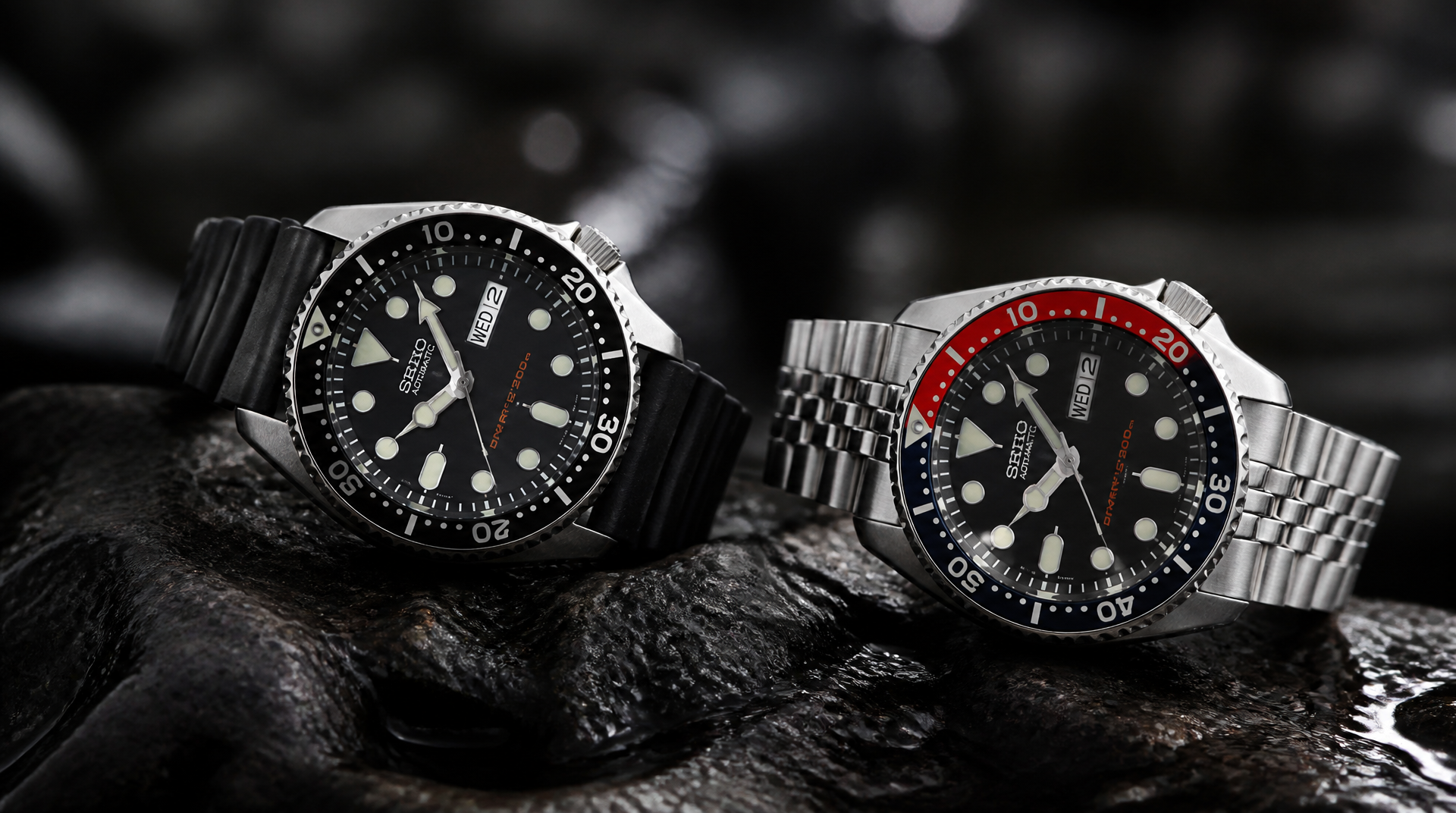
If you’re hunting for an SKX today, the short version is this: the Seiko SKX007 and SKX009 are discontinued, ISO-rated automatic divers you can only buy pre-owned. They’re still tough, legible tool watches, but you’ll pay $250–$350 and up for a clean example, and you’ll live without hand-winding or hacking seconds that most modern competitors include at the same price. Use this guide to understand which variant makes sense for you, how to spot the most common deal-breakers before you hand over money, and whether an SKX still earns its keep in 2026.
The history: from the 7002 to the SKX’s discontinuation
Seiko launched the SKX family in 1996 as the successor to the 7002 diver. The change brought a new 7S26 automatic movement, a redesigned 42.5mm case with a 4 o’clock screw-down crown, and a unidirectional bezel with a pronounced coin-edge grip. Crucially, Seiko kept ISO 6425 dive-watch certification, meaning every SKX was tested for pressure resistance, legibility, shock resistance, and magnetic resistance—standards far above a typical sports watch.
The 7S26 beat at 21,600 vibrations per hour, stored roughly 41 hours of power, and relied on Seiko’s Magic Lever winding system. It had no hand-winding and no hacking, a compromise that kept the watch affordable and sparked decades of forum debate. Across a 23-year production run, Seiko added color and market variants such as the orange-dial SKX011 and the North American SKX173, each with small but meaningful spec changes.
Seiko phased out the entire SKX line quietly in 2019. The replacement Seiko 5 Sports “5KX” models reused the case silhouette but lost the 200-meter ISO rating, the screw-down crown, and the dive-ready DNA. The discontinuation turned the remaining new-old-stock examples into collector targets and pushed pre-owned prices upward almost immediately.
SKX007, SKX009, SKX011, and SKX173: what’s the difference?
Buyers often treat all SKX watches as interchangeable, but the four core references differ in ways that affect wearability, long-term value, and everyday matching. All share the 7S26 movement, 200-meter water resistance, Hardlex crystal, and a 4 o’clock screw-down crown.
| Model | Dial / Bezel | Key Distinction | Original Market |
|---|---|---|---|
| SKX007 | Black dial, black bezel insert | The baseline reference; subdued monochrome look | Global / Japan export |
| SKX009 | Dark blue dial, red-and-blue “Pepsi” bezel insert | Most recognizable colorway; strong daylight legibility | Global / Japan export |
| SKX011 | Bright orange dial, black bezel | Least common of the trio; favored for high-visibility topside wear | Primarily Asia / Middle East |
| SKX173 | Black dial, black bezel; block-capital “SEIKO” text | U.S.-market variant; slightly thicker case, different dial layout, often sold on rubber | North America |
The SKX173 catches newcomers off guard because it doesn’t display “SKX” on the dial or caseback. Its dial text and slightly chunkier profile are the clearest tells, and it typically omits the “21 Jewels” line beneath the depth rating. Today, the SKX009 generally commands a small premium for the Pepsi bezel. The SKX011 and SKX173 appear less often and fetch higher prices in clean, all-original condition.
What to check before buying a used SKX007 or SKX009
The most painful and common failure mode on a used SKX is factory misalignment that the seller either doesn’t notice or hopes you won’t. Combine that with worn crown threads and swapped parts, and a watch that looks crisp in listing photos can become a constant annoyance or a hidden service project.
The misalignment trap and how to catch it early
The SKX’s chapter ring—the angled ring between the dial and crystal that carries minute markers—and the 60-click bezel insert must both align perfectly at 12 o’clock. Seiko’s production from the mid-1990s onward frequently let watches leave the factory with the chapter ring rotated a fraction of a degree, or the bezel insert sitting a hash mark off center. A slight misalignment seems minor in a static photo, but once you notice it on your wrist, it’s impossible to unsee.
Use this three-step check before you commit:
1. Request a photo taken with the watch facing the camera dead-on, not tilted or angled.
2. Confirm that the triangular lume pip at 12 o’clock on the bezel insert lines up exactly with the 60-minute mark on the insert and the center of the 12 o’clock dial index.
3. Move your focus to the chapter ring’s 12 o’clock tick: it should bisect the dial’s 12 o’clock marker evenly on both sides. If the tick leans noticeably toward the left or right edge of the index, the ring is misaligned.
A small misalignment won’t hurt water resistance, but it’s a visual irritant that kills resale interest. Fixing it requires removing the crystal and reseating the ring—a job that demands a crystal press. If a seller claims alignment was corrected, ask directly whether the watch was pressure-tested after the crystal was reinstalled. A reused or poorly seated gasket can turn a 200-meter-rated tool into a watch that fogs up in a rainstorm.
Crown threading: 10 seconds that reveal the real water resistance
A stripped or gritty crown thread is the most overlooked deal-breaker on a used SKX. The screw-down crown is the main barrier against water entry. If the threads are damaged, the watch loses its dive capability even if the movement runs perfectly.
Perform this simple test when you first handle the watch:
- Unscrew the crown fully and thread it back in using light fingertip pressure. The action should feel smooth with a gradual increase in resistance—no grinding, skipping, or sudden free-spinning.
- When the crown is fully seated, check that no visible gap remains between the crown and the case. A gap means the gasket isn’t compressed and moisture has a clear path inside.
A bad crown thread turns the watch into a service project. Replacing a crown tube requires a case tube press and a follow-up pressure test, which typically costs $60–$100 at a watchmaker.
Movement and authenticity checks
The stock 7S26 does not hack or hand-wind. If a seller presents the watch as having those features and it hasn’t had a documented NH36 (4R36) movement swap, walk away—something has been altered in a way that’s hard to verify without opening the case. Inspect the rotor for the engraved “7S26” marking. Avoid listings where the dial looks too perfect but the text appears fuzzy under magnification; original SKX007 dials show crisp “DIVER’S 200m” and a tiny “JAPAN” or “MALAYSIA” suffix that often blurs on reprinted dials used in “Mumbai special” rebuilds.
Price reality check
Early 2026 pricing for a clean, unmodified SKX007 or SKX009 on a rubber strap runs $250–$350. A full set with the original Seiko Jubilee bracelet and box adds $50–$100. New-old-stock units occasionally cross $500, but they’re scarce. Any listing below $200 signals heavy wear, missing original parts, or a pieced-together watch. Aftermarket bezel inserts, hands, or dials presented as original erase collector value quickly, so only pay that premium if you want a custom-modded piece and know what you’re getting.
Is the SKX still worth it in 2026?
The SKX’s value equation has shifted. At its sub-$200 street price a decade ago, the watch was an undisputed bargain. At today’s $300–$400 club, you’re paying collector markup for a diver that lacks crown winding, offers no regulation adjustment without opening the case, and ships on a rattly pressed-metal bracelet. That same money buys a modern Seiko 5 Sports SRPD (hacking, hand-winding, 100-meter water resistance) or a Citizen Promaster Eco-Drive diver with solar charging and superior timekeeping. The Orient Kamasu also enters the picture—a sapphire crystal, 200-meter water resistance, and a hand-winding/hacking automatic for roughly $250–$300.
What the SKX keeps that its successors gave up is ISO 6425 certification and a case engineered to be submerged, not just style a dive look. The SKX has a proper screw-down crown at 4 o’clock, caseback engravings mandated by the standard, and a movement validated for use at 200 meters. The 5KX replaces that with a push-pull crown, 100-meter resistance, and a display caseback—fine for a desk, not the ocean. If you actually swim or want a piece of Seiko’s discontinued tool-watch lineage, the SKX still makes sense.
But factor in the daily friction. When the watch runs down completely, you shake it awake and set the time to the nearest minute—you cannot stop the seconds hand to synchronize precisely. If the 7S26 gains or loses 30 seconds a day, you live with it or pay a watchmaker to open the case and adjust the balance, because there’s no fine-tuning through the crown. That’s not spec-sheet trivia; it becomes a practical annoyance every time you need an accurate departure time or a quick reference without your phone.
Where the 7S26 stands among Seiko dive movements
A quick ranking of Seiko calibers shows why so many SKX owners eventually upgrade the movement or cross-shop a different model. The 7S26 is proven and durable, but it sits at the entry tier of the feature ladder.
| Caliber | Hacking | Hand-winding | Power Reserve | Typical Accuracy | Found In |
|---|---|---|---|---|---|
| 7S26 | No | No | ~41 hours | -20/+40 sec/day (unadjusted) | SKX series, older Seiko 5 |
| NH36 / 4R36 | Yes | Yes | ~41 hours | -20/+40 sec/day | 5KX, entry Prospex divers, microbrands |
| 6R35 | Yes | Yes | ~70 hours | -15/+25 sec/day | Mid-range Prospex (Samurai, Sumo, SPB series) |
The NH36 is essentially a 7S26 with hacking and hand-winding added, and it drops straight into an SKX case. That’s why many pre-owned examples already carry the swap. The 6R35, found in pricier Prospex divers, adds a longer power reserve and tighter accuracy, which matters if you rotate watches and hate resetting the date. In this lineup, the SKX’s 7S26 is a classic workhorse that falls behind anything modern in the same price bracket.
Living with an SKX: sizing, straps, and mods that keep it water-tight
The SKX wears smaller than its 42.5mm diameter suggests. A 46mm lug-to-lug length and down-turned lugs make it comfortable on wrists as small as 6.5 inches. The 13.25mm overall thickness slips under most cuffs, though the Hardlex crystal adds a bit of profile. The factory Seiko rubber strap is purpose-built—vented, long enough for a wetsuit, and comfortable—but the folded-link Jubilee bracelet feels tinny and loose. Swapping to a solid-link Jubilee or Oyster from Strapcode/Miltat eliminates the rattle and makes the watch feel like a $500 piece. A single-pass NATO or a tropical-style rubber strap (such as Uncle Seiko’s GL-831) reinforces the tool-watch character and lets you color-match the Pepsi bezel on the 009.
If you want to modify the watch, start with reversible changes: swap the bezel insert for a ceramic or sapphire option from DLW or Namoki, or install a double-dome sapphire crystal. Drilling lugs for thicker spring bars, painting the dial, or artificially “aging” the case with chemicals destroys collector value—save those treatments for beaters you never plan to sell.
The one test that tells you if your SKX can still swim
An SKX’s ISO 6425 certification was only valid when it left the factory. A decade-old watch with original gaskets is a moisture hazard, not a reliable dive tool. Rubber O-rings in the crown, caseback, and crystal harden over time and lose their seal. The consequence: a fogged crystal after a quick swim, followed by rusted hands and a movement that needs a full rebuild.
Before you take any used SKX into the water, have a watchmaker perform a pressure test—dry or wet—to at least 200 meters. Most repair shops charge $25–$50. A pass means you can swim and shallow-dive with confidence. A fail means you need a full gasket replacement, which typically costs $40–$80 plus a follow-up test. Never assume a modded SKX with an aftermarket crystal or bezel insert was pressure-tested after assembly; many pre-owned mods have never been resealed, and they’re prone to leaking at depth. A small investment in verification separates a dependable tool from a decorative piece that can’t handle a dip in the pool.
FAQ
What does “SKX” actually mean?
Seiko uses “SKX” as an internal product-line prefix; it doesn’t stand for any particular words. Collectors adopted the code as the watch’s informal name.
Is the 7S26 movement reliable long-term?
The 7S26 is legendarily durable and, when properly lubricated, can run for decades. Because it cannot be hand-wound, you must wear it regularly or use a watch winder to keep it running. Service intervals matter more than the design itself; a dry movement will lose accuracy and eventually stop.
Can you still buy a brand-new SKX007 or SKX009?
Only as new old stock from dealers who held inventory. Seiko ceased production in 2019, so any “new” SKX today should come with box, papers, and original protective stickers, and you can expect to pay a premium for it.
Does the SKX lume match modern Seiko divers?
Yes. Seiko’s Lumibrite on the SKX is the same compound used on many current Prospex models. The large, applied hour markers charge quickly and stay legible all night, which is one reason divers still choose the SKX over fashion-oriented alternatives.
How do I know if a bezel insert is original?
Original SKX007 bezel inserts have a small lume pip at 12 o’clock that sits flush with a slightly rounded, glassy appearance. Many aftermarket inserts use a flat, plastic-like pip that looks dull. The insert numbers on an original are crisp, and the triangle at 12 has a fine edge; cheap copies often show rough paint or uneven lume color.
Explore This Topic
Related guides in this cluster:
- Seiko Alpinist SARB017 Guide: The Complete Collector’s Reference
- Seiko Watches: The Complete Brand Guide — Models, Movements & What to Buy
- Seiko Watch Nicknames Guide: Batman, Willard, Turtle, Samurai & More

The We Know Watches editorial team brings together over 40 years of combined watch collecting, trading, and repair experience. Our editors have owned and handled watches from every major brand — from entry-level Seiko 5s to Rolex, Omega, Patek Philippe, and independent Swiss watchmakers. We’ve bought and sold at auction, worked with authorized dealers, visited manufacturing facilities in Switzerland and Japan, and serviced hundreds of movements ranging from the Seiko 7S26 to the Longines L888. Every guide and review we publish is based on hands-on experience, original research, and consultation with professional watchmakers. We do not accept payment for reviews, and we clearly disclose when we use affiliate links.