
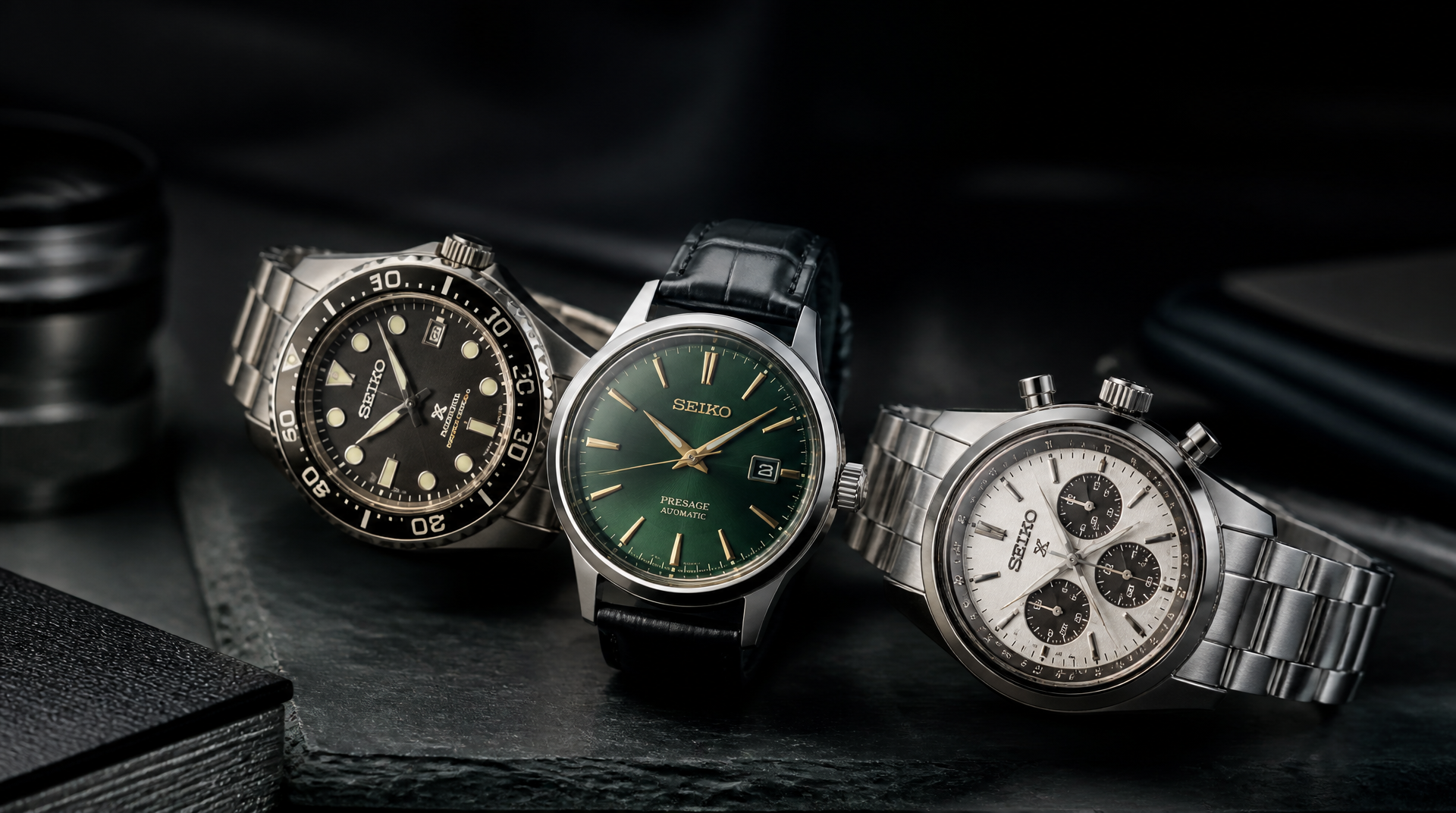
Seiko’s catalog spans sub-$100 automatics, tool-grade divers, dress watches with hand-finished dials, and Grand Seiko Spring Drive marvels. The right pick depends almost entirely on three things: where you’ll wear it, which movement fits your routine, and how the case actually sits on your wrist. This guide sorts the lineup by daily usability and real-world accuracy, filters out the fluff, and flags the models where common advice breaks down—so you can walk away with a shortlist that matches your life, not someone else’s forum thread.
What This Guide Covers — and When Your Choice Changes
The advice here focuses on current-production Seiko automatics, Spring Drive watches, and a few key quartz lines in the $100–$2,000 range. If you’re looking at vintage Seiko (pre‑2000), Grand Seiko, or battery-only quartz models that sit under $50, the rules shift substantially.
- Vintage models like the 6309 diver or early 6139 chronographs: service costs often exceed the watch’s market value. Parts are drying up, and a worn-out movement can spend more time on the bench than on your wrist. Unless you’re a collector already comfortable with that equation, a modern Prospex or 5 Sports will serve you better.
- Grand Seiko watches use the same 9R Spring Drive calibers but live in a different segment: case finishing, bracelet quality, and after-sale support all step up—alongside a price tag that typically starts above $3,000. They’re a separate decision, not a “nicer Seiko.”
- Basic quartz Seiko 5s (with batteries, not automatics) or wall-clock movements aren’t covered here. If zero-fuss timekeeping and a thin case are the mission, a solar Astron or a straightforward Seiko quartz diver is often a smarter pick than a mechanical alternative.
Once you know you’re in the mechanical or Spring Drive sweet spot from $150 to $2,000, the sections below become directly actionable.
Seiko’s Core Collections and What They’re Built For
Prospex (Professional Specifications)
Seiko’s tool-watch arm. Most Prospex divers carry ISO 6425 certification, a 200 m water resistance rating, a screw-down crown, and a sapphire crystal. The SPB143 (a modern reinterpretation of the 62MAS) and the King Turtle SRPE03 deliver robust specs in wearable dimensions. Land-oriented Prospex models, like the Alpinist series, add a compass bezel and keep the same 200 m rating in a slightly dressier package.
- Practical trade-off: Many Prospex divers measure 42–44 mm across, and case thickness hovers between 13 and 14 mm. If your wrist is under 6.5 inches, the 41 mm SPB317 Slim Turtle or the 38 mm SPB249 “Baby Alpinist” will fit noticeably better.
- What it means for your next move: If you need a watch that survives snorkeling, swimming lessons, or a rain-drenched commute, start here. If you never go near water deeper than a sink, you can safely look at Presage or 5 Sports and save a few hundred dollars.
Presage
Seiko’s dress and dressed-down line, built around the Cocktail Time and Sharp Edged series. You get multi-layered dials, box-shaped crystals, and 4R or 6R movements with hand-winding and hacking. Water resistance usually lands at 50 m without a screw-down crown, making the Presage an office-to-dinner companion, not a poolside friend.
- Practical trade-off: Many entry-level Cocktail Time models (SRPB41, etc.) use a Hardlex crystal instead of sapphire, and the push-pull crown means the watch relies on gasket integrity alone against moisture. A sudden rainstorm is unlikely to cause trouble, but an accidental bowl of water during clean-up can push moisture past the seals over time.
- Concrete consequence if you ignore this: A fogged crystal and corroded hands can turn a $300 dress watch into a repair bill equal to half the purchase price. If your daily routine includes washing a dog or rinsing dishes with the watch on, a Prospex Alpinist with sapphire and a screw-down crown is the safer call.
Seiko 5 Sports
The modern entry point. The SRPD “5KX” dive-style models and SRPG field variants run on a 4R36 movement with hacking, hand-winding, an exhibition caseback, and 100 m water resistance through a push-pull crown. Hardlex crystals are standard across the line, and street prices often sit under $300.
- Practical trade-off: These look like dive watches but aren’t. The push-pull crown and 100 m rating mean splashes and swimming are okay; scuba diving is not. The bezel is friction-based on some references and doesn’t click, and the lume pip at 12 o’clock may not glow. Treat them as everyday wear, not as real dive tools.
Astron
GPS solar watches that sync to satellite time automatically, delivering ±1 second per day accuracy with zero manual setting. Titanium cases, sapphire crystals, and world-time functions are common. Prices start around $1,500. For buyers who want absolute timekeeping precision without battery changes or winding, Astron is Seiko’s most technologically advanced quartz line.
Other series—Presage Sharp Edged, Prospex LX, and Marinemaster—simply push refinement upward within the same collection logic.
How to Narrow Your Seiko Watch in 3 Steps
Use these filters to move from a catalog of hundreds to a real shortlist you can buy with confidence.
Step 1: Pin Down the Primary Use
Be honest about the environment where the watch will spend 80% of its hours.
- Daily desk and commute: A slim Prospex (like the SPB143 at 13.2 mm) or a Sharp Edged Presage with a sapphire crystal disappears under a cuff. Seiko 5 Sports field watches work too, as long as you accept Hardlex.
- Regular water exposure: Go straight to a Prospex diver with a screw-down crown and a 200 m rating. A 5 Sports “dive-style” model can handle shallow swimming but repeated submersion will eventually stress the push-pull seals.
- Occasional formal events: A Presage Cocktail Time or a Sharp Edged GMT handles a suit well; just keep the watch away from heavy rain and accidental splashes. If you want one watch that does both dress and wet conditions, the Alpinist SPB121 is the compromise.
- Weekend-only wear: Prioritize a movement with at least a 50‑hour power reserve (6R35 or 8L35) so the watch is still running on Monday morning without a reset.
Step 2: Match the Movement to Your Routine
Seiko’s movement tiers affect how much daily friction you’ll experience. Run through these three checkpoints:
- Do you rotate watches every few days? You need hand‑winding at a minimum (4R or better) and ideally a 70‑hour reserve (6R35). The older 7S26 lacks hand‑winding and is a poor fit for rotators.
- Do you care about setting the time to the second? Hacking seconds (4R and above) let you stop the seconds hand precisely. The 7S26 does not hack.
- Is quartz‑level accuracy a must? If mechanical drift frustrates you, even a well‑regulated 6R35 will still vary a few seconds a day. For near‑zero deviation, Spring Drive (9R) or an Astron GPS solar are the only internal options. The movement ranking table further down maps out typical performance.
Step 3: Measure Your Wrist and Verify Fit
Many Seiko divers measure 42–44 mm in diameter, with lug‑to‑lug spans of 48–50 mm. If your wrist is under 6.5 inches, models like the 41 mm SPB313 Slim Turtle (46.5 mm lug‑to‑lug) or the 38 mm SRPB41 Presage Cocktail Time will wear more naturally. Lug‑to‑lug distance predicts overhang better than case diameter alone.
Verify fit before you buy:
- Trace the lug‑to‑lug length from the spec sheet onto a strip of paper, cut it out, and lay it across the top of your wrist. The ends should sit comfortably inside the edges of your forearm.
- Even better, find a Seiko dealer and try on an SPB143 (48.0 mm lug‑to‑lug) or an SRPD55 (46 mm lug‑to‑lug) as a reference—those two cases appear across dozens of models.
- If a store isn’t nearby, compare the spec sheet numbers to a watch you already own whose fit you know. A 48 mm lug‑to‑lug on a flat 6.3‑inch wrist typically results in noticeable overhang; that’s your stop sign for that case size.
What your shortlist means for your next move: After three steps you should land on two or three models. Now walk through this implication test: if the watch you like best lacks a screw-down crown, you are committing to a splash‑only lifestyle—a single dunk can force water past the push‑pull tube and cause corrosion that’s often more expensive to fix than the watch is worth. If you need a real dive‑capable piece, cross‑check that the model appears on Seiko’s current Prospex diver list with an explicit 200 m ISO rating. When the use case is purely an office and dry‑weekend environment, the absence of a screw‑down crown is an acceptable trade‑off, not a dealbreaker.
Seiko Movement Tiers: From Entry-Level to Spring Drive
All current Seiko automatics are in-house. The table below ranks the major families by what they deliver day to day. Accuracy ranges reflect Seiko’s published tolerances blended with typical user experience; regulation can tighten them noticeably.
| Caliber Family | Hacking | Hand‑Winding | Power Reserve | Beat Rate | Typical Daily Accuracy | Common Models | Key Trade‑Off |
|---|---|---|---|---|---|---|---|
| 7S26 / 7S36 | No | No | ~41 h | 21,600 bph | -20 to +40 sec, often better | SKX, older Seiko 5 | No hacking or hand‑winding; frustrating for occasional wear |
| 4R35 / 4R36 | Yes | Yes | ~41 h | 21,600 bph | -15 to +25 sec | Seiko 5 Sports, entry Prospex & Presage | Great value; accuracy adequate for a daily driver |
| 6R35 / 6R15 | Yes | Yes | ~70 h | 21,600 bph | -10 to +15 sec | Mid Prospex (Alpinist, SPB143), Sharp Edged Presage | 70‑hour reserve is the headline; higher cost |
| 8L35 | Yes | Yes | ~50 h | 28,800 bph | -10 to +15 sec (unadjusted) | Marinemaster, high‑end Prospex divers | Grand Seiko architecture with a smoother sweep |
| 9R65 Spring Drive | Continuous | Yes | ~72 h | Tri‑synchro glide | ±1 sec/day | Grand Seiko, Prospex LX | Quartz‑regulated perfection; luxury pricing |
The 7S26: The Classic That’s No Longer Enough
The 7S26 powered icons like the SKX007 and SNK809. It’s durable but lacks both hacking and hand‑winding. If you take the watch off Friday evening, it’ll be dead Monday morning and you’ll need to shake it back to life and reset the time—annoying when you rotate watches. For a first automatic that stays on one wrist all week, it still works, but most buyers today will be happier with a 4R variant.
4R35/36: The Sweet Spot for Most Buyers
The 4R36 adds hacking and hand‑winding at a modest premium. Seiko’s published tolerance is wide (-35/+45 sec/day), but many units settle into a range of +10 to +20 seconds per day after a break‑in period. This movement sits inside almost every sub‑$500 Seiko automatic worth considering. If you can live with a rate that might drift a minute or two per week, a 4R36 will save you hundreds over the 6R.
6R35: Power Reserve When You Rotate Watches
A 70‑hour power reserve means you can set the watch down Friday evening and pick it up Monday morning without resetting. Found in the SPB143 diver, Alpinist SPB121, and Sharp Edged Presage models, the 6R35 is often the dividing line between “budget beater” and a watch you’ll wear for years. Accuracy is quoted at -15/+25 sec/day and usually runs tighter after regulation. If drift bothers you, a watchmaker can adjust a 6R35 for $80–$150; if you’re unwilling to spend that once every few years, a quartz Astron is a lower‑maintenance alternative.
8L35: Precision Without the Grand Seiko Price
Built on undecorated Grand Seiko architecture, the 8L35 runs at 28,800 bph, delivering a smoother sweep and an accuracy envelope that often settles inside ±10 seconds per day after a few months of wear. It appears primarily in Marinemaster references and limited‑run Prospex divers. Because it’s unadjusted from the factory, individual specimens can fall on either side of that range, so if you’re chasing tight precision, budget for a local regulation before you judge the watch.
Spring Drive: The Sweep That Changes the Game
Spring Drive combines a mechanical mainspring with a quartz regulator—no tick, no escapement vibration, just a perfectly continuous seconds sweep and ±1 sec/day accuracy. Seiko puts it in Grand Seiko and select Prospex LX models. The tradeoff is cost: entry sits roughly $2,500 and climbs fast. If you prize inherent accuracy without battery changes and don’t want to give up the feel of a mechanical movement, Spring Drive is the only option that genuinely delivers both.
When Popular Seiko Picks Fall Short
These three families dominate forums and YouTube recommendation lists, but each carries a set of drawbacks that change the outcome for a buyer who doesn’t know the catch.
SKX007 / SKX009 — The Discontinued Diver with Real Trade‑Offs
The SKX is a legitimate ISO 6425 diver, but it ran on the 7S26: no hacking, no hand‑winding. Misaligned chapter rings were common from the factory, and correcting one today costs as much as a new lower‑end Seiko. Because production stopped, clean examples now trade near $400, a price that buys a brand‑new Prospex with a 4R36, sapphire crystal, and a warranty. The SKX is a historical touchstone, not a sensible first diver in 2026.
Seiko 5 Sports “5KX” (SRPD Series) — Looks Like a Diver, Isn’t One
The SRPD55 and its siblings borrow the SKX’s case shape but replace the screw‑down crown with a push‑pull version and rate water resistance at 100 m. The bezel is friction‑based (no ratcheting clicks), and the lume pip at 12 o’clock is present but may not glow. What can go wrong if you push it: an accidental crown pull during active swimming lets water straight into the movement; within hours you’ll get a fogged crystal, and within days you can expect rust on the keyless works—a repair that often exceeds $200. If you need a true dive tool, step up to a Prospex Turtle or SPB143.
Presage Cocktail Time — Dress Watch That Dislikes Water
The textured dials (SRPB41, SRPB77) are stunning, but they come paired with a Hardlex crystal and 50 m water resistance without a screw‑down crown. A quick hand wash is fine; a heavy downpour or an accidental dunk in the sink can overwhelm the push‑pull seal over repeated exposures. Moisture that condenses under the crystal doesn’t always dry out clean—it can leave permanent haze and start oxidation on the hands. For a dressier Seiko that handles real‑world moisture better, the Prospex Alpinist SPB121 (200 m, sapphire) splits the difference without shouting “tool watch.”
Which Seiko Line Fits Your Life?
If You Need a Real Dive Tool
The Prospex Slim Turtle SPB317, 62MAS‑inspired SPB143, and King Turtle SRPE03 all carry ISO certification, screw‑down crowns, sapphire, and lume that lasts through the night. Pick the SPB317 or SPB313 if wrist comfort is your priority.
If You Dress Up More Than You Get Wet
Sharp Edged Presage models (SPB165, SPB203) pair a 6R35 with a sapphire crystal and 100 m push‑pull water resistance—enough for daily life. If a richly textured dial matters more and you accept a Hardlex crystal, the Cocktail Time SRPB41 remains a strong value under $400, provided you stay aware of its moisture limits.
If You Want One Watch for Everything
The Prospex Alpinist (SPB121, SPB249) puts 200 m water resistance, a screw‑down crown, sapphire, and the 70‑hour 6R35 inside a case that looks at home on a leather strap or NATO. The compass bezel is a novelty, but the overall package crosses from office to weekend outdoors better than most Seikos.
If Budget Is the Priority
Seiko 5 Sports field watches (SRPG27, SRPG35) and the SRPD dive‑style models deliver a 4R36 movement with hand‑winding and hacking for well under $300. Hardlex and a push‑pull crown are the two compromises; accept those and you get a genuine mechanical tool that can handle daily knocks and casual swimming.
Seiko Buying Decision: Movement, Crystal, and Case Trade‑Offs
Explore This Topic
- Back to Seiko
- Back to Seiko Brand Hub
Related guides in this cluster:
- Seiko Watch Movements Guide: 7S26, 4R35, 6R15, Spring Drive Explained
- Seiko Watch Nicknames Guide: Batman, Willard, Turtle, Samurai & More
- Rolex Watches: The Complete Brand Guide — History, Models & Buying Advice

The We Know Watches editorial team brings together over 40 years of combined watch collecting, trading, and repair experience. Our editors have owned and handled watches from every major brand — from entry-level Seiko 5s to Rolex, Omega, Patek Philippe, and independent Swiss watchmakers. We’ve bought and sold at auction, worked with authorized dealers, visited manufacturing facilities in Switzerland and Japan, and serviced hundreds of movements ranging from the Seiko 7S26 to the Longines L888. Every guide and review we publish is based on hands-on experience, original research, and consultation with professional watchmakers. We do not accept payment for reviews, and we clearly disclose when we use affiliate links.
