
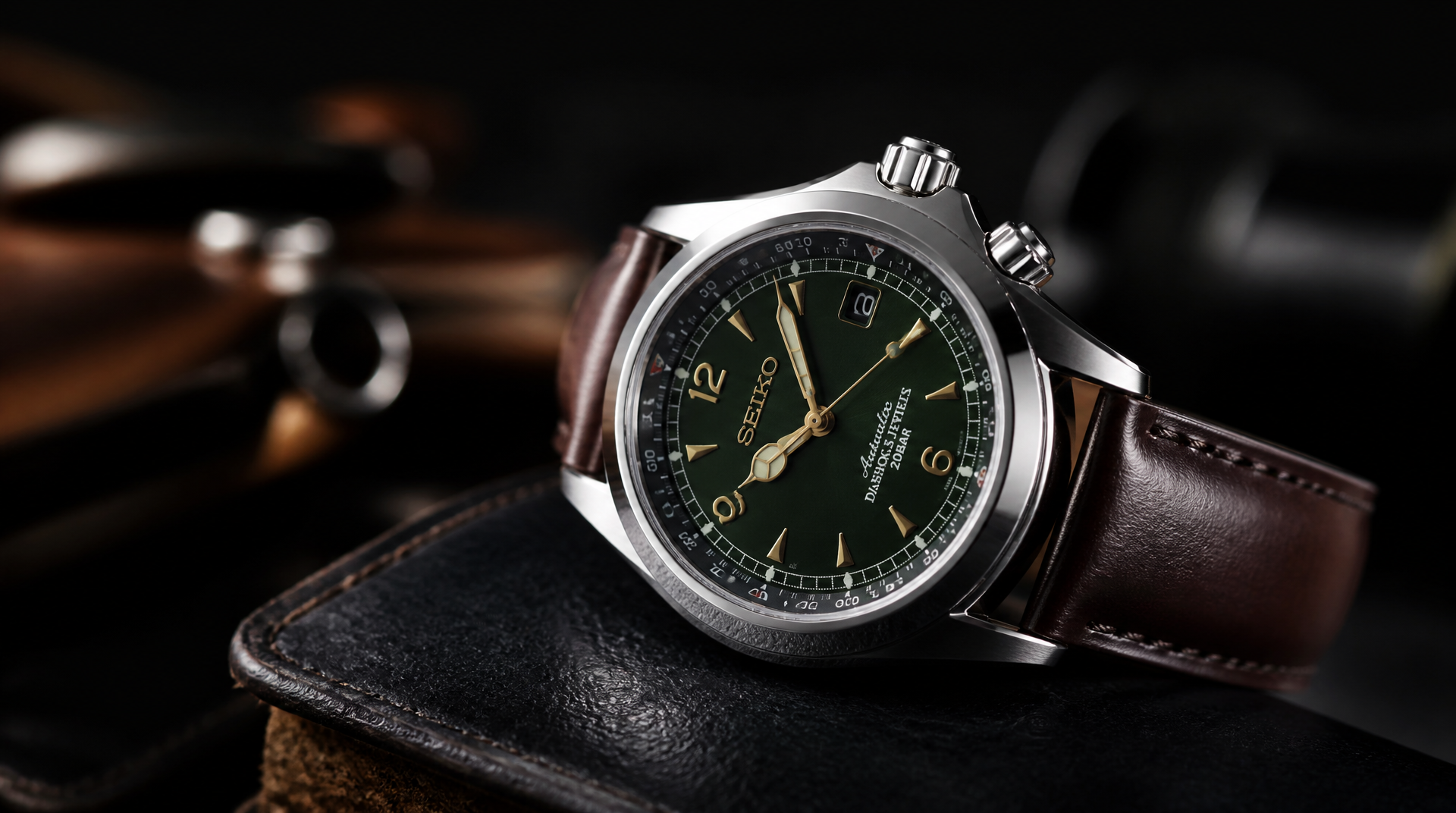
The SARB017 is a retired Japanese domestic market automatic that now trades for roughly two to three times its original ¥40,000–¥45,000 retail. The collector premium is high, but the watch’s mechanical condition and originality rarely match the asking price without careful vetting. Your first move should be verifying the compass crown, crystal, and movement health before paying the typical $800–$1,300. If you skip that step, you risk buying a worn example that costs more to service than a new Prospex Alpinist.
How the Discontinued SARB017 Became a Collector Benchmark
Seiko revived the “Alpinist” name with the SARB017, drawing from a lineage that began with the 1961 Laurel Alpinist. The green sunburst dial, gold cathedral hands, and gold applied indices under a domed Hardlex crystal gave it a rare split personality—dressy enough for a suit, but rated to 200 meters of water resistance with an internal rotating compass bezel you could actually use. At its original ¥40,000–¥45,000 price point, nothing else in Seiko’s lineup offered the same mix of decoration and functionality.
Power came from the 6R15 automatic, a movement family that sat above the entry-level 7S26 by adding hacking, hand-winding, and a 50-hour power reserve. Seiko’s official accuracy tolerance was -15/+25 seconds per day, but well-regulated examples routinely ran inside +10 seconds. A signed crown and a display caseback with a gold-colored rotor completed a package that felt far more expensive than it was.
Seiko discontinued the SARB017 in 2018, and that’s when the market took over. Prices climbed steadily, putting clean examples into the same used-market range as current Alpinist models that ship with sapphire crystals, longer-running movements, and manufacturer warranties. That tension—paying more for a retired watch that lacks modern daily-wear upgrades—is what every buyer has to weigh.
The SARB017 Family: Direct Relatives and Modern Successors
The Original JDM Trio
All three SARB-coded Alpinists used the 6R15 movement and an identical 38mm case architecture. The dial color is what separates them.
| Reference | Dial | Key Distinction | Market Note |
|---|---|---|---|
| SARB017 | Green sunburst, gold accents | The icon | $800–$1,300 used, plentiful listings |
| SARB013 | Cream/ivory, silver-tone hands | Same case, cleaner look | Rarer, often priced above the green model |
| SARB015 | Black, red-tipped seconds hand | Subdued military vibe | Hard to find unmolested |
The SARB017 gets almost all the attention, but the SARB013 offers the same case and movement without the flash. Because collectors often overlook the 013 and 015, supply is smaller and less reliable—finding a clean example takes more patience.
The Blue Alpinist (SPB089)
In 2019, Seiko produced 1,959 numbered pieces of the SPB089 for Hodinkee. It cloned the SARB017’s 38mm case and added a sapphire crystal, but replaced the green dial with sunburst navy blue. The movement remained the 6R15. The sales page crashed on launch day, and aftermarket prices quickly settled between $1,200 and $2,000. Today a routine used sale sits above $1,000, driven entirely by colorway scarcity and a limited run that never resurfaced in the regular catalog.
The Modern Prospex Alpinist Line
In 2020, Seiko folded the Alpinist into the Prospex series. The direct successor, the SPB121J1, kept the green dial and compass bezel but moved to a 39.5mm case, a flat sapphire crystal with internal anti-reflective coating, and the 6R35 caliber with a 70-hour power reserve. New retail runs about $725–$750, and lightly used examples often appear near $530–$600.
Other current references worth knowing:
- SPB117 – Black dial, supplied only on a bracelet.
- SPB119 – White/silver dial with compass bezel.
- SPB197 – “Mountain Glacier” blue dial European limited edition.
- SPB155 – “Baby Alpinist” drops the compass crown entirely and uses a cleaner 38mm case, making it the closest size alternative to the SARB017 for those who don’t need the internal bezel.
The overlooked point: a modern Alpinist gives you a sapphire crystal, a longer power reserve, and a warranty at a price that often undercuts a tired SARB017. The reflexive collector advice to “always buy the original” ignores that the newer watch works measurably better for daily wear.
How to Inspect a Used SARB017 Before You Pay
Red flags that should end the deal instantly
Before you go through a full inspection, recognize the deal-breakers that show up again and again on used SARB017s.
- Frozen compass crown – The secondary crown at 4 o’clock can seize after years of neglect or a poor caseback reseal. Dried seals or hardened lubricant are the usual causes. A stuck internal bezel ring is rarely a quick fix and often requires a full movement-side disassembly.
- Hardlex damage or undocumented sapphire swaps – The original domed Hardlex chips easily. Many owners replace it with aftermarket sapphire, which can alter edge distortion and compromise water resistance if the gasket wasn’t replaced correctly. A chipped Hardlex that hasn’t been pressure-tested since 2018 is a water-damage waiting to happen.
- Dry movement – Even the newest SARB017 dates to 2018. A dry 6R15 often shows excessive rotor noise, wild positional variation, or a steep amplitude drop below 220° on a timegrapher. Lubricant breakdown is the most common cause.
- Mismatched parts – Aftermarket dials, repainted hands, or incorrect crowns are common in listings from regions with known part-swapping operations. A green sunburst that lacks the original’s layered, almost glowing depth at the center is almost always a replacement.
If any of these red flags appear and the seller can’t provide clear documentation to resolve them, walk away. The market is deep enough that you don’t have to gamble on a questionable example.
Inspection steps (in order)
Work through these checks in order. Each clean answer cuts your risk sharply.
1. Demonstrate the compass crown. Ask the seller to rotate the secondary crown fully in both directions while you watch the internal bezel ring. Any binding, wobble, or misalignment of the ring relative to the case dial markers signals a problem that will require a watchmaker. If the seller won’t operate it on video or in person, treat the watch as a non-starter.
2. Verify the crystal and the water-resistance path. Confirm whether the crystal is the factory Hardlex or an aftermarket sapphire. If it’s sapphire, ask who did the swap and whether the crystal gasket was replaced. Collectors who want an unmolested example should look for Hardlex free of deep edge chips. Crucial extra step: If you plan to wear the watch near water, request a recent pressure-test certificate. A 200-meter rating from a decade-old seal means nothing if the gaskets are dried out. Water ingress can destroy the dial, costing you a $200+ replacement and months of waiting for Seiko parts.
3. Check movement health with data, not optimism. Request a timegrapher photo showing rate, amplitude, and beat error in at least the dial-up position. A healthy 6R15 should show amplitude above 240° at full wind and beat error under 0.5 ms. If the seller can’t provide one, listen for loud grinding rotor noise, which often signals dry reversing wheels or a gummed-up automatic module. A service record from the last two years is the single best signal that you won’t face a $150–$300 overhaul immediately.
4. Match strap and packaging to the price. The original chocolate-brown alligator-embossed leather strap with a signed deployant clasp stiffens and cracks over time. A complete set with box, hangtag, papers, and an unworn strap commands the top of the market—often $1,100–$1,300. Watch-only examples typically land between $800 and $950. “Full kit” pricing reflects collector completeness, not mechanical condition.
5. Flag mismatched finishing. Compare the caseback metal texture to known original examples; mismatched graining or an off-color rotor is a red flag. The sunburst green should shift visibly as you tilt the watch under natural light; a flat, static finish usually means an aftermarket replacement dial.
When to walk away or negotiate
If all five checks pass with documented evidence, you have a solid candidate. If the compass crown sticks, the crystal swap lacks paperwork, movement health is a mystery, or the dial finish looks even slightly off, either negotiate a discount that covers an immediate service or walk away. There are enough SARB017 listings active across forums and secondary platforms that you rarely need to settle for a questionable one.
Where the Nostalgia Premium Turns Into a Risk
The SARB017 earns its reputation on character, but the modern SPB121 makes a stronger daily-wear case in several measurable ways. The 6R35 movement’s 70-hour power reserve is the most obvious upgrade. You can set the watch down after work Friday and pick it up Monday morning without winding or resetting—a tangible convenience gap versus the 6R15’s 50 hours, especially for a watch that few owners keep on a winder. The flat sapphire crystal on the SPB121 resists scratches and manages glare more effectively indoors, while the SARB017’s domed Hardlex reflects light in ways that can wash out the green dial under office lighting.
Dial text tells another side of the story. Earlier SARB017 production shows “21 JEWELS” above 6 o’clock; later runs drop that line, creating small inconsistencies between production years. The SPB117/SPB121 generation cleans up the script entirely, replacing jewel-count clutter with a symmetrical “AUTOMATIC 20 BAR” that improves at-a-glance legibility. Some view that as sanitized; others see a cleaner layout. Either way, the modern dial prioritizes clarity over vintage charm.
Where the SARB017 still wins is proportion and presence. The 38mm case wears slimmer under a cuff, the domed crystal softens edges in a way flat sapphire cannot replicate, and the signed “S” crown feels more deliberate than the unsigned Prospex crown on the current models. If those subjective details matter enough to you, the premium may be worth it.
| Feature | SARB017 (Discontinued) | SPB121 (Current) |
|---|---|---|
| Movement | 6R15, 50-hour power reserve | 6R35, 70-hour power reserve |
| Crystal | Domed Hardlex | Flat sapphire, inner AR |
| Case diameter | 38 mm | 39.5 mm |
| Lug width | 20 mm | 20 mm |
| Water resistance | 200 m | 200 m |
| New retail price | ~$400 (at release) | ~$725–$750 |
| Typical used price (2026) | $800–$1,300 | $530–$600 |
The Water Resistance Liability
The SARB017’s 200-meter depth rating looks reassuring on paper, but it becomes a liability on a used watch with unknown service history. Gaskets harden over time, the secondary compass crown adds an extra entry point, and any aftermarket crystal swap introduces variability in seal integrity. If water gets inside, the dial can develop permanent stains within hours, and sourcing a genuine replacement green sunburst dial is both expensive and slow. Before you rely on that rating for swimming or accidental submersion, insist on a fresh pressure test. If the seller can’t provide one, assume the watch is splash-resistant only and treat it accordingly—or factor the cost of gasket replacement and testing into your purchase price.
SARB017 or SPB121: How to Choose
The SARB017’s used-market premium only makes sense if you specifically want the 38mm case, the domed Hardlex look, and the signed crown—and you are willing to accept the maintenance and verification burden that comes with a discontinued watch. If your priority is a dependable green-dial Alpinist that can handle daily wear without a pre-purchase autopsy, the SPB121 is the safer, cheaper alternative. Buyers who insist on the SARB017 solely for its “investment” profile should keep in mind that a $1,000 example with an unknown service history can quickly become a $1,300 watch after a movement overhaul, eating any assumed appreciation. Treat the SARB017 as a collector piece you buy for its specific charm, not as a value play.
Quick-fit cheat sheet
- Choose the SARB017 if: Proportion is everything, you prefer a domed crystal and a signed crown, and you have the patience (and budget) for a thorough pre-purchase inspection plus eventual servicing.
- Choose the SPB121 if: You want a longer power reserve, a scratch-resistant sapphire crystal, a warranty, and the ability to walk into the water without trusting decades-old seals.
- Look at the SPB155 “Baby Alpinist” if: The SARB017’s size speaks to you but the compass bezel adds clutter you’ll never use. It’s the same 38mm footprint with upgraded 6R35 internals and a cleaner dial.
- Seek a SARB013 or SARB015 if: You want the original 38mm case without the green-dial premium, and you’re willing to hunt for a well-kept example.
Frequently Asked Questions
Is the SARB017 a good investment?
Buy it because you love the green sunburst and gold accents, not because you expect appreciation. Values have already climbed steeply, and while clean examples will likely hold a decent floor, further large jumps are far from guaranteed.
What’s the difference between the SARB017 and the SPB089 Blue Alpinist?
The SPB089 is a 2019 limited edition with a navy sunburst dial and sapphire crystal, otherwise identical in case, movement, and dimensions. It’s rarer and usually sells for more than the SARB017 on the secondary market.
Are fake SARB017s common?
Outright counterfeits from scratch are rare, but frankens with aftermarket dials, swapped hands, and mismatched movements show up often. Listings priced well below market from regions known for part-swapping should be treated as high-risk unless a trusted watchmaker can verify the movement and dial.
Should I buy the SARB017 or the newer SPB121?
If the smaller 38mm case, domed Hardlex, and signed crown matter more than daily practicality, hunt for a well-documented SARB017. If you want a longer power reserve, a sapphire crystal, and a manufacturer warranty at a lower used price, the SPB121 is the clear value pick.
Explore This Topic
- Back to Seiko
- Back to Alpinist Guide
Related guides in this cluster:
- Seiko Watches: The Complete Brand Guide — Models, Movements & What to Buy
- Seiko SKX007 & SKX009: The Complete Guide to the Legendary Dive Watch
- Seiko Watch Nicknames Guide: Batman, Willard, Turtle, Samurai & More

The We Know Watches editorial team brings together over 40 years of combined watch collecting, trading, and repair experience. Our editors have owned and handled watches from every major brand — from entry-level Seiko 5s to Rolex, Omega, Patek Philippe, and independent Swiss watchmakers. We’ve bought and sold at auction, worked with authorized dealers, visited manufacturing facilities in Switzerland and Japan, and serviced hundreds of movements ranging from the Seiko 7S26 to the Longines L888. Every guide and review we publish is based on hands-on experience, original research, and consultation with professional watchmakers. We do not accept payment for reviews, and we clearly disclose when we use affiliate links.