
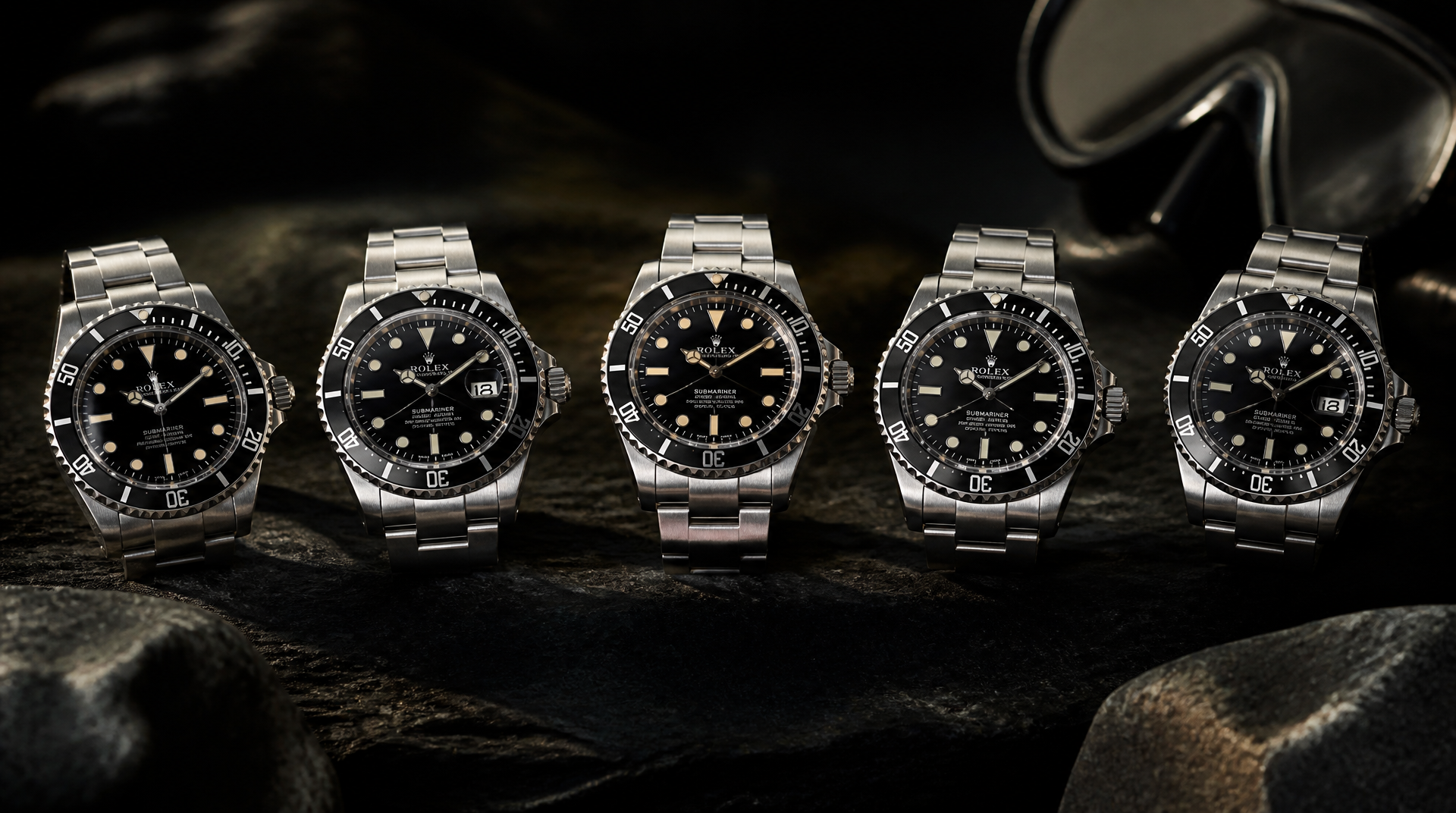
The Submariner breaks into four broad eras: early four-digit no-guard tool watches (1953–1960s), five-digit aluminum-bezel classics (late 1960s–2012), six-digit ceramic maxi-case models (2010–2020), and the current 41mm slimmed-down generation (2020–present). Knowing those buckets immediately narrows your search, but the right choice ultimately hinges on how the watch fits your wrist and how you plan to wear it. This guide maps every key reference, decodes the numbers, and walks you through a practical inspection routine so you can buy with confidence.
Submariner Generations at a Glance
The table below covers the main production references (not every dial variant). Use it to place any Submariner in its era.
| Reference(s) | Production Years | Case / Material | Movement | Key Trait |
|---|---|---|---|---|
| 6204, 6200, 6536, 6538, 5510 | 1953–1960 | 37–38mm steel | cal. A260, A296, 1030 | No crown guards; small crown vs. big crown; gilt dials; some 3-6-9 Explorer-style |
| 5512 (Chronometer), 5513 (non-COSC) | 1962–1990 | 40mm steel | cal. 1530/1520 (5513); 1560/1570 (5512) | Square crown guards; matte tritium dials; “meters first” on earliest 5513 |
| 1680 (Date) | 1966–1979 | 40mm steel | cal. 1575 | First Submariner Date with cyclops; early “Red Sub” dials collectible |
| 16800 | 1979–1988 | 40mm steel | cal. 3035 | Sapphire crystal, quickset date, glossy dial with white-gold surrounds, 300m |
| 168000 | 1988 | 40mm steel | cal. 3035 | First 904L steel Sub; very rare |
| 16610 (Date), 14060/14060M (no-date) | 1988–2010 | 40mm steel | cal. |
3135 (16610), cal. 3000/3130 (14060) | Aluminum bezel on slim lugs; 14060M COSC from 2007 |
| 16610LV “Kermit” | 2003–2010 | 40mm steel | cal. 3135 | Green aluminum bezel, black maxi dial |
| 116610LN / 116610LV “Hulk” | 2010–2020 | 40mm steel | cal. 3135 | Cerachrom bezel, maxi case, Glidelock clasp; Hulk has sunburst green dial |
| 114060 (no-date) | 2012–2020 | 40mm steel | cal. 3130 | Ceramic bezel, maxi case, no cyclops |
| 126610LN (Date), 124060 (no-date) | 2020–present | 41mm steel | cal. 3235 (Date), cal. 3230 (no-date) | Slimmed lugs, 70-hour power reserve, Chronergy escapement, AR-coated crystal |
| 126613, 126618 | 2020–present | 41mm steel/YG or full gold | cal. 3235 | Two-tone and full-gold versions of the current 41mm proportions |
How to Decode a Submariner Reference Number
Rolex’s numbering logic gives you the generation, material, and bezel color at a glance.
- Four-digit (e.g., 5513) = strictly vintage, pre-quickset, no reference suffix.
- Five-digit (e.g., 16610) began in the late 1980s; “1” signals a newer-generation movement. The “6” generally marks the Submariner family (12 is modern Submariner; 5-digits mix model and metal codes differently).
- Six-digit (e.g., 126610) follows the pattern: 12 = Submariner, 6 = Date (0 = no-date), 10 = steel case. A 124060 is a no-date steel Sub.
Modern suffixes tell the bezel color:
- LN – “lunette noire” (black)
- LV – “lunette verte” (green)
- LB – “lunette bleu” (blue)
A final digit in the last pair often denotes metal: 1 = all steel, 3 = Rolesor two-tone, 8 = 18k gold. So a 126613LB is a current-generation Submariner Date in two-tone with a blue ceramic bezel.
One Factor That Can Change Everything: Wrist Fit
Most Submariner buying advice focuses on age, patina, and resale, but if the watch doesn’t sit comfortably on your wrist, it’ll spend more time in the safe than on your arm. Case thickness, lug shape, and the lug-to-lug span vary enough across generations that the same nominal “40mm” can wear dramatically differently.
If your wrist measures under 7 inches and you prefer a slim, low-profile piece, five-digit aluminum-bezel references (16610, 14060M) wear noticeably thinner and disappear under a shirt cuff. The current 126610 trims the maxi-case bulk and fits more wrists, but it’s still taller than a 14060. The maxi-case 116610 generation is the least forgiving: the broad lugs and 50mm lug-to-lug distance make it top-heavy on smaller wrists and prone to overhang.
What this means for your purchase: If you can’t try the watch on, measure the lug-to-lug dimension against the flat top of your wrist. A 50mm span on a maxi case can hang past the wrist bones on a 6.5-inch wrist, causing the watch to slide around or bang on desk edges. In that scenario, a 14060M (roughly 48mm lug-to-lug) or the 124060 (49mm) will fit more securely and feel deliberate rather than clown-car large. The difference may steer you away from a cheaper, high-condition 116610 that you’d end up never wearing.
Inspecting a Pre-Owned Submariner, Step by Step
These steps work whether you’re examining the watch in person or analyzing a seller’s photos. The goal is to confirm originality and avoid unexpected costs before you commit.
Before You Open the Clasp
Verify the reference and serial numbers. On ceramic models from roughly 2005 forward, the serial is engraved on the inner rehaut ring; earlier models have it between the lugs at 6 o’clock. The reference number is between the lugs at 12 o’clock. Fuzzy or shallow rehaut engraving on any six-digit Sub is an immediate red flag.
A quick fit check you can do without wearing the watch: place a ruler or caliper across the lugs horizontally to get the lug-to-lug span. If the span exceeds the width of your wrist by more than a few millimeters, the watch will overhang and feel unbalanced, no matter how tight the bracelet.
Ordered Inspection Checklist
1. Bezel and insert – On ceramic models, examine the edges under direct light for chips; a replacement ceramic bezel insert costs several hundred dollars. Aluminum inserts on older references must have the luminous pearl centered at 12 o’clock and should not wobble. Rotate the bezel: a smooth 120-click action with no lateral play indicates a healthy assembly.
2. Dial and lume – Vintage tritium dials with an even, creamy patina are desirable; blotchy relume jobs lower value. Modern Super-LumiNova should glow bright blue and evenly. Use a UV light to spot paint touch-ups that look invisible in daylight. Check the cyclops: the date should fill the window without tilt, and the lens should be scratch-free.
3. Crown and winding – Unscrew the crown and wind the movement. It should feel smooth with consistent resistance, not gritty or loose. For date models, advance the hands past midnight to confirm the date snaps crisply. Any grinding or hesitation likely means a service is overdue.
4. Bracelet and clasp – Hold the bracelet horizontally; more than a couple of millimeters of droop on a modern Oyster band points to heavy wear. On six-digit models, open and close the Glidelock extension; it must slide with deliberate friction and lock with a distinct click. The clasp code (two letters) should roughly match the watch’s era, though mismatched clasps aren’t automatically a dealbreaker for a daily wearer.
5. Case and lugs – Factory satin brushing on the lug tops and sides should be sharp, not rounded. A once-polished 16610 loses the distinct chamfer. On collectible references like the 5513, ask for high-resolution side-view photos to assess whether the case has been softened—original sharp bevels are a huge part of the value.
The Hidden Cost That Changes Whether You Buy
Even if the watch looks clean, budget realistically for what comes next. A Submariner that winds stiffly and has noticeable bracelet stretch will realistically need a full service ($800–$1,200 at a Rolex Service Center) and possibly a bracelet overhaul or replacement. All-in, that “good deal” on a 116610 for $11,000 can turn into a $13,500 project—more than the price of a ready-to-wear example with a recent service invoice. If the seller cannot show a service record from the last five years, treat the watch as a fixer-upper and negotiate accordingly, or walk away and find one that’s already been maintained.
Limits and Trade-Offs When Buying Vintage for Daily Wear
Vintage Submariners with original tritium dials and period-correct gaskets aren’t swimmers unless they’ve been fully serviced and pressure-tested. A 5513 that’s been sitting for decades may fail a pressure test even after gasket replacement if the crown tube threads are worn or the case back seal was never restored to factory specification. The consequence: you think you’re buying a diver you can wear in the pool, but in practice you get a beautiful desk diver that must stay dry. If you plan to swim or snorkel with the watch on, choose a modern ceramic Sub that you can pressure-test annually, and keep the vintage piece for dry land.
When to Walk Away
A few warning signs should end the transaction immediately:
- The seller refuses to open the case back. No movement photo, no sale.
- The price is dramatically below market for a steel professional model. A 126610LN offered at $8,000 in 2025 isn’t a bargain; it’s a counterfeit or a stolen watch.
- The movement looks factory-fresh but the case shows significant dings – this often signals a swapped motor.
- Serial number engravings appear altered, sanded, or mismatched between the rehaut, case, and paperwork.
After a successful inspection, still plan to spend $50–$100 on a pressure test before you trust the watch near water. That small step confirms sealing that no photo can prove.
New vs. Pre-Owned: What You Get at Each Price Point
Retail stainless steel Subs remain scarce. A new 126610LN from an authorized dealer costs about $10,250 (no-date 124060 roughly $9,100), but waitlists can run many months. Secondary-market pricing reflects that gap: a full-set 126610LN typically trades between $13,000 and $14,500.
Pre-owned pricing for earlier generations:
| Reference | Typical Condition / Set | Approximate Price Range |
|---|---|---|
| 14060M (COSC, 2007–2012) | Full set, sharp case | $7,500–$9,000 |
| 16610 (2000s) | Box and papers | $8,500–$10,000 |
| 116610LN (ceramic maxi) | Full set, unpolished | $11,000–$13,000 |
| 126610LN (current 41mm) | Pre-owned full set | $13,000–$14,500 |
| 5513 “meters first” matte-dial | Good original condition | $15,000–$25,000+ |
If your priority is a slim profile and you’re comfortable with a daily wind, a 14060M or 16610 saves thousands while delivering a classic tool feel. If you want the 70-hour power reserve, on-the-fly Glidelock, and the latest movement, the 124060 or 126610 is the obvious pick—but you’ll pay for that modern convenience.
What Can Sink a Sub’s Value
Beyond outright fakes, several overlooked details can turn a promising listing into a money pit.
- Service replacement dials on vintage pieces. A 1680 with an immaculate, bright white lume that glows for minutes under UV has a later LumiNova service dial. It’s fine for daily wear, but don’t pay original-dial collector money.
- Heavy polishing. When lugs lose their sharp chamfer or the caseback teeth go soft, the watch trades 15–20% below equivalent unpolished examples. Ask for macro photos of lug edges and brushing direction.
- Bracelet mismatches. A 93150 folded-link bracelet on a 16800 should have correct end links (e.g., 593). A solid-end-link retrofit isn’t wrong for a wearer, but period-correct completeness affects resale value.
- Structurally compromised cases. Laser-welded screw threads, cracked lug tips, or deep gouges near the case tube mean the watch may never hold a proper seal. Walk unless the seller provides a credible recent pressure-test certificate.
FAQ: Submariner Buying Questions
Which Submariner holds its value best?
Stainless steel Date models are historically the strongest. The 116610LV “Hulk” shot up after discontinuation, and full-set 16610LV “Kermit” examples consistently outperform standard 16610s. Among vintage references, original-parts 5512 and 5513 gilt-dial watches draw steady collector money, especially when the case is unpolished and the set is complete.
Does any production Submariner have an exhibition caseback?
No. The solid steel back is integral to the dive rating. Clear casebacks only appear on limited custom pieces; they’re not factory-issue sports models.
What does “meters first” mean on a 5513?
Early dials place “SUBMARINER” above the depth text (“600m = 2000ft”); later dials flip the order. Meters-first examples date to roughly 1962–1969 and carry a premium over later feet-first versions.
Is the 124060 worth the premium over a used 114060?
If you value the 70-hour reserve, AR-coated crystal, and slimmer lugs, the 124060 earns its price. If those upgrades don’t matter to you and you find a full-set 114060 at $9,500 or below, the older ceramic no-date Sub remains a fully capable daily with no real mechanical disadvantage.
A Submariner from any generation is built to outlast its owner when properly maintained. The model you choose ultimately turns on wrist fit, how much vintage character you want, and whether you’re willing to wait for a retail allocation or pay the secondary-market premium. Focus on originality, documented service, and how the watch actually sits on your wrist—and the decision becomes simple.
Explore This Topic
- Back to Rolex
- Back to Submariner Guide
Related guides in this cluster:
- Rolex Watches: The Complete Brand Guide — History, Models & Buying Advice
- Rolex vs Omega: Which Luxury Watch Brand Is Right for You?
- Cartier Watches: The Complete Brand Guide — Tank, Santos & Buying Advice

The We Know Watches editorial team brings together over 40 years of combined watch collecting, trading, and repair experience. Our editors have owned and handled watches from every major brand — from entry-level Seiko 5s to Rolex, Omega, Patek Philippe, and independent Swiss watchmakers. We’ve bought and sold at auction, worked with authorized dealers, visited manufacturing facilities in Switzerland and Japan, and serviced hundreds of movements ranging from the Seiko 7S26 to the Longines L888. Every guide and review we publish is based on hands-on experience, original research, and consultation with professional watchmakers. We do not accept payment for reviews, and we clearly disclose when we use affiliate links.