
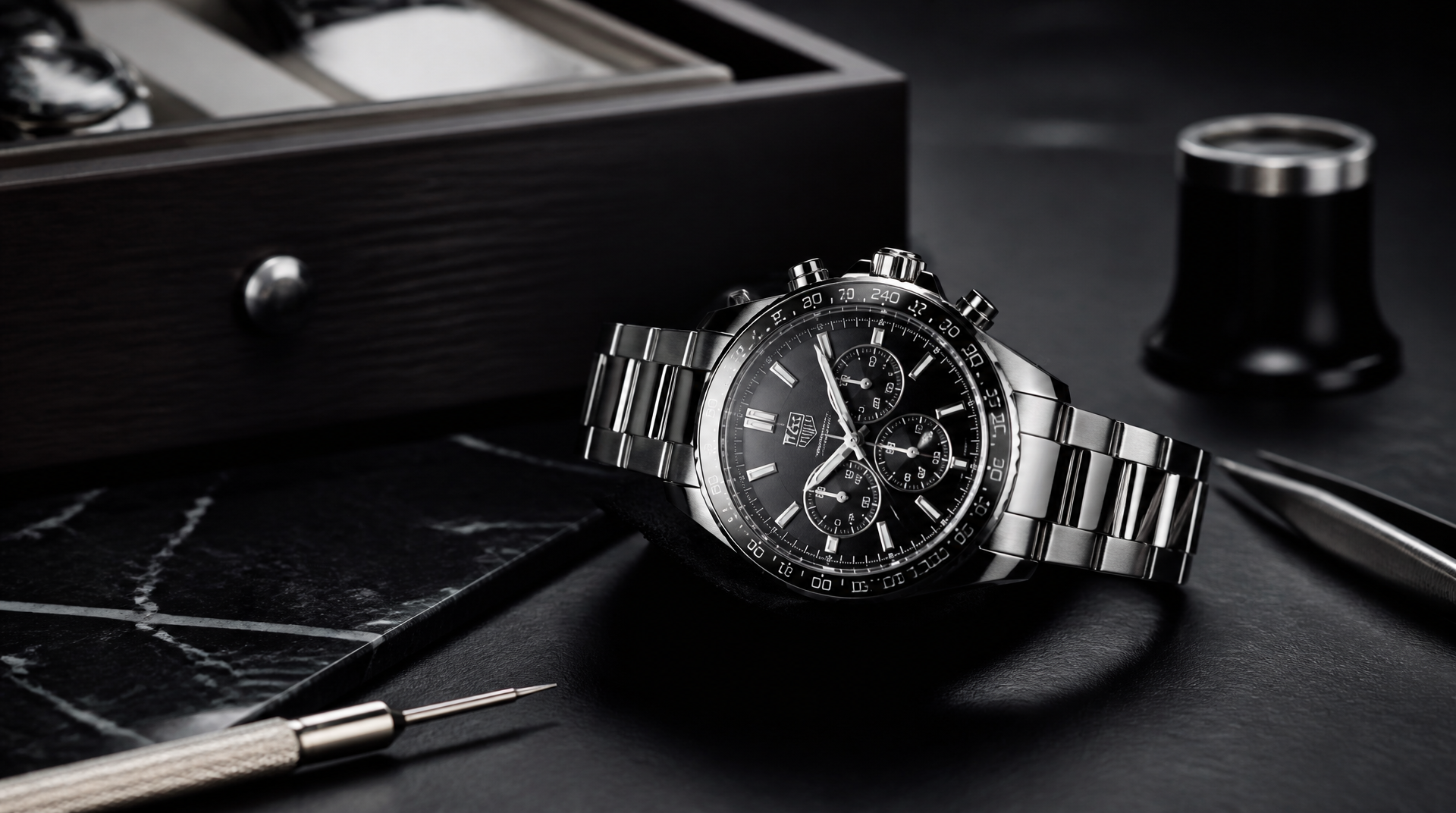
Your Tag Heuer serial number is the fastest way to start authentication. Locate the serial on the case back at 6 o’clock (or between the lugs on vintage models), then check its format and engraving quality against era-specific standards. If the number is missing, poorly engraved, or doesn’t match the expected pattern, the watch is likely counterfeit. For 100% certainty, go to an authorized Tag Heuer dealer or service center.
Where to Find the Serial Number
Tag Heuer engraves the serial number on the case back, usually below the 6 o’clock position. On models from before 2000, you may need to remove the bracelet to find it stamped between the lugs. The location hasn’t changed much, but the format varies dramatically by era.
- Modern watches (2000 onward): 12-character alphanumeric code, often starting with a letter pair like “CR,” “BG,” or “ND” followed by ten digits. Example: CR1234567890.
- 1980s–1990s models: 6- to 8-digit all-numeric serial. Example: 1234567. Some models from the late 1990s overlap into early alphanumeric.
- 1970s and earlier: 4- to 6-digit numeric, sometimes with a single letter prefix. Example: A12345. The famous Autavia and Carrera 1153 series from the 1970s often have six-digit numbers starting with “2” or “3.”
The reference number (model number) is a separate identifier, usually on the inside of the case back or on the warranty card. Both numbers must be consistent for the watch to be legitimate. For example, a Tag Heuer Aquaracer from 2015 will have a serial starting “CR” and a reference number like WAY2110.BA0928. Mixing a 1980s-style numeric serial with a modern reference number is a clear red flag.
Serial Format by Era (Quick Reference)
| Era | Expected Format | Example |
|---|---|---|
| 2000–present | 2 letters + 10 digits | CR1234567890 |
| 1980–1999 | 6–8 digits | 12345678 |
| 1970s | 4–6 digits, sometimes with a letter prefix | 12345 or A1234 |
| 1960s and earlier | 4–5 digits | 12345 |
A watch claiming to be from 2010 should have a 12-character alphanumeric serial, not an 8-digit numeric one. Conversely, a 1985 model with a modern “CR” prefix is automatically suspect. If you don’t know the approximate production year, look up the reference number online using CaliberCorner or the Tag Heuer forum to match the era.
Checking the Serial Number Step by Step
Preparation
- Clean the case back with a soft cloth so the engraving is fully readable.
- Write down the serial exactly as it appears, including any letters. Don’t assume a zero is an O or vice versa.
- Note the reference number if you can access it (often on the inside of the case back, visible with a loupe when the case back is open).
Step 1: Inspect the Engraving Quality
Authentic modern Tag Heuers use laser engraving that is crisp, evenly spaced, and consistent in depth. The font is a specific sans-serif typeface (similar to Helvetica or Arial but with subtle differences in the serifs and number shapes). Run your fingernail across the engraving — genuine engraving feels sharp and distinct. Fakes often show shallow, blurry, or uneven engraving that looks more like printed ink than cut metal. Some counterfeiters use a laser that burns the surface, producing a dark, rough edge — this is also a giveaway.
On vintage pieces, the serial was stamped with a die, producing deep, clean impressions with raised edges that feel prominent. If the vintage engraving looks too shallow or like it was added later, that’s a red flag. Pay special attention to the spacing between characters. Tag Heuer uses consistent, narrow spacing; fakes often have irregular gaps or characters that are too wide apart.
Step 2: Verify the Format Matches the Watch’s Age
This is the key decision point that changes based on the watch’s claimed era. You need to know the approximate production year to judge the serial format. How do you find that? For modern models (post-2000), the first two digits of the serial often indicate the year — for example, a serial starting with “CR22…” could mean 2022, but this is not always reliable. More dependable: search the reference number on a forum like WatchUSeek or use the Tag Heuer service request portal to match the reference to its release period.
If the format is wrong, stop. A 2012 Formula 1 should have an alphanumeric serial; if it shows an 8-digit number, it’s either counterfeit or a replaced case back. Similarly, a vintage 1970s Carrera with a 12-character serial is almost certainly fake.
Step 3: Cross-Reference with Online Databases
Free resources like WatchCharts, the Tag Heuer forum, and Facebook authentication groups let you enter the serial to check if it has been reported as stolen or appears on known counterfeit lists. Some counterfeiters reuse the same serial numbers across multiple watches — if you search and see that your serial appears on several different watches for sale, that’s a strong red flag. This is a quick sanity check but not definitive — many legitimate serial numbers are not publicly catalogued, and some stolen watches are never reported correctly.
Step 4: Use an Authorized Dealer or Tag Heuer Service
This remains the only fully reliable method. Tag Heuer can match the serial against their production records. Some authorized dealers will verify the number on the spot if the watch is still under warranty. For out-of-warranty watches, you can submit a formal verification request through Tag Heuer’s website (tagheuer.com/service). Expect a small fee around $50–$100 depending on the market. Turnaround time is usually 1–3 business days for email confirmation, or longer if you mail the watch for a full service inspection. Always ask for a written confirmation of authenticity — verbal assurances aren’t sufficient for resale.
When the Serial Checks Out: What’s Next?
A passing serial number is a good sign, but it doesn’t guarantee the watch is authentic. Counterfeiters sometimes repurpose genuine serial numbers from real watches. Next steps:
- Check the movement. Open the case back (or ask a jeweler to do it) and compare the movement to an authentic image. Tag Heuer uses specific calibers — for example, the Calibre 5 in the Aquaracer has a distinct rotor with a TAG Heuer logo and a specific bridge layout.
- Check the crown and pushers. Genuine crowns have crisp edges and the logo sits precisely centered. Fake crowns often have a glossy finish or misaligned logo.
- Weigh the watch. Authentic stainless steel models weigh between 150 and 200 g (depending on model). Counterfeits using cheaper metals are often lighter by 20–30 g.
If anything feels off — even after the serial passes — get a professional authentication.
When to Stop and Escalate
If the serial number format is wrong for the watch’s claimed era, stop. An obviously mismatched format is an immediate red flag, even if the watch looks good otherwise. Also stop if the engraving appears rubbed off, smudged, or uses a generic typewriter-style font instead of Tag Heuer’s specific sans-serif font. These are concrete signs you cannot fix or work around — move directly to an authorized dealer for professional inspection before making any purchase. Do not attempt to buy, sell, or service the watch until it has been officially authenticated.
Common Red Flags at a Glance
| Red Flag | What to Look For |
|---|---|
| Serial number missing entirely | Nearly always counterfeit. A few very old Tag Heuers lack serials, but this is rare and usually limited to 1960s Heuer models with no case back engraving. |
| Engraving that appears rubbed off or smudged | Real engraving does not wear away. Forgers sometimes try to obscure a fake serial with scratches or polishing. |
| Same serial found on multiple watches for sale | Search your serial online. If it appears on many different watches, it’s a known fake number that’s been reused. |
|
| Font mismatch with genuine Tag Heuer engraving | Genuine engraving uses a specific sans-serif font with defined number shapes (e.g., the number “1” has a serif at the top; the “4” has a closed top). A generic typewriter-style font is suspicious. |
| Serial located off-center or under a different lug | On modern models, the serial must be exactly at 6 o’clock. Any other position is a problem. |
If you see any of these signs, do not buy the watch. Even a tempting price is not worth the risk of a counterfeit.
Frequently Asked Questions
How do you authenticate a TAG Heuer watch?
Start with the serial number by checking its format, engraving quality, and location against the era-specific guidelines above. Then compare the movement, crown, and weight against known authentic examples for that model. The most reliable method is a professional inspection by an authorized Tag Heuer service center, which can verify serial records and open the case back to examine the movement.
Can a jeweler verify my TAG Heuer serial?
Only a jeweler who is an authorized Tag Heuer dealer or has extensive watch authentication experience can do this reliably. Many independent jewelers can spot obvious fakes — for example, a plastic crystal versus sapphire, or a quartz movement in an automatic model — but they lack access to Tag Heuer’s official production database. For certainty, use an authorized dealer or submit a formal verification request through Tag Heuer.
Can I check my watch serial number?
Yes. Look for the serial on the case back at 6 o’clock or between the lugs if you remove the bracelet. Write it down exactly as it appears. Compare its format against the age-specific guidelines in the table above. Online forums like WatchUSeek and WatchCharts can help you see if the serial has been reported stolen or copied. For a definitive check, contact Tag Heuer directly.
How to check if the watch is original or not?
The serial number is one key indicator. Combine it with other checks: the weight (genuine steel models feel solid and dense — typically 150–200 g for a bracelet-mounted watch), the movement (automatic watches should have a smooth sweeping seconds hand — quartz fakes often have a ticking seconds hand), and the crown and crystal quality (genuine sapphire crystal is scratch-resistant and has a slight blue tint when viewed at an angle). If anything feels off, get a professional authentication.
Explore This Topic
- Back to Tag Heuer
- Back to Tag Heuer Serial Verify
Related guides in this cluster:
- Tag Heuer Serial Number Guide: How to Check & Authenticate Your Watch
- Tag Heuer Watches: The Complete Brand Guide — Carrera, Monaco & Aquaracer
- How to Set the Date on a Tag Heuer Watch: Complete Guide for All Models

The We Know Watches editorial team brings together over 40 years of combined watch collecting, trading, and repair experience. Our editors have owned and handled watches from every major brand — from entry-level Seiko 5s to Rolex, Omega, Patek Philippe, and independent Swiss watchmakers. We’ve bought and sold at auction, worked with authorized dealers, visited manufacturing facilities in Switzerland and Japan, and serviced hundreds of movements ranging from the Seiko 7S26 to the Longines L888. Every guide and review we publish is based on hands-on experience, original research, and consultation with professional watchmakers. We do not accept payment for reviews, and we clearly disclose when we use affiliate links.