
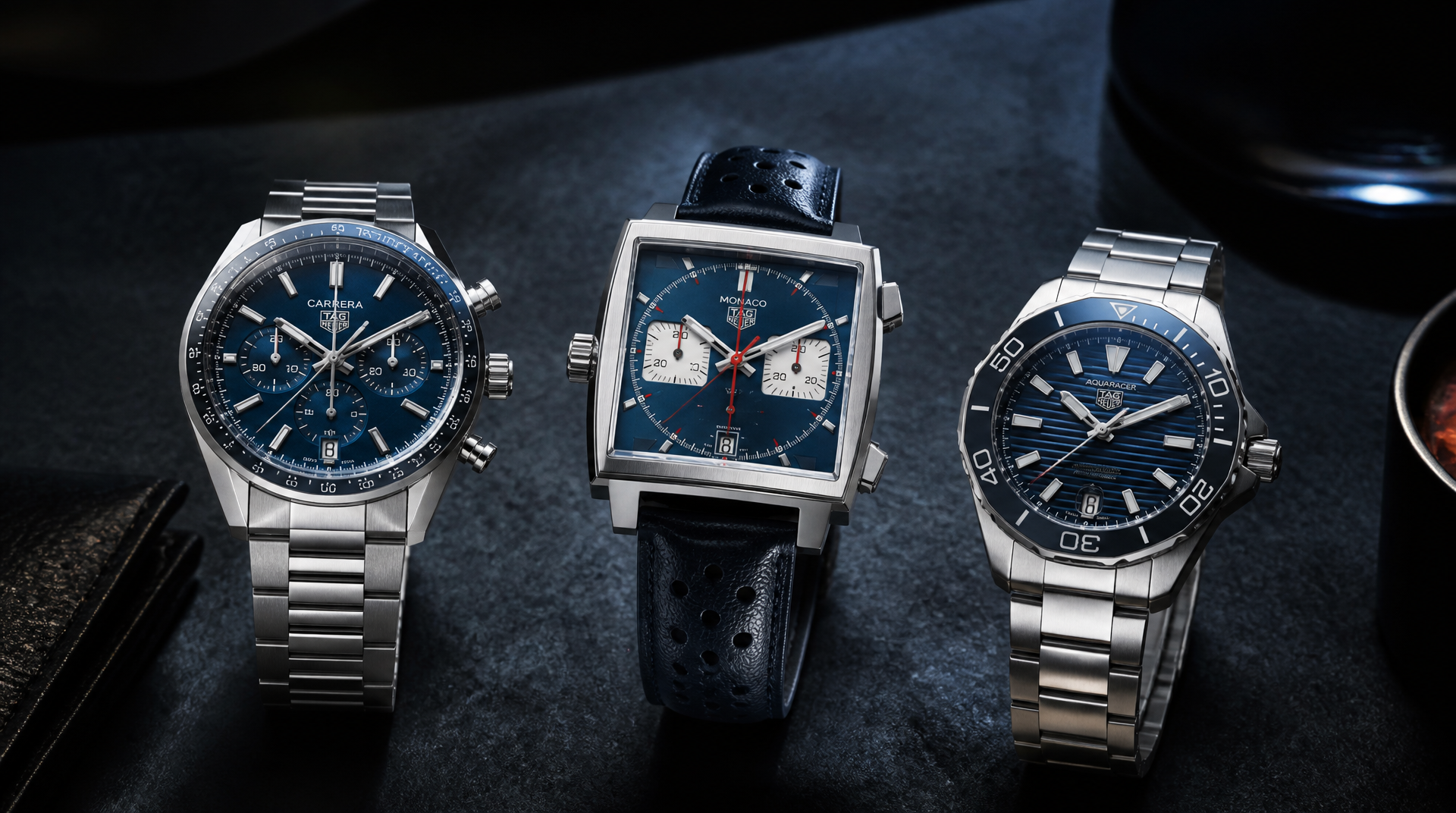
For most wrists, the Carrera is the easiest everyday Tag Heuer; choose the Aquaracer only if you regularly swim or dive, and pick the Monaco only when the square design outweighs the bulk you’ll feel on the wrist. The real decision usually narrows to one practical limit — how much thickness you’ll tolerate daily, how wet you’ll get, and whether a strap needs to swap quickly. The flow below blocks the wrong line early so you land on the one that fits how you actually wear a watch.
Which Tag Heuer Line Matches Your Wrist and Routine?
This isn’t a pros-and-cons list. It’s a short, ordered decision path that cross-checks the limits you’ll hit in real life.
Step 1: What level of water exposure is realistic?
- Frequent swimming, snorkeling, or salt water → cross the Monaco off first. Its 100 m water resistance lacks a screw-down crown and rarely includes a dive bezel.
- Same use but you want a timing bezel → Aquaracer is the only line engineered for it.
- Rain, hand washing, occasional splash → all three can handle it, so move to Step 2.
Branch if your plans change
If you love the Monaco’s design but your summer schedule now includes pool time, don’t try to make the Monaco a swimmer. The push-pull crown and exposed pushers will fail under repeated immersion. The correct move is to buy a Monaco for desk wear and a beater for water, or switch entirely to the Aquaracer. Pushing the Monaco beyond splash duty will almost certainly flood the case.
Step 2: Measure your size and thickness tolerance
- Wrists under 6.3″ or a need to slide under dress cuffs → the Monaco often becomes a friction point. Even at 39×39 mm, its 14+ mm thickness and square shape create an overhang that catches shirt fabric. Many Aquaracer automatics also sit above 14 mm. The Carrera, especially 39 mm or 41 mm three-hand versions, stays flatter and narrower.
- You don’t mind presence → the Monaco and Aquaracer wear like modern tool watches, which is either a statement or a nuisance depending on your sleeve habits.
Hard stop for small wrists
If you try the Monaco on your wrist and the square case overhangs past both edges of your wrist bone when you flex, the watch will snag shirts daily and never sit comfortably. Don’t rationalize it as “getting used to it.” The only viable Tag Heuer alternative is the Carrera 39 mm; anything else will be a purchase you regret.
Step 3: Narrow by style and strap flexibility
- Straps matter to you → the Aquaracer’s proprietary end-link geometry and the Monaco’s unusual lug setup limit aftermarket options. Carrera uses standard 20 mm or 21 mm lugs, so off-the-shelf leather and rubber straps are easy.
- You want a classic Swiss chronograph look → Carrera and Monaco both deliver, but the Carrera’s round case, tachymeter bezel, and pump pushers read as more traditional. The Monaco is deliberately square and more about collector theatre.
Reality check before you buy
At a dealer, ask to remove the bracelet from the Aquaracer or Monaco and try to fit a standard straight-end strap. If the springbar access is blocked by an integrated end-link or the lug shape won’t accept anything but curved bars, understand that quick strap changes at home will be a hassle. If you swap bands seasonally, you’re far better served by the Carrera.
Stop checkpoint: When to skip all three
If you need a true dress watch thinner than 10 mm, a dedicated beater under 40 mm with a rotating bezel, or a watch that won’t draw unsolicited “that’s a Tag?” comments, none of these lines hit the mark. A Carrera 39 mm on leather works for casual dress codes, but for formal suits you’ll want a slimmer piece outside the brand entirely. Stop here and don’t compromise — no amount of specification juggling will turn any of these into a thin dress watch.
Model Specs and Everyday Fit
| Carrera (automatic 3‑hand/chrono) | Monaco (Calibre 11) | Aquaracer (300 m automatic) | |
|---|---|---|---|
| Typical case size | 39–44 mm | 39×39 mm | 41–43 mm |
| Thickness | 12–15 mm (chronos thicker) | ~14.3 mm | 14–14.5 mm |
| Water resistance | 100 m (push-pull crown on many) | 100 m (no screw-down) | 300 m (screw-down crown) |
| Core movements | Calibre 5 (ETA 2824/Sellita SW200), Calibre 16 (ETA 7750) | Calibre 11 (SW300 + Dubois-Dépraz chrono module) | Calibre 5, some Calibre 16 |
| Power reserve | ~38–42 h | ~40 h | ~38–42 h |
| Bezel function | Fixed tachymeter on chronos | None | Unidirectional ceramic 60‑min |
| Strap/bracelet swap ease | High (standard lug widths) | Low (curved springbars, odd lug shape) | Low (integrated end-links, curved bars) |
| Best for | Daily wear, desk-to-dinner | Collecting, wrist presence | Swimming, shallow diving |
Carrera: Everyday Usability With a Crown to Inspect
The Carrera does the least to shout “I’m a sports watch” — and that’s why it works on more wrists. The 41 mm Calibre 5 Day‑Date (ref. WAR201A) is a no-surprises daily driver: 100 m water resistance, a smooth Sellita-based movement, and a thickness around 12.5‑13 mm that won’t wedge against a jacket cuff. Chronograph versions (Calibre 16) add a tachymeter bezel and about 3 mm of height, pushing them under sleeves with less grace.
Where common recommendations fail: many buyers assume 100 m on a Carrera means swim-ready. Unless the specific reference has a screw-down crown — and many don’t — you’re really at a splash-safe level. Before you buy, physically unscrew and screw the crown (if it screws down). A gritty feel or a crown that doesn’t seat flush is a red flag: the tube threads may be damaged, and the watch cannot be trusted near water without service.
Checkpoint list before buying a Carrera
- Does the specific model have a screw-down crown? If it’s a push-pull crown and you plan any pool use, stop. Switch to an Aquaracer or a Carrera Diver reference with 300 m and a screw-down crown.
- Try the chronograph version on with a shirt cuff. If the extra 3 mm makes the crown guard dig into your hand, the three-hand is the better daily choice.
- If accuracy matters, the Sellita SW200 base often gains 10–15 s/day out of the box. Factor in a regulation at a watchmaker if you want tighter specs.
Verify the seal before you swim
If you buy a pre-owned Carrera or a display unit, don’t assume the seals are intact. Take it to a local watchmaker for a pressure test (usually $20–$40). A passing test confirms the case will survive a swim; a fail means the gaskets need replacement. No receipt, no water — treat any untested watch as splash-only.
Monaco: Iconic Square Design With Real Bulk
The Monaco’s square case, left-set crown, and chronograph pushers at 2 and 4 o’clock turn heads, but the sub‑40 mm diameter hides real bulk. At 14.3 mm thick and without a conventional bezel to break up the visual mass, it sits high and catches shirt edges. The Calibre 11 chronograph uses a modular mechanism on top of an SW300; servicing can cost more than a straightforward integrated chronograph, and not every local shop has the training to handle it.
The sapphire crystal is flat and reflective, so reading the subdials in bright light can be a squint exercise — an annoyance glamour shots rarely show. On the plus side, the bracelet version (e.g., CAW211P) is comfortable once sized, and the sense of occasion is genuine.
When the Monaco makes sense
- You want a distinctive motorsport design and will wear it loose on a cuff or with short sleeves.
- You accept a 14+ mm slab that wears larger than most 42 mm divers.
- You’re comfortable with legibility compromises and higher service costs.
Branch for physical comfort issues
If the deployant clasp digs into your skin on the first full day of wear, don’t force a break-in. Many owners find the clasp sharp on thick wrists. Swap to a perforated leather rally strap or a straight-end mesh bracelet to reduce bulk under the wrist and eliminate the hot spot. This keeps the character intact but makes the watch livable.
Stop/escalate threshold for chronograph trouble
If the chronograph seconds hand stutters or doesn’t reset precisely to zero within the first month, stop wearing it and use the warranty. The modular chrono design demands specialized repair; a general watchmaker may strip the module trying to adjust it. Let Tag Heuer service handle the alignment — this is not a do-it-yourself fix.
Aquaracer: The True Dive Line That’s Overfinished
The Aquaracer solves the water-resistance shortfall with a proper screw-down crown, ceramic bezel insert, and 300 m rating. The 43 mm WBP201A (Calibre 5) is the volume seller: 14.5 mm thick, fine‑ratcheting clasp, and a wave‑pattern dial that hides fingerprints. But that thickness and the 43 mm span put it firmly in the “big watch” category, and the proprietary bracelet end links make third‑party rubber straps a frustration unless you buy curved springbars from specialty suppliers.
The rotating bezel is satisfying at first, but desk wear can dull the ceramic’s crisp clicks over a year. More critically, some units leave the 12 o’clock triangle slightly off‑center at the zero position — a QC slip that destroys tool‑watch credibility.
Hard stop if the bezel is misaligned
Check the alignment before you leave the store or immediately upon unboxing. If the triangle doesn’t line up precisely when the bezel is at zero, stop. A dive bezel off by even half a click can cause a dangerous timing error. Return the watch or demand a realignment under warranty. Do not accept “they’re all like that” — a properly assembled Aquaracer should align dead on.
Verify after swimming
After any swim or dive, hold the watch under a warm light and inspect the crystal for internal fog. Condensation means water has entered the case, even if the crown was fully screwed down. If you see haze, get the watch serviced immediately to prevent dial rust; a quick pressure test afterward confirms the new gaskets hold. A clean, dry crystal after a dive is your sign the seals are intact.
Bracelet tension point
If the bracelet catches arm hair or feels sharp on the edges, don’t just live with it. You can switch to the OEM rubber strap, but it requires curved springbars. Buy directly from Tag Heuer or a supplier that guarantees water-seal integrity; generic straight bars may let water in. The swap takes 10 minutes and removes the main daily bother.
When None of These Three Is the Right Tag Heuer
Tag Heuer’s Formula 1 quartz line gives you a lighter, thinner, more affordable way into the brand with better beater credentials, and the Autavia brings a vintage-inspired chronograph with a bi‑directional bezel that sidesteps the Carrera’s water resistance ambiguity. If you need a slimmer dress piece, look outside the current core lines. Between Carrera, Monaco, and Aquaracer, the decision hinges on what you’ll forgive daily. Pick the Carrera for wearability, the Aquaracer for real water use, and the Monaco only when the look matters more than how it sits on your wrist.
Explore This Topic
- Back to Tag Heuer
- Back to Tag Heuer Brand Hub
Related guides in this cluster:
- Tag Heuer Serial Number Guide: How to Check & Authenticate Your Watch
- Christopher Ward Watches: Complete Brand Guide & Review
- Omega Watches: The Complete Brand Guide — Speedmaster, Seamaster & More

The We Know Watches editorial team brings together over 40 years of combined watch collecting, trading, and repair experience. Our editors have owned and handled watches from every major brand — from entry-level Seiko 5s to Rolex, Omega, Patek Philippe, and independent Swiss watchmakers. We’ve bought and sold at auction, worked with authorized dealers, visited manufacturing facilities in Switzerland and Japan, and serviced hundreds of movements ranging from the Seiko 7S26 to the Longines L888. Every guide and review we publish is based on hands-on experience, original research, and consultation with professional watchmakers. We do not accept payment for reviews, and we clearly disclose when we use affiliate links.