
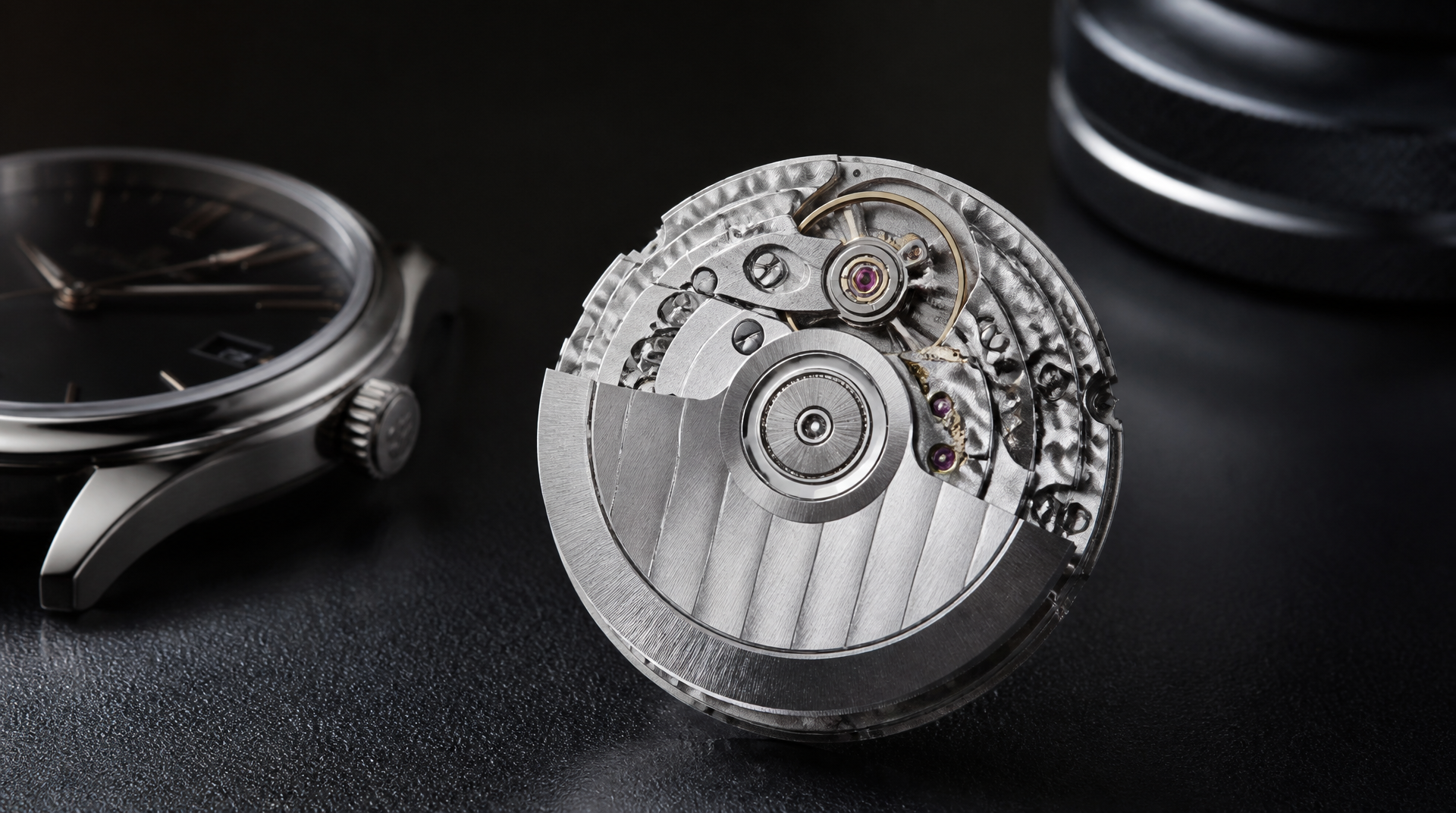
The Longines L888 is an exclusive automatic caliber built on an ETA A31.L01 base. It delivers a 72-hour power reserve at a deliberately moderate 25,200 vph beat rate, and it powers most modern Longines three-hand watches—from the HydroConquest and Spirit to the Master Collection. It replaced the aging L619 (ETA 2892) starting around 2015. The family now spans five main variants that differ in hairspring material, anti-magnetic protection, and certification, and the real-world accuracy, service thresholds, and early failure signs are more practical to know than you might expect.
L888 Variant Specs at a Glance
| Specification | L888.2 & L888.3 | L888.4 (Silicon) | L888.5 (COSC) |
|---|---|---|---|
| Base caliber | ETA A31.L01 | ETA A31.L01 | ETA A31.L01 |
| Jewels | 21 | 21 | 21 |
| Power reserve | 72 hours | 72 hours | 72 hours |
| Beat rate | 25,200 vph (3.5 Hz) | 25,200 vph (3.5 Hz) | 25,200 vph (3.5 Hz) |
| Hairspring | Nivachron (L888.3) or standard alloy (L888.2) | Silicon | Silicon |
| Factory accuracy | –5/+15 s/day | –5/+15 s/day | –4/+6 s/day (COSC) |
| Date | Yes | Yes | Yes |
| Winding | Automatic, bidirectional | Automatic, bidirectional | Automatic, bidirectional |
| Hand-winding / hacking | Yes / Yes | Yes / Yes | Yes / Yes |
| Anti-magnetic | Moderate (Nivachron helps) | High (silicon) | High (silicon) |
| Typical model years | Pre-2018 (L888.2); 2018–2021 (L888.3) | 2021–present, higher-tier | 2021–present, COSC models |
Every L888 shares the same architecture. The 25,200 vph rate sits between classic 28,800 vph high-beat movements and slower 21,600 vph workhorses, giving you a three-day run with a smooth sweep that’s indistinguishable from faster beats to the naked eye. The Spron 510 mainspring is the key ingredient that makes the 72-hour reserve possible while keeping amplitude reasonably flat across most of the wind.
How to Identify Which L888 Caliber You Have
Longines rarely prints the full caliber designation on the dial. The most reliable method is a quick inspection of the caseback engraving or documentation. Start with these checks:
1. Caseback and rotor engravings
Look at the transparent caseback or the rotor/steel ring if the back is solid. You’ll often see “L888.2,” “L888.3,” “L888.4,” or “L888.5” engraved directly. On models like the HydroConquest with a solid caseback, the caliber may be printed on the caseback text line instead.
2. Warranty card and hang tag
If you bought the watch new, the paperwork usually lists the full caliber. The hang tag that comes on the watch at retail is the quickest way to confirm a variant without opening anything.
3. Model year cross-reference (approximate)
- Pre-2018 models almost always carry the L888.2 with a standard alloy hairspring.
- 2018–2021 models typically upgraded to L888.3, adding a Nivachron hairspring for better magnetic resistance.
- 2021–present higher-tier watches (HydroConquest, Spirit, some Master Collection) use L888.4 with a silicon hairspring.
- L888.5 appears exclusively in COSC-certified references, most notably the Spirit collection and limited editions.
4. Watchmaker inspection (the definitive check)
If the caseback is opaque and you don’t have paperwork, a watchmaker can confirm the variant in minutes by opening the case. Silicon hairsprings have a distinctive glossy, dark-gray appearance and will not stick to a magnet. Don’t try a magnet test yourself near a fully assembled watch—you can magnetize other components.
Real-World Accuracy and Everyday Tuning
Factory tolerance for non-COSC L888 variants is –5 to +15 seconds per day, but owner reports across forums and service data paint a tighter picture. Most L888.3 and L888.4 examples settle into ±5 seconds per day after a few weeks of regular wear. L888.5 COSC pieces stay within –4/+6 seconds, and many owners see ±2 seconds in a daily rotation.
The 3.5 Hz beat rate contributes to flatter accuracy as the mainspring runs down compared to higher-beat movements that can tail off faster. Accuracy often holds within 10 seconds per day even after 60 hours.
What makes an L888 drift outside that range
- Low amplitude after 48+ hours unworn – The watch can gain 8–12 seconds in the last 12 hours of reserve. That’s normal behavior and not a defect.
- Magnetism – L888.2 units with standard hairsprings are sensitive. If a watch suddenly runs 30+ seconds fast after sitting near a laptop lid, tablet case, or magnetic clasp, a demagnetizer usually restores normal timekeeping. L888.3 (Nivachron) and L888.4/L888.5 (silicon) resist this much better.
- Positional variation – Crown-up at night tends to lose a couple of seconds; dial-up tends to gain. Use this to self-regulate without opening the case. If your watch is +4 seconds per day dial-up, resting it crown-up overnight can keep the week’s total drift near zero.
One Common Failure Mode and How to Detect It Early
The most common early warning across the L888 family is intermittent rotor noise and reduced winding efficiency, typically caused by worn or dry reversing wheels. The watch works fine on the wrist but dies overnight despite a full day of wear. If left unattended, the rotor can rub the bridges and lead to expensive damage.
Early warning signs
- A gravelly, whirring, or rough clicking sound when the rotor spins, especially in a quiet room.
- The watch runs while you’re active but stops within 12–18 hours after being set down fully wound.
- Power reserve feels noticeably shorter than 60 hours, even after a manual full wind.
Three-step at-home check
1. Listen to the rotor
Take the watch off, hold it horizontally, and rotate it gently. A healthy L888 produces a smooth, nearly silent free-spin sound. Any grinding, clicking, or uneven whirring points to a problem in the automatic winding works.
2. Test winding efficiency in real use
Manually wind the watch fully (about 30–40 crown turns until you feel resistance). Wear it for a full day—at least 8 hours of normal wrist movement. Set the time, then place the watch dial-up on a nightstand before bed. Check in the morning. If it stops in less than 20 hours, the automatic winding system isn’t translating motion into mainspring tension well enough.
3. Look for a power-reserve drop
Fully wind the watch, let it rest dial-up, and time how long it runs. If you consistently get less than 55-60 hours on a full wind that used to deliver near 72, the reversing wheels are dragging. A watchmaker can confirm with an amplitude reading below 200 degrees after a full wind.
What to do with the results
- Mild noise but still passes the overnight test and reserve is above 60 hours: You can schedule a service in the next 3–6 months. The reversing wheels are starting to dry out but aren’t failing yet.
- Loud grinding or the watch stops overnight: Stop wearing it and have a watchmaker inspect the automatic works. Running a worn rotor risks scratching bridges, which turns a routine service into a more involved repair.
Escalation signal: If a watchmaker finds metal debris inside or rotor contact on the bridges, the repair moves beyond a standard service.
Explore This Topic
- Back to Longines
- Back to Longines L888 Movement
Related guides in this cluster:
- Christopher Ward Watches: Complete Brand Guide & Review
- Fossil Watch Battery Replacement: Complete Guide for All Models
- Citizen Eco-Drive Complete Guide: Setting Time, Battery Life & Care

The We Know Watches editorial team brings together over 40 years of combined watch collecting, trading, and repair experience. Our editors have owned and handled watches from every major brand — from entry-level Seiko 5s to Rolex, Omega, Patek Philippe, and independent Swiss watchmakers. We’ve bought and sold at auction, worked with authorized dealers, visited manufacturing facilities in Switzerland and Japan, and serviced hundreds of movements ranging from the Seiko 7S26 to the Longines L888. Every guide and review we publish is based on hands-on experience, original research, and consultation with professional watchmakers. We do not accept payment for reviews, and we clearly disclose when we use affiliate links.