
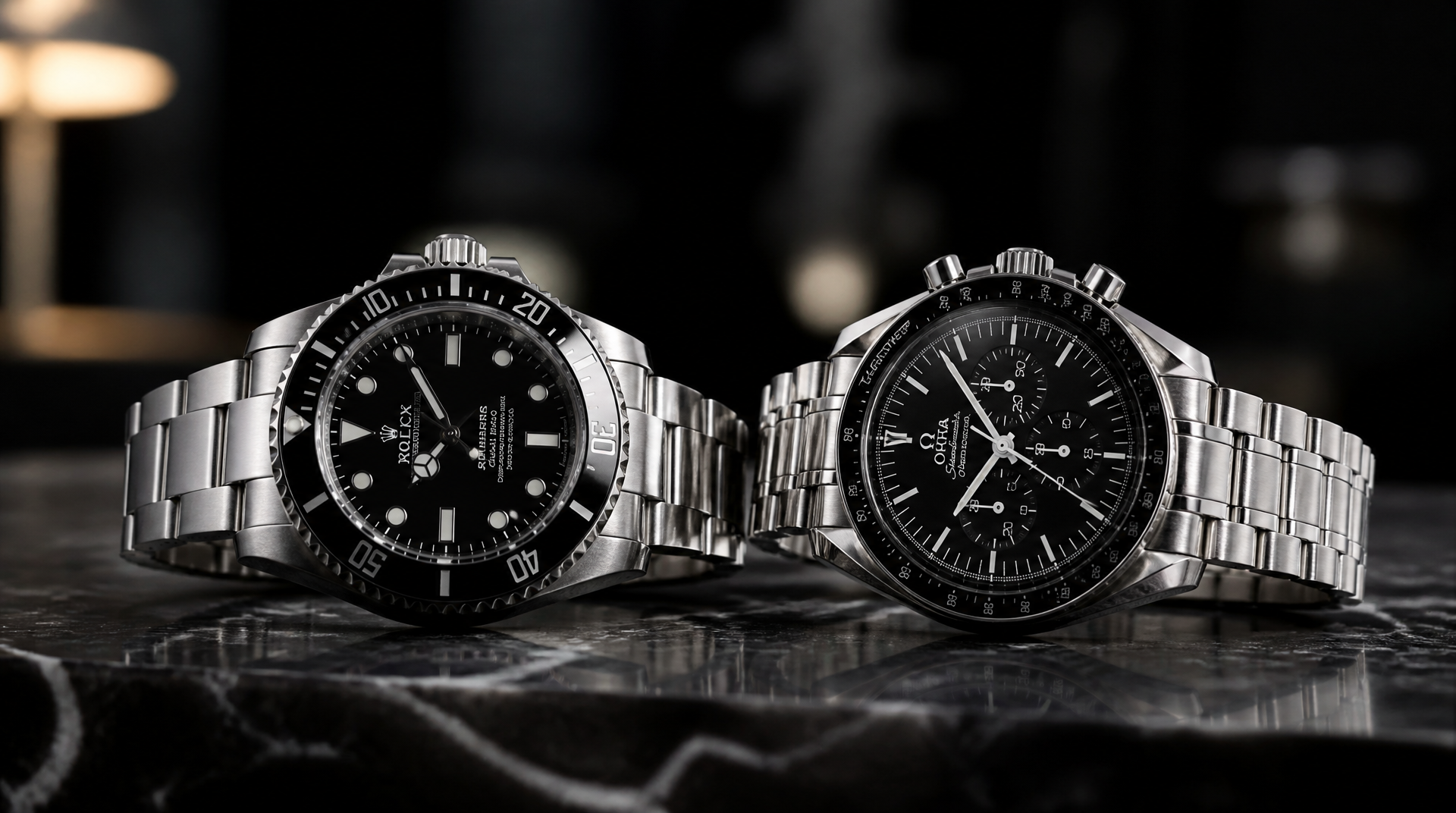
Omega gives you more technical innovation, easier retail access, and a lower cost of entry. Rolex commands stronger recognition, deeper resale liquidity, and a brand gravity that makes a stainless-steel sports model an instantly understood statement. The short answer is binary: buy Omega when you want a personal tool that over-delivers on specs without shouting; buy Rolex when daily social signaling and exit value are non-negotiable. Use the filters below before you pay — and before you get trapped by a spec-sheet winner that doesn’t fit your wrist or your life.
Choose with two filters, not just specs
Start with a side-by-side of what each brand actually delivers, then run two filter questions that reveal which camp you truly belong in. After that, perform a quick try-on checkpoint to confirm your shortlist works in the real world.
At a glance: Rolex vs Omega
| Dimension | Rolex | Omega |
|---|---|---|
| Heritage | Founded 1905; defined by professional tool watches (Submariner, Day-Date) and relentless brand consistency. | Founded 1848; deep ties to spaceflight, the Olympics, and James Bond; a track record of technical firsts. |
| Entry price (new, steel) | ~$6,000 (Oyster Perpetual); most sports models $9,000–$12,000+ at retail. | ~$3,000 (De Ville Prestige quartz); mechanical sports models start near $5,000–$6,000. |
| Movement hallmark | In-house Superlative Chronometer (−2/+2 sec/day); COSC plus internal certification. | Co-Axial Master Chronometer (0/+5 sec/day); METAS certified, typically antimagnetic to >15,000 gauss. |
| Design approach | Evolutionary; the Oyster case and fluted bezel change little between generations. | Varied; heritage-inspired pieces alongside modern ceramics, titanium cases, and open casebacks. |
|
| Resale value retention | Strong; many steel sports models sell above retail on the secondary market. | Good, but most standard models trade below MSRP pre-owned; Moonwatch and limited editions hold firmer. |
| Availability (retail) | Chronically low for steel professionals; waitlists are the norm without a purchase history. | Generally walk-in available; most collections are not capacity-constrained. |
| Approximate service cost | ~$800–$1,000+ for a standard movement service. | ~$550–$800; co-axial models often have longer recommended service intervals (5–8 years). |
| Brand perception | Universal status symbol; bracelet often read as “money on the wrist” — for better or worse. | Enthusiast-favorite, less public flash; an Aqua Terra flies under the radar where a Datejust doesn’t. |
Prices and service costs are approximate and vary by model and region; verify with the manufacturer or an authorized service center for current figures.
Filter 1: Daily social signal or personal tool?
If the watch needs to be a recognizable marker of success, Rolex wins with zero effort. An Oyster Perpetual or a smooth-bezel Datejust communicates achievement in almost any professional room.
If you care more about what the watch does than what people assume, Omega often gives you more for the money. A Seamaster Aqua Terra is antimagnetic to 15,000 gauss, METAS-certified, and technically more advanced than a Rolex at an equivalent price — all without the commentary a crown logo attracts.
The early failure signal to listen for: you’re drawn to a Rolex purely for recognition, but the idea of getting “Is it real?” questions or unwanted attention already bothers you. If that thought lingers, try wearing a Speedmaster or a Seamaster for a day and notice whether the lower profile suits you better.
Filter 2: Long keep or exit plan?
Rolex steel sports models are liquid assets you can sell quickly, often near or above what you paid at retail. If you flip watches regularly or want a financial safety net, Rolex’s secondary-market depth matters.
Omega loses less value than many luxury brands, but you’re typically looking at a depreciation hit if you sell soon after purchase. That isn’t a defect; it means you treat an Omega as a buy-to-wear decision, not a short-term store of value. Hold either brand for a decade, and the difference narrows — both command respect, and both are built to be serviced for decades.
Where this filter creates a concrete go/no-go: If you’re financing the watch and need it to hold bail-out value within 2–3 years, a Rolex steel sports model at MSRP is the safer choice. If you won’t sell until a major life milestone anyway, Omega’s lower upfront spend and longer service intervals often produce a lower total cost of ownership, making it the smarter long hold for the buyer who plans to wear and forget.
The trap of “better” on paper
Most comparison guides feed an endless spec-sheet loop, and the resulting failure mode is subtle: you buy the technical winner, wear it for a few months, and realize it doesn’t fit your day. You can spot this early by checking whether you’re comparing watch-for-watch details without ever trying one on.
A real example: a buyer picks the Omega Seamaster Professional 300M over a Submariner because the Omega has a display caseback, higher magnetic resistance, and no waitlist. All true. But after six months, the helium escape valve bulge at 10 o’clock irritates him, and the bracelet doesn’t slide under a dress cuff as cleanly as the Sub’s flatter design. The spec-sheet “better” watch became the wrong watch.
Escalation signal: if you catch yourself searching “watches like Submariner but cheaper” or “Rolex alternative under $7k,” stop and admit you want the Rolex but are negotiating. Try on the real thing before you buy a proxy you’ll resent.
Try before you decide: a 5-minute fit check
Confirm the top candidate works in your actual day, not in a boutique mirror.
1. Dress for your typical workday — long-sleeve shirt, jacket, or whatever you wear most often.
2. Close the clasp and slide the cuff over the watch. Repeatedly. If the case edges catch or the bracelet hangs up, that friction will annoy you weekly.
3. Sit at a desk and move through your work posture. Check whether the crown digs into the back of your hand.
4. Look at the watch in a real mirror from arm’s length. This reveals case thickness and the visual footprint better than close-up admiration.
5. Check the clasp’s micro-adjustment in warm and cool conditions. A clasp you can’t fine-tune without tools will lead to a loose, rattling fit by evening.
If the watch fails more than one of these checks, test the next-best model from the other brand before committing. A failed fit-check today saves months of buyer’s regret.
Where each brand fits best
Use these segment picks only after the filters above confirm which direction you lean.
The one-watch daily wearer
Stronger fit: Omega Aqua Terra (38 mm or 41 mm). METAS-certified, 150 m water resistance, clean date layout, and a movement that shrugs off magnetic fields from tablets and phones. It’s less ostentatious than a Rolex Datejust and available at retail. The Datejust is elegant, but the fluted bezel and cyclops magnifier draw eyes — exactly what you want or exactly what you don’t.
The desk diver who wants serious specs
Stronger fit: Omega Seamaster Professional 300M. Helium escape valve, ceramic bezel insert, 300 m rating, and a bracelet with a micro-adjustment clasp that works over a wetsuit or a shirt cuff. The comparable Rolex Submariner (no-date or date) is iconic, but getting one at an authorized dealer without a purchase history remains a lottery. If you want a watch now and hate playing waitlist games, the Seamaster is the more rational pick. However, confirm the 42 mm case and HEV crown don’t interfere with your cuffs during the fit check above.
The chronograph enthusiast
This branches on which story matters more.
- Omega Speedmaster Professional Moonwatch — manual-wind, hesalite crystal, and the actual flight-qualified watch from Apollo. The newer Master Chronometer models (caliber 3861) modernize the movement without losing the vintage feel.
- Rolex Daytona — automatic, motorsport icon, and one of the hardest watches to buy at list price. At MSRP from an authorized dealer, the value is undeniable. At secondary prices, the premium often exceeds what you’d pay for two high-end Omegas.
Honest bottom line: buy the Moonwatch if you want the story and mechanical engagement; chase the Daytona only if you can get it at list price and genuinely prefer the Oyster case. If a dealer tells you “two years for a steel Daytona,” verify by calling two other authorized dealers; consistent answers of 18+ months should kill the hope and redirect your budget.
The dress-watch buyer who wants one reliable piece
Stronger fit: Omega De Ville or Constellation. Rolex Datejust 36. Omega’s dress watches run thinner and cost less; the quartz De Ville Prestige can anchor an office wardrobe without mechanical worry. If you prefer a mechanical, a Rolex Datejust 36 with a smooth bezel and Oyster bracelet stays timeless and discrete. Choose Omega when you’d rather not have anyone read your watch. Choose Rolex when you want the quiet confidence it can bring in professional circles.
The investment-minded or limited-edition collector
Rolex holds the edge in breadth and speed of resale. Steel Daytonas, GMT-Master IIs, and Submariners have become alternative assets with global buyer depth. Omega’s limited editions (Snoopy Speedmaster, Bond 60th Seamaster) can appreciate, but the market is thinner and less predictable. If liquidity is part of your decision, Rolex’s used-market velocity is hard to match.
Trade-offs to know
- Retail access vs. resale premium: what you lose in Rolex wait-time patience, you may gain in exit stability when you sell. Omega you can buy today, but you won’t get the same financial backstop.
- Horological innovation vs. brand mythology: Omega pushes co-axial escapements, silicon hairsprings, and METAS-level magnetism resistance. Rolex prefers refined, proven architecture. Neither approach is wrong; they suit different owners.
- Recognition vs. discretion: a Panda Daytona draws glances in a bar. An Aqua Terra simply tells time. Decide which atmosphere you prefer before you hand over cash.
- Service costs and intervals: Omega’s longer recommended service intervals (often 5–8 years) can reduce lifetime ownership cost. Rolex’s shorter cycle and higher per-service price make long-term maintenance more expensive on average than an equivalent Omega. Request a current service estimate from a brand-authorized center for the exact reference you’re considering; prices shift with model complexity and location.
Related questions
Which brand is more prestigious?
In broad public perception, Rolex still leads. Omega carries enormous respect among enthusiasts and watchmakers, but Rolex occupies a tier of instant name recognition that no other brand matches.
Which holds value better in 5 years?
Rolex steel sports models typically retain a higher percentage of purchase price and can even appreciate. Omega’s standard models depreciate more initially, though limited editions and the Moonwatch hold value better.
Is Omega more accurate than Rolex?
On paper, a Master Chronometer Omega can surpass Rolex’s Superlative Chronometer spec in certain conditions, particularly magnetism. Real-world performance is often so close that wear pattern and regulation matter more than brand.
Which is better for a first luxury watch?
An Omega often makes a smarter entry: lower cost, easier availability, and less pressure around wear-and-tear. But if you’ve always wanted a Rolex and can afford the model you want without a multi-year wait, buying the one you desire first prevents trading up later at a loss.
Can I swim with both?
Yes. Most steel sports models from both brands have screw-down crowns and at least 100 m of water resistance. Confirm the specific model’s rating, and always ensure the crown is tightened before submersion.
How do I verify real-world availability for a specific Rolex reference?
Call two authorized dealers, identify the exact reference number (e.g., 126610LN for a steel Submariner Date), and ask directly: “What is the realistic wait time for someone without a prior purchase history?” Answers beyond 12–18 months signal that walking into an Omega boutique and leaving with a watch the same day is the faster path to wearing a luxury watch.
Explore This Topic
- Back to Rolex
- Back to Rolex vs Omega
Related guides in this cluster:
- How Much Does Watch Service Cost? Complete Brand-by-Brand Breakdown
- Watch Size Guide: How to Choose the Right Case Diameter, Thickness & Fit
- Breitling Watch Buying Guide: Are They Worth It in 2026?

The We Know Watches editorial team brings together over 40 years of combined watch collecting, trading, and repair experience. Our editors have owned and handled watches from every major brand — from entry-level Seiko 5s to Rolex, Omega, Patek Philippe, and independent Swiss watchmakers. We’ve bought and sold at auction, worked with authorized dealers, visited manufacturing facilities in Switzerland and Japan, and serviced hundreds of movements ranging from the Seiko 7S26 to the Longines L888. Every guide and review we publish is based on hands-on experience, original research, and consultation with professional watchmakers. We do not accept payment for reviews, and we clearly disclose when we use affiliate links.