
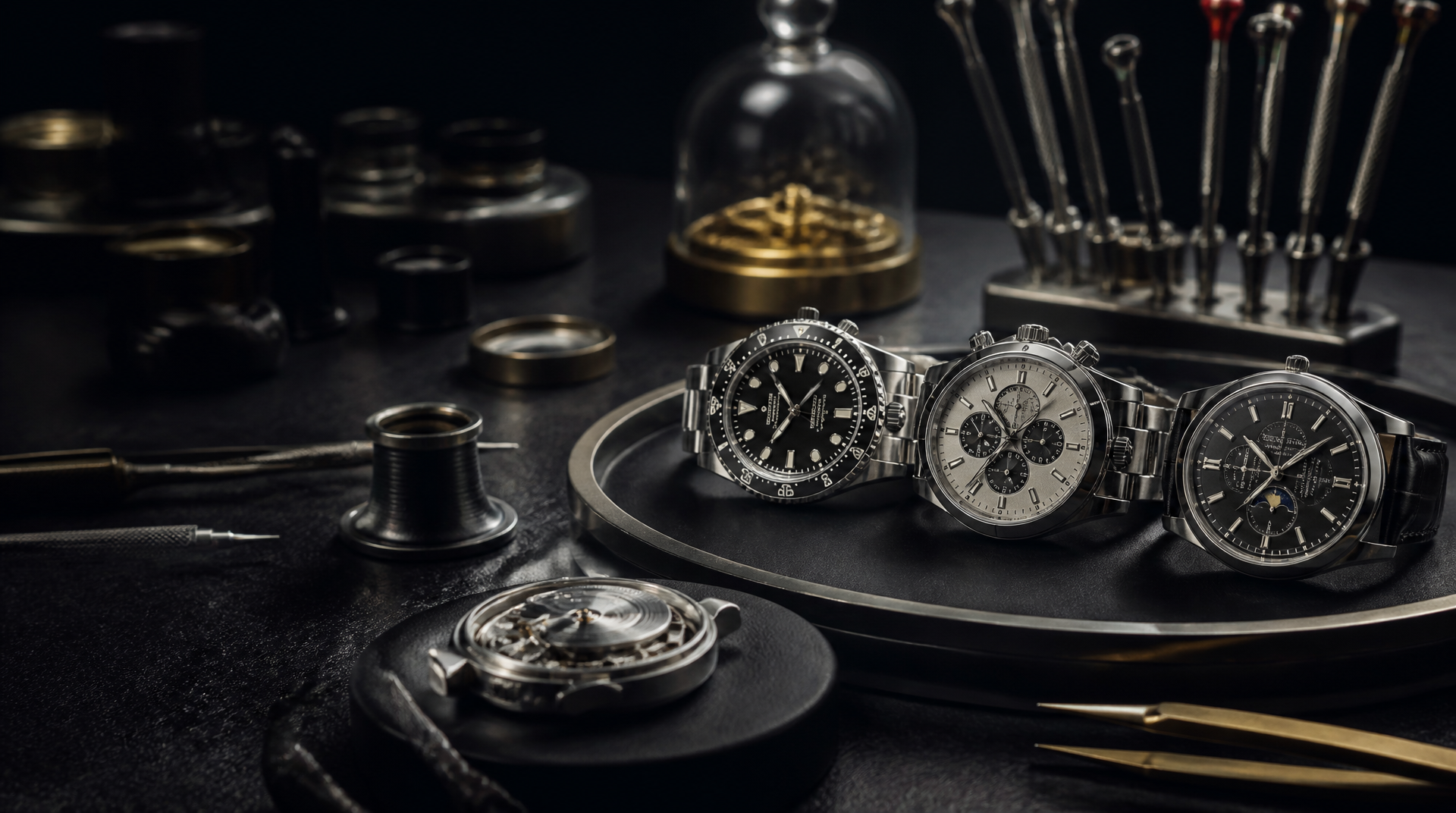
A standard mechanical watch service runs from roughly $150 to over $1,000, and the final number pivots on the brand, the movement, and who turns the screwdrivers. A Seiko automatic with a modern NH workhorse generally lands between $150 and $250 when the movement is swapped, while a Rolex overhaul through an authorized center routinely reaches $800–$1,000. Omega co-axial three-handers cluster between $600 and $800, and adding a chronograph or a vintage complication pushes the cost higher. The numbers aren’t abstract — they shift based on what you authorize, what you skip, and whether the watch is already wearing itself out inside.
Before You Pay for a Service: A 4-Point Owner Health Check
Don’t ship a watch off for a full overhaul solely because the sticker on the caseback says “service every 5 years.” Use this fast, owner-level sequence to decide what the watch actually needs — or whether it needs anything at all. Every step is something you can do at home or request during a free ten-minute evaluation at a local watchmaker.
1. Measure real daily accuracy. Wind the watch fully, set it to a reference time, and wear or rest it in a consistent position for 24 hours. For a non-chronometer mechanical movement, –10 to +20 seconds per day is normal. Chronometer-certified watches that drift outside –4/+6 seconds per day need attention — but only after you rule out magnetism, which often mimics a sick movement.
2. Test water resistance if the watch matters near water. A screw-down crown and good seals don’t guarantee a tight case. Any shop with a pressure tester can verify the rating in minutes. If the test fails, stop wearing the watch anywhere it can get wet and plan a gasket-and-crown service — you don’t necessarily need a full movement teardown yet.
3. Listen to the rotor with the watch next to your ear, then give it a gentle shake. A dry automatic movement often produces a metallic whirring or a “helicopter” spin where the rotor spins wildly in one direction on a bidirectional movement. That’s bare-metal friction grinding microscopic debris into the train. It’s a hard service trigger.
4. Inspect the crown, stem, and crystal for signs of moisture entry. Gritty winding, a crown that won’t thread down smoothly, a cracked crystal, or a quick puff of condensation that disappears in an hour all signal that water has gotten inside. Even if the movement runs, rust has already started. Open a watch with internal fogging within days, not weeks.
Immediate stop threshold: If you find condensation (even a fleeting fog), rotor grinding, or a timing deviation that demagnetizing and regulation can’t correct, stop wearing the watch immediately and get it to a competent watchmaker. Do not attempt to open the case yourself or apply a hairdryer or bag of rice — the moisture won’t leave through a closed case and the additional running hours will deepen the corrosion you’ll later pay to fix. Every day of continued wear after one of these failures adds damage. The same rule applies if a pressure test shows a leak: the seals have failed, and any subsequent exposure to rain or a sink splash is a gamble.
Checkpoint verdict: If the watch keeps good time, passes a pressure test, winds smoothly, shows no rotor noise, and has never fogged, you don’t need a full service right now. Schedule another check in 12 months. One failed test is enough to act — address the specific repair the watch requires, not a blanket overhaul.
When Full Service Doesn’t Make Sense: The Replacement-Value Rule
There’s a practical decision that overrides most service-price charts. Compare the cost of a full movement overhaul to half of what the same watch costs on the pre-owned market. When the service quote approaches or exceeds that half-value mark, swapping the entire movement is often the smarter financial move — especially on sub-$500 watches where originality doesn’t carry heavy resale weight.
Many modern Seiko calibers and entry-level Swiss automatics fall straight into this bucket. A brand-new NH35 movement costs a professional roughly $40–$60, and the installed cost with gaskets and regulation lands between $150 and $250 — markedly less than a full disassembly, cleaning, and re-oiling of the original movement. On a watch you can replace lightly used for under $300, that swap keeps the case, dial, and hands on your wrist without burning cash on labor hours that exceed the movement’s raw value. The rule flips entirely for heirloom pieces and watches with emotional or collectible significance, where preserving the original movement matters more than a clean balance sheet.
Service Cost by Brand: What to Expect in Real Dollars
The numbers below are based on widely reported owner experiences, published manufacturer schedules, and the going rates at both independent watchmakers and authorized service centers. They assume the watch is complete and running, not a box of parts. Vintage or discontinued calibers will push costs higher.
| Brand / Movement Tier | Typical Mechanical Service (Independent) | Factory/Authorized Service | Key Inclusions |
|---|---|---|---|
| Seiko 4R/NH movement | $150–$250 (often movement swap) | $200–$350 (through Seiko) | Movement replacement/regulation, new gaskets |
| ETA 2824/Sellita SW200 | $200–$350 | $400–$600 (brand-dependent) | Full disassembly, cleaning, oiling, seals |
| Omega Co-Axial (three-hand) | $400–$550 | $650–$800 | Factory co-axial servicing, gaskets, optional refinish |
| Rolex (three-hand, 31xx/32xx) | $550–$750 (if authentic parts are accessible) | $800–$1,000 | Complete overhaul, pressure test, case refinish, warranty |
| Chronograph (Valjoux 7750) | $450–$600 | $700–$950 | Chronograph module labor, multiple timing adjustments |
| Vintage/Dress (hand-wound, 1950s–1970s) | $250–$400+ | Rarely applicable; NOS parts may add $100–$300 | Component sourcing, delicate hand-finishing |
Rolex Service Costs: What to Expect
A current factory overhaul for a three-hand Rolex — Oyster Perpetual, Datejust, Submariner No-Date — runs $800–$1,000 at the Rolex Service Center. GMT-Master II and Day-Date models with additional calendar mechanisms often cross $1,100. The price includes a standardized protocol: complete disassembly, ultrasonic cleaning, replacement of all worn and borderline components, regulation to –2/+2 seconds per day, new crown tube and gaskets, and a full case-and-bracelet refinish. You leave with a service warranty that covers the work for 2–5 years depending on current policy.
Independents with access to authentic parts can service a base 3135 or 3235 movement for $550–$750, usually without mandatory polishing. The catch is parts availability. Rolex has tightened its authorized parts network, so many independents must work with their existing stock or rely on generic gaskets. On a dive watch, that substitution matters — a generic seal that doesn’t precisely match the original profile can fail at depth even if it passes a dry pressure test. Always insist on a documented wet-test or vacuum-check result if the watch is going near water again.
Failure point to watch for: A Submariner or Sea‑Dweller that returns from a non-factory shop without a depth-specific certificate may be dry on the surface and still leak under dynamic pressure. If the independent cannot provide a written pressure test to the rated depth, consider sending the watch to the manufacturer for that final seal verification alone.
Omega Service Costs: Co-Axial and Beyond
Omega’s authorized service for a three-hand co-axial model (Seamaster 300M, Aqua Terra, Speedmaster ‘57 co-axial) sits at roughly $650–$800. The co-axial escapement requires a precise oiling sequence and specific escapement alignment tools; a shop without Omega training can accidentally leave the movement with marginal amplitude that degrades over months. A classic Speedmaster Professional Moonwatch (caliber 1861/3861) through an independent often lands between $500 and $650, provided the chronograph wheels haven’t been deformed by years of dry running.
One overlooked benefit of factory service is the incidental parts upgrade. Many owners of 2500-series Seamasters report receiving updated co-axial wheels and barrel components during routine factory servicing, which extends service intervals and improves positional stability. The trade-off: the watch comes back looking nearly new. If you want to preserve the original brushed finish or years of subtle wear, give explicit instructions to skip cosmetic refinishing — both Omega and independents will comply, though light cleaning is unavoidable.
Failure case for early Planet Ocean 2500 owners: Mid-2000s co-axial movements sometimes develop a sticking escapement wheel under low amplitude. A service that doesn’t verify co-axial wheel alignment can return a watch that stops erratically despite running on the timing machine in a single position. When you drop off a co-axial Omega, ask for amplitude readings in dial-up, dial-down, and 6H vertical positions. Full-wind amplitude below 250° in vertical positions is a strong signal that the co-axial train needs a deeper refresh, not just a standard clean-and-oil.
Seiko Service Costs: Mechanical vs. Quartz
Seiko’s range is so broad that two owners with completely healthy watches can pay $160 and $700 for service, both fairly.
Entry-level mechanical Seikos (4R35, NH35/36). Most independent shops treat these as movement-replacement jobs. A new NH35 unit costs $40–$60 wholesale, and with labor, fresh gaskets, and final regulation the bill comes to $150–$250. Authorized centers charge $200–$350 for the same approach with a manufacturer-supplied movement. For a watch whose street price hovers around $250–$350, a movement swap keeps repair costs rational.
6R, 8L, and Grand Seiko 9S calibers. These are strip-and-clean candidates, not swaps. A 6R15/6R35 at an independent runs $250–$400; a Grand Seiko 9S mechanical through the official service channel costs $500–$700, with optional Zaratsu polishing added separately. The 9F quartz Grand Seikos use sealed capsules, but when the capsule eventually develops a fault, a rebuild or movement exchange falls around $300–$500 and is typically recommended every decade.
Quartz Seikos (non-Grand Seiko). A dead battery and dried gasket is a $30–$60 fix. If the circuit or coil fails years later, a replacement quartz module installed costs $40–$80 — the lowest service bill on the board.
A Common Owner Mistake: The “Quick Regulation” That Turns Into a $400 Repair
A watch that suddenly gains 40 seconds a day can tempt an owner to open the caseback, nudge the regulator arm, and call the job done. If the real cause is magnetism, a broken pivot, or dried oil creating erratic friction, moving the regulator arm covers up the symptom without addressing the damage. The watch may briefly show better numbers on a timing app, then drift further as worn parts continue grinding against each other.
The unsafe next step is to keep wearing the watch, believing it’s “regulated.” Within weeks, low amplitude from a failing mainspring or a contaminated balance jewel worsens, and the watch eventually stops. By then, a simple demagnetizing or a barrel clean has morphed into a full service that includes pivot repair or a new balance assembly — easily $350–$450 extra. The safer move: before touching anything, have the watch demagnetized and tested on a timing machine in multiple positions. If amplitude at full wind drops below 220° in the horizontal positions or below 180° in vertical positions, the movement genuinely needs a tear-down, not a regulator tweak.
The Hidden Consequences of Skipping a Service
Skipping a mechanical service when the movement is clearly crying for help doesn’t produce a sudden explosion — it compounds quietly and then hits your wallet all at once.
- Oil breakdown wears irreplaceable steel. Synthetic lubricants last 5–7 years; natural oils in vintage movements degrade faster. As the film disappears, pivots grind into jewels, creating microscopic metal paste that accelerates wear on the train wheels and barrel walls. Once amplitude drops enough to stop the watch, you may need new barrel assemblies and repivoting — far beyond a standard clean-and-oil job.
- Condensation is rust in slow motion. A fogged crystal that vanishes after half an hour still left water behind. That moisture attacks steel pinions, the ratchet wheel, and the hairspring’s positional accuracy. Drying the movement immediately might cost $100–$150 with the movement still intact. Wait six months, and rusted steel components demand replacement parts and a full service.
- A single drop can bend balance pivots. A shock that doesn’t break the balance staff but slightly bends a pivot creates a watch that runs with low amplitude and erratic rates. Regulation won’t fix it, and continued running grinds the bent pivot into the jewel setting. Early catch: a new balance pivot or staff. Late catch: replacement balance wheel and possibly lower jewels.
- Chronograph pusher seals fail silently. Dry pusher seals on a watch worn in rain or during handwashing allow moisture straight into the chronograph coupling mechanism. Once the module gets wet, the repair expands from a base movement service to a base-plus-chronograph overhaul that can double the original estimate.
To confirm whether the oil has reached the end of its life before visible damage appears, any watchmaker with a timing machine can measure amplitude. If full-wind amplitude in a horizontal position falls below 220° on a modern lever movement, the lubricants are no longer doing their job, even if timekeeping looks acceptable on your wrist. That is your window for a standard-cost service, not an emergency repair.
When to Hand the Watch Over and Stop the DIY Effort
Not every watch problem can be spotted or solved at home, and some DIY attempts create bigger bills than the original issue.
Stop and schedule a professional evaluation if:
- You lack a timing machine or pressure tester and the watch shows erratic timekeeping, stopping, or rotor noise. The free ten-minute assessment many independent shops offer gives you the amplitude and rate numbers that tell you whether a service is due — no guesswork needed.
- The watch has been exposed to water — a submerged mishandling, a failed pressure test, or frequent condensation — and you don’t have the tools to open the case safely in a dust-free environment. Opening it without a proper environment introduces debris that accelerates wear.
- You’ve already attempted a home regulation and the watch’s behavior got worse: the rate became more erratic, the watch now stops in certain positions, or the rotor suddenly spins loudly. Continuing to tinker risks shearing screws, bending the hairspring, or stripping a caseback thread, each of which adds $100+ to the eventual repair.
The line is clear: once you’ve ruled out magnetism and a simple daily-rate check, any sign of mechanical distress beyond a minor timing drift should send you to a watchmaker, not deeper into the toolbox. A watch that exhibits two or more of these failure signals simultaneously — poor amplitude and rotor noise, for example — is already eating itself. Every additional day of wear costs you more, not less.
Frequently Asked Questions
How often should I service a mechanical watch?
Most manufacturers suggest every 4–7 years, but a watch that runs within spec, passes a pressure test, and shows no abnormal rotor noise can safely extend to 8–10 years with periodic checks. Vintage movements lubricated with natural oils usually need attention every 3–4 years regardless of timekeeping.
Do quartz watches need the same periodic service as automatics?
No. Quartz watches need battery changes every 2–3 years and periodic seal inspections to maintain water resistance, but the circuit and stepping motor don’t require routine disassembly. When the movement eventually fails, a module swap is the practical repair, not a full rebuild.
Is a factory service always better than an independent watchmaker?
It depends on what you value. Factory service guarantees genuine parts, a written depth-test certificate, a warranty, and a like-new finish, but it often forces cosmetic work and costs more. An independent gives you flexibility to skip polishing and can be cheaper, but the result hinges entirely on their parts access and testing equipment — especially for dive watches.
Can I service my own watch to cut costs?
A hobbyist can change gaskets and regulate a movement with good tools and practice, but full disassembly and oiling demands a clean workspace, specialty lubricants, and precision measurement. Mistakes — a bent hairspring, a sheared screw, a stripped caseback thread — quickly cost more than the service fee you wanted to avoid. For most owners, self-service is not a reliable money-saver.
What should I do when the service bill exceeds the watch’s market value?
Run the replacement-value check again. On many sub-$500 automatics, a movement swap delivers a fresh heartbeat for far less than a full overhaul while keeping the original case and dial. Sentimental or vintage pieces that cannot be replaced justify the higher number even when the math looks lopsided — because their value to you isn’t on a price chart.
Explore This Topic
- Back to General
- Back to Service Costs
Related guides in this cluster:
- Automatic vs Quartz vs Manual: Watch Movements Explained for Beginners
- Watch Size Guide: How to Choose the Right Case Diameter, Thickness & Fit
- Watch Water Resistance Guide: What 30m, 50m, 100m & 200m Actually Mean

The We Know Watches editorial team brings together over 40 years of combined watch collecting, trading, and repair experience. Our editors have owned and handled watches from every major brand — from entry-level Seiko 5s to Rolex, Omega, Patek Philippe, and independent Swiss watchmakers. We’ve bought and sold at auction, worked with authorized dealers, visited manufacturing facilities in Switzerland and Japan, and serviced hundreds of movements ranging from the Seiko 7S26 to the Longines L888. Every guide and review we publish is based on hands-on experience, original research, and consultation with professional watchmakers. We do not accept payment for reviews, and we clearly disclose when we use affiliate links.