
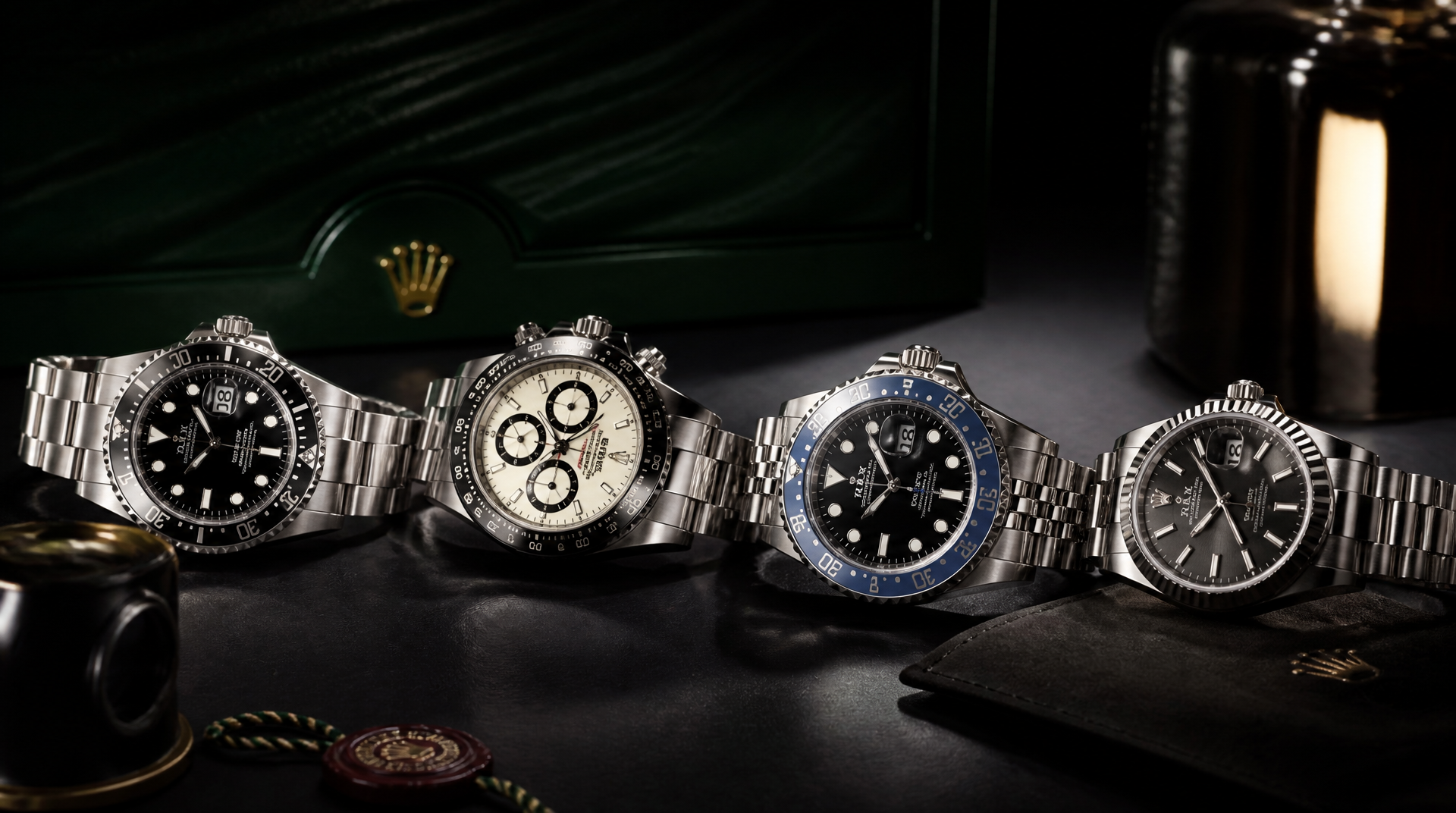
Buying a Rolex today means choosing between an authorized-dealer relationship that can take years and a grey-market premium that sometimes exceeds the price of a good used car. This guide covers every current collection, the engineering history that still dictates how the watches are built, and a repeatable method for inspecting a pre-owned example—so you can stop guessing and make the call that fits your budget and your wrist.
History That Still Matters: From the Oyster to the GMT-Master
Rolex didn’t become a luxury status symbol through marketing alone. The brand built its reputation on a string of engineering firsts that solved real problems for professionals, long before anyone wore a Submariner to a board meeting.
- 1910: First wristwatch to earn a Swiss Certificate of Precision.
- 1926: The Oyster case—the first truly waterproof wristwatch case—proved itself when Mercedes Gleitze wore one while swimming the English Channel.
- 1931: The Perpetual rotor self-winding mechanism set the template for nearly every automatic watch that followed.
- 1945: The Datejust launched as the first automatic wristwatch with an instantaneously changing date window.
- 1953–1954: The Submariner, Explorer, and GMT-Master appeared within 12 months, each purpose-built for diving, mountaineering, and transatlantic pilots respectively.
These milestones aren’t museum trivia. A modern Submariner still carries a 300 m depth rating and a unidirectional bezel because the original specifications were never just decoration. That same Oyster architecture, refined over decades, lives in every Rolex sold today.
The Complete Model Lineup: Which Rolex Fits Your Actual Days
The catalog splits into Professional watches built for specific environments and Classic watches designed for everyday wear. The table below adds a “skip if” column—because the popular pick isn’t always the right pick.
| Collection | Built For | Case Sizes | What Makes It Different | Skip This If… |
|---|---|---|---|---|
| Oyster Perpetual | No-complication daily wear | 28, 31, 34, 36, 41 mm | Smooth bezel, no date, broad color range | You need a date or a rotating bezel for timing |
| Datejust | The do-it-all dress/sport crossover | 31, 36, 41 mm | Cyclops date, Jubilee or Oyster bracelet | You want a tool-watch bezel or max water resistance |
| Day-Date | Formal presence, precious metal only | 36, 40 mm | President bracelet, day spelled out at 12 | You prefer steel, or a watch under $15,000 |
| Submariner (Date/No Date) | Dive-watch icon with high liquidity | 41 mm | Cerachrom bezel, Glidelock clasp, 300 m | Your wrist is under 6.5 in. and you hate top-heavy watches |
| GMT-Master II | Dual-time travel | 40 mm | Bidirectional 24-h bezel, distinctive color inserts | You don’t track a second time zone, and you’re unwilling to pay 60–80% over retail |
| Explorer / Explorer II | Legibility-first sports | 36 mm (Explorer), 40 mm (Explorer II) | 3-6-9 dial, fixed 24-h bezel (Explorer II) | You prefer a rotating bezel or a date (Explorer omits it) |
| Yacht-Master | Luxury sport crossover | 37, 40, 42 mm | Rotating bezel with raised numerals, often in precious metal | You want true tool-watch heritage and maximum resale value |
| Daytona | Motorsport chronograph | 40 mm | Tachymeter bezel, three subdials | You’re not willing to wait years or pay 80–100% over MSRP |
| Sea-Dweller / Deepsea | Extreme saturation diving | 43, 44 mm | Helium escape valve, depth ratings 1,220–3,900 m | You have a wrist under 7 in. |
or prefer a slimmer profile |
| Sky-Dweller | Travel complication | 42 mm | Annual calendar, Ring Command bezel | You prefer a simpler dial and want to avoid the $15,000+ entry price |
One decision criterion changes the entire recommendation: If immediate availability and wearing comfort under a dress cuff matter most, an Oyster Perpetual 36 or a Datejust 36 on a smooth bezel and Oyster bracelet is the path that usually skips the multi-year wait. If maximum resale value and wrist presence are your non-negotiables, the steel Submariner Date (ref. 126610LN) and the GMT-Master II “Pepsi” (ref. 126710BLRO) hold value better than almost any other current-production watch—but both require either a long purchase history or a stiff premium.
How Much a Rolex Really Costs: Retail, Grey, and Pre-Owned
Buying a steel sports Rolex at an authorized dealer (AD) feels unlike any other luxury purchase. Showrooms often have empty cases, and watches are allocated based on relationship, not first-come-first-served.
- Authorized Dealer (AD): The only way to get a factory-fresh watch at MSRP with a full five-year warranty. Waiting lists for steel Professional models can stretch years. Prior purchase history of jewelry or less-hyped watches frequently shortens the wait.
- Grey Market Seller: Unworn, fully stickered watches sold immediately—above MSRP. The premium on a steel GMT-Master II often hits 60–80%. Warranty may come from the seller rather than Rolex, so vet the guarantee carefully.
- Pre-Owned (Modern and Vintage): The most practical route to a discontinued reference or a specific production detail. A thorough inspection is mandatory, but pre-owned often delivers better value and a wider selection.
MSRP is only half the picture. The table below shows how a few references compare at retail versus estimated market prices observed in early 2025.
| Reference | Approximate MSRP | Typical Pre-Owned Market Price | Premium Over MSRP |
|---|---|---|---|
| Oyster Perpetual 41 (124300) | $6,400 | ~$7,500–8,500 | 20–30% |
| Datejust 36 steel/Jubilee (126234) | $8,550 | ~$9,000–10,500 | 5–20% |
| Submariner Date 126610LN | $10,250 | ~$13,000–14,500 | 30–40% |
| GMT-Master II “Pepsi” 126710BLRO | $10,700 | ~$17,000–19,000 | 60–80% |
| Daytona 126500LN | $15,100 | ~$26,000–29,000 | 80–90% |
Verify current pricing with an authorized dealer or a trusted pre-owned platform; market values shift monthly.
Cross-brand reality: Rolex’s entry-level Oyster Perpetual starts around $6,400, while a mechanical Swiss chronometer from Breitling—like an Avenger or a Superocean—sits closer to $3,000–$4,000. You get a fully in-house movement and stronger resale value with Rolex; Breitling gives you a chronometer-certified automatic for less upfront, often with more aggressive case sizing and a more flexible buying experience. If liquidity matters, Rolex wins; if entry price and availability are your top concerns, a new Breitling may be the smarter immediate buy.
Inspect a Pre-Owned Rolex Like You’re Buying a Used Car (But Smarter)
This sequence works for references produced from roughly 2005 onward—the era of ceramic bezels, engraved rehaut rings, and updated clasp markings. Vintage models with acrylic crystals, tritium lume, aluminum bezels, and 4-digit or early 5-digit references require a different set of checks: dial-font consistency, lug chamfer sharpness, bracelet stretch, and movement-bridge finishing. Know which era you’re dealing with before you start.
Three Checks Before You Examine the Watch Itself
- Serial and model number cross-check: Remove the bracelet to see the serial and model number engraved between the lugs (post-2005 models also show the serial on the rehaut ring at 6 o’clock). Confirm the model number matches the configuration—a 116610 is a ceramic-bezel Submariner Date; a 16610 is the older aluminum-bezel version.
- Seller documentation and reputation: A full set (box, papers, hang tags, warranty card) adds confidence but isn’t foolproof. Review the seller’s return policy, physical business address, and transaction history. Reputable dealers provide a written condition report and their own warranty.
- Crown and bezel alignment: The coronet on the dial should sit upright at 12 o’clock when the crown is screwed down (modern models). On a Submariner or GMT-Master, the bezel triangle must align precisely with the 12 o’clock marker. Misalignment can signal a damaged or aftermarket bezel ring.
Hands-On Sequence
1. Case finish: Rolex alternates brushed and polished surfaces with sharp transitions. Over-polishing rounds the edges, especially on the lugs. A modern watch should look crisp, not soft.
2. Lume and printing: Under a loupe, printed text must be sharp, not blobby. Lume plots should be uniform in color and shape. The cyclops lens must magnify the date 2.5×—1.5× or less points to an aftermarket crystal.
3. Rotor and winding: Manually wind the crown. A modern Rolex movement feels buttery smooth with consistent resistance, never gritty or loose. Gently shake the watch; the rotor should spin silently or near-silently. A loud rattle or scraping sound means internal trouble.
4. Bracelet and clasp markings: The clasp code (alpha-numeric, inside the clasp) should match the case’s approximate production era. Cross-check it against production-year tables from trusted watch forums. Modern clasps show a deep, crisp crown logo; etched, shallow, or wavy stamping is a red flag.
5. Open the caseback (if the seller permits): The movement must be clean, marked with the correct caliber number (e.g., 3235 in a current Datejust, 4131 in a current Daytona), and show fine finishing on the rotor and bridges. A rough, undecorated movement kills the deal instantly.
When to Walk Away
- If any alignment, magnification, or movement check fails, do not buy the watch—regardless of the price.
- If the seller refuses to provide clear caseback photos or resists an independent watchmaker’s inspection, treat that as the exit signal.
- If everything passes but the watch lacks service history and is more than five years old, budget for a full service ($600–$1,200 at a Rolex Service Center, depending on model) and factor it into your offer.
Wrist Size and Cuff Clearance: When the Popular Choice Doesn’t Work
A Submariner’s Glidelock clasp lets you adjust without tools, but the 41 mm case and thick lugs often feel top-heavy on wrists under 6.5 inches, and the watch head can shift around during active wear. The Oyster Perpetual 36 solves the size problem but drops the dive bezel and the date, which you may miss for quick timing checks. If you want a date and a slim profile that slides under a dress cuff, a Datejust 36 on an Oyster bracelet with a smooth bezel fits better than any Professional model—yet it loses the unidirectional bezel’s utility and the thicker bracelet’s presence.
Try on the actual watch before committing to a reference you’ve only seen in photos; a 1 mm lug-to-lug difference can change whether you wear it daily or leave it in the box.
Spot a Fake with No Tools: Five Instant Red Flags
Some signs are loud enough that you don’t need a loupe or a caseback opener.
- The date magnification is clearly less than 2.5×, or the cyclops lens sits crooked on the crystal.
- A GMT-Master II bezel rotates in both directions with clicks—genuine models rotate only one direction and have a distinct 24-click feel.
- The crown wobbles noticeably when unscrewed and pulled out to set the time.
- The seconds hand ticks in one-second jumps on any modern professional model; every current Rolex movement sweeps smoothly at a high beat rate.
- The engraved rehaut (the inner ring around the dial) is faint, uneven, or missing entirely—Rolex uses laser engraving that looks crisp and aligned with the minute markers.
Service, Warranty, and What It Costs to Keep a Rolex Running
Modern Rolex movements with a 70-hour power reserve (calibers 3235, 3285, 4131) are regulated to run within -2/+2 seconds per day when properly adjusted. If the watch starts gaining or losing beyond that range and demagnetizing doesn’t fix it, a movement service is likely needed.
Plan for a full service every 7–10 years on a contemporary model. Vintage references with older calibers (1570, 3035) should be inspected more frequently, especially if the rotor spins excessively or the amplitude drops. An independent watchmaker qualified in Rolex repairs can often service vintage pieces for less than a Rolex Service Center, but make sure they use authentic parts or disclose any aftermarket components.
Every new Rolex purchased from an authorized dealer since 2015 carries a five-year international warranty. The warranty card must be filled out with the buyer’s name and the sale date at the time of purchase to activate coverage.
Frequently Asked Questions
Do all Rolex watches have a screw-down crown?
Almost all current Oyster-cased models use a Twinlock or Triplock screw-down crown; the discontinued Cellini line had a push-pull crown, so verify the specific reference.
Can I swim with a vintage Submariner from the 1970s?
Not unless it has been recently pressure-tested and every gasket replaced by a qualified watchmaker. Vintage seals degrade, and a 50-year-old watch can flood at much shallower depths than its original rating.
Is it worth buying a Rolex without papers?
Yes, if the price reflects the missing paperwork and the watch passes a thorough inspection by a trusted watchmaker. The watch itself should be the primary evidence of authenticity.
How long is the Rolex warranty on a new watch?
Since 2015, new Rolex watches purchased from an authorized dealer come with a five-year international warranty that activates when the warranty card is filled out at the point of sale.
Can I verify a clasp code’s production year myself?
Yes, using a reference table from a reputable watch forum. Match the clasp code to the case serial or dial configuration. A mismatch usually indicates a replacement part or a mixed watch, which isn’t always a deal-breaker but must be disclosed and priced accordingly.
Explore This Topic
- Back to Rolex
- Back to Rolex Brand Hub
Related guides in this cluster:
- Rolex vs Omega: Which Luxury Watch Brand Is Right for You?
- Cartier Watches: The Complete Brand Guide — Tank, Santos & Buying Advice
- Seiko Watches: The Complete Brand Guide — Models, Movements & What to Buy

The We Know Watches editorial team brings together over 40 years of combined watch collecting, trading, and repair experience. Our editors have owned and handled watches from every major brand — from entry-level Seiko 5s to Rolex, Omega, Patek Philippe, and independent Swiss watchmakers. We’ve bought and sold at auction, worked with authorized dealers, visited manufacturing facilities in Switzerland and Japan, and serviced hundreds of movements ranging from the Seiko 7S26 to the Longines L888. Every guide and review we publish is based on hands-on experience, original research, and consultation with professional watchmakers. We do not accept payment for reviews, and we clearly disclose when we use affiliate links.