
Watch Investment Guide: Which Watches Actually Hold or Increase in Value?
Quick answer
A vanishingly small number of watches gain value; most lose 20–40% the moment you leave the dealer. The narrow group that routinely appreciates is dominated by steel sports models from Rolex, Patek Philippe, and Audemars Piguet with sustained demand and restricted supply. The real edge-case returns, however, rarely come from the obvious hype pieces—they show up in discontinued neo-vintage references that the crowd has stopped paying attention to, like a Seiko SKX007 that once retailed for under $200 and now trades for multiples of that. If you’re buying for financial gain, treat the watch as an illiquid collectible, not an asset class, and expect years of holding before you see a worthwhile net return.
A framework for comparing investment potential
Most generic advice lumps all “investment watches” together, but the resale behavior of a steel Rolex GMT-Master II is completely different from that of a limited-edition microbrand diver. Use this comparison to sort the categories before you buy.
| Category | Example models (check current references) | Typical resale performance | Risk level | Who it fits |
|---|---|---|---|---|
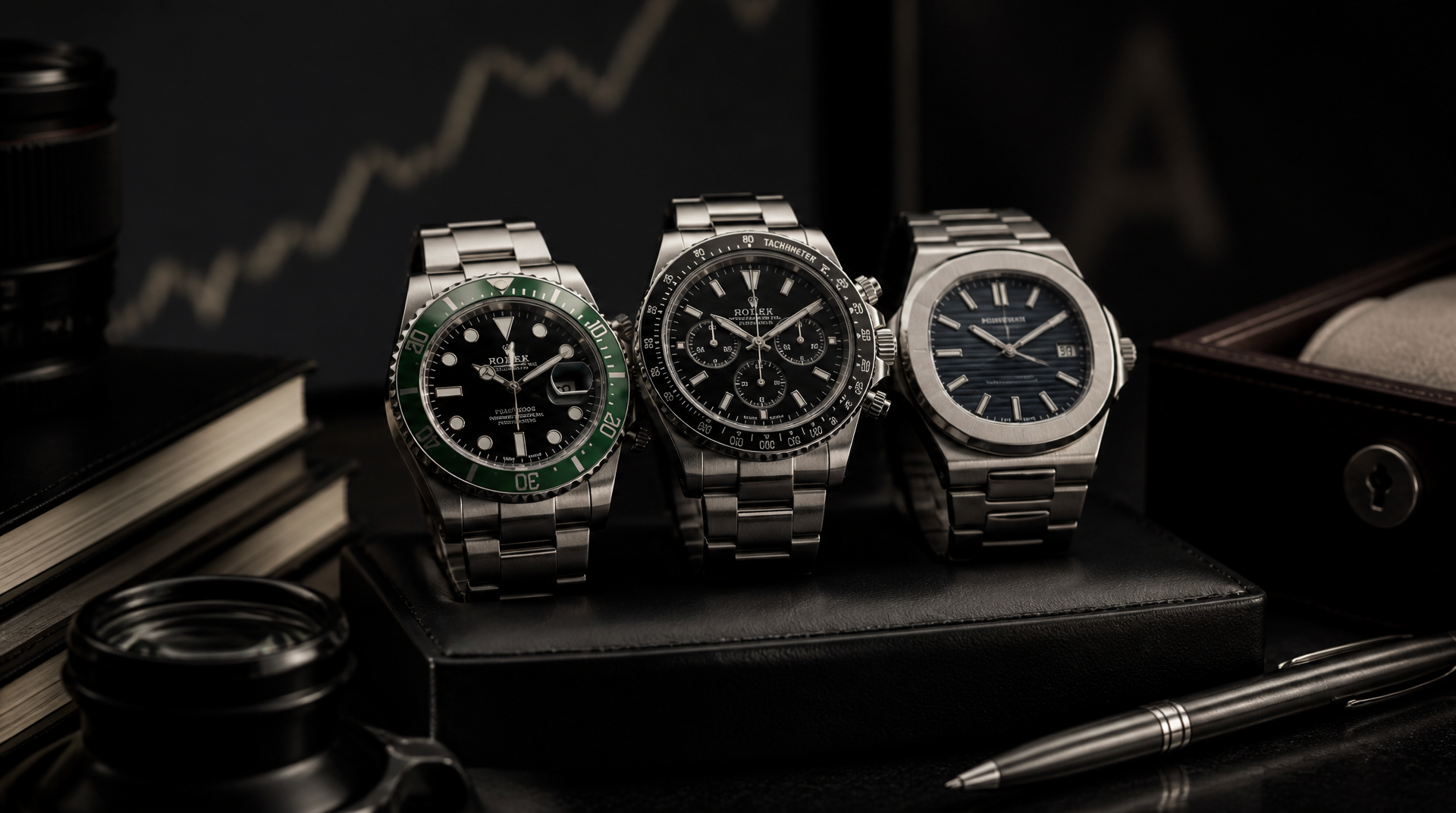
| Blue-chip steel sports | Rolex Submariner 126610LN, Patek Philippe Nautilus 5711, Audemars Piguet Royal Oak 15500ST | Often trade 30–80% above retail on secondary markets; retain >90% of market value after 3 years | Lower liquidity risk but regulatory and hype-cycle exposure | Buyers who want to wear the watch occasionally and preserve capital |
| Neo-vintage outliers | Discontinued Seiko divers (SKX007, 6309 Turtle), 1990s Tudor Submariner, mid-2000s Omega Speedmaster 3570.50 | Can see 200–500% appreciation over original retail; highly reference-dependent | High—condition, box/papers, and sudden collector sentiment swing values fast | Collectors willing to research specific references and sit on them for 5+ years |
| Boutique limited editions | Grand Seiko SBGW231 “Kurahoshi,” some Lange 1 limited runs | Inconsistent—some plateau quickly; a few double in value if the reference becomes a brand touchstone | Very high; scarcity often fades and secondary demand is thin | Buyers who want a story and are comfortable with break-even as the best case |
| Mainstream luxury non-sports | Breitling Navitimer B01, Cartier Tank Must, IWC Portugieser | Typically lose 25–35% in the first year; excellent pre-owned bargains, poor new-investment vehicles | Medium—depreciation is reliable, but a few vintage revivals can surprise | Anyone prioritizing wearing pleasure over resale, or bargain-hunting pre-owned |
The takeaway: If your budget is under $5,000, blue-chip appreciation is mostly out of reach at retail, and neo-vintage becomes the more realistic path to any price increase.
Best-fit picks by use case
When you want a wearable asset you can liquidate quickly
Buy a steel Rolex OP, Datejust, or Submariner at retail—if you can actually get the allocation. Real-world availability is the biggest friction point. Most people cannot walk in and buy one, so any investment plan has to account for that. If you do secure one at list price, a Submariner 126610LN can be sold within days on the secondary market, usually at a premium.
Just don’t confuse short-term flipping with investing: the spread between what a dealer pays and what the watch lists for often eats your profit unless you bought at MSRP and the market has risen further. Before you pull the trigger, verify the reference’s true liquidity. Open Chrono24 or WatchCharts and filter for sold listings. If you see 10+ completed sales in the last 30 days for the exact reference and bracelet configuration you’re targeting, the liquidity is real. If only a handful pop up, your exit window may be months, and you may have to accept a lower bid than the asking prices suggest.
When you’re hunting for overlooked value
Look outside the obvious brands. Discontinued dive watches from Seiko, long-out-of-production Tudor references like the 79090 Submariner, and underappreciated Grand Seiko quartz models from the early 2000s have all posted gains that beat many Rolex references on a percentage basis. The common thread: they were mass-produced but not hoarded, and the surviving supply of pristine examples is tiny. The Seiko 6309-7040 “Turtle” could be had for under $300 a decade ago; a clean all-original example now sells for well over $1,000. That’s a better multiple than many watches that made headlines.
However, these gains assume you buy at a true market floor. Before bidding, search for recent sold prices on eBay (completed items filter) and WatchRecon to establish a real price range—not just what sellers are asking. If you can’t find multiple completed sales for the reference in the condition you’re considering, the market is too thin to plan a clean exit, and you may be sitting on the watch far longer than expected.
When you’re buying to hold for 10+ years
Focus on iconic references that are unlikely to be radically redesigned. A Patek Philippe 5711 is the obvious example, but a more attainable path is a Jaeger‑LeCoultre Reverso in a discontinued case size or a vintage Heuer Autavia from the 1970s that already survived speculation cycles. The long-term story is driven by a shrinking supply of mechanically intact pieces, not by current fashion. If you can service it affordably—check independent watchmaker costs before you commit—these watches often appreciate slowly.
Trade-offs to know
- Liquidity has a cost. Even a hot watch often requires selling through a dealer or platform that takes 10–20% in fees or bid-ask spread. Factor that in before you count a gain. A Submariner that shows a $2,000 market increase can net you under $1,000 after fees and shipping.
- Condition and “full set” matter more than brand. A no-box, no-papers Rolex trades at a steep discount; a complete set Seiko diver can command a premium that surprises casual sellers. Missing paperwork on a neo-vintage piece can cut its resale value by 30% or more. Before paying a premium for completeness, ask the seller for a photo of every item—box, warranty card, hang tag, original bracelet links, and any service receipts—laid out next to a handwritten note with today’s date. If any piece is missing, negotiate accordingly.
- Hype is a leading indicator of risk. When everyone on social media starts calling a watch the next big investment—think recent integrated-bracelet microbrands—you’re often buying near the peak. The same pattern has played out with luxury steel sports watches that cooled after production increases.
- Servicing costs can erase returns—or kill resale entirely. A vintage automatic chronograph that needs a $1,200 overhaul already carves into your profit. Worse, a movement with no available parts turns a watch into unsellable inventory. Before paying a premium for a vintage reference, call an independent watchmaker who specializes in that brand and ask point-blank: “Can you source a mainspring, balance staff, and escape wheel for caliber XXX without cannibalizing another watch?” If the answer is a pause or “maybe,” treat the piece as a wearable risk, not an investment.
- “Holds value” does not equal “makes money.” Many watches that retain 80% of purchase price after five years still lose ground after inflation and selling costs. Reserve the word “investment” for pieces where you have a concrete exit plan and a target net return that beats a savings account.
Related questions
Are Rolex watches always a good investment?
No. Only a subset of steel professional models consistently trade above retail, and even those depend on scarcity created by allocation policies. Two-tone, diamond-set, or less popular Datejust configurations often sell below MSRP on the secondary market. If you pay a grey-market premium for a hot Rolex, you are already behind and need the market to rise further just to break even.
Which watch brands hold value best over time?
Rolex, Patek Philippe, and Audemars Piguet lead in residual value for their core steel sports lines. Beyond them, certain references from Tudor, Grand Seiko, and Jaeger‑LeCoultre hold value reasonably well on the pre-owned market, but retail depreciation is still common. Discontinued models from Seiko and vintage Heuer can also show strong value retention when condition and completeness are high.
Should I buy pre-owned or new for investment?
For true investment potential, pre-owned is almost always the better route because someone else absorbed the initial depreciation and you can target references with proven price floors. A new watch at retail only makes sense when you can get an allocation for a highly sought-after steel model that immediately commands a premium. Even then, pre-owned examples of the same watch can offer a lower entry point and less downside risk.
Do limited editions always appreciate?
No. Most limited editions follow a boom-and-flat pattern: early speculators drive prices up briefly, then resale stabilizes at or below original retail once the hype fades. Only limited editions that become defining references for a brand—like the original Omega Speedmaster Snoopy or rare Grand Seiko seasons—sustain higher values, and predicting them is difficult. Buy the watch because you want it, not because the edition number is small.

The We Know Watches editorial team brings together over 40 years of combined watch collecting, trading, and repair experience. Our editors have owned and handled watches from every major brand — from entry-level Seiko 5s to Rolex, Omega, Patek Philippe, and independent Swiss watchmakers. We’ve bought and sold at auction, worked with authorized dealers, visited manufacturing facilities in Switzerland and Japan, and serviced hundreds of movements ranging from the Seiko 7S26 to the Longines L888. Every guide and review we publish is based on hands-on experience, original research, and consultation with professional watchmakers. We do not accept payment for reviews, and we clearly disclose when we use affiliate links.
