
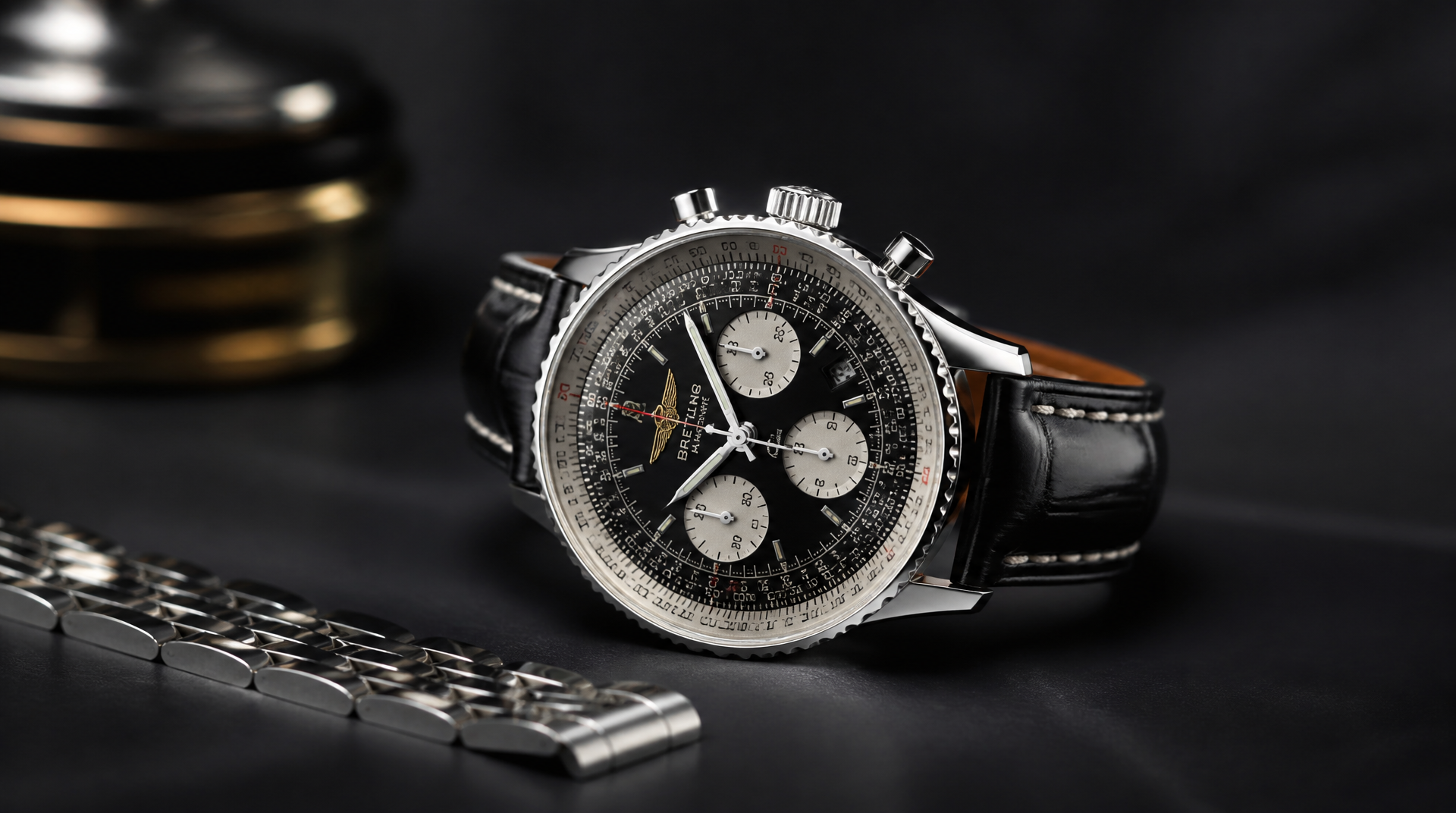
A Breitling serial number gives you a production date, not a model name. To identify the watch, you need the reference number—engraved between the lugs at 12 o’clock—and then you use the serial number to confirm the era and spot inconsistencies. The process below walks you through finding both numbers, cross-checking them, and what to do when one or both are missing.
Locate the Reference Number
The reference number is the model identifier. On almost every Breitling from the 1960s onward, it’s stamped into the case between the top pair of lugs. You’ll see it after you remove the strap or bracelet.
What you need: a spring bar tool, a bright light, and 1.5×–3× magnification (a loupe or your phone’s macro lens). If you’re uncomfortable removing the strap, any watchmaker can do it in under a minute—just ask them to show you the engraving.
Look for a code like A13022, A17360, A23322, or K13355. The leading letter usually identifies the case material: A for steel, K for gold, J for two-tone. The digits encode the model family and specific variant. As soon as you have a clean reference number, you have a model hypothesis you can verify.
Stop and branch here: if the area between the lugs is polished smooth, the engraving is worn beyond reading, or metal has been refinished to the point that no characters remain, do not try to force a reference out of that location. Jump to the section “When the Numbers Are Missing or Illegible” and follow the fallback workflow that relies on the dial, case dimensions, and movement instead.
Find the Serial Number
With a reference number in hand, grab the serial to lock in the production window. Serial placement depends on the watch’s age.
- Pre‑2010 models (especially 1990s–2000s): the serial is typically engraved on the outside of the case back, often a plain numeric string with no letter prefix (for example, 2217000). On earlier pieces from the 1950s–1970s, it may be stamped inside the case back—a watchmaker can open the case safely.
- Post‑2010 COSC‑certified models: many modern Breitlings moved the serial to the inside of the case back or onto a transparent sticker. Some references print it on the warranty card or the digital COSC certificate that came in the box.
If only a sticker serial existed and it’s missing, treat the watch as having a missing serial. Continue with the era check only if you can find an intact engraving or a matching warranty document.
Cross-Check the Production Era
Breitling never released a full public database, but decades of service records and collector research produced reliable serial ranges. Use the serial as a sanity check: it must fall inside the known production window for your reference number.
Approximate Serial-to-Year Ranges
| Serial Number Range | Production Era |
|---|---|
| 500,000 – 600,000 | Early 1940s – 1950s |
| 900,000 – 1,100,000 | 1960s |
| 1,300,000 – 1,500,000 | 1970s |
| 1,700,000 – 2,000,000 | 1980s |
| 2,000,000 – 2,200,000 | Early 1990s |
| 2,200,000 – 2,900,000 | Late 1990s – 2002 |
| 3,000,000 – 3,500,000 | 2003 – 2009 |
| 3,600,000+ | 2010 onward (some limited editions can jump) |
Real‑world example: reference A13022 (a Navitimer “Fighters” with a Valjoux 7750-based movement) typically shows serials between 2,200,000 and 2,500,000, which places it around 1998–2000. If yours reads 2,400,000, everything aligns. A serial like 5,000,000 on the same reference cannot match—that number range didn’t exist when the A13022 was produced.
What a mismatch really means: it’s not an automatic fake. A service case replacement during an overhaul can create a serial outside the original era if the movement was retained. Heavy polishing can thin an engraving until it’s illegible, and a poorly executed re‑engraving under magnification often looks uneven or shaky. A mismatch is a signal to investigate deeper, not a final verdict.
When the Numbers Are Missing or Illegible
Serial vs. Reference Conflict
If the serial doesn’t fit the reference’s known era, open the case (or have a watchmaker do it) and read the movement caliber and any movement serial. A caliber that matches the reference but sits inside a later service case can still be authentic. A completely different caliber—for example, a quartz movement in a case marked for a mechanical reference—points to an aftermarket build or a counterfeit.
Missing Reference Number Only (Fallback Identification)
When the between‑lugs engraving is gone, identify the model by cross‑referencing three things: the dial layout, the case dimensions, and the movement caliber.
- Measure the case width excluding the crown, and note the lug shape.
- Photograph the dial clearly: number of sub‑dials, date window position, bezel type (tachymeter, slide rule, unidirectional diver).
- If you can safely open the case, read the caliber number on the movement plate or oscillating weight.
Compare those data points against archived Breitling catalogs and reference tables. A 42 mm steel watch with a three‑o’clock date, unidirectional bezel, and caliber 17 (ETA 2824‑2) matches Superocean reference A17360 from the mid‑2000s. You’ll get the model with high confidence, though you’ll only be able to estimate the production window from the movement’s own era rather than the specific year.
Both Numbers Missing or Heavily Re‑engraved
If both the reference and serial are gone, the case is almost certainly aftermarket. The movement and dial become your only anchors. Follow the same caliber‑and‑catalog method, but accept that you will not get a factory‑verified production date. This situation is the strongest indicator that the watch needs a professional inspection before you buy, sell, or insure it.
Escalation threshold: if you see re‑engraving under magnification—uneven stroke depth, misaligned numerals, or fresh metal where the rest of the caseback shows aged patina—stop. A polished or re‑engraved surface can hide a rebuilt watch. Have a Breitling‑authorized service center or an independent expert with the right reference materials examine the piece before you act on any conclusions.
Success Check: Confirming Everything Fits
If you’ve reached this point and the picture looks like this, you’ve likely identified an authentic Breitling:
- The reference number points to a specific model family and generation.
- The serial number falls inside the expected production range for that reference.
- The movement caliber (if you could inspect it) matches the reference’s specification and shows no signs of a transplant.
At that stage, you can use the model name for insurance scheduling, listing descriptions, or service orders. If any one of those checks fails, or if you’re missing a critical number and can’t get the case open safely, hand the watch to a qualified watchmaker for a full authentication.
Frequently Asked Questions
Can I identify my Breitling model using only the serial number?
No. The serial only tells you the production year or range. You need the reference number (between the lugs) to determine the actual model, because multiple models shared the same production windows.
What do the letters in a Breitling reference number mean?
The leading letter typically denotes case material: A for stainless steel, K for gold, J for two‑tone. Later two‑digit letter codes can indicate design families, but the numeric portion is the strongest model identifier. Check a Breitling catalog or enthusiast database to decode the exact variant.
Where can I verify a Breitling serial number?
There is no official public lookup tool. The most practical approach is to compare your serial against the community‑maintained year tables (like the one above) and cross‑reference it with the reference number’s known production window. Breitling service centers can confirm authenticity during an inspection but do not provide an online VIN‑style decoder.
What should I do if my reference number is worn smooth but the dial and case look original?
Use the dial configuration, case dimensions, and movement caliber to identify the model. A watchmaker can safely open the case, read the movement number, and confirm the correct reference. That method replaces the missing engraving and gives you a reliable model identification, even without the reference stamp.
Explore This Topic
- Back to Breitling
- Back to Breitling Model ID
Related guides in this cluster:
- Breitling Watch Buying Guide: Are They Worth It in 2026?
- How to Change a Battery in a Breitling Watch: Complete Step-by-Step Guide
- How to Remove Breitling Watch Links: Easy Guide to Resize Your Bracelet

The We Know Watches editorial team brings together over 40 years of combined watch collecting, trading, and repair experience. Our editors have owned and handled watches from every major brand — from entry-level Seiko 5s to Rolex, Omega, Patek Philippe, and independent Swiss watchmakers. We’ve bought and sold at auction, worked with authorized dealers, visited manufacturing facilities in Switzerland and Japan, and serviced hundreds of movements ranging from the Seiko 7S26 to the Longines L888. Every guide and review we publish is based on hands-on experience, original research, and consultation with professional watchmakers. We do not accept payment for reviews, and we clearly disclose when we use affiliate links.