
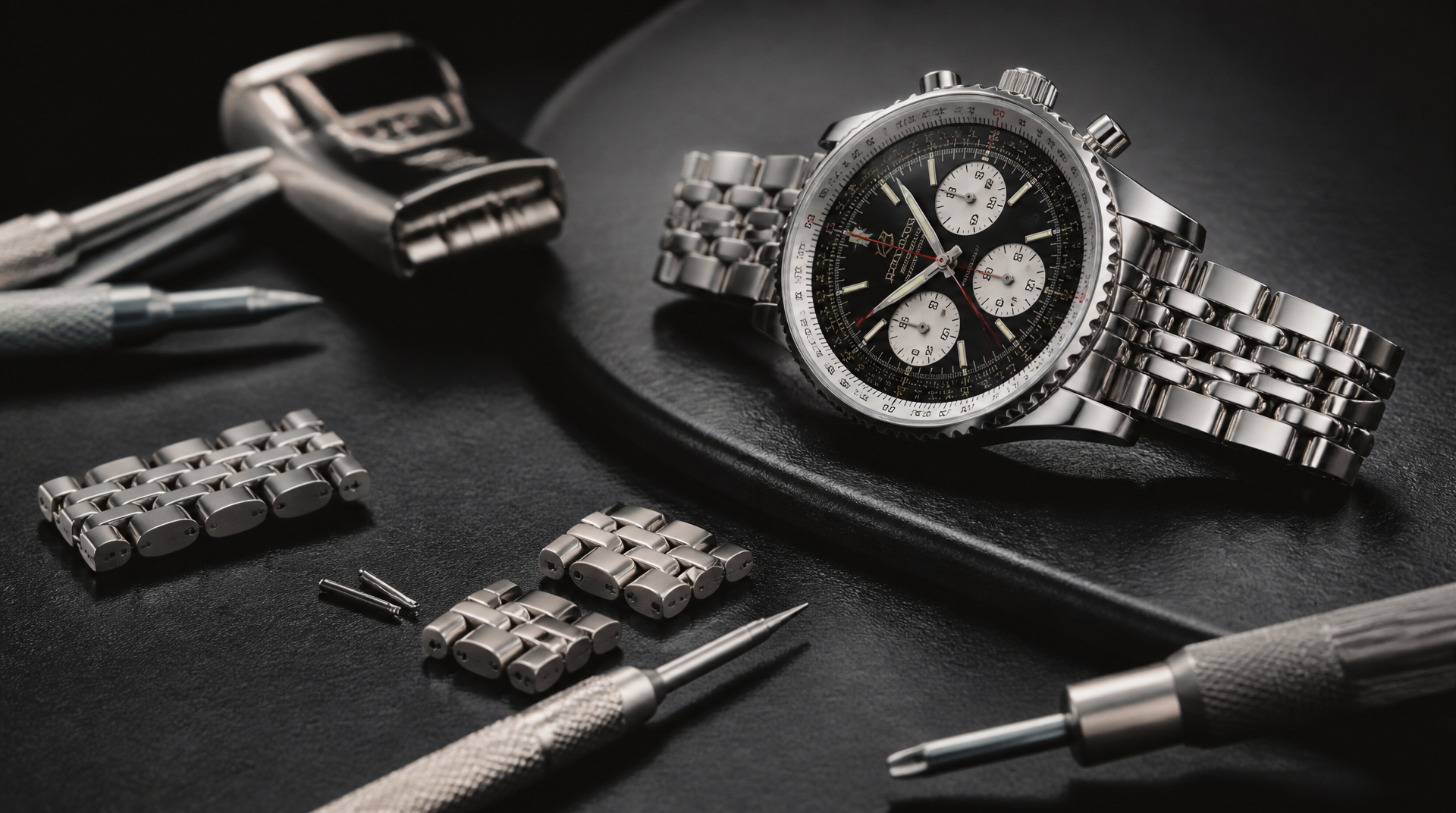
You can resize your Breitling bracelet at home with a few precision tools and the right technique, but the method depends entirely on whether your links use flat‑head screw pins or push pins. Screw pins are the most common on modern Breitling steel straps, while some older or dressier bracelets use friction‑fit push pins that follow a directional arrow. This guide walks you through both processes, shows you when to apply heat for thread locker, and—just as importantly—tells you exactly when to stop and hand the job to a watchmaker.
What to Gather Before You Start
Using an undersized driver or skipping basic protection is the quickest way to chew up finished screw heads or scratch polished links. Have these ready before you touch a single pin:
- Hollow‑ground precision screwdriver bits — 1.2 mm or 1.4 mm flat‑head. On many Professional bracelets a 1.4 mm bit fits, but confirm with a caliper or your manual.
- Pin pusher tool with a smooth, interchangeable tip smaller than the pin diameter. A hammer‑style pusher helps on stubborn push pins.
- Bracelet holding block (or a firm microsuede cushion) to support the bracelet while you drive pins.
- Watchmaker’s tape / polyimide tape — mask adjacent links to avoid tool marks.
- Hair dryer or very low‑heat gun (150–200°F / 65–95°C) for screw‑pin bracelets that have thread locker. A variable‑temperature heat gun set to its lowest setting works if you keep it moving.
- Isopropyl alcohol and a clean lint‑free cloth for cleaning threads.
- A parts tray with small compartments — you will handle tiny screws, collars, and ferrules.
Determine Your Pin Type (This Step Changes Everything)
Look at the side of a link you plan to remove. The entire approach pivots on whether you see screw slots or smooth pin ends.
| Pin Type | Visual Clues | Common Breitling Examples | Tools You Need | Critical Note |
|---|---|---|---|---|
| Screw pins | Tiny flat‑head slots on both sides of the link; an arrow often shows the drive direction. | Professional bracelets on Superocean, Avenger, Colt, Chronomat. | Hollow‑ground bit that fills the slot completely. | Blue or red residue means factory thread locker — turning without heat will strip the head. |
| Push pins / friction pins | Smooth, slotted‑free ends; an arrow stamped inside the bracelet indicates push direction. If no arrow, the exit side has the slightly larger hole. | Older Navitimer straps, pilot‑link designs, dressier Breitling bracelets. | Pin pusher tool that sits square on the pin. | Always push the arrow direction; forcing the wrong way jams the pin and can deform the tube. |
The decision that changes the next move: If you spot any trace of blue or red compound near the threads, you must soften it with heat first. For push pins, no heat is needed but arrow direction is non‑negotiable. Getting this call wrong right here turns a 15‑minute resize into an expensive repair.
How to Remove the Links
Screw‑Pin Bracelets (Most Breitling Steel Straps)
1. Mask the work area. Tape over the link you’re removing and the two adjacent links, leaving only the screw heads exposed.
2. Test for resistance — and apply heat if needed. Warm the link with a hair dryer on medium‑high for 15–30 seconds per side. The metal should feel hot to the touch but never burning. If the screw turns freely on the first gentle try without heat you can skip this step, but even slight resistance means the threads are bonded; heat it.
3. Choose the exact‑fit bit. A hollow‑ground 1.4 mm or 1.2 mm bit that completely fills the slot prevents cam‑out. If the 1.4 mm wobbles, step down.
4. Turn counterclockwise with steady downward pressure. If the screw doesn’t break loose immediately, stop, re‑heat for another 20 seconds, and try again.
Escalation point: After two rounds of careful heating and a correctly sized driver, if the screw still refuses to move with moderate finger‑and‑driver pressure, stop right there. Continuing will almost certainly strip the slot. A watchmaker can remove it with a purpose‑ground blade and solvent without scarring the link.
5. Remove the screw and separate the link. On many Breitling designs you must take out two opposing cap screws; sometimes a single through‑pin is held by two end screws. Keep each tiny part — screws, the link bar, and any collar — organized in your tray.
6. Repeat, removing the same number of links from each side of the clasp. When you need an odd count, take the extra link from the 6‑o’clock side for better balance on the wrist.
Push‑Pin Bracelets
1. Find the directional arrow on the inside of the bracelet. The pin exits toward the side with the smaller visible hole. If the arrow is missing, compare hole diameters on each side of the link — the exit hole is slightly larger.
2. Support the bracelet on a holding block so the exit hole sits over the block’s cutout.
3. Push the pin out slowly. Use a pin pusher tip that fits inside the tube. Start with light, steady pressure. If it doesn’t move, tap the tool gently with a small mallet. A pin that’s stubborn often releases suddenly after the first millimeter.
4. Pull the pin free from the opposite side. Keep it oriented exactly as it came out — it must go back the same way.
5. Remove the link and any tiny ferrules. Some systems use a split tension sleeve; check the old link before you put it aside.
Escalation point: If moderate tapping won’t budge the pin and you’ve confirmed you’re pushing the arrow direction, the inner tube may be deformed. Stop before you mushroom the pin head or crack the link, and let a pro press it out safely.
Putting the Bracelet Back Together (and Keeping It Secure)
Reassembly is the reverse of removal, but these steps prevent the bracelet from loosening on its own later.
- Clean every thread. Wipe screws, bars, and threaded sleeves with isopropyl alcohol. Old thread locker dust or skin oil acts like grease and defeats your torque.
- Reapply thread locker only if needed — and only the right kind. If the factory used a blue compound and you want the same security, apply a single tiny dab of low‑strength Loctite 222 (purple) to the screw thread. High‑strength red Loctite requires destructive heat to remove and has no place on a watch bracelet. If your screws previously stayed tight with no compound, you can safely skip it.
- Tighten until the screw head sits flush and does not spin freely. Don’t go “hero tight.” If the screw tightens and then suddenly feels soft, you may be stripping the threads or cross‑threading — back it out, inspect the link, and visit a watchmaker if the threads look damaged.
- Fine‑tune at the clasp. Use any micro‑adjustment holes before adding or pulling more links. A small tweak at the clasp often gives a perfect fit without further disassembly.
When DIY Isn’t Worth the Risk
Walk away from the project and head to a Breitling boutique or a qualified watchmaker if:
- A screw head is already slightly rounded before you even start.
- The screw doesn’t turn after two rounds of proper heating and a correctly sized driver.
- A push pin stays stuck after moderate tapping despite following the arrow — the tube may be deformed and will only get worse.
- The bracelet includes a diver’s extension with its own sleeved pin assembly that you’re not confident you can reassemble without a diagram.
- You don’t have a bit that fits the screw slot with zero slop. A watchmaker can remove the screw cleanly, replace it with a fresh original, and often do the entire resize for the cost of the tool you might ruin.
Confirming Everything Is Secure
Before you put the watch on and go about your day, run these quick checks to confirm the fix worked:
- Grab‑and‑twist test. Hold the bracelet steady and try to gently twist the watch head side‑to‑side. Any click, tick, or slight wiggle means at least one screw isn’t fully seated or a pin hasn’t locked in place. Retighten that side until the play disappears.
- Flush‑feel check. Run your fingertip along both edges of the bracelet. No screw head or pin end should protrude or catch on fabric.
- Clasp function. Open and close the deployant or butterfly several times; it should snap shut firmly without binding.
- Wrist fit. The watch should stay above your wrist bone without spinning freely, yet you should be able to slide one finger snugly under the clasp. If it’s too loose, remove an additional half‑link or use a micro‑adjust hole before doing anything drastic.
Frequently Asked Questions
Can I use a standard eyeglass screwdriver to remove Breitling screw pins?
No. Eyeglass drivers are tapered and rarely fill the slot completely, which guarantees the blade will cam out and chew up the screw head. Always use a hollow‑ground precision bit that matches the slot width exactly.
Does every Breitling bracelet have screw pins?
No. Many Professional steel bracelets (Superocean, Avenger, Chronomat) use screw pins, but dressier straps like those on some Navitimer models use push‑in friction pins. Always check for a tiny flat‑head slot on each side of a link before assuming the type.
Can I use medium-strength Loctite (blue 242) to secure the screws?
Medium‑strength Loctite 242 requires higher heat to break loose later, which can damage the bracelet’s finish or plating. Stick with low‑strength Loctite 222 (purple) if you need a thread locker, or skip it entirely if the screws originally stayed tight without any compound.
What if I lose a screw or tiny ferrule during the process?
Breitling service centers and some watch supply retailers sell original replacement screws, pins, and collars individually. If you cannot source a spare, do not wear the watch until a watchmaker replaces the part — a missing screw or sleeve can cause the bracelet to fail.
Explore This Topic
- Back to Breitling
- Back to Breitling Link Removal
Related guides in this cluster:
- Breitling Watch Buying Guide: Are They Worth It in 2026?
- How to Change a Battery in a Breitling Watch: Complete Step-by-Step Guide
- How to Identify Your Breitling Watch Model by Serial Number

The We Know Watches editorial team brings together over 40 years of combined watch collecting, trading, and repair experience. Our editors have owned and handled watches from every major brand — from entry-level Seiko 5s to Rolex, Omega, Patek Philippe, and independent Swiss watchmakers. We’ve bought and sold at auction, worked with authorized dealers, visited manufacturing facilities in Switzerland and Japan, and serviced hundreds of movements ranging from the Seiko 7S26 to the Longines L888. Every guide and review we publish is based on hands-on experience, original research, and consultation with professional watchmakers. We do not accept payment for reviews, and we clearly disclose when we use affiliate links.