
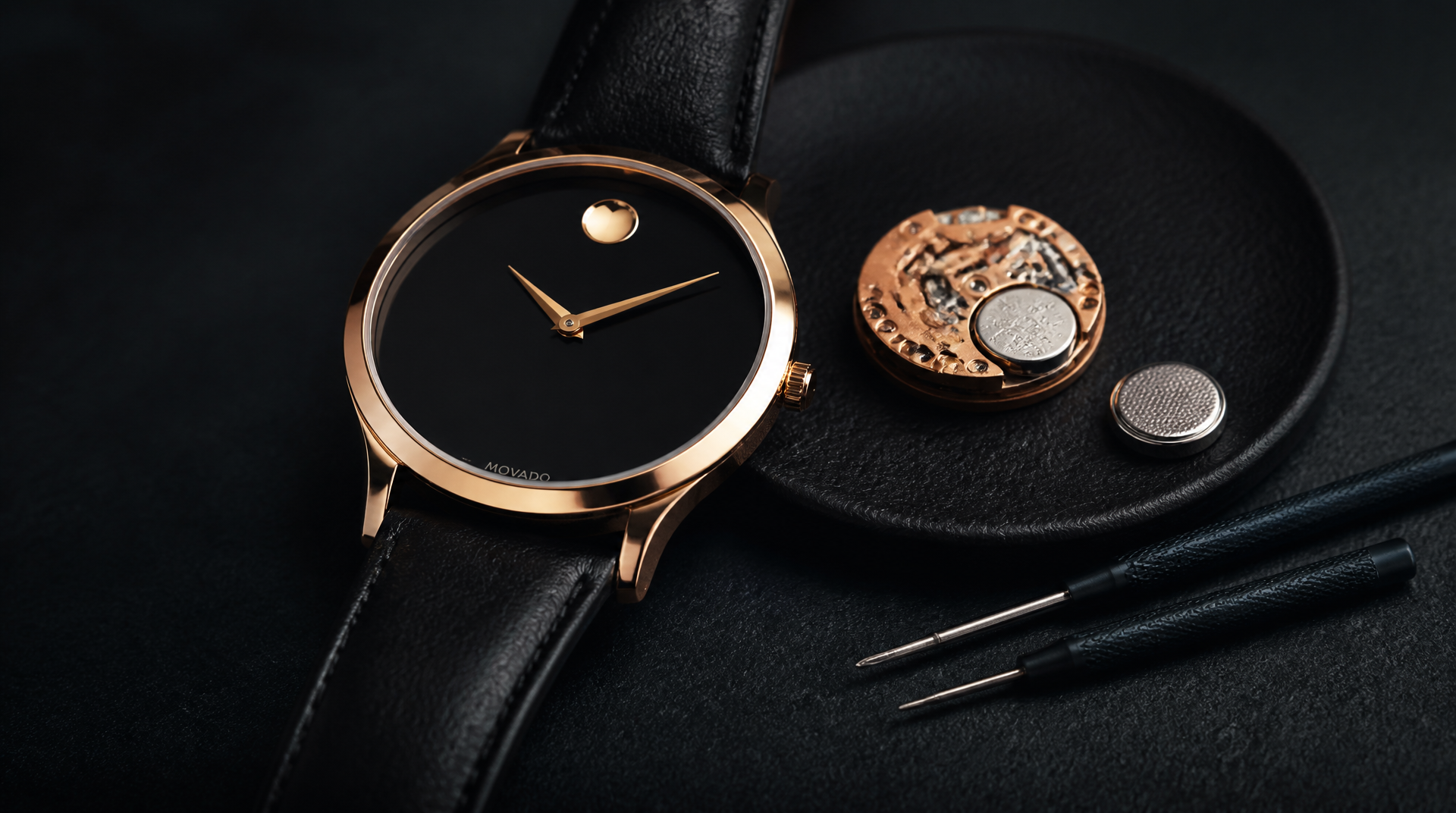
Your Movado has stopped. The second hand is frozen, and you’ve confirmed the quartz movement itself isn’t dead (rare). A battery swap is the fix for most Movado models—Bold, Museum Classic, Bold Horizon, and others—and you can do it yourself with basic tools and a steady hand. This guide covers the exact steps, the common mistakes that cost people a case back or a gasket, and when to walk away and call a watchmaker.
Before You Start: Tools, Battery, and Shutdown
Movado cases come in two styles: snap-off (press-fit) or screw-down. You need to know which yours is before ordering tools or a battery. Most Museum-dial and Bold-series watches use snap-off backs. The Bold Horizon Ultra Thin is also a snap-back. The Bold Iconic often uses a screw-down case.
Tools you’ll need:
| Tool | Purpose |
|---|---|
| Case back opener (adjustable wrench for screw-down; thin pry tool or case knife for snap-off) | Opening the back |
| Small screwdriver (JIS #00 or Phillips #0) | Battery clamp screws |
| Non-magnetic tweezers | Handling battery without shorting |
| Soft cloth or watchmaker’s pad | Protecting the crystal and case |
| Replacement battery | Type depends on movement (see table below) |
Common Movado battery types:
| Battery | Dimensions | Found In |
|---|---|---|
| SR621SW (364) | 6.8mm x 2.1mm | Bold Horizon Ultra Thin, some Museum |
| SR626SW (377) | 6.8mm x 2.6mm | Bold Iconic, many Bold models |
| SR920SW (371) | 9.5mm x 2.0mm | Bold Access, larger Museum cases |
BLOCKQUOTE_0
If you own a Movado Bold Access Women’s Quartz Watch, it uses a standard quartz movement with a snap-back case—one of the easiest to work on. The Movado Bold Iconic Women’s Watch (36mm) often takes an SR626SW, while the Movado Bold Horizon Ultra Thin Watch uses the thinner SR621SW. Always confirm by opening the watch first—the old battery number is your best guide.
The Replacement Sequence
1. Open the Case Back
- Snap-off back: Place the watch face-down on a soft cloth. Find the small notch at the edge (usually near 9 or 11 o’clock). Insert a thin pry tool or case knife and gently lever upward until you hear a click. Work around the perimeter if it resists—never force a single point.
- Screw-down back: Use an adjustable case-back wrench. Fit the prongs into the notches, turn counter‑clockwise. If it’s tight, apply steady pressure. Stop if the wrench slips—you risk damaging the engravings.
Checkpoint: Once the back is off, inspect the rubber gasket. It should be pliable, crack‑free, and seated in its groove. A dry or brittle gasket should be replaced before closing. A new gasket costs a few dollars; a water‑damaged movement costs much more.
2. Remove the Old Battery
- Note the battery’s orientation (usually “+” side up for Movado quartz, but verify from your watch).
- Use plastic tweezers (or non‑magnetic metal tweezers) to lift the battery straight out. Do not pry against the circuit board.
- If a metal clamp holds the battery, remove the small screw (turn counter‑clockwise), lift the clamp, then extract the battery.
3. Insert the New Battery
- Confirm the new battery matches the old one exactly in diameter and thickness. A battery that’s too thick will prevent the case back from sealing; too thin causes intermittent contact.
- Place the battery with the correct polarity (usually “+” up). If you’re unsure, the movement’s contact tab should rest on the positive side.
- Reinstall any clamp and tighten the screw gently—just snug. Overtightening can crack the battery or strip the thread.
4. Test Before Closing
- Push the crown back in (if you had pulled it out). The second hand should start moving within a few seconds.
- If nothing happens, check the battery orientation, ensure the contact tab is touching the battery, and confirm the battery is fresh (test with a multimeter if available—should read 1.55V). If it still won’t run, the movement may need professional service.
5. Reinstall the Case Back
- Ensure the gasket is fully seated. A thin smear of silicone grease on the gasket helps it seal and prevents sticking.
- Snap-back: Align the back so the notches match the case orientation. Press down firmly with your thumbs around the perimeter until you hear an even click. Run your thumbnail along the seam—there should be no gap.
- Screw‑down: Hand‑tighten counter‑clockwise until you feel the threads engage, then turn clockwise until snug. A quarter turn past resistance is enough.
Where People Get Stuck (and How to Avoid It)
Prying Damage
Symptom: You see a curled metal shaving or the case back edge looks scratched or bent.
Cause: Using a blade that’s too thick or angling it incorrectly.
Safer move: Switch to a plastic pry tool or a dedicated case knife. If damage is already done, stop—a watchmaker can polish out shallow scratches, but bent case backs often need replacement.
Missing or Misaligned Gasket
Symptom: After reassembly, a portion of the gasket pokes out from the seam, or the back doesn’t sit flush.
Cause: The gasket rolled out of its groove when you pressed the back on.
Safer move: Immediately pop the back off, reseat the gasket carefully, and try again. Never force a closed back with a protruding gasket—water will get in.
Wrong Battery Size
Symptom: The back won’t close fully, or the watch runs intermittently.
Cause: You installed a battery that’s too thick (common mistake) or too thin.
Safer move: Open the watch first, read the number on the old battery, and order that exact size. Avoid guessing based on model name alone—Movado sometimes changes movements within the same product line.
Movement Still Dead After New Battery
Symptom: Fresh battery installed correctly, but the second hand doesn’t move.
Cause: A dead quartz movement, a loose connection, or a short from a dropped screw.
Safer move: Check the contact tab is pressing firmly against the battery terminal. If it still won’t run, the movement likely needs replacement. This is an escalation point.
When to Stop and Call a Watchmaker
Stop DIY and seek professional help if:
- You cracked the crystal, bent the case back, or lost the crown stem.
- The movement doesn’t run after a known-good battery and correct contact pressure.
- The gasket is torn, swollen, or missing—and you don’t have the exact replacement.
- Your watch is under manufacturer warranty (opening it yourself will void coverage).
A watchmaker can replace a quartz movement for $50–100 (depending on the model) and reseal the case properly. For a mid‑range Movado, that’s cheaper than the cost of a ruined movement from a botched DIY.
How to Confirm the Battery Replacement Worked
- The second hand moves in one‑second increments consistently for at least one minute. (Some Movado models have a smooth sweep—look for steady, uninterrupted motion.)
- If your watch has a date or chronograph pusher, test each function. They should operate smoothly.
- The crown screws down (if applicable) without binding.
- After 24 hours, compare the time to a reference. Expect accuracy within ±10 seconds per day. If it’s running fast or slow beyond that, the movement may have an unrelated issue.
Frequently Asked Questions
Can I replace the battery in a Movado Museum watch myself?
Yes, if it uses a snap‑back case. Most Museum Classic models are snap‑back. Look for a small notch on the edge of the case back.
How often should a Movado battery be replaced?
Every 2–3 years on average. Chronograph movements drain faster. Replace when the watch stops or the second hand jumps in two‑second intervals—that’s the low‑battery indicator.
Will opening the case back void my warranty?
If the watch is still under manufacturer warranty (usually two years), opening it yourself may void coverage. Wait until the warranty expires, or have an authorized dealer do it.
What if I force the case back and it won’t seal?
Stop immediately. You may have bent the gasket or deformed the case. A watchmaker can reseat or replace the gasket for a small fee—far less than the cost of a new movement from water damage.

The We Know Watches editorial team brings together over 40 years of combined watch collecting, trading, and repair experience. Our editors have owned and handled watches from every major brand — from entry-level Seiko 5s to Rolex, Omega, Patek Philippe, and independent Swiss watchmakers. We’ve bought and sold at auction, worked with authorized dealers, visited manufacturing facilities in Switzerland and Japan, and serviced hundreds of movements ranging from the Seiko 7S26 to the Longines L888. Every guide and review we publish is based on hands-on experience, original research, and consultation with professional watchmakers. We do not accept payment for reviews, and we clearly disclose when we use affiliate links.