
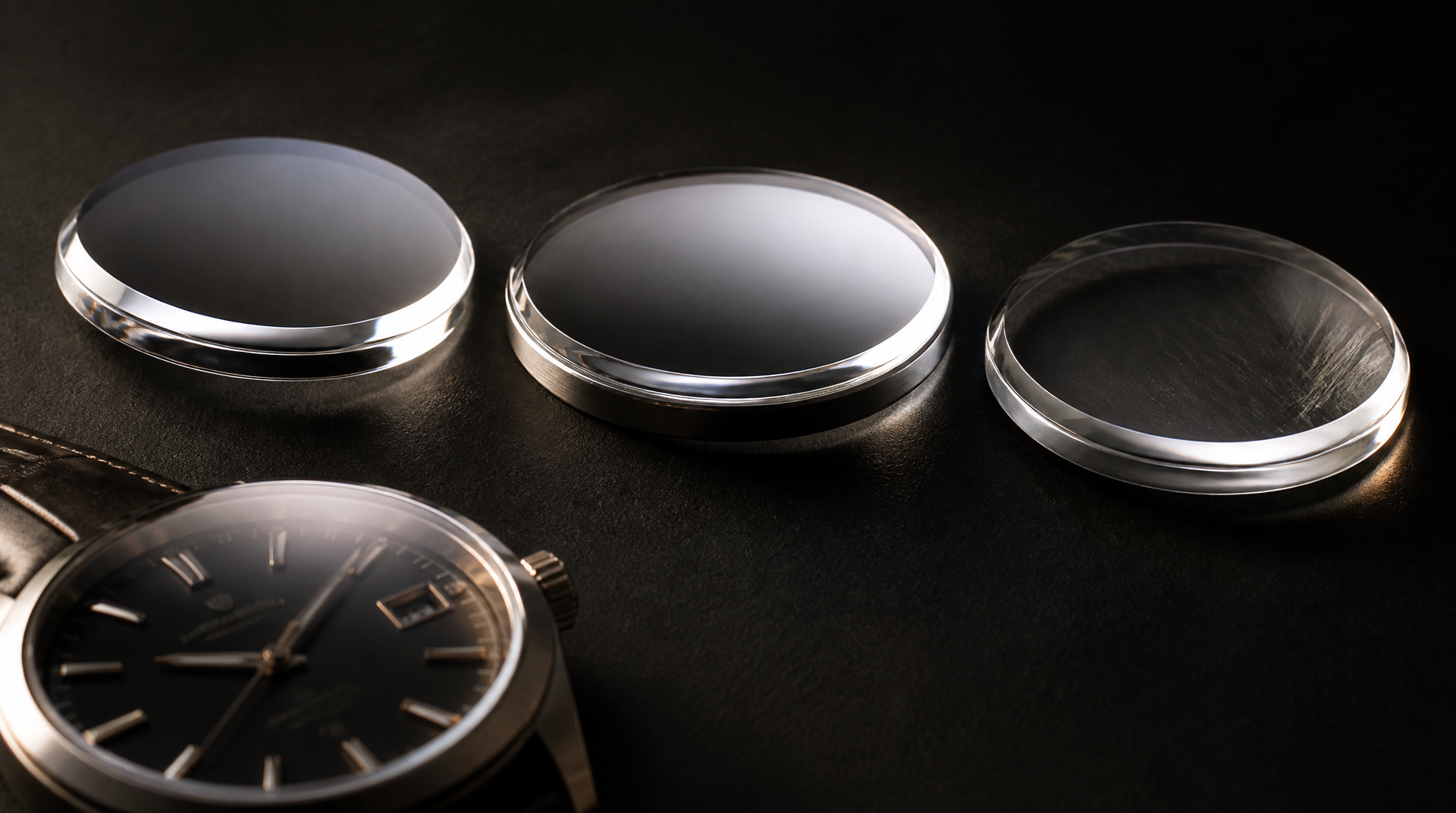
Sapphire won’t scratch during normal wear, acrylic polishes back to clear with a few minutes of hand work, and mineral glass splits the difference at a lower price. Those are the headlines, but they don’t tell you which crystal will survive your Wednesday, or when a common recommendation turns into a costly mistake. This comparison focuses on the practical differences—the kind that show up after a year of wear, a drop, or a misguided crystal swap—so you can choose a watch (or a replacement) that matches how you actually live.
Quick answer
For a daily watch that needs to stay legible through grit and friction, sapphire is the low-drama pick. For a vintage piece or a tool watch that has to survive sharp blows without shattering, acrylic remains the smarter, more repairable material. Mineral glass—especially tempered versions like Seiko’s Hardlex—works when budget matters more than scratch immunity, but it can’t be polished back to new. If you hate hairline scratches and don’t want to replace a crystal every couple of years, skip untreated mineral glass entirely.
Comparison framework
Use the hardness and impact trade-off to frame your decision. Hardness controls scratch resistance; toughness controls shatter resistance. No crystal gives you all of both.
| Property | Sapphire | Mineral glass | Acrylic |
|---|---|---|---|
| Mohs hardness | 9 | 5–7 (tempered types push higher) | ~3 |
| Scratch risk | Almost zero from everyday materials; only diamond or silicon carbide leaves a mark | Picks up fine swirls from quartz dust, sand, and pocket grit | Scratches easily from keys, fingernails, and abrasive cloths |
| Shatter risk | Brittle; a sharp edge impact can spider-web or shatter the crystal instantly | Tougher than sapphire; can crack but often survives drops that would destroy sapphire | Highly flexible; absorbs shock without shattering—rarely cracks |
| Clarity and glare | Extremely transparent; often coated with anti-reflective layers that can scratch if applied externally | Slightly less transparent; rarely coated, so glare is noticeable | Warm, slightly distorting look; uncoated and softens reflections naturally |
| DIY repair | Requires a press, matched dies, and a correctly sized gasket—not home-friendly | Also requires a press; misalignment risks breaking the crystal or the case | Polishes by hand in minutes; many friction-fit domes pop in with a lever tool |
| Replacement cost (typical aftermarket) | $30–$80 | $10–$30 | $5–$20 |
| Replacement frequency (daily wear, rough use) | Usually once ever, unless cracked by impact | Every 2–3 years when scratches become distracting | Polish several times, replace when too thin or cracked |
| Recognizable examples | Rolex Submariner, Grand Seiko, Tudor Black Bay | Seiko SRPD divers (Hardlex), Orient Bambino | Omega Speedmaster Moonwatch (Hesalite), vintage Rolex Daytona |
Anti-reflective coating nuance: Many sapphire crystals carry an outer AR coat that scratches long before the crystal does. A hairline on a sapphire watch is often just a damaged coating—not the crystal itself—and it cannot be buffed out without stripping the entire layer and increasing reflections.
Best-fit by use case
Daily beaters and hard-use tools
Sapphire protects the dial when abrasive dust is constant; mineral handles blunt impact better.
Concrete dust, drywall compound, and silica sand are harder than mineral glass. A sapphire crystal keeps the watch readable through all of them. If your day involves sharp edge hits—rock climbing, mechanic work, swinging tools near the wrist—mineral or acrylic survives longer because they don’t shatter from off-angle blows. Seiko ships its SRPD divers with Hardlex precisely for that reason: a mineral crystal that costs under $20 to replace and rarely takes out the movement when it fails.
Vintage restorations and purist builds
Acrylic is historically correct and the easiest material to maintain at home.
1960s divers, military watches, and classic chronographs left the factory with acrylic domes. The material’s warm optical distortion is part of the look that flat sapphire retrofits rarely replicate. More important, acrylic polishes in under 10 minutes with Polywatch and a cloth—no crystal press, no gasket guesswork. Omega’s Hesalite Speedmaster remains the purist pick because the dome catches light without the milky ring that a sapphire “sandwich” can introduce on the 1861 models.
Dress and office watches
Sapphire with underside-only AR coating stays clear without demanding constant cleaning.
Dress watches rarely suffer edge impacts, so sapphire’s brittleness is a minor risk. A glare-free crystal reads as high-quality across a table. If fine marks appear on a sapphire dress watch and won’t wipe away, inspect for an outer AR coating under magnification; a watchmaker can strip it, but the crystal will become more reflective afterward. Before buying, confirm whether the brand uses underside-only AR, which eliminates this problem entirely.
Budget mods and first-time builds
Start with acrylic, learn the feel of crystal work, then move to mineral only when scratch tolerance drops.
Acrylic crystals cost roughly the same as a takeout meal and can be pressed with a simple lever tool—or even by hand on older friction-fit cases. If you ruin one during a build, you’re out very little. Upgrade to mineral glass when you want a harder surface but aren’t ready to risk a sapphire press-in on a case that might have tight tolerances. Save sapphire for a watch you intend to keep long enough that the upfront labor and cost make sense.
Real-world trade-offs
Material choice changes how much you’ll spend on maintenance, how often you’ll notice the crystal’s condition, and whether a single hard knock turns into a movement-teardown bill.
Scratch-tolerance vs. shatter anxiety. Sapphire owners rarely stress about scratches but flinch when the watch hits a doorknob edge-on because they know a $60 crystal swap can turn into a $300+ service if the crystal shatters and lets moisture inside. Acrylic owners accept that deep scratches will appear but also know they can fix them in minutes. Mineral users live between these worlds until they can’t unsee a swirl, at which point the only option is replacement—there is no effective hobby-grade polish for mineral glass.
Retrofitting a different crystal type isn’t a universal plan. The failure that catches enthusiasts off guard: swapping a vintage acrylic dome for a flat sapphire crystal, then losing water resistance or jamming the seconds hand. Acrylic crystals on older divers (like Seiko 6309 and 6105 models) often rely on a tension ring and a specific dome profile to seal. A generic flat sapphire may sit flush on the bench but leak at pressure because the case neck flexes differently underwater or the gasket stack height changes.
On chronographs, even a 0.3 mm difference in dome height can cause the chronograph seconds hand to drag against the underside. Before ordering a retrofit, measure the original crystal’s thickness, dome height, and edge profile with digital calipers. If the case was engineered for a beveled acrylic edge, stick with acrylic or source a crystal from a specialist who supplies a matched gasket kit.
Polishing acrylic extends its life—until it doesn’t. Every polishing session removes material. A dome that drops below 0.8 mm at the center becomes dangerously flexible and will crack under pressure that a full-thickness crystal would handle. Keep a set of calipers handy and replace the crystal once it hits that threshold.
Catching trouble before it costs you: two practical checks
1. Verify your crystal type before ordering a replacement
Misidentification leads to the wrong gasket, a press-fit mismatch, or wasted money. Use a layered verification, not a single trick.
- Water-drop test (quick field check). Place a clean drop of water on the center. On sapphire it beads up into a tall, tight dome that rolls easily. On mineral or acrylic the drop spreads flatter. Oleophobic coatings can alter this, so don’t treat it as the sole proof.
- Edge tint inspection (more reliable). Hold the watch under bright white light and look across the crystal edge with a loupe. Sapphire often shows a faint blue or purple hue; mineral appears pale green or clear; acrylic looks warmer, with no color tint.
- Case markings and known specs. “Hardlex” printed at the crystal perimeter or on the case back confirms mineral. Most watches above roughly $400 MSRP use sapphire. Orient and many entry-level Seikos default to mineral. The spec sheet ends the argument—use it when you can.
After identification, measure with digital calipers: diameter to 0.1 mm, edge thickness, and dome profile (flat, single-dome, or double-dome). A dome difference of just 0.3 mm can interfere with hand clearance.
2. Acrylic polishing: a 10-minute rescue with a clear stop signal
Acrylic polishing is fast, but overdoing it thins the crystal until it cracks. Here’s the operator flow that keeps you safe.
1. Mask the bezel. Low-tack painter’s tape around the crystal edge prevents compound from packing into the bezel ring or dulling a lume pip.
2. Start with a light compound. Pea-sized amount of Polywatch or Novus #2 on a cotton cloth. Rub in tight circles with moderate pressure for 2–3 minutes. Buff off residue and check under ambient light.
3. Assess. Light swirls usually clear in one or two passes. Deep gouges that catch a fingernail need the heavy-cut path. If the crystal is clear and legible now, stop.
4. Deep scratch path (only if needed). Apply a heavy-cut polish (Novus #3) the same way for another 2 minutes. Wipe clean, then immediately follow with the lighter compound from step 2 to restore transparency. Never end on a heavy compound.
5. Stop signal. Measure crystal thickness at the center with calipers after every two complete cycles. Once thickness drops below 0.8 mm, order a replacement. A thinned dome cracks easily, and the resulting blow can compromise the gasket seal.
3. Sapphire edge inspection: catch a crack before moisture gets inside
Sapphire’s scratch immunity is real, but a chipped edge often goes unnoticed until morning fog appears on the dial. After a drop or a hard knock, spend two minutes on these checks.
- Edge walk. Run a wooden toothpick or cuticle stick slowly around the crystal perimeter. Any catch or tiny lip signals a chip or a shifted crystal.
- Tap test. Fingernail tap produces a sharp, high-pitched ping on intact sapphire. A dull, clicky sound suggests a crack that dampens vibration.
- Bright light sweep. Hold the watch near a desk lamp and tilt through all angles. A star-shaped micro-crack at the rim or a hairline that disappears as the angle changes means a fracture is developing.
If you find an edge chip, schedule a replacement immediately. A $60 swap now routinely prevents a $300–$500 service later when moisture corrodes the hands, dial, and movement.
Common questions
Is sapphire crystal unbreakable? No. It resists surface scratches extremely well but shatters under sharp edge impact. A drop onto tile can crack it instantly.
Can I replace a watch crystal myself? Acrylic is the most DIY-friendly—many friction-fit domes can be pressed in without a full crystal press. Mineral and sapphire require a press, correct die sizes, and a properly sized gasket. A watchmaker is the safer route unless you have practiced on inexpensive pieces first.
Does mineral glass scratch more easily than sapphire? Yes. Everyday grit contains quartz particles harder than mineral glass. Even careful wear accumulates fine swirls, which is why many manufacturers upgrade their tool-watch lines to sapphire on higher-tier models.
What gets lost when I swap acrylic for sapphire on a vintage piece? You lose the warm dome distortion that defines the original look, the ability to polish out scratches in the field, and—unless the replacement crystal and gasket are an exact match—you risk losing water resistance below the rated depth. A flat sapphire retrofit can also interfere with hand clearance on older movements.
How can I verify that a used watch actually has a sapphire crystal? Combine the water-drop test with a loupe-based edge tint inspection. For a definitive check, use a diamond tester (gemstone type) set to sapphire mode; it gives a certain reading in seconds and removes any doubt.
Explore This Topic
- Back to General
- Back to Crystal Types
Related guides in this cluster:
- How Much Does Watch Service Cost? Complete Brand-by-Brand Breakdown
- Why Your Automatic Watch Keeps Stopping: Complete Troubleshooting Guide
- How Often Should You Service a Watch? Complete Service Interval Guide by Brand

The We Know Watches editorial team brings together over 40 years of combined watch collecting, trading, and repair experience. Our editors have owned and handled watches from every major brand — from entry-level Seiko 5s to Rolex, Omega, Patek Philippe, and independent Swiss watchmakers. We’ve bought and sold at auction, worked with authorized dealers, visited manufacturing facilities in Switzerland and Japan, and serviced hundreds of movements ranging from the Seiko 7S26 to the Longines L888. Every guide and review we publish is based on hands-on experience, original research, and consultation with professional watchmakers. We do not accept payment for reviews, and we clearly disclose when we use affiliate links.