
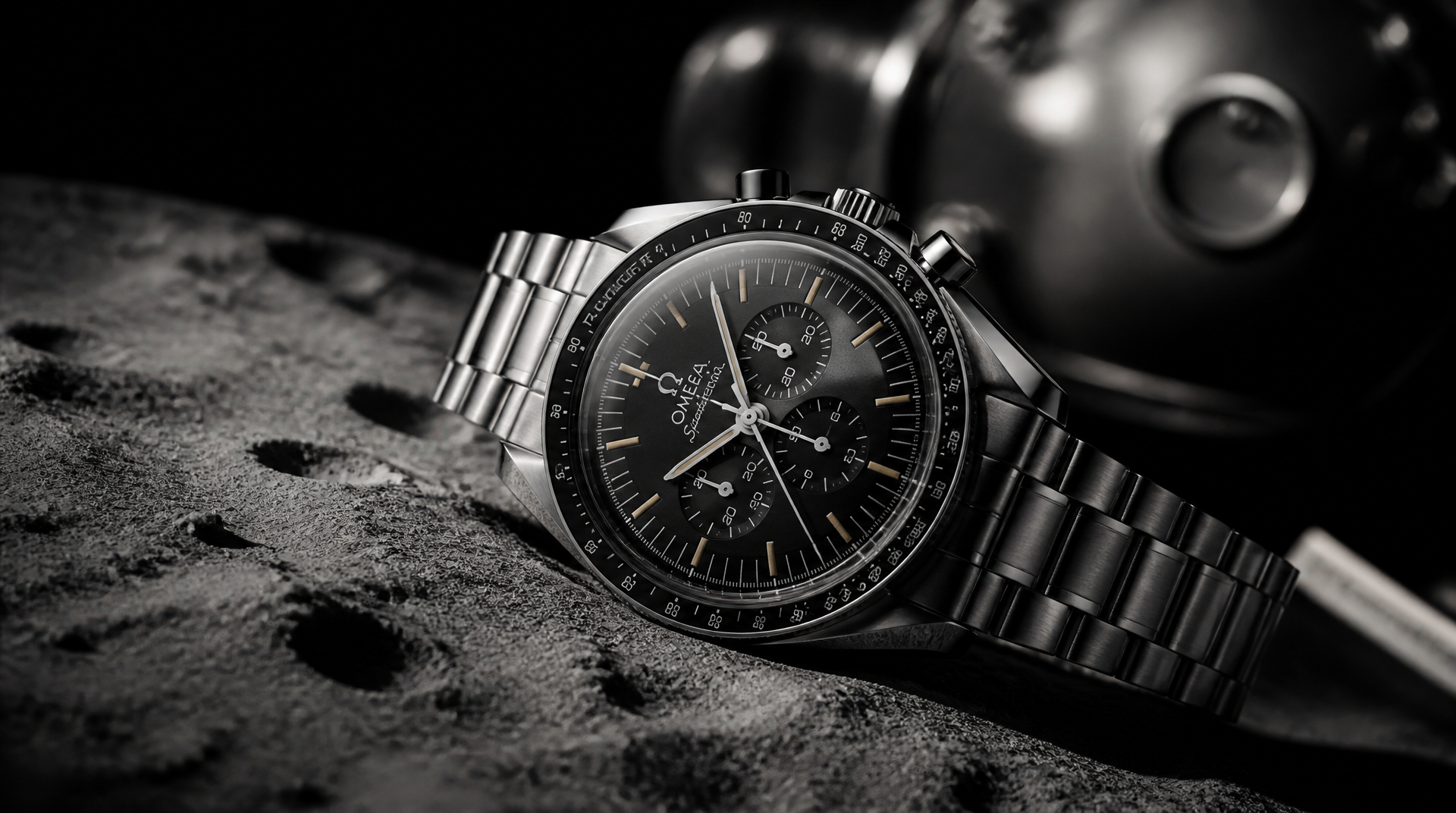
The Omega Speedmaster Professional “Moonwatch” is the only watch worn on the moon, but the name gets slapped onto dozens of Speedmaster variants that share none of its flight‑qualified heritage. This guide gives you the reference‑level definition that actually matters, decodes the models buyers chase, and arms you with a framework to land a real Moonwatch without paying genuine‑Moonwatch money for something that isn’t one. You’ll learn to spot the most expensive buying mistake early, verify a watch remotely, and decide whether a $4,500 neo‑vintage example or an $8,000 birth‑year 145.022 fits your wallet and risk tolerance.
Where the Moonwatch Definition Applies — and Where It Doesn’t
A Moonwatch is strictly a hand‑wound Speedmaster Professional whose lineage traces directly to the references NASA qualified for spaceflight starting in 1965. The moment you encounter an automatic movement, a date window, a case smaller than 42 mm, or a chronograph register layout that deviates from the classic 3‑6‑9 subdial pattern, you are looking at a different watch that shares only the Speedmaster name.
This boundary changes your purchase rules immediately. A Speedmaster Reduced (ref. 3510.50) with its piggyback automatic chronograph and 38 mm case trades between $2,000 and $3,500 and will never appreciate like a professional‑grade hand‑wound reference. Similarly, a “Speedmaster Date” or a racing‑dial automatic costs far less, parts availability differs, and the collector market treats these models as unrelated lines. If your goal is ownership of the actual Moonwatch lineage, the automatic and reduced‑size variants do not count, no matter what the seller’s headline claims. Confirm the reference number on the caseback or the lug engraving before anything else — a 3510.xx, 3210.xx, or 323.xx prefix rules out what you’re after.
A Quick Timeline: Motorsport to the Lunar Surface
Omega launched the Speedmaster in 1957 as a motorsport chronograph, the hand‑wound Calibre 321 column‑wheel movement sitting inside reference CK2915. By 1962, NASA procurement officers purchased several off‑the‑shelf Speedmasters for the Gemini program, and in 1965 — after extreme thermal, shock, humidity, and decompression testing — the agency selected reference 105.003 as the official flight article. That model, which collectors call the “Ed White,” is the exact watch worn during America’s first spacewalk. The later 105.012, the first Speedmaster with crown guards, is the reference Buzz Aldrin wore on the moon during Apollo 11.
The movement story drives value. The 321 gave way to the simpler cam‑switched 861 in 1968, which later became the 1861 (solid caseback) and the rhodium‑plated 1863 (display back). In 2021, the modern Moonwatch jumped to the Calibre 3861, a co‑axial Master Chronometer movement that added METAS certification, a silicon balance spring, and 15,000‑gauss magnetic resistance — the biggest technical leap since the Apollo program. This timeline is not trivia. It explains why a pre‑Moon 321‑powered 105.012 costs $30,000 more than a 1990s 1861‑powered 3570.50 that looks nearly identical at arm’s length.
Key References That Define the Market
Skip the marketing clutter. These references are what serious buyers compare.
Pre-Moon References (1957–1969)
CK2915 “Broad Arrow,” 105.003 “Ed White,” 105.012, and 145.012 all run the Calibre 321. Unpolished examples with correct DON (Dot Over Ninety) tachymeter bezels and matching tritium hands regularly hit five‑figure territory. A 105.012 sold at a major auction in 2023 for just above $40,000 with provenance; a similar example without documentation or with a service‑replaced crown still commanded $22,000–$27,000. If you are buying here, independent authentication and an Omega extract from the archives are non‑negotiable.
Classic Moonwatch Professional (1980s–2020)
The workhorse is ref. 3570.50 — hesalite crystal, solid caseback, Calibre 1861 — and it’s the watch most people picture when they think “Moonwatch.” Sibling 3572.50 adds a sapphire display back and the 1863. Later, the “big box” ref. 311.30.42.30.01.005 (2014–2020) came with generous accessories and a sturdy bracelet. These 3570.50‑family watches sit between $4,500 and $6,500 in good pre‑owned shape with the bracelet. They are the lowest‑risk entry to an authentic Moonwatch.
Modern Co‑Axial Master Chronometer (2021–Present)
Ref. 310.30.42.50.01.001 (hesalite) and ref. 310.30.42.50.01.002 (sapphire sandwich) bring the step dial, a refined bracelet, and the 3861 movement with a 5‑year warranty. New hesalite models sticker around $6,800–$7,500; pre‑owned examples have dipped to $5,500–$6,200 as the initial depreciation curve plays out. They are technically the best Moonwatches yet built, but if you plan to flip quickly, the depreciation bite will be sharper than on a well‑bought 1861 classic.
Limited Editions: Separate the Signals from the Noise
Apollo 11 50th Anniversary Moonshine gold ref. 310.20.42.50.01.001 and the “Silver Snoopy” 50th Anniversary 310.32.42.50.02.001 do not follow standard Moonwatch price curves. The Snoopy peaked above $25,000 and has since cooled. Treat these as collectible side plays, not as safer Moonwatch alternatives. If you are shopping for a daily‑wear piece tied to the space legacy, a standard production steel reference almost always offers better value and easier resale.
How to Buy a Moonwatch Without Overpaying
Three Non‑Negotiables Before You Hand Over Payment
First, verify the movement matches the reference. A 321 in a 1980s case is a frankenwatch. A 145.022‑69 from the late 1960s must contain an 861‑series movement, never a 321 whose production had already ended by that case reference’s run. Photograph the movement with the seller’s dated note, and cross‑reference the serial number with Omega’s published serial chart. A discrepancy of even five years between the serial range and the posted reference is a deal‑killer unless the price reflects the uncertainty.
Second, confirm that the dial and hands share the same luminous material period. Tritium ages to a warm yellow‑orange, while later Luminova stays white. A tritium dial paired with bright white Luminova hands signals a service replacement — not a crime, but it must be priced like a service‑dial watch, not an original one.
Third, demand a clear, glare‑free photo of the caseback engraving. On a 105.012 or 145.012, the hippocampus medallion should show crisp, slightly uneven stamping from a period press. A perfectly centered, laser‑sharp medallion on a “vintage” caseback is often a modern replacement bolt‑on.
What These Rules Mean for Your Actual Offer
If you find a 145.022‑71 with a correct step dial but a service‑replaced crown and a scuffed crystal, you can safely factor in $200–$300 for a correct Omega crown and a new Omega hesalite crystal. The final offer should sit $200–$300 below the price of a comparable all‑original example — and that’s still a fair buy. However, if the lume is mismatched and the case has lost its lyre‑lug sharpness to over‑polishing, the discount must be deeper, likely 20–30% off market, because the watch will never regain the crisp geometry collectors pay a premium for. When you see two red flags, don’t negotiate; move on to a cleaner example.
Remote Verification: Three Checks Before You Wire Money
Even if you cannot visit the watch in person, you can eliminate many bad buys from your desk.
1. Timegrapher photo with a visible movement serial. Ask the seller to place the watch on a timegrapher and capture the display alongside a handwritten card showing the date and the seller’s name. Look for amplitude above 270° in the horizontal position and a beat error under 0.5 ms for a modern 1861/3861. Lower amplitude or beat error above 1.0 ms warns of imminent service cost.
2. Macro shot of the bezel dot. Request a sharp macro of the “90” on the tachymeter bezel. A DON bezel on a pre‑1969 reference has the dot placed above the 90 (“Dot Over Ninety”), while later service bezels show the dot next to the 90. A DON bezel alone can add $2,000‑plus in value on a 105.012, so mismatch here walks away with your money.
3. Clasp code and end‑link check. For 1990s and 2000s references, the bracelet clasp code (stamped inside the clasp) should align with the approximate production year. A 1450‑end‑link bracelet on a 3570.50 that should carry 840 end links is a parts‑bin swap that lowers fit quality and resale value.
The One Buying Mistake That Can Cost You Thousands — And How to Catch It Early
Paying full‑market money for a heavily refurbished watch marketed as “original” is the single most expensive trap in Speedmaster collecting. It usually surfaces with private sellers or small dealers who operate without a return policy and rely on dim, angled photos.
Early detection signs that should stop you:
- Lume mismatch. Overly white puffy lume on a tritium‑era dial when the hands show even yellowing, or vice versa. A mid‑1960s 105.003 with bright white plots is almost certainly a relume.
- Over‑polished case geometry. The iconic lyre lugs on a ref. 145.022 should end in sharp bevels. A soft, rounded profile means the case has been aggressively buffed, and the watch will never regain the factory lines that serious collectors look for.
- Caseback engraving too neat or absent. An engraving‑free caseback on a 105.012 or 145.012 that should show the hippocampus is a red flag. A stamped medallion that looks laser‑etched in its sharpness is a modern fake — original strikes have a slight uneven depth that comes from a worn die.
- Service‑replacement dials priced as originals. Omega service centers sometimes install a newer stepped dial or an applied‑logo dial that differs from the original year’s tritium configuration. The watch is still authentic, but it should be priced at the service‑dial level, typically $800–$1,200 less than an untouched original‑dial example.
If you spot even one of these signals, pause. Request high‑resolution macro shots in daylight. If the seller balks or sends blurry repeats, walk away. The market constantly produces better examples; you are buying a Speedmaster, not the last moon rocket.
How to Inspect a Pre‑Owned Moonwatch in 15 Minutes
Use this sequence when you have the watch in hand or are receiving a series of unboxed photos from a cooperative seller.
Prep: What You Need
A loupe (10x is enough), a smartphone to take your own photos, a handwritten card with the date, and a timegrapher app or a watchmaker nearby. Keep the original listing photos open for comparison.
Step 1: Confirm Reference and Movement Family
Remove the caseback only if you have the proper tool and experience; otherwise, ask the seller to do it and provide a time‑stamped photo of the movement with the card. The engraving on the base plate must match the caliber the reference expects: a 145.022 must show “Omega 861” or a variant, never “321.” Look for any bridge engraving that looks laser‑etched instead of pressed — a sign someone re‑marked a generic movement. A bridge with deep gouges or twisted screws points to ham‑fisted service.
Step 2: Wind and Test the Chronograph
Wind the watch fully — about 30 turns of the crown — and feel for consistent resistance without grit or grinding. Start the chronograph; the central seconds hand must sweep smoothly, not stutter. Run it for two minutes, then stop and reset. The hand must snap back to zero with no overshoot. A lagging minute counter or a reset that stops at 0.5 seconds beyond the mark signals a dry coupling clutch that will need service soon ($500–$800 at a specialist).
Step 3: Check One Visual Authenticity Marker
For pre‑1990s models, examine the step dial with a loupe. The step is a slight drop‑down from the outer minute track to the center of the dial; service‑replacement dials often miss this subtlety. For neo‑vintage 3570.50 examples, look at the dot relative to the “90” on the bezel — a modern service bezel with “dot next to 90” on a 1990s case can wipe $300–$500 off the value because it’s not period‑correct.
Step 4: Identify a Deal‑Killer Fast
Walk away immediately if the watch loses more than 30 seconds per day on a timegrapher, if the chronograph minute counter jumps two minutes with one push, or if the crystal is flat sapphire on a reference that shipped with domed hesalite. Reversing a butchered crystal conversion typically costs more than the saving you thought you were getting.
Success Check
A ready‑to‑wear buy winds smoothly, resets to a crisp zero, shows minimal lug‑hole elongation from bracelet wear, and carries either a traceable recent service or an Omega archive extract. If it meets those marks and the price reflects its completeness, you can button up the deal.
Hesalite vs. Sapphire Sandwich: The Trade‑Off That Alters Wear and Value
The most common buyer conflict is choosing between hesalite and sapphire, and the choice carries a material consequence.
Hesalite (a domed acrylic crystal) is the NASA‑spec original. It scratches easily under a shirt cuff but can be polished back to clarity in minutes with a $10 polishing kit. Under hard impact, it cracks rather than shattering into fragments — why NASA insisted on it for spacewalk use. Over years, micro‑swirls build a warm, vintage haze that many buyers prize. If you opt for hesalite, you commit to a cosmetic maintenance task every few months, and you must never subject the watch to aggressive chemicals that can cloud the crystal permanently.
Sapphire on the modern sandwich reference (310.30.42.50.01.002 and previous 3572.50) is far more scratch‑resistant, but it cannot be polished — once scored by a diamond ring or concrete, the crystal needs full replacement ($300‑plus from Omega). The display back reveals the 1863/3861 movement, which looks attractive but shows rotor‑less finishing that some owners find underwhelming. For pre‑2000 references, a sapphire crystal is a red flag unless the model originally shipped with it; a “upgraded” sapphire on a 145.022 kills temper and value because it alters the watch’s factory spec. If you value low daily maintenance and don’t mind the slightly different optical reflection, sapphire is the practical choice, but you lose the authentic Apollo‑era feel and the problem‑free polish‑at‑home advantage.
New vs. Vintage Speedmaster: Which Fits Your Budget and Risk Tolerance?
Use this table to match your situation to a reference tier.
| Option | Typical Price Range | Movement / Crystal | Everyday Wearability | Maintenance & Risk | Best For |
|---|---|---|---|---|---|
| Modern Co-Axial 3861 (steel, hesalite) | $6,800–$7,500 new, $5,500–$6,200 pre-owned | 3861 METAS, hesalite | Excellent; 50m WR, anti-magnetic | Factory warranty, low risk | Buyers who want zero projects and modern accuracy |
| Neovintage ref. 3570.50 / 311.30.42.30.01.005 (1861) | $4,500–$6,500 pre-owned | 1861, hesalite, solid back | Very good; must be mechanically sound | Service every 5–7 years; parts obtainable | First-time Moonwatch buyers looking for the iconic look at lower entry cost |
| Vintage 145.022 (1970s-80s) | $7,000–$12,000+ | 861, hesalite | Acceptable but fading lume; avoid daily water exposure | Authentication risk high; parts harder to source | Collectors who prioritize patina and history over modern convenience |
| Pre-Moon 105.012 / 321 references | $20,000–$50,000+ | Calibre 321 | Wearable but insurability and shock worry are real | Costly service by specialist; scarce parts | Serious collectors who treat the watch as an asset and wear sparingly |
What a Complete Set Really Means — And When You Can Skip the Premium
Full box and papers adds $800–$1,500 on a modern Speedmaster and far more on a vintage example with the original guarantee and hang tag. For a 2022 sapphire sandwich, missing the cards is a $600–$1,000 haircut; you can order an Omega extract and still have a perfectly authentic watch. For a rare 1969 Apollo XI limited edition, the missing original velcro strap and souvenir booklet could cut a five‑figure deal by more than 20%.
Skip paying the full‑set premium when you are buying a wearable, pre‑2020 Moonwatch that will be serviced and worn regularly. Insist on it only when you are purchasing a pre‑Moon reference or a numbered limited edition that relies on original paperwork to prove provenance. For a standard 3570.50, the $1,000 uplift for a big red box and faded cards rarely makes financial sense; a clean extract from the Omega archive and a detailed service receipt provide equivalent proof of authenticity without the collector mark‑up.
How to Spot a Parts‑Bin Build and Avoid It
Many Speedmasters traded online are genuine pieces assembled from mismatched components that hurt long‑term value. Knowing where to look stops you from paying all‑original money for a watch that is not.
- Bracelet and end links. The clasp code (e.g., “1450” or “1498”) must match the production window. A 3570.50 originally came on end links 840 or later 1998/849; a 1450 end‑link bracelet swaps on fine but belongs to a different generation and signals a pieced‑together kit.
- Crown and pushers. Pre‑1970 models wore a narrow crown with a flat pusher profile. A later, fat pusher set on a 105.003 means service replacement, which drops value unless documented by Omega. The crown logo should match the dial logo style of the era — later, wider crowns on an early watch is a red flag.
- Caseback stamping mismatch. The reference engraved between the lugs and the caseback interior stamping must tell the same story. A caseback interior marked “145.022” on a watch sold as a “145.012” should make you stop and request a full explanation. It can happen on legitimate late‑transition examples, but it must be backed by an Omega extract or a known case‑production overlap, not a seller’s guess.
A quick way to screen for mismatched parts is to open the chronograph pushers with the appropriate tool and photograph the gaskets. If a watch advertised as “never polished” shows fresh silicone and no back‑plate oxidation anywhere near the pusher tubes, the case has been opened and likely partly refitted. That’s not automatically a deal‑breaker, but it should be reflected in the price.
Where to Buy a Speedmaster Moonwatch: Dealer, Private, or Platform
Your sourcing channel changes the post‑purchase protection you get, not just the price.
- Omega Boutique or Authorized Dealer (new models). You pay retail ($6,800–$7,500) but walk away with warranty, box, papers, and zero authenticity risk. Best for a 3861 you plan to keep long‑term.
- Reputable pre‑owned watch dealers (e.g., Bob’s Watches, Wind Vintage, Analog/Shift). Expect to pay 10–15% over private‑party pricing for a curated, inspected example with a short return window. This is the safest path for a first vintage Speedmaster, especially a 145.022 or 3570.50.
- Watch forums (Omega Forums, WatchUSeek). You can find fair private deals from knowledgeable collectors, but you must perform every authenticity check yourself. Seek sellers with long transaction history and specific, time‑stamped photos. A forum deal without a third‑party escrow is a gamble.
- eBay and Chrono24. Both offer buyer protection if the listing criteria are met, but the “unworn” 2005 Speedmaster with a fresh service bezel is common. Filter for sellers with at least 50 positive transactions in watches, and never waive the authentication‑guarantee option. Chrono24’s escrow service holds funds until you confirm the watch matches the listing, which adds a layer of safety on a cross‑border transaction.
Always pay via a method that leaves a trace — wire only when you have references you’ve verified independently, and never fund a deal through friends‑and‑family PayPal for a watch you haven’t held.
Final Word on Buying the Right Moonwatch
The Speedmaster Professional Moonwatch is one of the few watches where provenance, reference, and condition can shift value by ten times between a $4,500 neo‑vintage daily wearer and a $40,000 pre‑Moon grail. The definitions are narrow for good reason: NASA’s flight qualification applies to a strict family of hand‑wound references, and everything outside it is a different watch wearing the Speedmaster shield. Once you learn to read a bezel dot, press a pusher, and ignore the marketing noise, you can buy the Moonwatch that delivers what you actually want — the only watch worn on the lunar surface, in the exact mechanical form that earned its place there.
Explore This Topic
- Back to Omega
- Back to Speedmaster Guide
Related guides in this cluster:
- Omega Watches: The Complete Brand Guide — Speedmaster, Seamaster & More
- Rolex Watches: The Complete Brand Guide — History, Models & Buying Advice
- Cartier Watches: The Complete Brand Guide — Tank, Santos & Buying Advice

The We Know Watches editorial team brings together over 40 years of combined watch collecting, trading, and repair experience. Our editors have owned and handled watches from every major brand — from entry-level Seiko 5s to Rolex, Omega, Patek Philippe, and independent Swiss watchmakers. We’ve bought and sold at auction, worked with authorized dealers, visited manufacturing facilities in Switzerland and Japan, and serviced hundreds of movements ranging from the Seiko 7S26 to the Longines L888. Every guide and review we publish is based on hands-on experience, original research, and consultation with professional watchmakers. We do not accept payment for reviews, and we clearly disclose when we use affiliate links.