
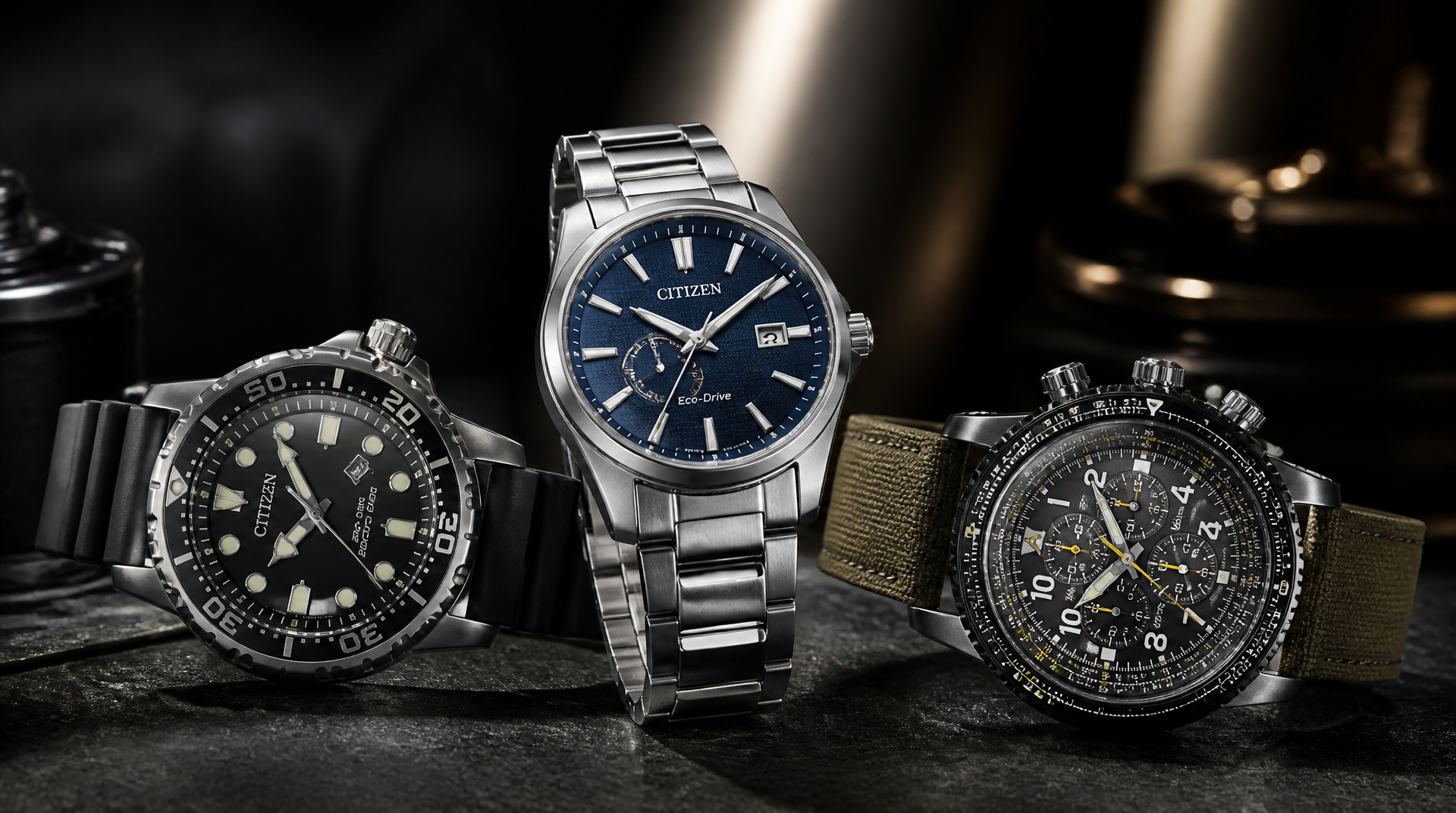
Citizen builds its reputation on Eco-Drive solar movements and the hard‑use Promaster family. For most buyers, that means a watch that runs for a decade without a battery, survives salt water, and rarely costs more than $600. The single most expensive mistake happens when a worn‑out rechargeable capacitor stops the watch dead, and someone pays for a full movement overhaul instead of a $30–$60 cell swap. This guide walks you through diagnosing that failure, breaks down the collections worth your money, and shows where Citizen fits against the obvious Seiko alternative.
How to Detect a Dying Eco-Drive Capacitor Before Paying for a Full Movement Overhaul
Eco‑Drive watches don’t use a disposable battery. They store energy from light in a rechargeable lithium‑ion capacitor. That capacitor has a service life of roughly 10–15 years under normal wear. When it degrades, the watch can quit completely even after days of direct sun. Treating that as a dead movement is the most common and costliest error an owner can make.
Here is the sequence to diagnose the problem yourself, decide whether a capacitor replacement will fix it, and confirm the repair later.
Step 1: Rule out a simple low charge
1. Hack the movement. Pull the crown out to the time‑setting position so the seconds hand stops.
2. Give it a hard solar charge. Place the watch face‑up in direct sunlight—not behind a window—for a full 48 hours. A windowsill won’t deliver the intensity needed to wake a deeply discharged cell.
3. Attempt a normal restart. Push the crown back in and wear the watch on your wrist for a few hours. If the seconds hand moves normally (one tick per second), the capacitor accepted a charge.
Step 2: Test the reserve to confirm capacitor health
1. Charge the watch in direct sun for another full day so the cell starts from a known full state.
2. Place the watch in a dark drawer overnight. If it stops within 12–18 hours, the capacitor can no longer hold a meaningful charge. That is your first definitive sign that the cell is failing—even though it still ran after a fresh charge.
3. If the watch keeps running for at least 24 hours in darkness and shows no erratic behavior, the capacitor still has useful life. Soak it in sunlight once a month and you’ll likely avoid issues for years.
Models like the Promaster Diver BN0151‑09L and the Avion AW1361‑10H routinely exceed 12 years on a single capacitor, but watches stored in a dark drawer for months tend to degrade faster. Deep discharge accelerates oxidation inside the cell, making a replacement mandatory sooner than the typical 10‑year mark.
If the watch still won’t start after 48 hours of sun
This is the branch where the next action changes. A watch that stays completely dead—no second‑hand movement, no two‑second‑jump low‑charge warning, nothing—tells you one of two things: the capacitor is so far gone it can’t accept any initial charge, or the movement itself has a fault (rare on a previously running Eco‑Drive). To isolate, place the watch under a bright LED desk lamp (300‑lux minimum) with the dial facing the light for another 24 hours. If the watch still doesn’t respond, a watchmaker can check whether the solar panel is outputting voltage. In most cases, an unresponsive Eco‑Drive still comes back after a capacitor swap, but the bench measurement rules out a dead circuit board before you spend money.
When to stop DIY and escalate
Replace the capacitor only if you’re comfortable opening a caseback and handling tiny parts. After a successful capacitor change, the watch should start running within minutes of exposure to light. Stop and seek a professional in any of these situations:
- After replacing the capacitor, the seconds hand still won’t move or only stutters, even under direct sun.
- The second hand jumps in two‑second intervals (the low‑charge warning) after a full day of sunlight—this means the new cell isn’t charging or the circuit isn’t drawing power correctly.
- You see fogging inside the crystal or corrosion on the movement when you open the case. That’s moisture damage, and a capacitor alone won’t fix it.
A Citizen service center or a competent independent watchmaker can supply the correct capacitor part number (popular cells include the MT621 and CTL621R) and test the charging circuit afterward. The repair fee usually runs $30–$60. Paying for a full movement replacement on a dead Eco‑Drive is almost never the right move without this diagnosis first.
Verify the fix after a capacitor replacement
After the new capacitor is installed and the caseback is sealed, follow this quick verification:
- Charge the watch in direct sunlight for 4–6 hours. The seconds hand should move in smooth one‑second steps, with no two‑second jumps.
- Wear the watch normally for a day, then put it in a dark drawer for 48 hours. After that period, the watch should still be running. A healthy capacitor holds enough reserve to last up to six months in total darkness, so 48 hours is a conservative pass/fail test.
- If the watch passes, you’ve just bought yourself another decade of battery‑free operation.
Why Eco‑Drive Is the Smart Default for No‑Fuss Quartz
Eco‑Drive solar movements hit ±15 seconds per month under normal light, skip battery swaps for the better part of a decade, and appear in everything from field watches to atomic‑syncing pilot chronographs. That predictability is why Citizen anchors nearly the entire core catalog on it.
Concrete examples that show the range:
- Citizen Chandler BM8180‑03E: 37 mm field watch with day and date, 100 m/330 ft water resistance, Eco‑Drive caliber E101. Often under $150, it remains one of the most recommended starter watches among enthusiasts—small enough to disappear under a cuff, bright enough lume for pre‑dawn walks.
- Citizen Nighthawk BJ7000‑52E: A true GMT with a slide‑rule bezel, 200 m/660 ft water resistance, and Eco‑Drive caliber B877. Street price $250–$300. The busy dial works because Citizen spaces the subdials deliberately, and the luminous hands stay readable at night.
- Citizen World Chronograph AT8020‑54L (Blue Angels): Radio‑controlled atomic timekeeping synced to six stations, sapphire crystal, Eco‑Drive power. This model moves fast during sales events. Its rotating inner‑bezel crown is stiff and can frustrate users with large fingers, but the watch essentially sets itself—useful if you skip time‑zone math when you travel.
Eco‑Drive won’t give you a mechanical sweep seconds hand or a high‑end dress finish. That’s not the point. The line exists to be grab‑and‑go reliable.
Promaster: Marine, Land, Sky—and What You Actually Get at Each Tier
Citizen groups its tool watches under three Promaster environments. Water resistance, bezel action, and lume quality differ enough between models that a side‑by‑side look prevents a bad purchase.
Promaster Marine (Dive)
ISO‑certified divers like the BN0190‑07E (200 m/660 ft) and the slightly smaller BN0151‑09L (44 mm) run on Eco‑Drive. Lume is aggressive and lasts through the night. The knurled 60‑click bezel provides a firm grip, but saltwater can stiffen it; a quick rinse and a few turns under running water restores it to normal. The crown is undersized and unscrews with more effort than a Seiko Prospex, yet the screw‑down caseback and hard mineral crystal hold up well. The included rubber strap attracts lint and may need upgrading for daily wear.
The Promaster Aqualand BN2036‑14E adds an analog depth gauge driven by a membrane. The gauge works but can fog permanently if the sensor port gets contaminated, so inspect a used one carefully—or skip the depth‑meter version altogether if you’re buying pre‑owned without a return period.
Promaster Land
The standout is the Promaster Tough BN0211‑50E. Its monocoque titanium case removes the caseback entirely, eliminating a common water‑ingress point. That design, plus a sapphire crystal and 200 m/660 ft water resistance, makes it a genuine field tank. The fixed bezel is decorative, so if you need a timing bezel look at the diver‑styled Land models instead. The monocoque case does make capacitor servicing slightly more involved; a watchmaker still handles it, but confirm the shop knows the case before you book the work.
Promaster Sky
Pilot watches with slide‑rule bezels and multi‑function dials. The Skyhawk A‑T JY8078‑52L packs radio‑controlled atomic time, world time, a chronograph, alarm, and perpetual calendar. It demands a steep learning curve—many owners keep the manual close for the first month. The Blue Angels edition adds a sapphire crystal and a striking blue‑and‑yellow colorway, while the standard version uses mineral glass. If you want a watch you can set once and let the radio tower do the rest, this is it, but only if you live within reliable signal range.
All Promasters share an unapologetic utilitarian approach. They are not slim and don’t pretend to be dress watches. If your priority is a piece that handles a day in salt water and then syncs to an atomic clock, a Promaster is the natural pick.
Quick‑Reference: Promaster Model Comparison Table
| Line & Model | Movement | Depth Rating | Crystal | Typical Price (USD) | Best Fit |
|---|---|---|---|---|---|
| Promaster Diver BN0151‑09L | Eco‑Drive E168 | 200 m (660 ft) | Mineral | $200–$250 | Everyday dive beater, smaller‑wrist friendly |
| Promaster Diver BN0190‑07E | Eco‑Drive E168 | 200 m (660 ft) | Mineral | $180–$230 | ISO‑certified desk diver with standout lume |
| Promaster Tough BN0211‑50E | Eco‑Drive E168 | 200 m (660 ft) | Sapphire | $250–$300 | Monocoque field tank, no‑nonsense outdoor piece |
| Promaster Skyhawk JY8078‑52L | Eco‑Drive U680 | 200 m (660 ft) | Mineral | $450–$550 | Radio‑controlled world timer for frequent flyers |
| Promaster Tsuno Chrono AV0070‑57L | Eco‑Drive Cal. 2100 | 200 m (660 ft) | Mineral | $350–$400 | Retro bullhead chronograph for wrists that can carry 48 mm |
Prices reflect typical street and authorized‑dealer figures, not MSRP. Water‑resistance ratings are static‑pressure tested; surface swims and snorkeling are safe, but high‑impact activities like wakeboarding can exceed gasket limits.
Beyond Solar: Citizen Automatics and the Miyota Movement Factor
Through its Miyota subsidiary, Citizen supplies automatic movements to microbrands worldwide and uses them in its own mechanical watches. The most visible in‑house automatic right now is the Tsuyosa NJ0150 series, powered by the Miyota 8210/8215. These calibers hack and hand‑wind (unlike older 8200‑series movements that lack hand‑winding) and run at 21,600 bph. Accuracy typically falls between –20 and +40 seconds per day, trailing Seiko’s NH35 but easy to regulate.
Key trade‑offs owners notice:
- Rotor noise. A distinct whirring sound when shaken is normal on the 82‑series and not a defect. The noise disappears once the watch is on the wrist.
- Bracelet sizing. The Tsuyosa integrated bracelet lacks micro‑adjustment; falling between link positions can make a perfect fit hard. A half‑link or aftermarket clasp may be needed.
- Higher‑end autos. Citizen’s Series 8 line (NA1010‑84X) uses the thinner Miyota 9039, but at that price point Swiss rivals and higher‑tier Seiko Presage models offer better case refinement and decoration.
How Citizen Stacks Up Against Seiko
For sub‑$600 Japanese watches, the choice usually hinges on movement preference and design philosophy.
- Solar versatility: Citizen’s Eco‑Drive platform offers a wider range of complications (radio‑control, depth meter, world time) than Seiko’s solar line, which is mostly three‑hand or chronograph. If you want a solar watch that goes beyond basic time‑only, Citizen leads.
- Mechanical feel: Seiko’s NH35/4R35 wind more smoothly and produce less rotor noise than the Miyota 82‑series. Seiko dive watches like the SRPD series also deliver a subjectively better bezel action and a feel many enthusiasts prefer. Citizen counters with the Tsuyosa’s distinctive integrated‑bracelet look and bold bullhead chronographs.
- Build quality at entry level: Both brands use folded end‑links and pressed clasps at this price. The Promaster Tough’s monocoque titanium case is a notable step above, while Seiko’s Turtle and Samurai provide similar toughness with wider aftermarket strap support.
The frequent advice to “just get a Seiko automatic” makes sense if a smooth sweep seconds hand is a must. If grab‑and‑go accuracy and a decade‑long capacitor matter more, Citizen is the rational pick.
FAQ
How often do Eco‑Drive capacitors really need replacing?
Most last 10–15 years with regular wear. Watches stored in darkness for years may need a capacitor sooner because lack of light accelerates cell degradation. After a fresh capacitor is fitted, expect another similar lifespan.
Can I replace an Eco‑Drive capacitor myself?
It is possible on models with a screw‑down caseback and a simple movement holder, but you will need a caseback wrench, plastic tweezers, and the correct capacitor type. Dust on the dial or a pinched gasket can compromise water resistance, so a $30–$60 watchmaker job is often the safer path.
Which Citizen automatic watches hack and hand‑wind?
The Miyota 8215 (used in many Tsuyosa models) and the 9015/9039 (Series 8) offer both hacking and hand‑winding. Older 8200‑series automatics found in some vintage‑inspired pieces hack but lack hand‑winding, so check the specs before buying if manual winding is important to you.
Is radio‑controlled atomic timekeeping worth the extra cost in a Citizen?
Yes if you live within reliable signal range (most of the US, Europe, and parts of Asia) and value a watch that sets itself precisely and adjusts for daylight saving time automatically. Outside signal zones the watch behaves like a standard quartz, so the premium only pays off where reception is consistent.
Explore This Topic
- Back to Citizen
- Back to Citizen Brand Hub
Related guides in this cluster:
- Citizen Eco-Drive Complete Guide: Setting Time, Battery Life & Care
- Christopher Ward Watches: Complete Brand Guide & Review
- Omega Watches: The Complete Brand Guide — Speedmaster, Seamaster & More

The We Know Watches editorial team brings together over 40 years of combined watch collecting, trading, and repair experience. Our editors have owned and handled watches from every major brand — from entry-level Seiko 5s to Rolex, Omega, Patek Philippe, and independent Swiss watchmakers. We’ve bought and sold at auction, worked with authorized dealers, visited manufacturing facilities in Switzerland and Japan, and serviced hundreds of movements ranging from the Seiko 7S26 to the Longines L888. Every guide and review we publish is based on hands-on experience, original research, and consultation with professional watchmakers. We do not accept payment for reviews, and we clearly disclose when we use affiliate links.