
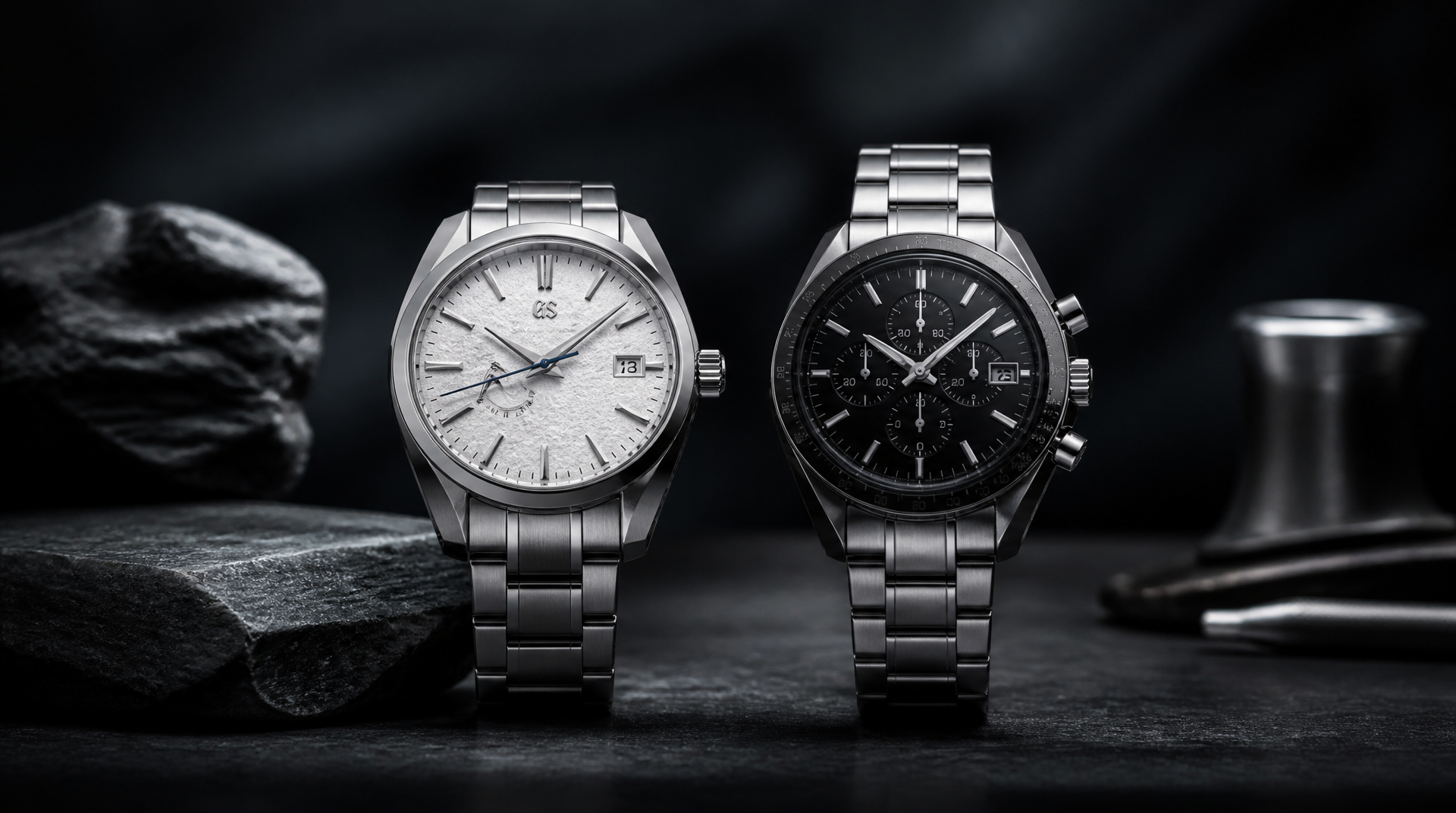
When the dial says “Swiss Made” you’re paying for a tradition of hand‑finishing and status that goes back centuries. When it says “Japan” you’re usually getting relentless engineering, lower service stress, and more watch for the money. Neither side wins across the board—but the right pick changes dramatically with budget and what you expect from ownership.
Quick answer
- Under $1,000: Japanese watches (Seiko, Citizen, Orient) are the clear value leaders. You get in‑house movements and solid build quality that Swiss brands struggle to match at this price.
- $1,500–$4,000: The choice tightens. A Japanese Grand Seiko quartz or entry‑level mechanical delivers world‑class finishing; Swiss mid‑range automatics (Longines, Oris) offer heritage and aftermarket demand.
- Above $5,000: Swiss luxury (Rolex, Omega, JLC) dominates on prestige, resale, and traditional movement decoration. Grand Seiko and high‑end Credor compete on dial work and accuracy, but the Swiss brands hold stronger resale value.
If you prioritize innovation per dollar—or hate frequent servicing—Japanese watches usually win. If status, hand‑finishing, and resale matter most, Swiss remains the safer bet. What this means for your next move: if you’re buying one watch today under $1,000, go Japanese without hesitation; you’ll get more durability and far fewer service headaches than any Swiss watch at the same sticker. Once your budget climbs above $5,000 and you need the watch to hold its value or act as a social signifier, the Swiss path gives you a more liquid, widely recognized asset.
Comparison framework
Use the table below to side‑step the spec‑sheet trap and focus on the factors that change long‑term ownership.
| Factor | Japanese | Swiss | What makes the difference |
|---|---|---|---|
| Typical mechanical start price | $200–$500 (Seiko 5, Orient) | $800–$1,200 (Tissot, Hamilton) | Japanese in‑house movements cost less to produce; Swiss entry‑level often uses ETA ébauches. |
| Accuracy (out of the box) | Quartz HAQ ±10 sec/year; Spring Drive ±1 sec/day | COSC automatics -4/+6 sec/day; quartz inexpensive | Japanese technologies like Spring Drive and solar GPS quartz set daily accuracy leads—often at lower prices. |
| Movement decoration | Grand Seiko’s Zaratsu polishing rivals Swiss high‑horology; budget models are utilitarian | Traditional Geneva stripes, anglage, blued screws are the norm above $2,000 | Below $1,000, Swiss decoration is mostly machine‑applied; Japan wins on surface finish at mid‑tier. |
| Service interval & cost | 3–5 years for mechanical; $150–$300 typical | 5–7 years; $300–$700+ depending on brand | A Grand Seiko mechanical service can cost less than an Omega; a Spring Drive or solar quartz needs almost no regular intervention. |
|
| Resale value (5‑year) | Grand Seiko holds ~55–70%; budget Seiko can drop 40%+ | Rolex often appreciates or holds 80%+; mid‑tier Swiss 60–70% | Swiss brand perception drives stronger secondhand prices, especially for steel sports models. |
| Prestige & recognition | Grand Seiko recognized by enthusiasts; Seiko/Citizen rarely turns heads | Widespread recognition; Rolex, Omega, Patek Philippe signal status instantly | If social signaling matters, Swiss is the default—Grand Seiko is still a conversation starter, not a universal status symbol. |
| Innovation approach | Spring Drive, solar GPS, thermo‑compensated quartz, high‑intensity titanium cases | Co‑axial escapements, silicon hairsprings, materials innovation at high end | Japan often leads in practical, ready‑now tech; Swiss innovation tends to appear first in higher price brackets. |
Best-fit picks by use case
The daily tool watch you won’t baby ($300–$600)
A solar quartz or automatic that handles knocks without an expensive service schedule.
Japanese pick: Seiko Prospex diver (Caliber 4R35/6R35) or Citizen Eco‑Drive. The movement is robust, shock‑protected, and service costs are reasonable.
Swiss alternative: Hamilton Khaki Field Mechanical—costs more, hand‑wound, and harder to find below $500, but offers Swiss provenance.
Early decision shortcut: If you want accurate time with zero fuss, skip the mutual “which is better” debate and grab a solar‑driven Japanese quartz. The Swiss equivalent at this price will almost always be a battery quartz with a less impressive build.
The first serious mechanical watch ($1,000–$3,000)
Japanese: A Grand Seiko 9F quartz or an automatic like the SBGX models delivers a finishing level that makes Swiss ADs pause. You get a watch that looks and feels like a $5,000 piece—without the resale expectations.
Swiss: A Longines Spirit or Oris Aquis. Good build, ETA‑based movements, serviceable anywhere. Their brand heritage makes them easier to sell if you later step up.
Detect the failure mode early: many buyers focus solely on movement specs and ignore total ownership cost. A Swiss automatic in this tier might need a $400 service after 5 years; a Grand Seiko 9F quartz runs decades with occasional battery changes. Calculate 10‑year spend before you buy, not just the sticker.
Verify service access before you commit: Call an authorized service center for the specific caliber you’re considering. For a Grand Seiko Spring Drive, ask the Seiko Service Center (USA or Japan) for a current full‑service cost and turnaround time. If you can’t tolerate a 6–8 week wait and a $400+ bill, skip the Spring Drive and pick a Grand Seiko 9F quartz or a Swiss automatic that any local watchmaker can service in a week.
The status piece ($5,000+)
Swiss dominates here. A Rolex Datejust or Omega Speedmaster carries instant recognition, strong residual value, and a deep service network. Grand Seiko’s Spring Drive models (SBGA211 Snowflake) offer mesmerizing accuracy and dial texture, but resale is softer than Swiss for Swiss. If you intend to hold the watch long‑term and care about value retention, Swiss is the safer financial move—especially with steel sports references.
The collector’s oddity
If you hunt limited editions, microbrands, or unusual complications, Japan gives you factory‑customized dials, textured approaches like Arashi‑yaki ceramic, and movements you won’t find anywhere else. The Credor Eichi II rivals Swiss finissage but remains an insider’s secret. Swiss haute horology still leads auction rooms, but the Japanese collector corridor is where the most aggressive price‑to‑finish ratio lives.
Trade-offs to know
- Prestige vs. performance: A Grand Seiko Spring Drive is technically superior to a COSC‑certified Swiss automatic, yet a colleague may still see more value in the Swiss crown logo. If you need external validation, Swiss wins; if you wear the watch for yourself, Japan often delivers more.
- Service scarcity: While Swiss service centers are widespread, some high‑end Japanese movements (especially Spring Drive) must return to Japan for full service, adding time and shipping cost. Budget Japanese automatics, however, can be serviced by most independent watchmakers.
- The “Swiss made” label is not a monolith: Many entry‑level Swiss watches use machine‑assembled movements with minimal hand finishing; a comparably priced Japanese watch may actually offer more hand‑applied indices and case polishing. Sub‑$2,000 Swiss automatics rarely deliver hand‑beveled bridges—if you expect that level of decoration, you’ll be disappointed. A Grand Seiko quartz or mid‑range Seiko Presage at the same price often has more visible handwork on the dial and case.
- Quartz stigma: A quartz Grand Seiko is not an overpriced Casio—its growing, hand‑assembled 9F movement is a high‑accuracy module that rivals mechanical Swiss in craftsmanship. If you can’t stomach a quartz at a mechanical price, stick with mechanical options, but know you’re leaving precision on the table.
- Grey‑market risk: Both Swiss and Japanese watches use grey market discounts, but Japanese limited editions can disappear faster. Verify AD vs. grey warranty before buying; a missing warranty on a Spring Drive or co‑axial Swiss movement can turn a bargain into a headache.
- Servicing can exceed a cheap watch: A $600 Swiss automatic will likely need a $350–$450 service every 5–7 years. Over a decade, that can cost more than the watch itself. In that entry bracket, the smarter ownership math often favors a solid Japanese automatic or solar piece where service is under $200 and parts are widely available.
Related questions
Which lasts longer, Japanese or Swiss watches?
If maintained properly, both can last generations. Solar quartz and mechanical Japanese watches tend to need fewer interventions over 20 years; Swiss mechanicals can last just as long but require disciplined servicing that costs more.
Are Japanese watches easier to service than Swiss?
At the affordable end, yes—most independent watchmakers are comfortable with Seiko and Miyota movements. At the luxury level, Grand Seiko mechanicals are serviceable by trained centers, but Spring Drive often requires shipping to Japan, which can take weeks longer than a Swiss service at a local boutique.
Do Swiss watches hold value better than Japanese?
Generally yes, especially Rolex, Patek, and certain Omega models. Grand Seiko has improved retention, but the broader Japanese market depreciates faster. If you might sell within five years, the Swiss advantage in resale usually offsets the higher purchase price for equivalent models.
Is Grand Seiko considered on par with Rolex in quality?
In case and dial finishing, Grand Seiko meets or exceeds the Rolex standard at similar price points. Movement decoration and bracelet/clasp feel still lean slightly Rolex, and brand cachet differs significantly. Both deliver excellent quality; the choice often comes down to whether you prefer understated or recognized luxury.
Explore This Topic
- Back to General
- Back to Japan vs Swiss
Related guides in this cluster:
- Watch Size Guide: How to Choose the Right Case Diameter, Thickness & Fit
- Automatic vs Quartz vs Manual: Watch Movements Explained for Beginners
- Watch Water Resistance Guide: What 30m, 50m, 100m & 200m Actually Mean
The We Know Watches editorial team brings together over 40 years of combined watch collecting, trading, and repair experience. Our editors have owned and handled watches from every major brand — from entry-level Seiko 5s to Rolex, Omega, Patek Philippe, and independent Swiss watchmakers. We’ve bought and sold at auction, worked with authorized dealers, visited manufacturing facilities in Switzerland and Japan, and serviced hundreds of movements ranging from the Seiko 7S26 to the Longines L888. Every guide and review we publish is based on hands-on experience, original research, and consultation with professional watchmakers. We do not accept payment for reviews, and we clearly disclose when we use affiliate links.