Quartz keeps the most accurate time and costs almost nothing to maintain; automatic movements wind themselves as you move but drift by 5–15 seconds a day; manual mechanicals must be wound every 24–48 hours. If you already own a quartz watch and are considering a mechanical upgrade, expect to spend a few seconds every week resetting the time instead of once every few months.
Quick answer
Quartz is the zero-fuss choice: battery-powered, accurate to about ±15 seconds a month, and often maintenance-free beyond a battery swap every couple of years. Solar quartz variants such as Citizen Eco-Drive run for years without a battery change as long as they see regular light.
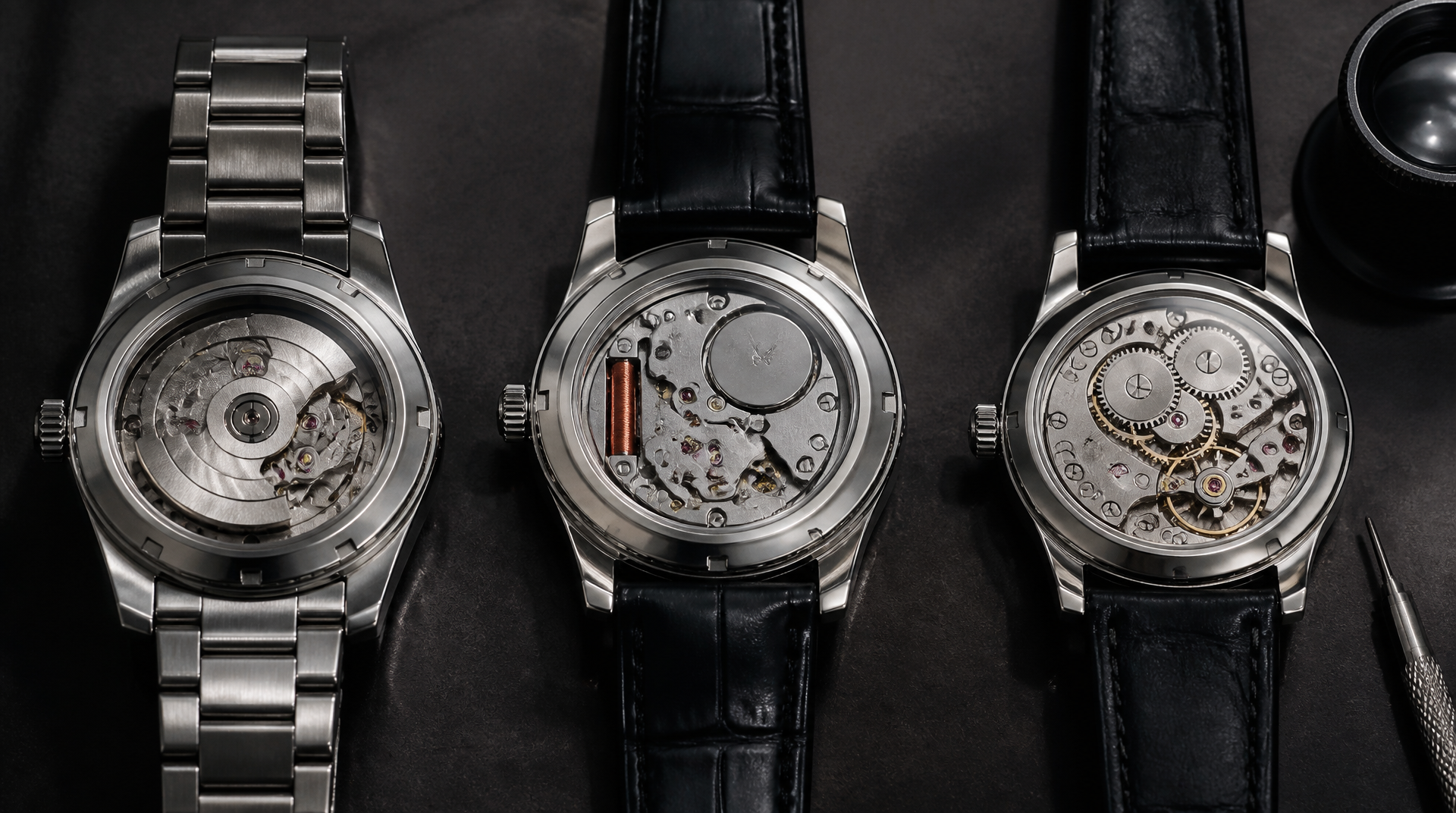
Automatic (self-winding mechanical) uses the motion of your arm to wind a mainspring. Typical accuracy is −5 to +15 seconds per day. You never replace a battery, but plan on a $200–$400 service every 5–7 years.
Manual mechanical (hand-wound) functions like an automatic without the self-winding rotor. You wind it by hand every day or two. It’s the thinnest of the three categories and appears most often in dress watches and vintage designs.
The practical implication: if your daily routine is mostly desk-bound and you wear the watch only for a few hours, an automatic can stop overnight. Quartz or manual then become safer picks because quartz doesn’t rely on arm motion and a manual can be fully charged in a few seconds of winding each morning. If you can’t tolerate drifting by a minute a week, rule out all mechanical movements entirely.
Comparison framework
| Movement type | How it runs | Typical accuracy | Maintenance cycle | Power reserve | Typical cost | Best for |
|---|---|---|---|---|---|---|
| Quartz | Electrical pulses through a quartz crystal | ±15–20 sec/month | Battery swap every 2–3 years (or none for solar) | 2–5 years on one battery | $10–$500+ | Set-and-forget reliability; solar quartz adds years of passive charging |
| Automatic | Rotor winds mainspring with arm motion | −5 to +15 sec/day | Service every 5–7 years ($200–$400) | 38–80 hours when fully wound | $200–$1,000+ | Enthusiasts who want a sweeping seconds hand and zero batteries |
| Manual mechanical | Crown tightens mainspring by hand | −10 to +20 sec/day | Service every 5–7 years ($200–$400) | 36–60 hours from full wind | $150–$800+ | Thin dress watches, vintage-style pieces, and owners who enjoy a daily winding ritual |
How to identify a movement in person (and why it matters)
You don’t need to open the case to confirm what’s inside. A few seconds of observation is enough to verify what you’re actually buying or already wearing.
1. Watch the seconds hand.
A sharp, once-per-second advance almost always means quartz. A continuous, fluid sweep (multiple small steps per second) is the hallmark of a mechanical movement.
2. Hold the watch to your ear.
Quartz movements produce a crisp electrical “tick” once per second. Mechanical movements tick faster—typically 6 to 10 times per second—so they sound like a rapid, smooth hum rather than discrete beats.
3. Check the case back and dial text.
Look for a marked case back or dial: “Quartz,” “Automatic,” or “23 Jewels” leaves little doubt. An unmarked watch that says nothing is usually quartz, but not always.
4. Try the winding feel (mechanical only).
On a manual watch, turning the crown meets even resistance and stops firmly when fully wound. An automatic usually has a slipping clutch that makes a quiet whirring sound or constantly slips, with no hard stop. This test helps you separate a manual from an automatic without seeing the rotor.
Verifying the movement type before buying prevents you from accidentally getting a manual watch when you expected an automatic, or assuming a watch is quartz because the seconds hand moves smoothly (some quartz movements sweep). If a seller can’t confirm, these four checks give you the answer.
Best-fit picks by use case
For anyone who wants to set it and forget it
Quartz is the clear answer. A solar Citizen Eco-Drive or a high-accuracy Seiko 8F56 perpetual calendar quartz will run for years without a battery swap and drift by only a few seconds a month. Even a basic Casio under $20 lives 7–10 years with nothing more than an occasional gasket check. If you travel across time zones often, a quartz watch with an independent hour hand makes quick changes trivial.
For the first mechanical watch experience
Entry-level automatics get the job done without costing a fortune to replace later. The Seiko 5 Sports line (4R36/4R35) and the Orient Kamasu/Mako (F6922) often drift −15 to +25 seconds per day out of the box. A minute or two of drift by the end of the week is normal.
A failure mode most beginners hit: expecting automatic accuracy to match quartz because it’s “mechanical and sophisticated.” It doesn’t. Quartz is objectively far more precise. Detect this early by tracking the watch over a full week. If a deviation of ±15 seconds per day bothers you more than the tactile joy of a sweeping seconds hand, you belong in quartz, not mechanical.
For a vintage feel with maximum case thinness
Manual-wind movements let designers build remarkably slim watches because there’s no rotor to stack. The Hamilton Khaki Field Mechanical and the JLC Reverso Classic both use hand-wound calibers to stay under 10 mm thick. These watches stop after 36–48 hours if you skip winding, so they’re a poor gift for someone who rotates a dozen watches or doesn’t understand the daily ritual.
When neither quartz nor cheap automatic feels right
High-accuracy quartz (HAQ) fills a gap most buyers don’t know exists. Movements like the Seiko 9F, Citizen Caliber 0100, and Longines V.H.P. achieve ±5 seconds per year while remaining entirely grab-and-go. They cost $300–$4,000 and deliver mechanical-level build quality without any accuracy compromise. If you want a watch that feels premium but refuse to accept daily drift, HAQ is the rational upgrade.
Trade-offs to know
Accuracy is the biggest surprise. A $15 quartz watch is approximately 60 times more precise than a $500 automatic. Treat a watch as a timing tool and quartz wins every round. In mechanical watches, the seconds-per-day drift is part of the character you’re buying.
Service costs don’t scale with purchase price. A $300 automatic will eventually need a $200–$400 service. Many owners skip it and simply buy a replacement watch, which means the “affordable mechanical” path can turn into a series of $300 throwaway purchases. Manual movements are mechanically simpler but still require full disassembly, cleaning, and oiling. Quartz owners face only a battery change—often under $20.
Power reserve dictates daily reality.
- Quartz: ignore it for months.
- Automatic: if you wear it for a full workday, it stays wound. Store it for two days and it stops unless you use a watch winder. A desk worker with modest wrist movement can find the watch dead by morning even after a 10-hour day.
- Manual: skip a day of winding and it’s dead. Some vintage manuals lack a hacking seconds hand, so setting the exact time is annoying. The daily winding ritual becomes a burden for anyone who thought they were buying a grab-and-go watch.
The “quartz tick” isn’t universal. While most quartz watches advance once per second, models like the Bulova Precisionist sweep continuously at 16 beats per second. Don’t dismiss quartz solely because you dislike the classic ticking seconds hand—smooth quartz exists.
Mismatch that frequently leads to returns and regret: giving a manual-wind watch as a birthday present without a five-minute explanation of winding and power reserve. The recipient puts it on, it stops overnight, and the watch is dismissed as broken. If the intended wearer isn’t enthusiastic about daily winding, an automatic or quartz is a safer gift.
Related questions
Does “automatic” mean there’s no battery at all?
Yes. An automatic watch is powered entirely by a mechanical mainspring wound by wrist motion, with no battery, solar cell, or capacitor in the movement.
Which is more accurate, quartz or mechanical?
Quartz is dramatically more accurate. A standard quartz movement drifts about 15–20 seconds per month, while mechanicals drift that much in a single day. Even a basic quartz watch is 30–60 times more exact than a well-regulated mechanical.
Do all quartz watches tick once per second?
No. Some models use a continuously sweeping seconds hand, such as the Bulova Precisionist or the Grand Seiko Spring Drive (a hybrid often grouped with quartz-like precision). However, the one-second tick remains the most common quartz behavior.
Will a manual-wind watch survive if I forget to wind it for a weekend?
Most manual watches have a 36–60 hour power reserve. If you wind it on Friday evening, it will likely stop by Sunday afternoon or Monday morning. A watch winder won’t help because manual movements cannot be wound automatically.
How much does it cost to service an automatic movement?
Budget $200–$400 every 5–7 years for a standard service that covers cleaning, lubrication, and gasket replacement. For entry-level automatics with movements like the Seiko NH35, replacing the entire watch often makes more economic sense than servicing.
Explore This Topic
- Back to General
- Back to Movement Types
Related guides in this cluster:
- How Much Does Watch Service Cost? Complete Brand-by-Brand Breakdown
- Watch Size Guide: How to Choose the Right Case Diameter, Thickness & Fit
- Watch Water Resistance Guide: What 30m, 50m, 100m & 200m Actually Mean

The We Know Watches editorial team brings together over 40 years of combined watch collecting, trading, and repair experience. Our editors have owned and handled watches from every major brand — from entry-level Seiko 5s to Rolex, Omega, Patek Philippe, and independent Swiss watchmakers. We’ve bought and sold at auction, worked with authorized dealers, visited manufacturing facilities in Switzerland and Japan, and serviced hundreds of movements ranging from the Seiko 7S26 to the Longines L888. Every guide and review we publish is based on hands-on experience, original research, and consultation with professional watchmakers. We do not accept payment for reviews, and we clearly disclose when we use affiliate links.