
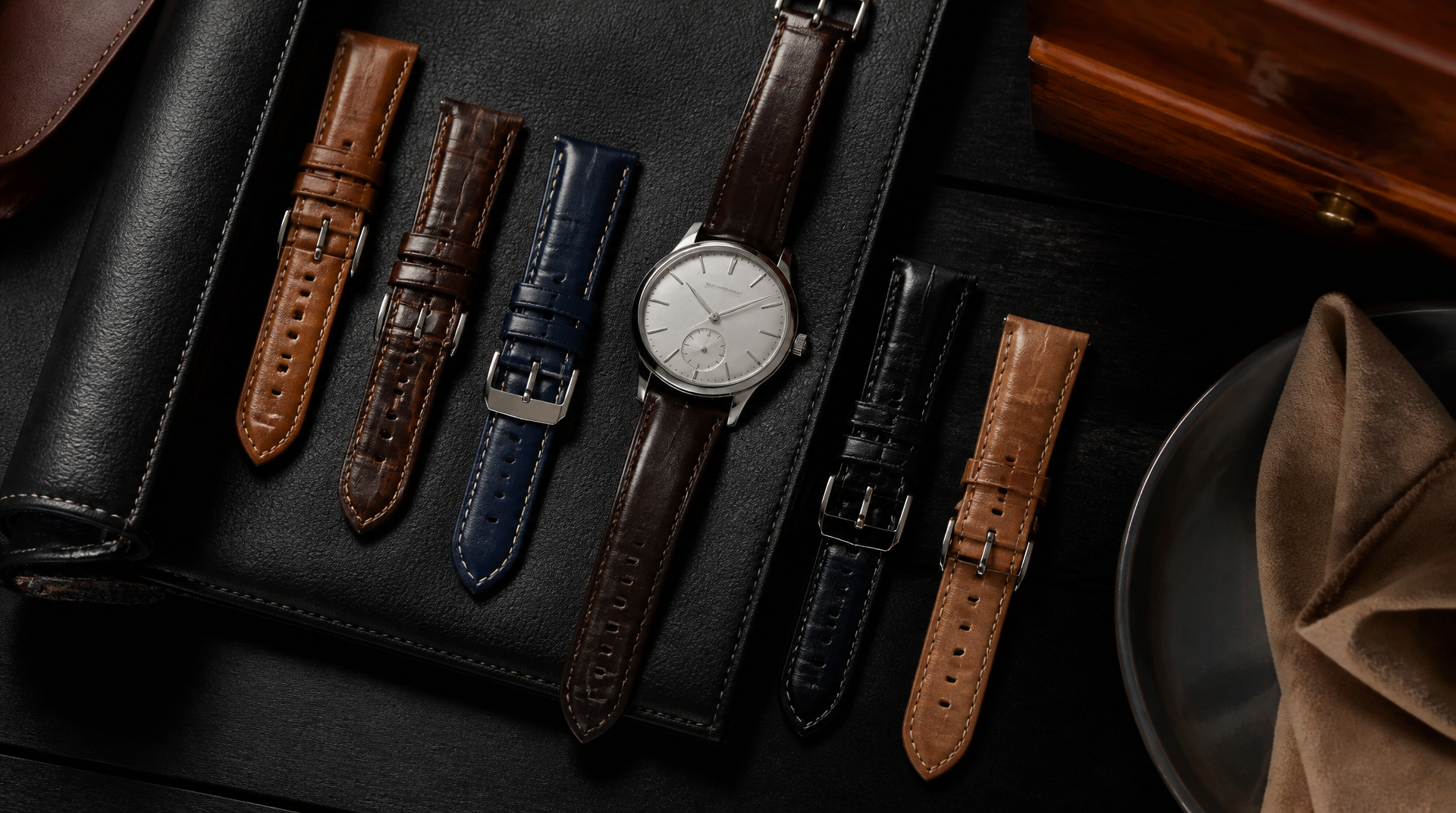
A leather strap changes the character of a watch in seconds, but the real difference between a strap that lasts two years and one that falls apart in six months comes down to three things: the leather type, the hidden construction details, and a care routine that matches how you actually wear it. This guide covers the main materials, what to look for in a well-made strap, and a step-by-step maintenance system you can start today.
Leather Strap Types at a Glance
| Strap Type | Key Material | Look | Durability | Water Tolerance | Typical Price Range | Best For |
|---|---|---|---|---|---|---|
| Calfskin | Top-grain or full-grain cowhide | Smooth, uniform, finishes from matte to high-shine | Medium | Low—keep away from water | $30–$150 | Everyday wear, office, dress watches |
| Shell Cordovan | Horse rump membrane | Glossy, virtually no creasing, deep dye | High | Low, but dense fibers resist moisture better than calfskin | $150–$300 | Premium dress and heritage watches |
| Alligator / Crocodile | Genuine exotic hide | Large, pronounced scale pattern | High (with a quality lining) | Very low—water can lift scales | $200–$500+ | Luxury dress watches, special occasions |
| Lizard | Lizard skin | Fine, uniform grain, very lightweight | Medium (tears easily at lug holes) | Low | $80–$200 | Slim dress watches under 8 mm |
| Suede | Split leather with napped finish | Matte, soft, casual | Medium (stains quickly) | Very low—water leaves permanent dark spots | $40–$120 | Casual and field watches |
| Nubuck | Full-grain leather sanded to a velvety surface | Like suede but denser | Medium | Low, slightly more water-tolerant than suede | $60–$150 | Casual, vintage-inspired watches |
| Bund / Rally | Calfskin or suede with extra pad or perforations | Vintage motorsport look | Medium | Low | $50–$200 | Chronographs, vintage tool watches |
Calfskin: The Everyday Standard
Calfskin is the leather strap you’ll see most often. Most production straps use top-grain calfskin with an embossed or painted surface that resists scuffs and holds consistent color. Full-grain calfskin—which keeps the hide’s natural outer layer—is rarer but develops a noticeable patina after a few months of wear, deepening in color around the lug holes and along the flex points.
Horween’s Chromexcel and French waxed-calf from tanneries like Haas are benchmarks in the strap world. A Chromexcel calfskin strap starts with a slight pull-up effect and, after six months, looks richer than when new. If you want a strap that evolves, pick full-grain vegetable-tanned calfskin and be prepared to condition it quarterly; if you want a clean, consistent look that resists stains straight out of the box, top-grain chrome-tanned calfskin is the safer bet.
Shell Cordovan: The Heirloom Choice
Shell cordovan comes from a dense membrane under the horse’s rump, not the outer hide. The material doesn’t crease like calfskin—it rolls into soft undulations—and holds a deep, glassy color that polishes with wear. Horween is the standard here; a single shell cordovan strap can run $200–$300, but it resists cracking for years and never develops the fine wrinkles that age lesser leathers.
Shell cordovan absorbs less moisture than calfskin, but it is not waterproof. It still darkens if soaked repeatedly. For a strap you plan to own for a decade and want to see gain character without falling apart, shell cordovan is the material. Avoid it if you expect to sweat heavily or get caught in rain often—the upfront cost won’t protect you from neglect.
Exotics: Alligator, Crocodile, and Lizard
Genuine alligator and crocodile straps show a distinctive scale pattern that varies in size from the hornback (larger, along the spine) to the belly (more uniform). Legitimate exotic straps ship with CITES certification for international transit. A well-made alligator strap from a specialist like Jean Rousseau or Camille Fournet can cost $300–$500, and the structure relies heavily on a stable lining; water that soaks through to the hide can cause scales to lift permanently.
Lizard skin is finer and lighter. It works best on thin dress watches under 8 mm. Because lizard is more fragile than alligator, any tear around the lug holes spreads fast—check for even, tight stitching at those points when you inspect the strap.
Textured Leathers: Suede and Nubuck
Suede is a split leather with an intentionally fuzzy finish. It absorbs water like a sponge and stains the moment a droplet hits. Nubuck starts as full-grain leather sanded on the grain side, so it feels velvety but is denser and slightly more water-tolerant. Both belong on casual or field watches, and neither should be worn if you frequently wash your hands without removing the watch.
A hydrophobic spray designed for untreated leather (such as those made for suede footwear) can buy you some protection. Apply it in thin coats, let it dry, and reapply every two to three weeks if you wear the strap daily. Even then, expect some darkening over time.
Specialty Designs: Bund, Rally, and NATO-Style Leather
A Bund strap adds a leather pad between the caseback and your wrist—originally for pilot insulation. It adds bulk, so if your watch already sits tall, a Bund can make it ride uncomfortably. Rally straps use large perforations inspired by racing gloves; they breathe better but offer no water resistance. NATO-style leather straps run a single piece under the spring bars, letting you swap in seconds without tools, though the extra layer underneath adds thickness.
What Separates a Cheap Strap from a Quality One
Material Grade: Full-Grain vs. Top-Grain vs. “Genuine Leather”
Full-grain leather leaves the hide’s original surface intact, preserving the tightest, most durable fiber structure. It feels stiff at first and shows natural grain marks, but it develops patina and strengthens with conditioning. Top-grain leather has the outermost layer sanded away to remove imperfections, then is often embossed and coated. It looks more uniform out of the box but won’t age with the same depth.
Beware straps labeled only “genuine leather.” That term often means a bonded or heavily corrected split leather that contains ground leather scraps pressed together with adhesive. These straps peel and flake within months of daily wear.
Tanning Process: Vegetable vs. Chrome
Vegetable-tanned leather uses natural plant tannins, resulting in a firmer leather that darkens with sunlight and body heat. It’s the choice if you want a strap that tells a story. Chrome-tanned leather uses chromium salts, making the leather softer, more pliable, and less reactive to sweat. For consistent color and slightly better moisture resistance, chrome-tan wins; for character and patina, vegetable-tan is the answer.
Lining and Padding
The underside of a strap affects breathability and sweat resistance. Calfskin linings feel soft but absorb moisture. Alcantara or microfiber linings wick sweat and resist staining. Rubberized or synthetic waterproof membranes block sweat entirely—better for hot, humid climates.
Padding thickness at the lug end typically runs 2.5–3.5 mm, tapering to about 2 mm near the buckle holes. A strap that stays thick all the way to the tip looks bulky under a cuff; a smooth taper is a sign of careful construction.
Stitching and Edge Finishing
Premium straps use tight, consistent stitches with no loose threads. Hand-saddle stitching—recognizable by its slight zigzag—won’t unravel if a single stitch breaks, while cheap machine lock stitches can run and separate. Edge finishing is just as telling: layered edge paint that is then burnished and sealed feels smooth, while a raw edge that’s simply painted with a single dye layer cracks early. Some high-end straps from makers like Jean Rousseau use a multi-layer hot-crease finish that stays round and glossy for years.
Hardware: Buckles and Quick-Release Bars
Solid stainless steel buckles resist corrosion; plated brass buckles eventually flake. Quick-release spring bars make strap changes tool-free, but budget versions can bend under moderate tension. Check that the release lever sits flush and moves with a firm, smooth action. For dress watches, a deployant clasp reduces the daily bending stress on the leather and can extend the strap’s life.
How to Choose a Strap That Survives Your Lifestyle
The single factor that changes the whole recommendation is moisture. If you wash your hands dozens of times a day, sweat heavily, or live somewhere humid, an unlined vegetable-tanned calfskin strap will stain, stiffen, and possibly develop mildew within months. For that environment, choose a chrome-tanned leather on a waterproof rubber or synthetic lining. It won’t develop the same dramatic patina, but it’ll survive daily life without turning brittle.
If you treat the strap as part of a rotation and can keep it dry, full-grain vegetable-tanned leather rewards you with deepening color and a molded fit every time you wear it. A second constraint is how often you swap straps. If you change them daily, quick-release spring bars are worth the cost. If one strap stays on the watch for weeks, standard spring bars are fine.
Leather Strap Care: A Practical Weekly and Quarterly System
What You Need
- Clean, dry microfiber cloths (dedicated to leather, not used with polish)
- Lukewarm water and a second soft cloth you can wring until no drips remain
- Saddle soap (if the strap has visible salt or sweat stains)
- A leather conditioner that breathes, such as Bickmore Bick 4 or Saphir Renovateur (avoid heavy wax-based products that seal the surface and prevent the leather from absorbing moisture)
- A watch strap changing tool or spring-bar tool to remove the strap safely
Weekly Light Care: 2 Minutes
1. Remove the strap from the watch case.
Checkpoint: If you notice salt residue or oil on the underside, your wrist chemistry is building up faster than a weekly wipe can handle—move to a deeper clean within a few days.
2. Wipe the entire strap—top, sides, and lining—with a dry microfiber cloth. Buff gently until surface oils disappear.
3. Let the strap air out away from direct sunlight for a few hours. Rotating between two straps gives each a full day to dry.
Quarterly Deep Clean and Conditioning: 20 Minutes
1. Remove the strap from the watch and lay it flat on a clean surface.
Do not submerge the strap in water or run it under a faucet.
2. Dampen a cloth with lukewarm water and wring it thoroughly so no water drips. Wipe the entire strap, including the lining, to lift surface dirt and sweat residue.
3. If you see visible sweat stains or a whitish salt crust, take a pea-sized amount of saddle soap on a damp cloth, work it into a light lather in your palm, and clean the affected areas. Wipe away all residue immediately with a separate damp cloth.
4. Apply a small amount of leather conditioner—use a dab about the size of a pea—on a soft cloth. Massage it into the leather with circular motions. Work it across the top surface, edges, and along the lug end where the leather flexes most. Avoid heavily saturating the stitching; conditioner can loosen glued thread channels over time.
5. Let the conditioner absorb for 15 minutes, then buff the strap with a clean, dry microfiber cloth until the surface feels smooth and no longer tacky.
6. Reattach the strap only when both sides are completely dry to the touch, ideally after sitting overnight in a room-temperature spot away from heat sources.
Success check: The strap should feel supple, not greasy. A uniform darkening rather than patchy stains is normal, especially on vegetable-tanned leather. If the strap feels sticky after buffing, you used too much conditioner—wipe again with a dry cloth until the tackiness disappears.
Emergency Water Exposure Handling
- Light splashes: Blot dry immediately and let the strap air-dry at room temperature. Never use a hair dryer, radiator, or direct sun—uneven heat causes the leather to shrink and crack.
- Saltwater or heavy sweat: Rinse the strap briefly with fresh lukewarm water, blot dry thoroughly, and apply conditioner once it is fully dry.
- Suede or nubuck after a spill: Blot (don’t rub) with a clean cloth, then, once fully dry, use a suede brush to lift the nap. Expect some permanent dark spots.
Common Care Mistakes That Shorten Strap Life
- Mistake: Using household leather wipes or shoe polish.
Why it matters: Those products often contain heavy waxes or alcohol that dry out the fibers or seal the pores, preventing the strap from breathing.
Fix: Stick to a conditioner designed for smooth upholstery or fine leather—look for pH-balanced, water-based formulas with no silicone.
- Mistake: Conditioning the strap while it’s still damp.
Why it matters: Trapped moisture under conditioner can encourage mildew inside the lining.
Fix: Always let the strap dry completely before conditioning.
- Mistake: Soaking a strap in water to “deep clean” it.
Why it matters: Full submersion swells the leather, weakens adhesive layers, and can permanently distort the shape.
Fix: Only use a wrung-damp cloth, never a running tap.
When to Stop DIY and Replace the Strap
Stop conditioning and replace the strap immediately if you see any of these signs:
- Deep cracks that expose the inner fibers near the lug holes or buckle holes. These can tear through suddenly, dropping the watch.
- Hard, glazed areas that no longer soften after a full conditioning cycle. The leather has lost its structural integrity.
- Mold growth on or inside the lining that doesn’t wipe away completely. Once mold spreads into the leather itself, no surface cleaning will kill it.
- Stitching that is broken in multiple places, allowing the layers to separate. A strap that is separating at the lug end cannot hold the watch securely.
Exotic straps with lifting scales or torn lizard skin at the lug holes are also past safe care. If the strap is valuable (e.g., factory-issued alligator from the watch brand), a leather restoration specialist may be able to replace the lining or reinforce the lug holes, but for most owner situations, replacement is the safer and more cost-effective path.
A strap that is cleaned and conditioned on schedule can last two to four years of regular wear. Shell cordovan and well-lined exotics often run longer; heavily worn suede or unlined calfskin may need replacement in under a year. Rotating straps, keeping them dry, and acting before cracks appear are the simplest ways to extend the life you get from a quality leather strap.
Explore This Topic
- Back to General
- Back to Leather Straps
Related guides in this cluster:
- Watch Crystal Types: Sapphire vs Mineral vs Acrylic — Complete Comparison
- Why Your Automatic Watch Keeps Stopping: Complete Troubleshooting Guide
- How Often Should You Service a Watch? Complete Service Interval Guide by Brand

The We Know Watches editorial team brings together over 40 years of combined watch collecting, trading, and repair experience. Our editors have owned and handled watches from every major brand — from entry-level Seiko 5s to Rolex, Omega, Patek Philippe, and independent Swiss watchmakers. We’ve bought and sold at auction, worked with authorized dealers, visited manufacturing facilities in Switzerland and Japan, and serviced hundreds of movements ranging from the Seiko 7S26 to the Longines L888. Every guide and review we publish is based on hands-on experience, original research, and consultation with professional watchmakers. We do not accept payment for reviews, and we clearly disclose when we use affiliate links.