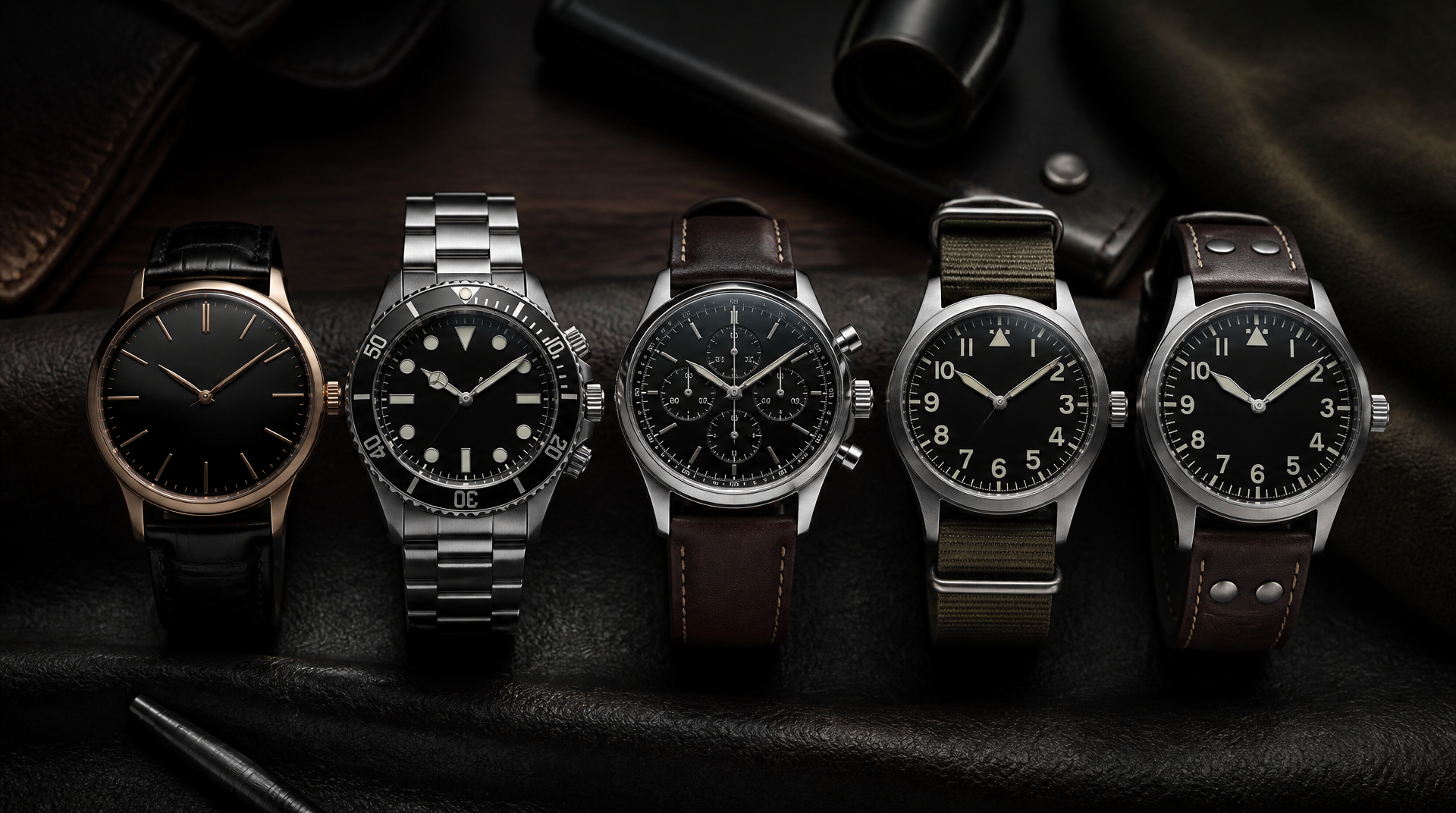
Five core styles—dress, diver, chronograph, field, and pilot—cover nearly every versatile mechanical watch you’ll actually wear. Each started around a specific functional job, and that job still shapes the proportions, dial layout, and hardware you see on current models.
Here’s the insight most roundups skip: the most practical everyday timer isn’t the one with two pushers and three subdials. A dive watch’s unidirectional bezel handles the short-interval timing people actually need—parking meters, coffee brews, meetings—faster, with no added service complexity, and zero risk of accidentally leaving a chronograph running and draining the power reserve. Keep that in mind as you work through the styles.
| Style | Defining Functional Trait | Typical Case Size | Minimum Water Resistance | Iconic Example |
|---|---|---|---|---|
| Dress | Time-only, ultra-thin to slide under a shirt cuff | 34–40 mm | 30 m (100 ft) | Patek Philippe Calatrava 5196 |
| Diver | Unidirectional elapsed-time bezel, ISO 6425 certified | 40–42 mm | 200 m (660 ft) | Rolex Submariner 124060 |
| Chronograph | Stopwatch function with subdials and pushers | 38–42 mm | 50–100 m (165–330 ft) | Omega Speedmaster Professional |
| Field | High-contrast legible dial, often with 24‑h track | 36–40 mm | 50–100 m | Hamilton Khaki Field Mechanical |
| Pilot | Oversized case, large Arabic numerals, triangle at 12, onion crown | 40–46 mm | 50–100 m | IWC Big Pilot 43 |
What Makes a Dress Watch Different
A dress watch subtracts everything that isn’t time-only. Case thickness runs around 6–8 mm so it disappears under a double cuff; the dial carries hours, minutes, and sometimes small seconds. No lume, no rotating bezel, no date window that disrupts symmetry on a black- or white-dial layout. The strap is alligator or calf, never a bracelet, and the case is typically polished steel, rose gold, or platinum.
That slimness is mechanically expensive. The Jaeger‑LeCoultre Calibre 849 in the Master Ultra Thin stands just 1.85 mm tall. Building a movement that thin demands tighter tolerances, ballet‑thin mainsprings, and jewel counts that leave almost no room for shock absorption beyond what the case provides. An ultra‑thin dress watch is, per gram, a more difficult engineering exercise than a 300‑meter dive watch.
The realistic risk with a dress watch is water ingress from unexpected sources. A push‑pull crown on a 30‑meter‑rated case has no gasket seal at the crown tube. Rain, a splash from a sink, or extended high humidity can push moisture past the crown, fog the crystal, and corrode hands within weeks. For the same reason, never tighten the strap and call it a pool watch. A dress watch belongs indoors; if you need a piece that handles weather, a diver or field watch is the safer call.
The Dive Watch’s Secret Superpower
Ask someone why they own a dive watch and they’ll usually say water resistance, legibility, or a tool‑watch look. All true, but the hardware that earns its keep every day is the timing bezel. Twist it to align the zero marker with the minute hand, and you have a 60‑minute countdown timer with no pushers to press and no running chronograph seconds to forget. It’s the least maintenance‑heavy timer in watches.
A proper dive bezel is unidirectional and graduated in minutes for the first 15 or 20, then five‑minute increments. ISO 6425 mandates that a dive watch survive 125% of its rated depth, handle magnetic fields, thermal shock, and a hard shock test. Contemporary examples like the Seiko SPB143 or Rolex Submariner 124060 stick to those rules. They also deliver bright lume, a screw‑down crown, and a legible handset that works underwater—but those traits translate just as well to the office.
How to verify a true ISO diver: look for “DIVER’S WATCH” printed on the dial and confirm that the bezel rotates only counter‑clockwise with a clear 60‑minute scale. A watch that omits either marking or has a bidirectional bezel wasn’t tested to the ISO standard and shouldn’t be trusted beyond surface swimming.
The overkill that matters almost never: a helium escape valve. It serves zero purpose outside a hyperbaric chamber. If you’re buying a diver for daily wear, a missing valve is an advantage; a valve adds an extra seal that can fail during a pressure test, and it leaves a permanent hole in the case side. For anything short of saturation diving, choose a diver without one.
Chronographs: More Than a Stopwatch
A chronograph adds start/stop/reset pushers and a cluster of subdials that track elapsed seconds, minutes, and hours. The central chronograph seconds hand sweeps when you push the top pusher; the bottom pusher resets it all to zero. Many dials layer on a tachymeter scale for speed over distance, or telemeter and pulsometer scales for niche medical and artillery use.
Iconic chronographs carry real functional bloodlines. The hand‑wound Omega Speedmaster Professional (Calibre 3861, descendant of the Cal. 321 that went to the Moon) was built for timing engine burns, not looking handsome at a dinner party. Breitling’s Navitimer embeds a circular slide‑rule bezel that performs fuel‑burn and climb‑rate calculations—useful in a cockpit, if you still fly with a chart table.
The counter‑intuitive trade‑off: a chronograph movement is a brick inside the case. Even a column‑wheel chronograph adds roughly 2 mm of thickness and about 50 extra components compared to a time‑only caliber from the same manufacturer, raising service costs by 30–50% and tightening service intervals to roughly 5–7 years. If you never time laps or runs, you’re paying that penalty annually. Parking‑lot countdowns, cooking timers, and meeting clocks are a one‑twist bezel task—no second hand running to drain amplitude, no partially depressed pusher to foul the mechanism. A chronograph is the right choice only if you actively record elapsed intervals, not if you just want a handsome case with some extra dial furniture.
Field Watches Built for the Ground War
A field watch descends directly from 1940s military specifications. The US A‑11 and the British WWW “Wrist Watch Waterproof” demanded a case no larger than about 34 mm by modern measure, a high‑contrast dial, a 24‑hour inner track for Zulu time, robust lume, and a movement that held ±30 seconds per day in the field. Every modern field watch that matters borrows from that blueprint.
The Hamilton Khaki Field Mechanical (38 mm, H‑50 caliber, 80‑hour power reserve) keeps the syringe hands, the railroad minute track, and the bead‑blasted case. It purposely omits a date window to maintain the clean dial hierarchy that makes reading time at night or under stress fast. CWC’s G10, issued to British forces for decades, remains a plastic‑cased fixed‑bar design with a simple quartz movement and a dial so stark it’s nearly typographic.
A field watch is the natural choice when absolute legibility matters and you want something smaller and quieter than a pilot watch. It takes NATOs, canvas, or simple leather without complaint, and its modest water resistance—usually 50–100 m—handles rain and handwashing gracefully. However, field watches rarely have a screw‑down crown; a 50 m rating means no swimming, and the gaskets should be pressure‑tested annually if the watch sees wet conditions. For a truly waterproof daily, step up to a diver. Also verify crystal type: a sub‑$150 field watch with a mineral crystal will pick up scuffs quickly. If you plan to wear it outdoors year‑round, a sapphire crystal knocks that failure mode out entirely.
Why Pilot Watches Are So Large
Early pilot watches weren’t designed to fit under a cuff. The 55 mm B‑Uhr (Beobachtungsuhr) issued to Luftwaffe navigators sat over a flight jacket, and an oversized onion crown let gloved fingers set the time without removing the watch. A matte black dial with stark white Arabic numerals and a triangle at 12 gave instant orientation in a dark cockpit.
Modern flieger watches from Stowa, Laco, and IWC preserve that DNA. The IWC Big Pilot 43 uses a soft‑iron inner cage to resist magnetic interference from cockpit avionics, and that still‑large crown—often push‑pull rather than screw‑down, because gloved screwing is clumsy—stands as a direct functional inheritance. The case is purposefully austere, with a brushed finish that kills reflections.
The downside is pure wrist‑real‑estate math. At 43 mm and above with long lugs, a pilot watch overhangs on wrists under 7 inches. The onion crown digs into the back of the hand when you flex upward, and the watch looks like a clock strapped on. Before buying, verify fit: measure your wrist across the flat top (width, not circumference) and compare it against the manufacturer’s stated lug‑to‑lug distance. If the lug‑to‑lug exceeds your wrist width by more than 3 mm, the watch will hang over the edges and feel unstable on a single‑pass strap.
When you need the legibility but can’t support the span, move to a 40 mm flieger (Stowa Flieger 40) or the IWC Mark series, which compresses pilot DNA into a 40–41 mm case with a date window—it’s a pilot watch that doubles as a field watch’s larger sibling.
Choosing a Style That Fits Your Life
Stop chasing the one watch that does everything; start by selecting the style that matches your most frequent environment, then compromise out from there.
- You wear tailoring more than once a month: a slim dress watch is the only piece that slides under a double cuff without catching. If you demand a complication, a manually wound small‑seconds piece like the Grand Seiko SBGW231 keeps the profile under 12 mm and stays visually quiet.
- Your day is casual, with a lot of short‑interval timing: a dive watch pays rent with its bezel every day. You’ll use it more than a chronograph, and servicing stays predictable.
- You need a rugged daily that disappears on wrist: a 38 mm field watch is lighter, cheaper, and more straightforward than any diver or pilot. It pairs with everything short of a tuxedo.
- Legibility is job‑critical and your wrist can carry size: a pilot watch gives you the fastest read, day or night. If you ride motorcycles, fly small aircraft, or work in low‑light conditions, the oversized numerals earn their place.
- You want one piece that signals mechanical depth: a chronograph provides visible proof of a complex movement, and if you’ll actually time things like heart rate, kettlebell intervals, or speed over distance, it’s the one that does it natively.
The practical implication for your next purchase is simple: buy the watch whose single‑core function you’ll actually use daily, not the one whose complication list looks most impressive. If you already own a watch, identify its style by checking the crown type, bezel function, water‑resistance rating, and lume—then use that to set hard boundaries. A dress watch’s 30 m rating means no pool, no sea, no pressure washer; it’s a liability in wet environments.
A diver with a timing bezel is the smarter daily timer than a chronograph for 90% of users. The real trick isn’t buying a hybrid that claims to do everything—it’s knowing that a tool watch dressed up works far better than a dress watch forced into tool duties. A dive watch on a high‑quality leather strap sits at a boardroom table without a second glance; a dress watch on a NATO strap just looks confused.
Hybrid Designs and When the Lines Blur
Few modern watches stay inside a single category. You’ll see dive watches with chronograph modules (Omega Seamaster Diver 300M Chronograph), chronographs with pilot‑scale slide‑rule bezels, and field watches that carry a GMT hand. These hybrids aren’t wrong; they just add a second set of design obligations that sometimes conflict. A chronograph diver, for instance, has pushers that need to function at depth, which adds bulk and sealing cost. A pilot watch with a GMT hand becomes a traveler’s tool, but the large case and sterile dial layout may make it less useful as a pure pilot reference.
When the Style Label Misleads You
Style names are marketing shorthand, not guarantees. A $120 “diver‑style” fashion watch with a push‑pull crown and 50 m water resistance shares none of the engineering of an ISO‑rated diver and shouldn’t go near a pool. Vintage watches add another layer: a 1960s dive watch might no longer seal to its rated depth unless its gaskets and crystal have been freshly replaced and pressure‑tested, and a grainy “pilot” dial without antimagnetic protection is just design language.
If you’re buying online, ignore the style tag and verify the three specs that actually define the category: water resistance rating and crown type, bezel function (if any), and lume quality. A watch that lacks a screw‑down crown, bright lume, and a clearly marked rotating bezel isn’t a tool watch regardless of what the seller calls it.
FAQ
Can a chronograph also serve as a dress watch?
Only a few thin split‑seconds chronographs, like the A. Lange & Söhne 1815 Chronograph, come close to formal dress proportions. Most chronographs are too thick and busy to sit under a shirt cuff without friction.
How much water resistance is enough for daily wear?
50 m (165 ft) handles rain and handwashing, but 100 m (330 ft) is the safe floor for swimming. Anything you’d take into salt water or below a pool surface should meet the 200 m (660 ft) diver standard.
Is a field watch just a small pilot watch?
No. Field watches are smaller, lack the oversized onion crown, and use a more subdued dial without the prominent triangle at 12. Some IWC Mark‑series pieces blur the boundary, but the lineages are distinct.
Do I need a helium escape valve on a dive watch?
Not unless you saturation dive in a hyperbaric chamber. For recreational diving and daily wear, a helium valve adds no practical benefit and introduces an extra potential failure point.
Explore This Topic
- Back to General
- Back to Watch Styles
Related guides in this cluster:
- Automatic vs Quartz vs Manual: Watch Movements Explained for Beginners
- Watch Crown Types Explained: Screw-Down, Push-Pull & Quick-Set Crowns
- How Much Does Watch Service Cost? Complete Brand-by-Brand Breakdown

The We Know Watches editorial team brings together over 40 years of combined watch collecting, trading, and repair experience. Our editors have owned and handled watches from every major brand — from entry-level Seiko 5s to Rolex, Omega, Patek Philippe, and independent Swiss watchmakers. We’ve bought and sold at auction, worked with authorized dealers, visited manufacturing facilities in Switzerland and Japan, and serviced hundreds of movements ranging from the Seiko 7S26 to the Longines L888. Every guide and review we publish is based on hands-on experience, original research, and consultation with professional watchmakers. We do not accept payment for reviews, and we clearly disclose when we use affiliate links.