
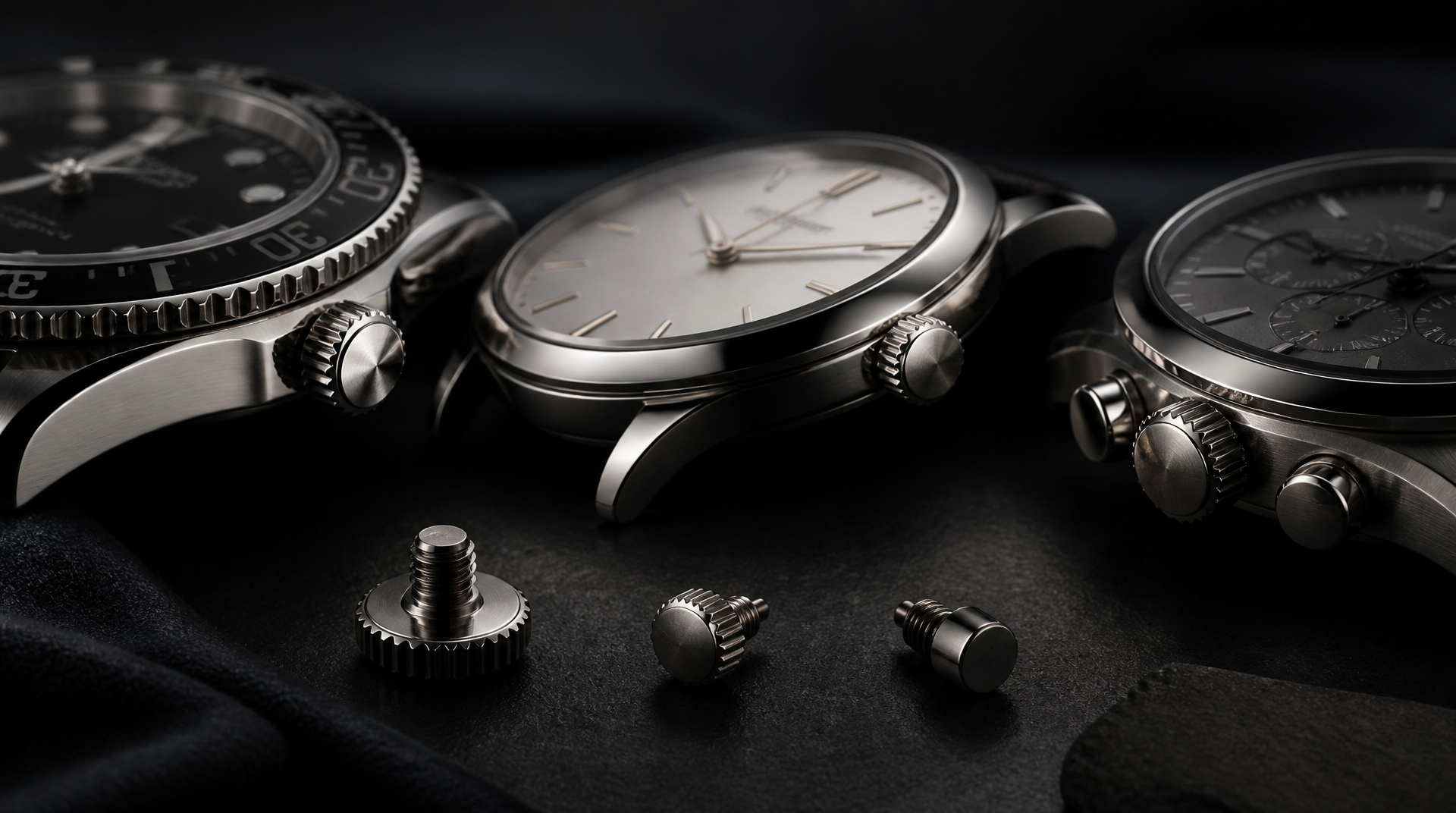
A watch crown is the most common entry point for moisture and grit. Screw-down crowns lock the case shut with threads and a compressed gasket, push-pull crowns rely on friction seals, and a quick-set position lets you advance the date without sweeping the hands through midnight. Knowing which design you’re dealing with changes how you operate it, how you catch a failing seal, and how you approach a replacement.
Three Crown Designs at a Glance
The quick-set isn’t a separate crown body—it’s a movement feature—but it’s often grouped with the two physical crown styles.
| Crown Type | How It Seals | Typical Water Resistance | Common on | Operation |
|---|---|---|---|---|
| Screw-down | Crown threads onto an external case tube; an o-ring or gasket inside the crown or tube compresses to form a seal. | 100 m to 1,000 m+ | Dive watches (Rolex Submariner, Seiko SKX007, Tudor Black Bay), most modern chronographs | Unscrew first, then pull to positions; screw back in after setting. |
| Push-pull | Friction-fit stem sealed by one or more gaskets inside the crown or case tube. |
No threads. | Usually 30–50 m; a few reach 100 m with multiple gaskets | Dress watches, vintage pieces, field watches (Omega Speedmaster Professional, Seiko 5 Sports) | Pull to positions, push home when done. |
| Quick-set position (feature) | No additional seal—relies on the crown type above. | Not a sealing feature | Watches with date complications (ETA 2824-2, Miyota 9015, Seiko NH35) | Pull to first click (or push a recessed button) to advance date rapidly. |
Screw-Down Crowns: The Threaded Seal and Its Failure Signs
A threaded tube protrudes from the case; the crown screws onto it like a nut. When properly tightened, the gasket compresses against the tube or inside the crown, forming a static seal. The Rolex Triplock system uses three separate o-rings for extreme depth ratings, but most screw-downs rely on a single rubber gasket.
Failure usually announces itself before water gets in. Cross-threading is the number‑one owner‑caused failure (covered in detail below). Other signals: the crown no longer threads down fully, it wobbles when seated, or you feel a gritty half‑turn every time you screw it in. If you inspect the gasket under a loupe and it looks flattened or cracked, replace it immediately—even if the crown still feels snug.
Push-Pull Crowns: Friction Seals and Hidden Leaks
Push‑pull crowns keep the seal simple: no threads, just a stem sliding through one or more gaskets. The Omega Speedmaster Professional uses this design, with the seal sitting inside the smooth case tube. Because the seal depends on constant friction, water resistance is lower and more sensitive to wear.
The failure you’re most likely to miss: a gasket that still holds the crown in place but has lost its spring. You’ll feel the crown seat with a soft click, but under a loupe the rubber looks shiny and smooth instead of matte and slightly proud. That gasket won’t stop a splash when you wash your hands. If you see fog inside the crystal after light exposure, stop wearing the watch immediately, open the caseback to dry it, and replace the crown gasket (or the whole crown if the gasket is molded in).
Quick-Set: The Movement Function, Not a Crown Type
A quick‑set is a mechanism inside the movement, not a sealing part. On an ETA 2824-2, position 1 winds the mainspring, position 2 quick‑sets the date (clockwise), and position 3 sets the time. When the quick‑set feels gritty or the date wheel refuses to jump, the fault can be a worn intermediate wheel or a broken yoke spring—but after a crown replacement, a misaligned or too‑short stem is the likeliest culprit.
The Mistake That Kills Water Resistance: Cross-Threading
Cross‑threading happens when you force the crown back on while the threads aren’t perfectly aligned. The soft metal threads of the crown or case tube chew each other up. Once damaged, the crown can’t form a seal—and you usually won’t know until moisture fogs the crystal.
Early detection signals
- The crown feels gritty or resists turning during the first half
Explore This Topic
- Back to General
- Back to Crown Types
Related guides in this cluster:
- Automatic vs Quartz vs Manual: Watch Movements Explained for Beginners
- Watch Crystal Types: Sapphire vs Mineral vs Acrylic — Complete Comparison
- Leather Watch Strap Guide: Types, Quality Grades & How to Care for Them

The We Know Watches editorial team brings together over 40 years of combined watch collecting, trading, and repair experience. Our editors have owned and handled watches from every major brand — from entry-level Seiko 5s to Rolex, Omega, Patek Philippe, and independent Swiss watchmakers. We’ve bought and sold at auction, worked with authorized dealers, visited manufacturing facilities in Switzerland and Japan, and serviced hundreds of movements ranging from the Seiko 7S26 to the Longines L888. Every guide and review we publish is based on hands-on experience, original research, and consultation with professional watchmakers. We do not accept payment for reviews, and we clearly disclose when we use affiliate links.