
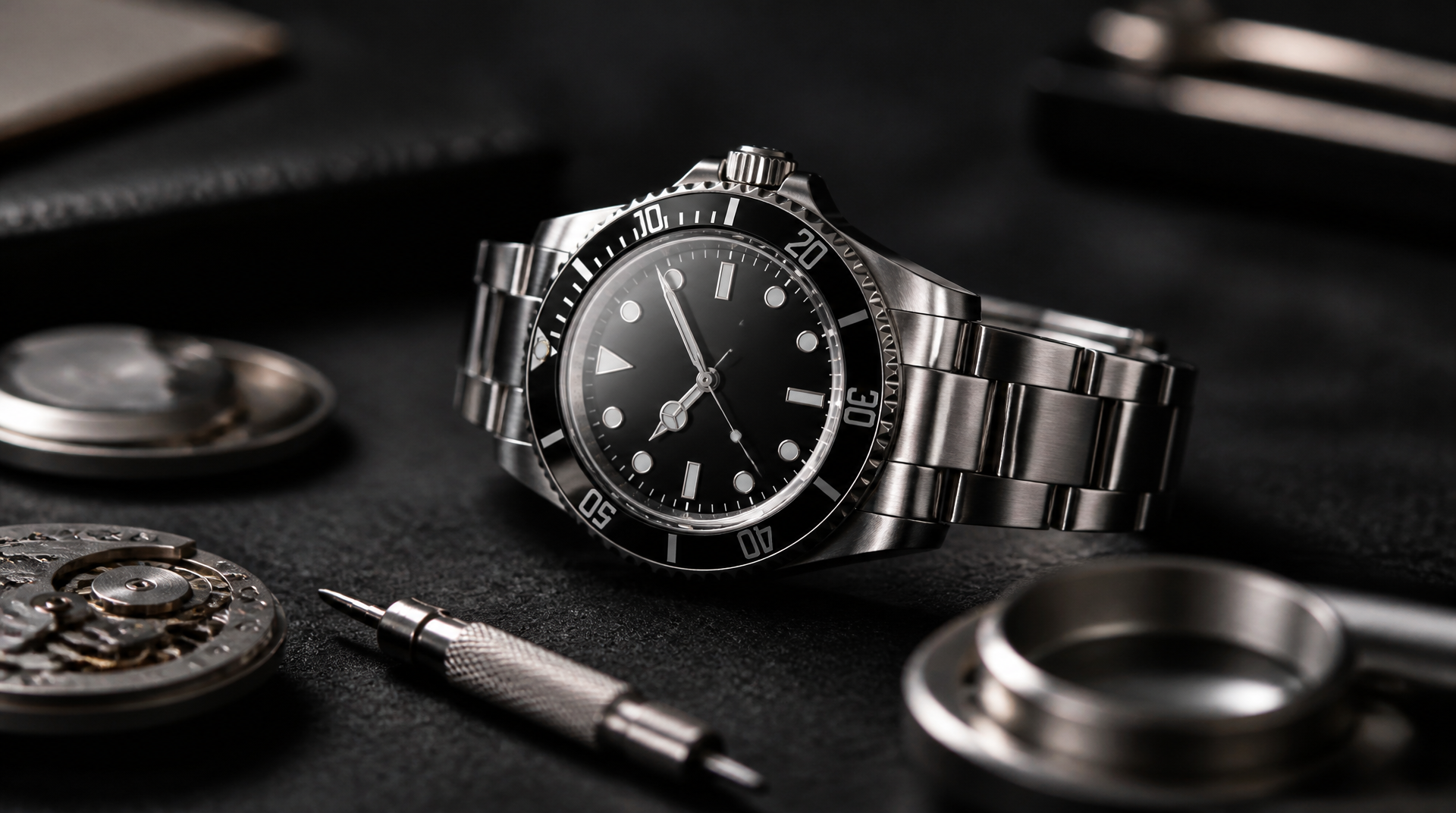
Most mechanical watches stay healthy with a full service every 4 to 7 years, but that number only holds if the watch is still running well. The real rule is simpler: service when performance drops, not when a calendar birthday arrives. Timekeeping drift, weak power reserve, rough winding, or moisture under the crystal always override a date. Use the home health check below to decide in five minutes whether your watch needs a watchmaker now or can keep running safely.
A 5-minute health check: skip the calendar for now
Stop guessing and run through these three checks. If any one of them turns up a problem, the movement is telling you something the owner’s manual cannot.
Step 1: Measure power reserve and accuracy at home
- Wind fully: For a hand‑wound movement, give 30–40 turns until you feel resistance. For an automatic, wear it on your wrist or a winder for a full day, then wind the crown until resistance builds.
- Set to a reference: Use an atomic‑clock source (time.is or a synced phone) and set the time exactly.
- Leave the watch dial‑up overnight in a clean, dry spot.
Check after 24 hours:
- Accuracy: Compare the drift to the watch’s own normal behavior. A movement that used to lose 3 seconds a day and now drifts to -15 seconds is signaling trouble, not a simple regulation tweak.
- Power reserve: After the full wind, let the watch sit untouched until it stops. If it quits hours before its rated reserve — say a 38‑hour movement that dies at 28 hours — the mainspring or barrel lubricant is running dry.
No timegrapher required; rough numbers are enough to decide.
Step 2: Listen and feel for rough winding or rotor noise
- Crown feel: Wind slowly. Smooth, light resistance is normal. Grinding, grittiness, or uneven tight spots mean debris or dried oil are inside the keyless works or winding train.
- Rotor noise: Hold an automatic near your ear and gently rotate your wrist. A faint whir is typical; a newly loud scraping or clicking sound often signals a worn rotor bearing or a loose part rubbing against the bridges.
A sudden change in either sound means the movement is grinding metal against metal. Stop wearing it.
Step 3: Inspect the crystal and case for moisture or haze
- Tilt the watch under bright light and look for any fog inside the crystal — even a fleeting haze after a warm shower counts. Moisture corrodes pivots, dials, and hands fast.
- Check the caseback and crown: a loose caseback or a crown that doesn’t seat firmly can let water in during hand washing or a surprise downpour.
Red‑flag result: stop and see a watchmaker immediately
If you detect any one sign — a large rate shift, weak power reserve, gritty winding, unusual noise, or condensation — do not wind or wear the watch again until it has been inspected. Continuing to wear it can chip jewels, bend pivots, and turn a straightforward service into a parts replacement that costs twice as much.
Still unsure? Confirm the need in minutes
Any watchmaker can measure amplitude and rate on a timegrapher; many will do it at no charge. A dial‑up amplitude below 220° means the movement is starved of lubrication and needs service regardless of what the calendar says. If the amplitude is healthy but the watch still drifts, demagnetizing or a simple regulation may be all you need — and both are far cheaper than a full service.
When to use the calendar: service intervals by brand
If every home check comes back clean and the timegrapher shows healthy amplitude, the table below keeps you on a sensible schedule. It blends official guidelines, owner experience, and what independent watchmakers observe daily.
| Brand / Movement | Typical Interval | Key Notes |
|---|---|---|
| Rolex (modern 32xx series) | Approx. 10 years | Annual seal checks keep water resistance valid between services |
| Omega Co‑Axial (8500 and later) | 5–8 years | Longer gaps safe when timegrapher amplitude stays above 240° |
| Seiko (NH35, 4R series) | 3–5 years (wear‑dependent) | Many budget movements get a full movement swap instead of a detailed service when accuracy tanks |
| ETA 2824 / Sellita SW200 | 4–6 years | Extremely common; independent service typically $200–$400 |
| Grand Seiko (9S mechanical) | 3–5 years | Seiko recommends 3–4 years for peak precision; high‑beat 36,000 vph movements may need checks sooner |
| Patek Philippe / Audemars Piguet / Vacheron Constantin | 3–5 years (traditional) / up to 7–10 years for select modern references | Intervals shorten dramatically with perpetual calendars, minute repeaters, or tourbillons |
| Vintage watches (pre‑1970) | 2–3 years (many specialists advise) | Old oils dry faster; scarce parts make preservation scheduling critical |
| ETA 6497/6498 (hand‑wound) | 5–7 years | Simple hand‑wound movements tolerate longer gaps when kept moisture‑free |
Always confirm with your brand’s current service guidelines. The calendar is a backup, not the boss.
The real wear indicators: amplitude and rate (why symptoms beat the calendar)
Most generic advice treats service like an oil‑change sticker, but a mechanical watch doesn’t wear on a fixed timer — its lubrication breaks down at a rate driven by use, temperature, and friction. Two vital signs tell you exactly when degradation starts.
- Amplitude below 220–240° dial‑up (measured on a timegrapher) means friction has climbed enough to threaten long‑term reliability. A movement still showing 270° and a steady rate can often safely defer service, even past the “recommended” interval.
- Rate instability — a daily swing from +2 to -20 seconds with no magnet exposure or shock — usually points to dry pivots, not a regulation problem.
One mistake even careful owners make: they notice the watch loses a consistent 8 seconds a day, so they get it regulated back to +2. The watchmaker may comply, but if the underlying amplitude is low (say 190°), the regulation only masks the friction. Within months the rate will swing wildly, and the dry escapement will have worn the escape wheel teeth. Always insist on amplitude numbers before any regulation. A watch that is chronically slow and has low amplitude demands a full service, not a quick tweak.
Water resistance runs on its own independent clock. Gaskets and O‑rings degrade regardless of movement condition. A 100‑meter rated watch that hasn’t been pressure‑tested in 3–4 years can leak during hand washing. Many brands now advise an annual water‑resistance test and seal replacement every 2–4 years, separate from a movement service. Even if the watch keeps perfect time, dried‑out gaskets can let humid air in during a single hot day; you’ll see condensation later, by which time rust may have started on the keyless works. Annual pressure testing is the cheapest insurance against that scenario.
Adjust the service interval: daily habits that stretch or shrink the clock
Your environment and wearing patterns shift the interval more than the name on the dial.
When you can safely stretch intervals
- The watch lives a clean, dry office life and comes off for sports.
- You pressure‑test it every year (even if it’s an automatic).
- A timegrapher shows stable rate and healthy amplitude (typically above 260°).
- The movement is a modern workhorse with a record of long‑running oil retention — ETA 2824, Sellita SW200, Rolex 3135/3235, Omega co‑axial 8500 or later.
When to shorten intervals
- The watch faces frequent vibration, high humidity, or temperature swings (golf, motorcycling, all‑day gardening in heat).
- It’s a vintage piece with unobtainable parts; a small problem can snowball into a big bill quickly.
- It’s a complicated watch — perpetual calendar, minute repeater, or a chronograph that multiplies friction points.
- You’re planning an ocean vacation and the watch hasn’t been pressure‑tested in over a year; service it now rather than risk a flood.
What a full mechanical service actually includes (and what it costs)
A proper service means complete disassembly, cleaning, inspection, lubrication, reassembly, and regulation. It is not a quick oil change.
- Ultrasonic cleaning of the case and bracelet
- Movement stripped to the bare plate; worn or broken parts replaced
- Fresh synthetic oils applied in metered amounts at every pivot and escapement surface
- Mainspring inspected or replaced (a mainspring left in place can “set” and deliver only a fraction of the rated power reserve later, so many experienced watchmakers replace it as a matter of course)
- All gaskets, seals, and crown O‑rings replaced
- Regulation to target rate in multiple positions
- Pressure testing to the watch’s rated depth
Typical cost ranges (USD)
| Service scenario | Cost range | Notes |
|---|---|---|
| ETA 2824 / Sellita SW200 at independent | $200–$400 | Sweet spot for most daily wearers |
| Rolex modern three‑hand (authorized) | $700–$1,000+ | Includes new crown tube, seals, and optional polishing |
| Omega co‑axial chronograph (boutique service) | $900–$1,300+ | Chronographs cost more; co‑axial requires specialized training |
| Grand Seiko 9S mechanical (Japan service) | $400–$600 | Often lower parts cost in Japan reported by owners |
| Vintage dress watch (independent specialist) | $300–$600 | Varies if parts must be fabricated |
| Quartz movement swap (battery + module) | $50–$150 | Not a full service; quartz avoids this cost pain |
Always get a written estimate before approving any work.
After the service: 4 checks to confirm the job was done right
When you pick up the watch, spend five minutes verifying the work. A well‑serviced watch feels and measures tighter in every dimension.
1. Timegrapher check: Amplitude dial‑up should be above 250–270° for most movements. Rate must be stable and within maker spec (often ±5 seconds/day).
2. Power reserve: Should match — or nearly match — the manufacturer’s claim. A 38‑hour movement that quits at 32 hours after a full wind suggests a tired mainspring that wasn’t replaced.
3. Winding and setting: Crown action should be smooth; date changes must snap cleanly near midnight.
4. Visual inspection: No dust under the crystal, hands aligned correctly, gaskets seated (caseback fully snug). If you later see any interior fogging, the pressure test was likely botched; return the watch immediately before moisture can cause permanent corrosion.
If any of these fall short, return the watch right away. A competent shop stands behind its work and will re‑regulate or reseal the watch at no charge within its warranty period.
FAQ
What happens if I skip servicing entirely for 10+ years?
Eventually the oils turn into abrasive paste, pivots wear oval, and the movement may seize or suffer permanent damage. At that point the repair bill often exceeds the cost of two or three routine services combined.
Can I just wait until the watch stops working?
You can, but a watch that stops from lack of lubrication usually has already worn components beyond simple cleaning. The final repair is almost always more expensive than preventive care.
Do quartz watches need service intervals?
Quartz movements don’t need mechanical service in the same way, but gaskets still degrade. Replace the battery every 2–3 years, pressure‑test the watch at the same time, and clean the contacts if you spot corrosion.
Is it safe to use an independent watchmaker for a luxury brand?
Yes, if the watchmaker is well‑rated, has access to parts where available, and uses proper tools. For watches still under factory warranty, sticking with the authorized service center preserves coverage.
How do I find a trustworthy watchmaker?
Look for a shop with a timegrapher, a pressure tester, and a long track record servicing your movement family. Online watch communities often share first‑hand experiences with specific independents.
Explore This Topic
- Back to General
- Back to Service Intervals
Related guides in this cluster:
- How Much Does Watch Service Cost? Complete Brand-by-Brand Breakdown
- Why Your Automatic Watch Keeps Stopping: Complete Troubleshooting Guide
- Watch Crystal Types: Sapphire vs Mineral vs Acrylic — Complete Comparison

The We Know Watches editorial team brings together over 40 years of combined watch collecting, trading, and repair experience. Our editors have owned and handled watches from every major brand — from entry-level Seiko 5s to Rolex, Omega, Patek Philippe, and independent Swiss watchmakers. We’ve bought and sold at auction, worked with authorized dealers, visited manufacturing facilities in Switzerland and Japan, and serviced hundreds of movements ranging from the Seiko 7S26 to the Longines L888. Every guide and review we publish is based on hands-on experience, original research, and consultation with professional watchmakers. We do not accept payment for reviews, and we clearly disclose when we use affiliate links.