
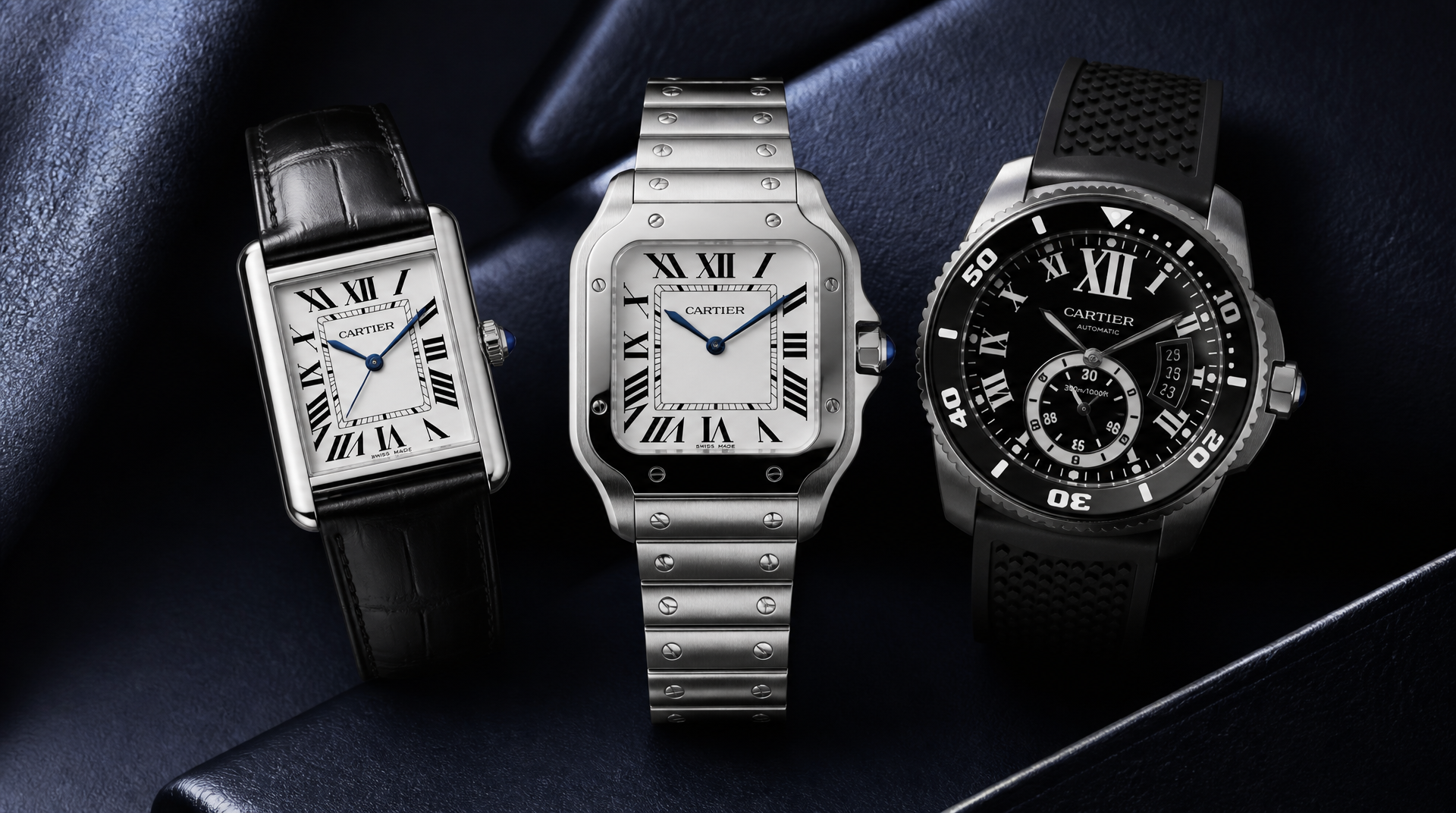
Cartier isn’t a movement-engineering house. It’s a jewelry house that happens to own two of the most iconic watch silhouettes ever produced. If you want the square case and Roman numerals, you buy a Tank. If you want a squared-circle sport watch with 100 m of water resistance, you buy a Santos. Every other Cartier model orbits those two. This guide sorts the real buying options inside each family, shows you where value lives on the pre-owned market, and gives you a repeatable method to avoid the one mistake that turns a $2,000 deal into a parts watch.
Cartier Tank vs. Santos: Quick Reference
| Line | Typical Case Size (mm) | Movement Examples | Water Resistance | Best Fit |
|---|---|---|---|---|
| Tank Must | 29.5 x 22 (small), 33.7 x 25.5 (large) | Quartz (ETA-based) or SolarBeat | 30 m | Entry-level Cartier, zero daily fuss |
| Tank Louis Cartier | 33.7 x 25.5 (large), 25 x 20 (small) | Manual-wind 1917 MC | 30 m | Hand-wound heirloom dress piece |
| Tank Française | 25 x 20 (small), 30 x 25 (medium) | Quartz or automatic (ETA 2000-1) | 30 m | Integrated-bracelet daily wear |
| Santos de Cartier (current) | Medium 35.1, Large 39.8 | Automatic 1847 MC | 100 m | Do-everything sport-luxe watch |
| Santos Galbée (vintage) | 24 (ladies), 29 (unisex) | Automatic ETA 2671 or quartz | 30 m | Small-wrist vintage at lower cost |
Cartier Tank: Which Version Actually Fits Your Life?
The Tank’s design came from a 1917 sketch, but today the family splits into three price brackets that target completely different wrists.
Tank Must: The Quartz Entry That Punches Above Its Price
Current Tank Must quartz watches use a high-torque ETA-based caliber accurate to about ±10 seconds per year, and the SolarBeat variant trades a battery for a photovoltaic cell behind the dial. Pre-owned quartz Musts trade between $1,500 and $2,500 depending on condition, box, and papers.
Key verification: Before you buy a used Tank Must, confirm the movement is original. Later 1980s–1990s Must de Cartier models used Cartier-finished versions of ETA calibers, not generic modules. A single unsigned quartz movement under the caseback destroys the watch’s originality and knocks its resale value to that of a case-and-dial salvage. If you cannot view the movement, price the watch as a potential movement-swap risk.
Tank Louis Cartier: The Heirloom Choice
The manual-wind Tank Louis Cartier runs the in-house 1917 MC, a 2.15 mm-thick movement that lets the case sit nearly flat on the wrist. Yellow-gold pre-owned examples start around $5,000; rose gold pushes past $8,000. The 38-hour power reserve means you wind it every morning—it won’t run through a weekend on the nightstand.
Tank Française: Bracelet Wear Without Going Sport
If you want an integrated metal bracelet and the Tank shape, the Française fills that slot. Early 2000s quartz models can dip below $2,000; automatics with the ETA 2000-1 sit closer to $2,500–$3,500. The curved case and chunky links make it wear larger than the paper dimensions, so a 25 mm Française often fits like a 28 mm round watch.
Fit Check: Don’t Guess It From Photos
A 33.7 mm Tank looks small on a round-watch comparison chart, but the square footprint covers more wrist area. Measure your wrist circumference with a flexible tape, then cut a 33.7 mm x 25.5 mm paper rectangle and lay it across your wrist. If the paper overhangs the edges of the flat part of your wrist, the large Must or Louis will wear you rather than the other way around. That quick test prevents the most common return reason for first-time Tank buyers.
Cartier Santos: From Pilot Tool to Smart-Luxe Icon
The Santos was built in 1904 as a wearable tool for Alberto Santos-Dumont. The current generation runs Cartier’s 1847 MC automatic, hits 42 hours of reserve, and carries 100 m of water resistance. Two practical features tip it firmly into daily-wear territory: the QuickSwitch strap release and the SmartLink bracelet adjustment—both work with a fingernail, no tools.
Pre-owned large Santos models on bracelet typically sit between $4,800 and $6,000, putting them straight against a pre-owned Rolex Datejust. Vintage Santos Galbée pieces from the 1980s–1990s trade for $2,000–$3,500 in strong mechanical condition, but the 29 mm case feels undersized on wrists above 6.5 inches, which is why they resurface on forums so often.
New vs. Pre-Owned: Where the Real Money Stays
A steel Tank Must on leather lists new at about $3,050, while a one-year-old example with warranty can close near $2,500. On gold Tank Louis models the pre-owned discount stretches to 25–35% because precious-metal depreciation hits hardest in the first two years.
Steel automatic Santos models carry the strongest residual demand, largely because the SmartLink system keeps them liquid. Quartz Tanks lose proportionally less cash overall, simply because the entry price is lower. The trade-off buyers routinely overlook: a pre-owned watch that arrives on an original Cartier strap that’s cracked and stiff will cost $250–$350 to replace at the boutique. If the seller can’t show a supple, unbroken strap in the photos, add that replacement cost to your purchase math before deciding the deal is cheaper than new.
The Authentication Trap: How a $300 Movement Swap Kills a “Great Deal”
The single most avoidable failure hits buyers of 1980s–1990s Must de Cartier watches listed near $1,200. Inside the case, the original Cartier quartz caliber—a caliber 87 or similar, based on an ETA 900.001 but fully finished with circular graining and Cartier script on the mainplate—gets replaced with a generic $30 module. The dial still shows Roman numerals and a Cartier signature, the watch ticks, and the buyer opens the box assuming everything is correct.
What this means for your next move: An unsigned quartz movement isn’t a minor maintenance quirk. It turns the watch from a collectible Cartier into a dressed-up case that will never regain its original value. If you’re shopping below $2,000 and can’t inspect the movement, you have exactly two safe roads: either walk away, or set a walk-away price that’s low enough to cover the cost of sourcing and installing a correct original caliber if one can even be found. A generic quartz swap that runs fine today won’t protect you when you eventually sell—and it’s the first thing the next buyer’s watchmaker will spot.
How to Spot a Swapped Movement Early
1. Ask for a clear photo of the movement before you pay. If the seller won’t open the caseback, require a 48-hour return window so your watchmaker can inspect it.
2. On quartz models, look for the Cartier double-C logo on the circuit spacer or battery retainer. On mechanical models, check for the Cartier name on the mainplate or rotor.
3. An unsigned quartz movement with plastic spacer rings and no Cartier markings is a replacement. Treat every such piece as parts-only unless you can source an exact original caliber and confirm the cost in advance.
Pre-Owned Buying Sequence: Inspect, Verify, Negotiate
Run this checklist on any used Cartier Tank or Santos before money moves.
1. Lock your reference and maximum budget. Decide between Tank Must quartz (~$1,500–2,500), Tank Louis manual-wind (~$5,000+), Santos automatic (~$4,800–6,000), or vintage Santos Galbée (~$2,000–3,500). Shopping across categories mid-search inflates the price you’re willing to pay.
2. Calibrate against sold prices. Use eBay completed listings, WatchCharts, and dealer sale archives. A large Santos sitting at $6,200 means nothing if the last four gray-market sales closed at $5,400.
3. Request a serial-number match. Cartier won’t give you a public database, but ask for the warranty card or a Cartier service receipt that shows the serial matches the caseback. An authorized dealer can run the serial internally to flag lost or stolen reports.
- Checkpoint: No matching card and no Cartier service paper? Factor $150 into your budget for an archive extract or independent authentication, and treat the deal as unverified until that step is done.
4. Get movement photos and a caseback serial shot in the same frame. This catches the swapped-movement trap. A used Cartier caseback is not sealed like a factory-new diver; a watchmaker can open and close it in minutes. If the seller pushes back with “it’s sealed, can’t open it,” walk.
5. Verify the clasp and crown signatures. Authentic Cartier deployants carry deep, crisp engraving. The cabochon crown should show no glue residue. On a modern Santos, press the QuickSwitch release button under the end-link; a replica often binds or fails to release cleanly.
6. Price on condition, not the seller’s story. A Santos with a scratched bezel and no recent service is a $4,400 watch, not a $5,200 watch. Factor in the cost of a Cartier service ($600–$700 for an automatic) if the seller can’t prove one in the last five years.
- Success check: Buy only with a 72-hour inspection window, open the caseback with an independent watchmaker, and confirm the movement, seals, and pressure resistance match the description. If they don’t, the watch goes back.
FAQ
Do Cartier watches hold their value over time?
Most steel Cartier models depreciate during the first two to three years and then stabilize; vintage gold Tank Louis pieces have appreciated steadily over the last decade because production is limited and collector demand for classic dress designs remains strong.
Is a quartz Cartier Tank worth buying?
Yes, a quartz Tank Must gives you the identical case finish and dial design at the lowest entry price, and you avoid the periodic servicing costs of a mechanical movement while keeping the exact Cartier look on the wrist.
How often does a Cartier watch need servicing?
Cartier recommends servicing mechanical models every five to seven years, and many owners stretch that to eight years with light wear; quartz models need a battery change every two to three years and a movement check on the same schedule to avoid leaking batteries damaging the circuit.
A genuine Cartier Tank or Santos wears its architecture as naturally fifteen years from now as it does today. The one move that turns a smart buy into a money pit is paying before you see what’s under the caseback. Lock in the movement, verify the paperwork, and let the deal go if those pieces don’t match—the market will offer another chance next week.
Explore This Topic
- Back to Cartier
- Back to Cartier Brand Hub
Related guides in this cluster:
- Rolex Watches: The Complete Brand Guide — History, Models & Buying Advice
- Christopher Ward Watches: Complete Brand Guide & Review
- Omega Watches: The Complete Brand Guide — Speedmaster, Seamaster & More

The We Know Watches editorial team brings together over 40 years of combined watch collecting, trading, and repair experience. Our editors have owned and handled watches from every major brand — from entry-level Seiko 5s to Rolex, Omega, Patek Philippe, and independent Swiss watchmakers. We’ve bought and sold at auction, worked with authorized dealers, visited manufacturing facilities in Switzerland and Japan, and serviced hundreds of movements ranging from the Seiko 7S26 to the Longines L888. Every guide and review we publish is based on hands-on experience, original research, and consultation with professional watchmakers. We do not accept payment for reviews, and we clearly disclose when we use affiliate links.