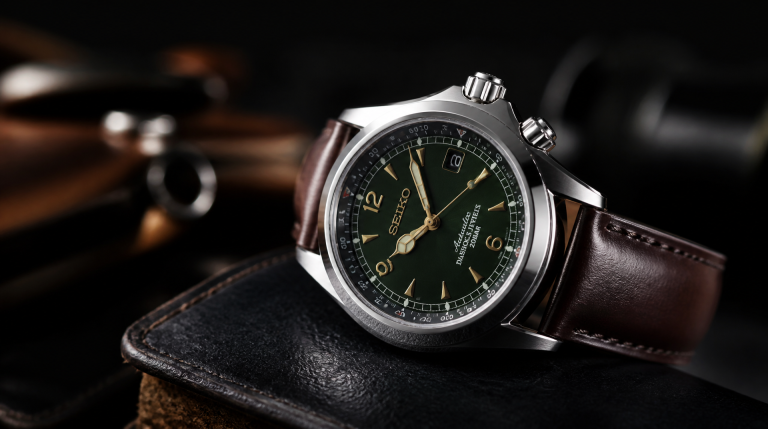

The practical difference between Seiko’s core automatic movements boils down to three features you’ll notice every day: hacking seconds, hand-winding, and power reserve. The entry-level 7S26 lacks the first two, the 4R35 adds both, the 6R15 stretches the reserve and tightens accuracy, and Spring Drive replaces a traditional escapement with a quartz-governed glide wheel to deliver a continuous sweep and accuracy measured in seconds per month. For most buyers, the 4R35 (or its day-date sibling the 4R36) hits the value sweet spot—but if you rotate watches constantly, demand set-to-the-second precision, or just hate shaking a dead watch alive, the higher tiers earn their keep.
Specs at a Glance
The table below gives you the technical differences instantly. Accuracy numbers reflect typical real-world performance after break-in, not just factory rated windows.
| Movement | Beat Rate (bph) | Power Reserve | Hand-winding | Hacking | Jewels | Rated Accuracy (s/day) | Typical Real-World Accuracy | Key Trade-Off |
|---|---|---|---|---|---|---|---|---|
| 7S26 | 21,600 | ~41 hours | No | No | 21 | -20 / +40 | 10–20 s/day; can be regulated to ~8 s/day | No hacking means you guess the offset every time you set the watch |
| 4R35 / 4R36 | 21,600 | ~41 hours | Yes | Yes | 23 | -35 / +45 | 8–15 s/day; often runs closer to 5–10 s/day after a good regulation | Date-only (4R35) or day-date (4R36) |
| 6R15 | 21,600 | ~50 hours | Yes | Yes | 23 | -15 / +25 | ±5–8 s/day in many examples; uses a flatter-torque Spron 510 mainspring | Higher cost, mostly found in Prospex/Presage lines |
| Spring Drive | 28,800 (glide) | ~72 hours | Yes</em>* | Yes | 30+ | ±1 (≈15 s/month) | Under 2 seconds per month for many owners | Hybrid system; service requires Seiko’s dedicated center |
\The seconds hand glides continuously; the glide wheel rotates at 28,800 beats but without an escapement tick.*
\\Hand-winding on a Spring Drive does not turn a direct mechanical train—it winds the mainspring that powers both the gear train and the electromagnetic brake.
Identify Your Movement in 5 Minutes (Without Opening the Caseback)
Pull the crown to the time-set position. If the seconds hand stops, the movement hacks—so it’s not a 7S26. Next, push the crown back in and turn it clockwise. If you feel gentle resistance and hear a faint clicking from the rotor, you have hand-winding. No hacking + no hand-winding = 7S26 or an older caliber. Hacking + hand-winding + about 41 hours of runtime = 4R35/4R36. Hacking + hand-winding + 50 hours of reserve = 6R15. A perfectly smooth glide of the seconds hand and “Spring Drive” on the dial or caseback confirm the hybrid.
What you’ll need
- Good light (a phone flashlight works).
- The bare watch—no tools required for the initial checks.
- Optionally, a loupe or phone macro lens to read rotor engravings through a display back.
Step-by-step identification flow
1. Read the caseback engravings first. Look just above the serial number. Many modern Seikos stamp the caliber directly—“4R35-01T0” or “7S26-0020.” If you see it, you’re done.
Branch: If the caseback has a crystal display back, skip to step 2 and read the rotor lettering through the glass instead.
2. Check rotor design through a display back. The 7S26 rotor shows a large cutout with plain brushed finishing and “7S26” printed simply. The 4R35 rotor looks very similar but often carries slightly more texturing and “4R35” or “4R36” engraving. The 6R15 rotor typically features gold-colored Seiko script and a striped finish. A Spring Drive display back shows a large, flat-looking rotor, often with “Spring Drive” text and the visible glide-wheel assembly near the bottom.
3. Confirm with crown functions. Pull the crown to the time-set click. If the seconds hand stops, hacking is present. Push the crown back in and turn it clockwise while listening and feeling closely. A subtle click-click sound and light resistance mean hand-winding is working. A 7S26 gives no resistance and no sound—the crown will spin freely. A 4R35 or 6R15 gives clear resistance. Spring Drive also hacks and hand-winds, but the winding feel is noticeably lighter and has a faint electronic-sounding click.
Branch: day-date complication.
If the watch has both a day and date display and the movement hacks and hand-winds, you are almost certainly looking at a 4R36—a day-date variant of the 4R35 that shares the same engineering but adds the day wheel. Treat it identically to the 4R35 for performance expectations, but note that day-setting procedure differs slightly (pull crown to position 1 for day/date, then rotate in opposite directions).
4. Cross-reference the caseback model code. The 8-character code (e.g., SKX007-XXXX) printed on the caseback, combined with a quick online search, usually reveals the exact factory movement batch. This catches edge cases such as regional variants or watches that were modified after purchase.
Checkpoint after step 3:
If the movement hacks but hand-winding feels absent or you only hear a faint rattling instead of a crisp click, the winding pinion may be worn. Do not force the crown further—a stripped pinion can shed metal particles into the movement. Have a watchmaker inspect and replace the pinion before resuming regular use.
Escalation signal:
If the caseback is solid metal and the crown tests are inconclusive—for example, you’re not sure whether you’re feeling hand-winding resistance—do not attempt to open the caseback yourself. Peeking inside requires a caseback wrench, a clean environment, and a new gasket to maintain water resistance. Take the watch to a professional. Opening a solid caseback at home without resealing it properly can instantly ruin a dive-watch’s water-tightness and invite condensation damage.
Success check: You’ve identified the movement correctly when at least two independent indicators match—engraving + crown behavior, or rotor appearance + model number lookup—without a single contradictory finding.
7S26: A Reliable Foundation With Two Real-World Gaps
What the 7S26 still does well
The 7S26 powered decades of Seiko 5s, the SKX-series divers, and field watches. It’s tough, parts are plentiful, and any competent repair shop can service it inexpensively. If you want a beater that runs under $200 and you don’t mind letting accuracy drift a few seconds each day, the 7S26 does its job without fuss.
Decision branch: If you wear the same watch daily, the missing hand-winding barely matters—your motion keeps it topped up and you rarely need to restart it from dead. If you rotate watches and leave the 7S26 off for a weekend, you’ll face a dead watch every Monday morning and a “shake, set, wear” routine that gets old quickly. The lack of hacking means you can’t precisely align the seconds hand with a reference clock; if you often need to sync to the second for train schedules or timing tasks, this alone rules out the 7S26.
What to watch for
The 7S26’s main weakness beyond missing features is positional variance. A well-regulated example might hold +8 seconds per day dial-up but drift to +18 seconds crown-down overnight. This isn’t a defect—it’s the design’s tolerance band. Owners who rest their watch in different positions each night can partially compensate, but the movement won’t match the consistency of the 6R15’s flatter torque curve. The 7S26 also lacks the Etachron regulator system found on the 4R and 6R families, which makes regulation adjustments slightly coarser and more dependent on a watchmaker’s skill.
4R35 and 4R36: The Practical Sweet Spot
The 4R35 (date-only) and 4R36 (day-date) solve the 7S26’s two biggest usability complaints by adding hacking and hand-winding while keeping the same 21,600 bph beat rate and 41-hour power reserve. The rated accuracy window looks worse on paper at -35/+45 seconds per day, but real-world performance tells a different story. Most 4R35 examples settle into a 5–10 second per day range after a few weeks of break-in, and the Etachron regulator makes fine adjustment straightforward for any watchmaker.
Why the 4R35 wins for most buyers
Hand-winding changes the ownership experience entirely. You can pick up a dead watch, wind it 20–30 turns, set it precisely with the hacking seconds, and walk out the door. No shaking ritual required. The 4R35 appears in watches ranging from $200 entry-level Seiko 5 Sports models to $500–$700 Prospex divers, so the movement itself doesn’t limit your case and dial options. The 4R36 adds the day wheel for those who prefer it, with no performance penalty.
Decision criterion that changes the recommendation: If you wear the same watch continuously for weeks, the 4R35’s hand-winding advantage shrinks to near zero—your wrist motion handles everything. In that scenario, a 7S26 watch at half the price delivers an identical daily experience once set. The 4R35 earns its premium only when you rotate watches, need precise time-setting, or let the watch stop between wears. If you’re a one-watch person on a tight budget, save the money and live with the 7S26’s quirks.
Common failure point
The 4R35’s winding pinion engages a plastic intermediate wheel in some production batches, which can wear prematurely if you hand-wind aggressively every day. A light touch and 20–30 turns from dead are plenty—don’t treat it like a manual-wind movement that needs a full 40+ turns daily.
6R15: The Quiet Upgrade That Matters Over Time
The 6R15 builds on the 4R35 architecture with two meaningful improvements: a Spron 510 mainspring that extends power reserve to roughly 50 hours, and tighter factory regulation to -15/+25 seconds per day. The Spron 510 alloy delivers flatter torque output across the unwinding curve, which means the balance amplitude stays more consistent whether the mainspring is fully wound or near empty. In practice, a 6R15 watch left on the nightstand Friday evening will still be running Monday morning, and its accuracy on Sunday morning won’t be dramatically worse than on Friday afternoon.
Where the 6R15 appears
Seiko fits the 6R15 primarily in mid-tier Prospex divers (like the SPB143 and SPB151 “Willard” reissues), Presage dress watches, and some limited editions. Prices typically start around $600–$800 and climb past $1,200 for special variants. The movement itself is visually more finished than the 4R35, with striped rotor decoration and gold-filled engraving, though this matters only on display-back models.
The accuracy consistency trade-off
The 6R15’s real advantage isn’t the peak accuracy number—a well-regulated 4R35 can match it—but the
Explore This Topic
- Back to Seiko
- Back to Seiko Movement Reference
Related guides in this cluster:
- Seiko Watch Nicknames Guide: Batman, Willard, Turtle, Samurai & More
- Automatic vs Quartz vs Manual: Watch Movements Explained for Beginners
- Breitling Watch Buying Guide: Are They Worth It in 2026?

The We Know Watches editorial team brings together over 40 years of combined watch collecting, trading, and repair experience. Our editors have owned and handled watches from every major brand — from entry-level Seiko 5s to Rolex, Omega, Patek Philippe, and independent Swiss watchmakers. We’ve bought and sold at auction, worked with authorized dealers, visited manufacturing facilities in Switzerland and Japan, and serviced hundreds of movements ranging from the Seiko 7S26 to the Longines L888. Every guide and review we publish is based on hands-on experience, original research, and consultation with professional watchmakers. We do not accept payment for reviews, and we clearly disclose when we use affiliate links.