Rubber & Silicone Watch Straps: Complete Guide for Divers & Daily Wear
For real saltwater submersion and hard daily use, natural rubber or FKM (fluoroelastomer) is the material that survives. For all-day desk comfort, a well-finished silicone strap with a deployant clasp is tough to beat — but the gap between a good one and a sticky, cracked failure is often less than a month. The key is knowing exactly what you’re buying and confirming it actually fits your watch before you click “order.”
- Diver-grade natural rubber: $40–$80, genuine caoutchouc, dense and slightly heavy, excellent in water, resists sweat odors.
- FKM (fluoroelastomer): $60–$150, the most UV- and chemical-resistant choice, stays flexible, virtually no odor buildup.
- High-quality silicone: $20–$40, very soft and lightweight; the trick is finding one with a matte, lint-resistant surface that doesn’t turn tacky after a few weeks.
- Hybrid straps (rubber-backed leather or nylon): $50–$100, a dress-down look but splash-only — never submerge them.
Fit check before you order
Many returns and snapped straps trace back to a single missed dimension. Take two minutes with a ruler or calipers to confirm the strap will actually work on your watch.
- Measure the lug width at the case, not the old strap. Use digital calipers or a millimeter ruler placed between the inner lugs. Even a 1 mm mismatch (e.g., 19 mm vs. 20 mm) can leave the spring bar partially seated.
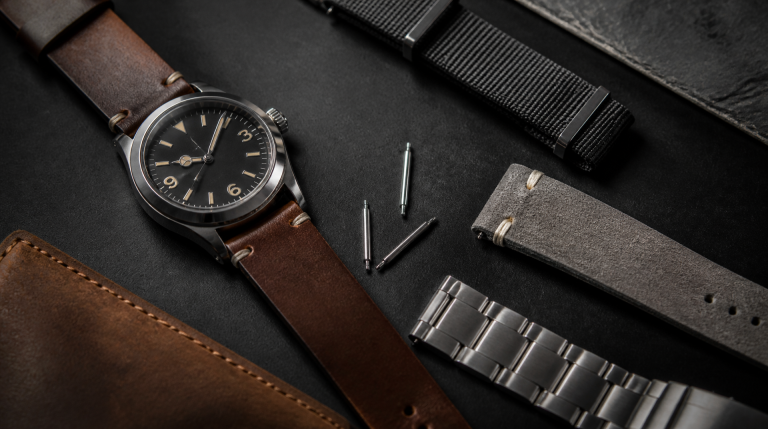
- Check the spring bar clearance. Slide a folded piece of paper (about 0.5 mm thick) between the case back and the spring bar. If it binds, a thick strap (over 4.5 mm at the lug) will push the watch up and may damage the spring bar tips.
- Test the thickness tolerance. Stack two credit cards (≈1 mm each) and try to fit them between the lug and the case. If the stack won’t slip in, order a strap with a lug-end thickness no more than 3.5 mm.
- Verify quick-release lever clearance. Measure the protrusion of the lever on your current strap. If it sticks out by more than 2 mm, check that it won’t catch a jacket cuff or a glove. On some tight-lugged cases, you may need to swap to a traditional spring bar.
Once those numbers match, move on to material selection.
How the materials stack up
Marketing terms like “premium silicone” or “vulcanized rubber” don’t tell you how a strap handles sunscreen, chlorine, or 10 hours of skin contact. The table below is a fast rule-out tool: focus on the row that matches your hardest use case.
| Material | Feel | UV & Chemical Durability | Submersion | Odor Resistance | Typical Price |
|---|---|---|---|---|---|
| Natural rubber (caoutchouc) | Dense, springy, molds to wrist | Excellent; rarely cracks or fades | Dive-ready | Good with rinsing | $40–$80 |
| FKM (fluoroelastomer) | Firm yet flexible, smooth matte | Excellent; resists chemicals, heat, and UV | Dive-ready | Very good | $60–$150 |
| Standard silicone | Soft, lightweight, can feel tacky | Moderate; can stiffen or yellow | Surface swimming, splash | Can retain odors | $20–$40 |
| TPU / polyurethane | Flexible, somewhat plasticky | Good abrasion resistance, may yellow | Splash and pool, avoid chemicals | Moderate | $20–$50 |
| Hybrid rubber + leather/nylon | Variable; leather face can dress up a tool watch | Leather or fabric side vulnerable | Do not submerge | Leather can absorb sweat | $50–$100 |
Best-fit picks by use case
Match the strap to the activity that punishes it the most, not the one that’s easiest on it.
Serious diving and saltwater exposure
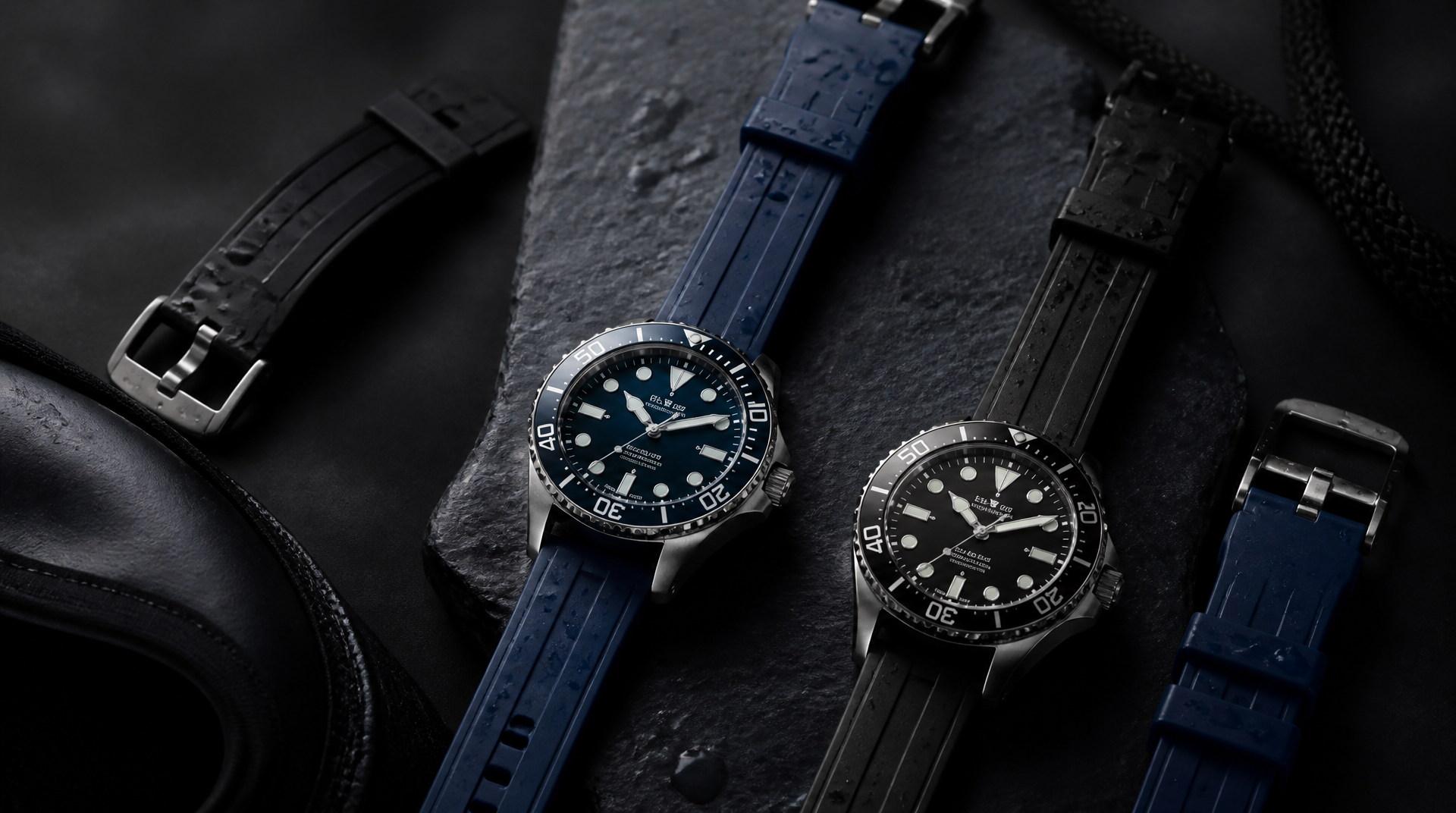
Go with natural rubber or FKM straps that carry a depth rating and a signed stainless steel buckle. Look for thick keepers and a vented “tropic” design that drains water quickly. Avoid anything labeled only “silicone” — at depth, standard silicone can tear or soften enough to slip a spring bar.
All-day desk and daily wear
A soft silicone strap with a matte, lint-resistant surface wears light for 10+ hours. Quick-release spring bars make mid-day swaps painless, and a deployant clasp extends strap life by removing the constant bending at the pin holes. Choose a taper from 20 mm at the lugs to 18 mm at the buckle; it reduces bulk and cuff snags.
Hot and sweaty workouts
Perforated FKM or aerated silicone keeps skin breathing and dries fast. FKM handles repeated sunscreen and sweat better, but a well-ventilated silicone strap works if you rinse it after every session.
Luxury watches (Oysterflex-style, Panerai, Omega)
A high-texture natural rubber strap with a close-to-waxy surface and a precisely machined buckle sits flush against the case. Glossy, sticky silicone instantly cheapens a fine watch. Expect to pay $80–$150 for exactly the right lug tolerance and buckle finish.
Small wrists or low-profile carry
Look for straps marked “short” (typically 105/65 mm for 20 mm lugs) and a low-profile buckle. FKM straps in a matte finish often come in shorter lengths and stay slim without sacrificing flexibility. Avoid extra-thick diver straps over 4.5 mm at the lug, which make a modest case look bloated.
Trade-offs to know
Every material has a pain point that appears after a few weeks of real-world wear. Recognizing the signs early prevents you from losing the watch.
The bargain silicone failure — and how to catch it early
Cheap silicone straps start soft but break down quickly when exposed to skin oils, sunscreen, and UV. The first sign is often a sticky residue on the inside of the strap within days, or a sharp chemical smell when you take the watch off. Next, discoloration creeps in near the spring bar holes. Once you see yellowing or tackiness, the material has already cross-linked and is losing tensile strength. Replace it with FKM or natural rubber the moment you notice the tackiness — a snapped strap at the spring bar can drop the watch before you feel it.
Lint, dust, and pet hair
Soft, uncoated silicone attracts lint like a magnet, especially in black. A textured matte finish reduces it, but only a denser rubber or FKM surface truly resists it. If you live with a shedding dog or work in a dusty environment, skip standard silicone.
Odor that won’t quit
Even premium straps build up a funk if you never rinse them. Natural rubber traps less bacteria than porous silicone, but both need a regular freshwater rinse. A permanent sour smell after a thorough soap wash means bacteria have colonized the material — the strap is done. No deep-cleaning hack or freezer trick can reverse it.
Color fading
Bright oranges, yellows, and whites degrade noticeably in a single summer. Darker colors and FKM blends hide UV fading better. Treat a bold color strap as a consumable you’ll replace every 12–18 months.
Thickness vs. case clearance
Extra-thick diver straps (over 4.5 mm) can push the watch head up and catch on cuffs. Always measure the gap between the case back and spring bar before ordering. If you can’t slide a standard credit card in, stick to a strap under 3.5 mm at the lug.
Care routine that catches damage early
A sub-$100 strap isn’t maintenance-free. This weekly-to-monthly flow takes two minutes and prevents the slow breakdown that surprises owners right before a dive.
1. Weekly rinse checkpoint (after salt, chlorine, or heavy sweat)
Rinse the strap under cool running water while it’s still on the watch. Pay attention to the buckle and the spring bar area. Wipe dry with a soft cloth. Salt crystals left in the crevices act as microscopic abrasives and eat away at the keeper loops.
2. Monthly deep clean
Remove the strap from the watch head. Wash both sides with lukewarm water and a drop of mild hand soap. Use a soft toothbrush to lightly scrub the textured surface, the inside of the buckle, and both keepers. Rinse until no soap residue remains — soap drying in the pores ages rubber faster than sweat does.
3. Dry without heat
Pat the strap dry with a microfiber towel and let it air-dry completely before reinstalling. Never use a hairdryer, radiator, or direct sun. Rapid heat exposure is what turns a supple strap brittle in a single afternoon.
4. Read the early warning signs
- Tacky surface or residue on skin: material degrading. Replace now.
- Discoloration around spring bar holes: uneven breakdown. Strap is on borrowed time.
- Hairline cracks visible when you flex the strap: no longer safe for any activity where losing the watch matters.
- Permanent odor after deep clean: bacteria have penetrated the structure; strap is finished.
5. Escalation trigger
If any crack appears within a few millimeters of a spring bar hole, replace the strap the same day. That spring bar is the only connection keeping your watch attached. Glue won’t hold under the tension of a bent wrist, and the next sharp movement can shear the strap clean through.
Related questions
Can I swim with a standard silicone watch strap?
Yes, in fresh water or a chlorinated pool, as long as you rinse it afterward. For open-water swimming or diving below a few meters, step up to natural rubber or FKM.
Is natural rubber always better than silicone for diving?
It’s more durable under pressure and in salt water, but heavier and less pliable. If light weight and all-day comfort matter more than deep technical dives, a high-quality silicone or FKM strap will still work, provided it’s depth-rated.
How do I get rid of a permanent odor on a rubber strap?
A deep clean with mild soap and a soft brush can reduce mild smells. If the odor remains after washing and drying, the strap has absorbed oils and bacteria past the point of recovery, and only a replacement solves it.
Do quick-release spring bars fail more often than standard ones?
A quality quick-release bar is equally strong, but the small toggle can snag on clothing or gear if it protrudes. Check that the lever sits flush against the strap. If it catches repeatedly, switch to a traditional spring bar.
How long should a silicone or rubber strap last with daily wear?
A good silicone strap typically lasts 12–18 months before visible wear. FKM and natural rubber can go 2–3 years or longer with regular rinsing. Cheap silicone blends may fail in under 6 months.

The We Know Watches editorial team brings together over 40 years of combined watch collecting, trading, and repair experience. Our editors have owned and handled watches from every major brand — from entry-level Seiko 5s to Rolex, Omega, Patek Philippe, and independent Swiss watchmakers. We’ve bought and sold at auction, worked with authorized dealers, visited manufacturing facilities in Switzerland and Japan, and serviced hundreds of movements ranging from the Seiko 7S26 to the Longines L888. Every guide and review we publish is based on hands-on experience, original research, and consultation with professional watchmakers. We do not accept payment for reviews, and we clearly disclose when we use affiliate links.