
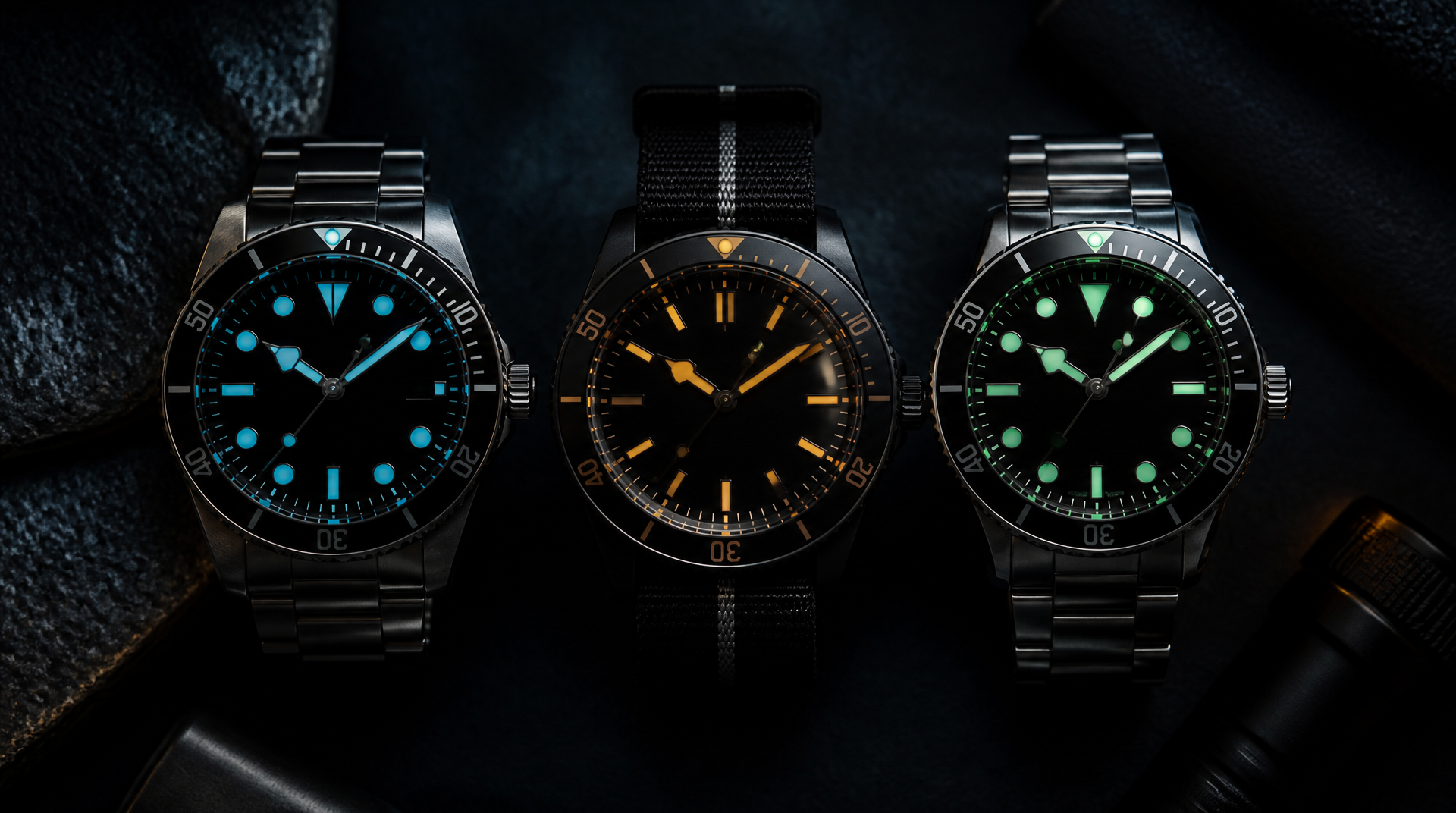
Super-LumiNova (or Lumibrite, LumiBrite) delivers the brightest initial glow after a charge, but it decays noticeably over minutes. Tritium gas tubes stay visible all night at a constant—though dimmer—level without ever needing a light source. Chromalight is Rolex’s proprietary blue photoluminescent pigment, essentially a tinted variant of Super-LumiNova with a longer-lasting intensity tail. Which one you want depends entirely on whether you value peak punch or constant, no-questions visibility.
Quick answer
- Super-LumiNova (SLN) — Brightest out of the gate after a strong charge; fades fast in the first 20 minutes, then decays slowly through the night.
- Tritium tubes (GTLS) — Never match SLN’s initial brightness, but they hold a steady, self-powered glow for years without charging. Best for true 24/7 low-light legibility.
- Chromalight — A blue-tuned SLN compound that wears almost identically to C3 Super-LumiNova; marginally better for perceiving fine detail in deep darkness, but still requires charging.
Comparison framework
| Factor | Super-LumiNova | Tritium (GTLS) | Chromalight |
|---|---|---|---|
| How it works | Absorbs light, re-emits it (phosphorescent) | Radioactive decay of tritium gas excites phosphor (self-illuminating) | Same as SLN, with tailored blue-emission phosphor |
| Peak brightness (charged) | High (especially C3 grade) | Low (fixed output; about 1/10th of freshly charged C3) | High (similar to SLN) |
| Brightness after 8 hours | Faint but legible if eyes are dark-adapted | Same as at minute 1, no degradation overnight | Slightly better than standard SLN in deep dark |
| Charge requirement | Needs direct light source; strongest after UV/sun | Zero charging; always on | Needs charging; benefits from strong initial boost |
| Color appearance | Green-yellow (C3) or light green (C1) | Usually green, sometimes orange or yellow | Ice blue |
| Half-life / longevity | Decades (with some fade over time) | ~12 years to half brightness; tube replacement needed after 15–25 years | Decades (same base chemistry) |
| Best at | High-contrast instant checks in mixed light | Pre-dawn missions, sleeping with a watch, tactical use | Filling a blue-dial aesthetic and night-reading small markers |
Color matters more than you think. Green (C3) appears brighter to the human eye than blue at equivalent energy output because our eyes are most sensitive in the green-yellow spectrum. Chromalight’s blue hue trades a hair of apparent brightness for a distinctly legible dial that doesn’t wash out minute markers in total dark.
Modern lume only: when this comparison applies
This guide focuses on current-production photoluminescent compounds (C3 Super-LumiNova, Lumibrite, Chromalight) and tritium gas tubes. If you’re evaluating a pre-1998 Rolex with tritium paint, a vintage radium dial, or an aftermarket re-lume job, the behavior—and safety considerations—change entirely. Old tritium paint darkens and stops glowing after a decade or two, radium carries health risks, and non-original lume can vary wildly in application quality. The brightness and longevity trade-offs below assume modern materials applied to factory standards.
Best-fit picks by use case
You want maximum “wow” after a daytime charge
Go with a watch using C3 Super-LumiNova or a brand equivalent like Seiko’s Lumibrite. Seiko divers (SPB143, SKX series) pump out tremendous initial glow that fades to a usable level hours later. The first 10 minutes are the magic window; after that, tritium catches up in practical legibility.
You need no-fuss, 24/7 readability, especially in complete darkness
Tritium tubes are the answer. Watches from Marathon (GSAR), Ball, and Luminox use self-powered tubes that are immediately visible the second you wake up at 3 a.m. The light is subtle—never blinding—but it’s always there. If you’ve ever fumbled to read a photoluminescent dial after a movie, a GTLS watch simply skips that problem.
You appreciate blue lume and want a watch that feels more premium at night
Chromalight on a Rolex Submariner or Explorer gives you that cold blue glow that’s easier on the eyes when reading small text or a date window in the dark. For everyday desk-to-dark use, Chromalight performs as well as any top-tier SLN, and it’s the only choice if you’re shopping Rolex. If you don’t care about the brand, a Tudor Pelagos (blue lume, same base material) delivers identical function for less.
What this means for your next purchase. If you routinely go from bright light to pitch darkness without warning—or you rely on a watch at 4 a.m. while camping or on call—skip photoluminescent lume entirely. Tritium guarantees visibility with zero prior charging, whereas even top-grade SLN will be near-invisible after a long movie or a fully sleeved afternoon. On the other hand, if most of your night-time use happens within two hours of a well-lit environment, a C3 SLN watch gives you more dramatic brightness and a wider range of watch choices.
How to test lume before you buy
If you’re cross-shopping in a store, a 5-second flashlight blast tells you almost nothing. Use this sequence to avoid buying based on a misleading first impression.
1. Charge evenly, but don’t overpower. Shine a phone’s LED flashlight 8–12 inches away for exactly 15 seconds on the dial. UV charging from a display light or sunlight can make SLN look artificially brilliant. A short, consistent burst levels the test.
2. Note the peak immediately. A tritium watch will already look steady and dim; SLN will look blazing. That’s expected. Don’t decide yet.
3. Check at the 10-minute mark. Step into a truly dark space (bathroom, closet). Compare the hands and hour markers. Tritium will still be its same self. SLN will have fallen off noticeably but should still outshine the tritium.
4. Wait 30–45 minutes and re-evaluate. After your eyes are fully dark-adapted, can you still read the time at a glance without moving the watch? At this point, many tritium watches will actually feel easier to read because the glow is uniform and doesn’t shift. SLN can look blotchy if the charge was uneven.
5. Cross-check with a known reference. If possible, place the watch next to a Seiko diver (good SLN baseline) or a Marathon GSAR (good tritium baseline). A direct side-by-side comparison eliminates the guesswork.
Success check: You can comfortably read the time in pitch darkness after 30 minutes. If you can’t, the lume formulation or tube age is insufficient for your use pattern.
Confirm tube age on pre-owned tritium watches. Tritium tubes lose half their brightness every 12 years. Check the watch’s production year; if it’s older than 8–10 years, compare its glow to a fresh GTLS reference. At arm’s length in a dark room, the time should still be unambiguous. If markers appear muddy or you have to strain, budget $150–$300 for tube replacement within the next service interval.
Trade-offs to know
Charging is the hidden maintenance step. Super-LumiNova and Chromalight need a strong light dose to reach full performance. A day spent under long sleeves can leave a diver almost dark by evening. Tritium never cares; it’s the “set and forget” option.
Tritium brightness is fixed—and it’s lower than you think. The common failure mode is comparing a freshly charged SLN dial to a tritium dial in a bright showroom. Under those conditions, tritium looks pathetic. Detect this early by cupping your hands over both watches for 30 seconds. If the tritium still looks dead, you’ve misjudged it. In actual darkness without a charge, it’s often the only one you can read confidently.
Uneven charging can mislead you with SLN. If a long-sleeve shirt partially covers a Super-LumiNova dial during the day, the exposed half of the dial glows brightly while the hidden half stays dark. This can make the minute hand disappear against a black background, forcing you to guess the exact time. Tritium’s uniform output eliminates this issue.
Tube degradation is real. Tritium tubes have a 12.3-year half-life. A 15-year-old Ball or Marathon will already be noticeably dimmer than a new one. If you’re buying pre-owned, factor in that the tubes will need replacement within a service cycle or two—a $150–$300 expense depending on the watch.
Photoluminescent lume can look uneven on pre-owned watches. Sunlight exposure, sweat, and age can cause SLN plots to crack or yellow, reducing performance. Check for crumbling around the edges of applied indices. That’s a sign the lume won’t hold a charge well.
Related questions
Which is brighter: Super-LumiNova or Chromalight?
They’re extremely close. In identical tests, green C3 Super-LumiNova reads as brighter to the eye, but Chromalight’s blue emission can feel sharper for reading fine details. If you value raw brightness, skip Chromalight and get a watch with green C3.
Does tritium need charging?
No. Tritium gas tubes emit light continuously through radioactive decay and do not require any external light source. They work immediately in total darkness with no prior exposure.
How long does Super-LumiNova glow?
After a full charge, it stays visibly above total darkness for 5–8 hours, depending on the compound. The first 60 minutes show the sharpest drop; thereafter the glow remains steady but faint. In a dark room at 3 a.m., you will usually still make out the hands if your eyes are adapted.
Can I replace tritium tubes myself?
No. Replacing GTLS tubes requires opening the dial and specialized tools. It’s a factory or qualified watchmaker job. Budget $150–$300 for the service when the tubes inevitably dim after 12–20 years.
Explore This Topic
- Back to General
- Back to Watch Lume
Related guides in this cluster:
- Watch Case Materials Guide: Steel, Titanium, Ceramic, Gold & More Compared
- Why Your Automatic Watch Keeps Stopping: Complete Troubleshooting Guide
- How Often Should You Service a Watch? Complete Service Interval Guide by Brand

The We Know Watches editorial team brings together over 40 years of combined watch collecting, trading, and repair experience. Our editors have owned and handled watches from every major brand — from entry-level Seiko 5s to Rolex, Omega, Patek Philippe, and independent Swiss watchmakers. We’ve bought and sold at auction, worked with authorized dealers, visited manufacturing facilities in Switzerland and Japan, and serviced hundreds of movements ranging from the Seiko 7S26 to the Longines L888. Every guide and review we publish is based on hands-on experience, original research, and consultation with professional watchmakers. We do not accept payment for reviews, and we clearly disclose when we use affiliate links.