
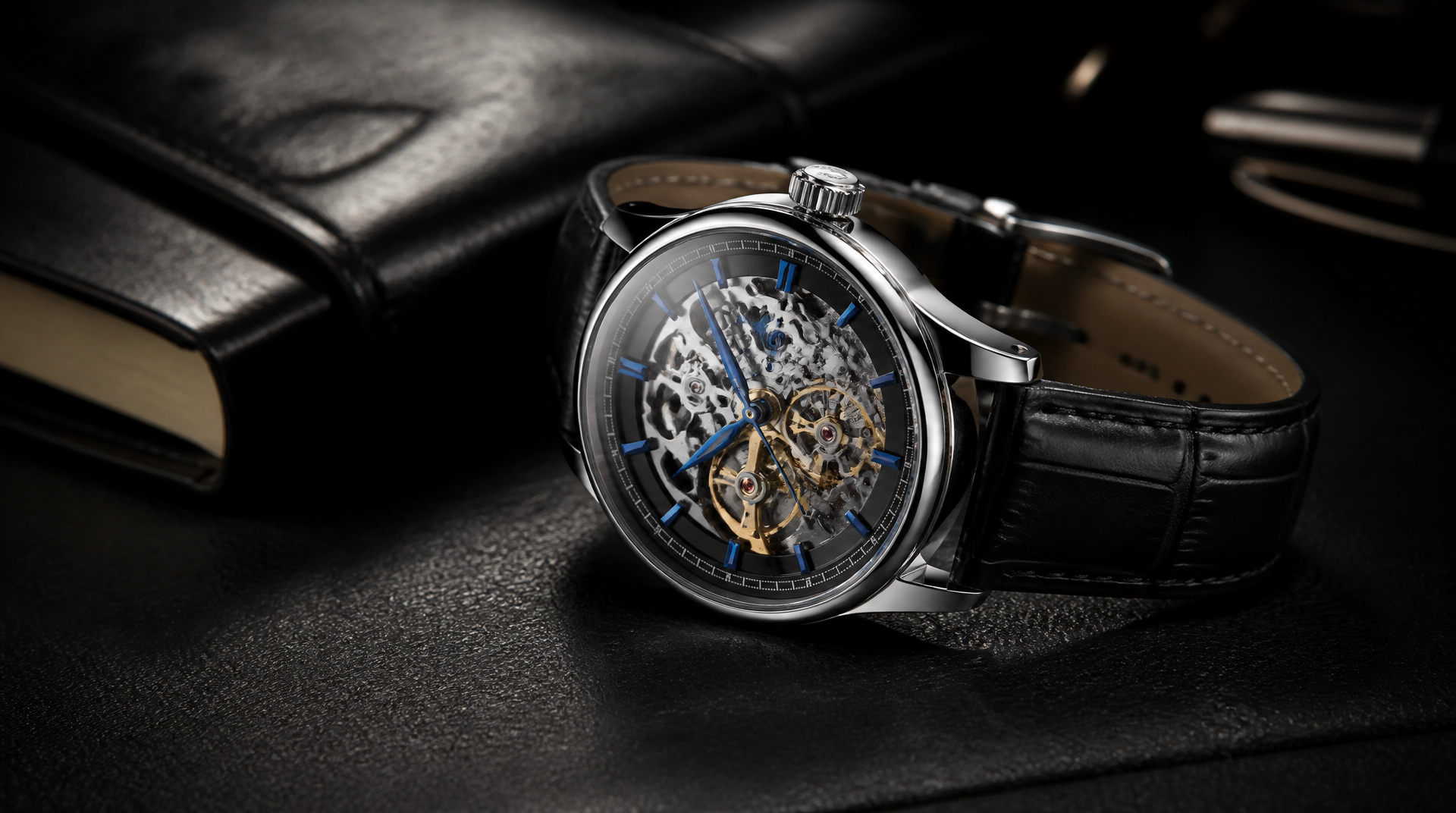
Stuhrling Original positions itself as affordable luxury with dramatic design and low entry prices. The reality is more specific: you are buying a visually ambitious watch built around a movement that will either carry the piece for years or turn it into a paperweight within months. Most models use a Japanese automatic (Seiko NH or Miyota), a no-name Chinese mechanical caliber, or a Swiss Ronda quartz module. The dial gets the attention; the movement decides whether the watch stays on your wrist.
If reliability is your top priority, take the same $80–$200 and put it into a Seiko 5 Sports or an Orient Bambino. Those offer in-house movements, predictable accuracy out of the box, and water resistance you can trust. Buy a Stuhrling when the look is the point, and you can treat the watch as a replaceable accessory rather than a long-term daily driver.
Quick answer
A Stuhrling Original watch can be a satisfying style purchase, but it is not a cost-effective way to get a reliable daily-wear automatic. The watches deliver genuine aesthetic ambition at a low price—open-heart dials, skeletonized movements, and exhibition casebacks are common. The trade-off is inconsistent quality control, unregulated movements, and water resistance that rarely matches what the dial claims.
The safest Stuhrling is a quartz model with a Swiss Ronda movement, followed by an automatic with a clearly named Seiko NH35 or NH36. The riskiest are models described only as “21-Jewel Automatic” or with an internal Stuhrling code that doesn’t correspond to a known Japanese or Swiss caliber. Those nearly always contain an unbranded Chinese movement that was never regulated after assembly, which is the single biggest source of owner frustration.
Spot the failure before the return window closes
The most common owner complaint follows a clear pattern: the watch arrives and runs, but accuracy swings wildly from one day to the next, or the watch stops overnight even after a full day of wear. The root cause is an unregulated Chinese movement that left the factory without adjustment. The tell is a product page that avoids naming the caliber entirely—if the description only says “21-Jewel Automatic” or an unrecognizable internal code, tread carefully.
You don’t need a timegrapher to catch a problem movement early. Use this two-step check.
1. Before you buy, find the exact movement reference. Search the model number plus “movement” on watch forums and Amazon Q&A. If the result is a specific Seiko, Miyota, or Ronda caliber, you have a known quantity. If the only description is vague or a proprietary Stuhrling code that doesn’t match any of those three manufacturers, you are likely looking at an unbranded Chinese engine.
2. After the watch arrives, set it to a known accurate clock (time.gov or a quartz reference) and wear it normally for a full day. Note the deviation after 24 hours. Repeat the check the next day without resetting. A brand-new mechanical watch—even a budget one—should not drift more than about ±45 seconds per day right away, and it should not show large swings between days. If it does, start a return immediately.
This is not about expecting chronometer precision. It’s about rejecting a movement that was assembled but never tuned, which accounts for the majority of Stuhrling reliability complaints.
Comparison framework
Stuhrling competes in the same $60–$200 bracket as entry-level Seiko, Orient, and Invicta models. The table below lays out the typical specs that matter most when you’re comparing one budget automatic to another.
| Feature | Stuhrling Original | Seiko 5 Sports (e.g., SNK, SRPD) | Orient Bambino | Invicta Pro Diver |
|---|---|---|---|---|
| Street price | $50–$200 | $80–$160 | $120–$200 | $60–$110 |
| Movement (typical) | NH35/36, Miyota 8215, Chinese auto, Ronda quartz | 4R36/7S26 in‑house automatic | F6 in‑house automatic | NH35 automatic or Ronda quartz |
| Crystal | Mineral or acrylic; sapphire rare | Hardlex mineral | Mineral | Mineral (some models sapphire) |
| Water resistance | 30m–100m (inconsistently sealed) | 50m–100m (dependable) | 30m | 200m (ISO-rated on many) |
| Bracelet | Usually folded links, hollow end‑links | Solid links on newer models | Leather strap standard | Solid links on most |
| Warranty | 2 years | 2–3 years | 1 year | 1–3 years |
The pattern is consistent. Stuhrling gives you more visual drama and design variety, while Seiko and Orient give you a movement platform that is predictable, serviceable, and regulated to a known tolerance. Invicta’s Pro Diver offers genuine 200m water resistance at a lower price but copies a Submariner aesthetic so closely that it won’t suit everyone.
When the common recommendation fails: you’ll often hear that a Stuhrling is a great value if you get one with a Seiko movement. That advice is incomplete. A Seiko NH35 inside a Stuhrling case is not the same as a Seiko NH35 inside a Seiko watch. Stuhrling typically does not regulate the movement after it leaves the supplier, and the case assembly—especially around the crown tube and case-back gasket—is built to a lower cost standard. The movement may be solid, but the watch around it can still fog in a rainstorm or lose time excessively. Even with a known caliber, budget for a possible $40–$60 regulation visit to a local watchmaker if you want consistent accuracy.
Best-fit picks by use case
A Stuhrling isn’t universally a bad idea, but it only fits specific scenarios comfortably.
A first automatic under $100. An open-heart or skeleton model equipped with an NH35 or NH36 delivers a legitimate conversation starter at a price where few brands show you the movement. The transparent dial is genuinely well-executed. Stick to listings that name the movement explicitly. If the only description is “21-Jewel Automatic,” skip it.
A style-forward gift. Stuhrling’s strength is design variety. The brand cycles through limited-run models constantly, so the recipient is unlikely to see the same watch on someone else. The presentation impresses for the money, with thick cases, exhibition backs, and textured dials. As an occasional accessory, it works. As a daily beater, it’s a gamble.
Where the brand falls short. A Stuhrling is the wrong choice if you plan to shower, swim, or snorkel with it. The seals and pushers are not reliably tested to their rated depths, and many models use snap-on case backs with a single thin gasket. A watch marked 100M can fog up after brief submersion. For a budget mechanical that can handle pool duty, the Invicta Pro Diver or a Casio Duro are far safer. Servicing is another dead end: a Chinese automatic movement cannot be economically overhauled, so the watch becomes disposable when it fails.
Trade-offs to know
The weight and wrist feel are the first things that surprise new owners. Stuhrling cases tend to be large and substantial, with polished surfaces that look premium from a distance. Close up, the bracelet often reveals the cost savings—folded metal links with hollow end-links that rattle and pull arm hair. The leather straps are generally stiff and benefit from an immediate aftermarket replacement.
Water resistance ratings deserve skepticism. A 50M or 100M marking means almost nothing in practice without a screw-down crown and tightly sealed case. Treat a Stuhrling as splash-resistant, not swim-ready, regardless of the number on the dial.
Resale value is essentially nonexistent. These watches depreciate steeply the moment you unbox them, and they rarely hold enough mechanical value to justify a service. Treat a Stuhrling as a consumable, not a piece you’ll pass down. The two-year warranty offers some protection, but the hassle of shipping and waiting for a replacement often outweighs the benefit on a sub-$150 purchase.
Related questions
Is Stuhrling a luxury brand?
No. Stuhrling Original is a mass-market brand that uses design cues from high-end watchmaking but operates firmly in the budget segment. The materials, finishing, and movement quality do not meet luxury standards.
How long do Stuhrling watches last?
A Stuhrling with a Japanese automatic or a Swiss quartz movement can run for several years without issue if you avoid water exposure and shocks. Models with unbranded Chinese movements may fail within the first year and are not cost-effective to repair. Treat the watch as a short-to-medium-term accessory rather than a decade-spanning tool.
Is Stuhrling a good investment?
No. These watches lose value immediately and do not appreciate. They are a fashion purchase, not a financial one.
How does Stuhrling compare to Invicta?
Both brands follow a similar high-discount, high-volume business model with aggressive styling. Invicta’s Pro Diver line typically offers better real-world water resistance and a more consistent bracelet, while Stuhrling skews toward dressier, more original designs. Neither offers strong long-term durability compared to equivalently priced Seiko or Orient models.
Can you swim with a Stuhrling watch?
Most Stuhrling models are not reliably sealed for swimming or submersion, even if the dial says 100M. Water damage is a common point of failure, and the warranty may not cover it if the crown was not screwed down or the gasket was thin to begin with. Limit the watch to handwashing and light rain.
Explore This Topic
- Back to Stuhrling
- Back to Stuhrling Brand Review
Related guides in this cluster:
- Japanese vs Swiss Watches: Quality, Value & Prestige Compared
- Christopher Ward Watches: Complete Brand Guide & Review
- Hamilton Pocket Watch Collector’s Guide: Serial Numbers, Models & Value

The We Know Watches editorial team brings together over 40 years of combined watch collecting, trading, and repair experience. Our editors have owned and handled watches from every major brand — from entry-level Seiko 5s to Rolex, Omega, Patek Philippe, and independent Swiss watchmakers. We’ve bought and sold at auction, worked with authorized dealers, visited manufacturing facilities in Switzerland and Japan, and serviced hundreds of movements ranging from the Seiko 7S26 to the Longines L888. Every guide and review we publish is based on hands-on experience, original research, and consultation with professional watchmakers. We do not accept payment for reviews, and we clearly disclose when we use affiliate links.