
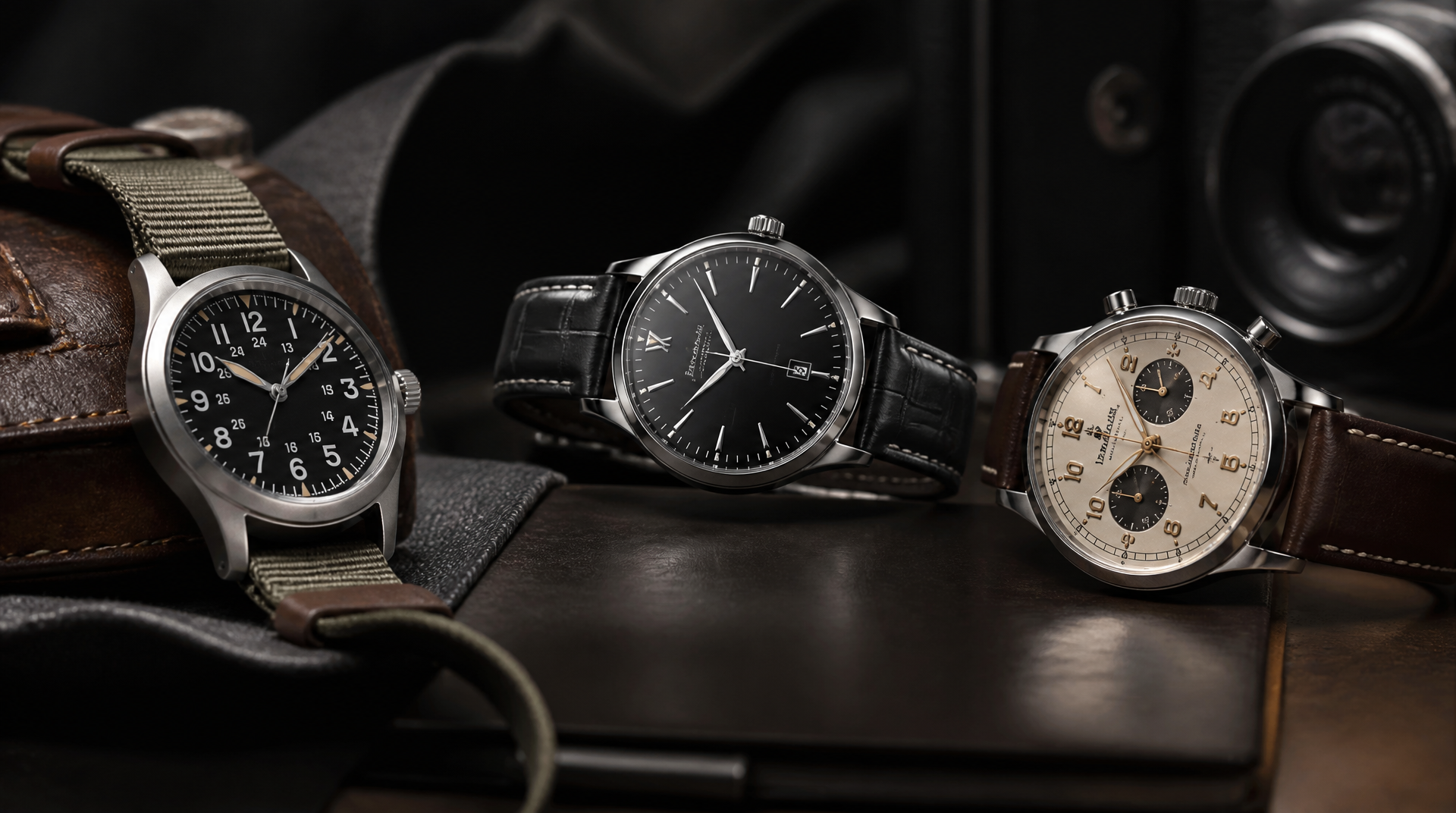
Hamilton gives you Swiss-mechanical build quality, an 80-hour power reserve across most models, and military design DNA that no other brand in its price range can match—all for roughly $395 to $1,500. The trap many buyers hit: they pick a manual-wind Khaki Field Mechanical because it looks right and costs under $400, then resent the daily winding within a month. This guide sorts the Khaki, Jazzmaster, and American Classic lines so you pick the one that actually fits your weekly rhythm, and it tells you exactly when to walk away from a reference that will only frustrate you.
Hamilton’s Military Heritage Defines the Khaki Dial
Hamilton didn’t just borrow military aesthetics—it manufactured them. During World War II, the brand produced more than one million timepieces for the U.S. armed forces, including marine chronometers and navigation watches built to the GG‑W‑113 pilot’s specification. That spec’s layout—bold Arabic numerals, syringe hands, hi‑contrast matte dial—sits directly on the current Khaki Field Mechanical reference H69439531 (black dial) and H69439931 (white dial). You’re looking at a 1960s‑issue watch updated with a modern Swiss manual‑wind movement.
The company was founded in Lancaster, Pennsylvania in 1892, but today Hamilton is a Swiss brand owned by Swatch Group. Headquarters and production are in Biel, Switzerland, and every current model carries “Swiss Made” on the dial. That Swiss‑made reality matters because Hamilton gets privileged access to ETA‑based movements—the H‑10 (automatic) and H‑50 (manual) calibers are derivations of ETA C07.611 and 2801‑2, respectively. You receive the component quality and assembly consistency of a Swiss‑group brand while pricing competes with Japanese rivals.
Khaki Field, Aviation, and Navy: Sorting the Tool‑Watch Family
The Khaki name covers three sub‑lines built for completely different environments. The table below isolates the must‑know differences because picking the wrong sub‑line is the second most frequent regret.
| Sub‑Line | Core Environment | Defining Feature | Typical Price (USD) |
|---|---|---|---|
| Khaki Field | Land / field use | Brushed case, syringe hands, vintage military dial with abundant lume | $395–$675 |
| Khaki Aviation | Air / cockpit | Inner rotating bezel or slide‑rule, oversized crown, large case diameter | $595–$1,495 |
| Khaki Navy | Water / diving | Unidirectional bezel, screw‑down crown, 100–300 m water resistance | $595–$1,295 |
Khaki Field: Military DNA in Its Purest Form
The Field line carries Hamilton’s heritage straight to your wrist. No polished surfaces, no fuss—just a high‑contrast dial, wire‑style lugs, and dial text that looks lifted from a mil‑spec drawing. The major split inside the line is mechanical versus automatic.
- Khaki Field Mechanical (H‑50 movement): Manual‑wind, 38 mm case, no date, 80‑hour power reserve. References H69439531 (black) and H69439931 (white) price around $395–$445. The lug‑to‑lug measurement is nearly 47 mm, so the watch wears long; it will overhang a wrist smaller than 6.25 inches. This reference demands roughly 30 turns every morning, which some people enjoy and others abandon by Wednesday. The H‑50 does not hack (the seconds hand keeps running when you pull the crown), so you cannot set the time to the second—a small but daily friction if you like precise synchronization.
- Khaki Field Auto (H‑10 movement): Automatic with date at 3 o’clock. Available as reference H70455133 (38 mm) and H70515137 (42 mm), priced about $595–$675. The 38 mm version fits wrists under 7 inches comfortably, and the 80‑hour power reserve means you can leave it off over a weekend and it’ll still be running. The date window pushes the feel closer to a daily‑wear piece and slightly away from purist mil‑spec correctness—exactly what many buyers actually need. The bracelet (on the 38 mm auto) uses solid end‑links and a pressed clasp, which feels secure but not premium; the watch wears best on a single‑pass nylon or leather strap.
Khaki Aviation: Genuine Pilot Function Without the IWC Bill
Hamilton’s aviation watches put cockpit utility front and center. The Khaki Aviation Pilot Pioneer Mechanical ref H764120 (about $845) recreates a 1970s chronograph‑adjacent look with a countdown bezel and tumbler crown. It’s hand‑wound, so the same winding reality applies. The Khaki Aviation Converter Auto ref H767560 (around $1,095) adds a bidirectional inner bezel for crosswind computation and a 44 mm case that will dominate wrists below 6.5 inches. These are correct pilot tool watches—make sure you want that much dial real estate before ordering.
Khaki Navy: The Diver That Deserves More Shelf Space
The Khaki Navy Scuba ref H822350 starts at about $595 and gives you a ceramic bezel insert, screw‑down crown, and 100 m water resistance—specs that many Swiss competitors in this price bracket reserve for much higher line extensions. The Khaki Navy BeLOWZERO ref H785350 pushes resistance to 300 m and uses a massive 46 mm case (about $1,295). If you need a Swiss automatic diver that isn’t a Tissot Seastar, this line delivers genuine dive‑rated protection. Keep an eye on bezel alignment; some examples leave the factory with a bezel that doesn’t line up perfectly at 12 o’clock.
Jazzmaster: A Dress Watch That Stays Under Four Figures
The Jazzmaster family moves Hamilton into business‑casual and semi‑formal territory. Polished bezels, applied indices, and thinner cases sit on the same 80‑hour automatic movements found in the Khaki line. Prices generally run $595–$1,195, which is rare for a Swiss automatic dress watch with a sapphire crystal and a movement that can stretch across a long weekend.
- Jazzmaster Open Heart ref H32565555 (around $795): The dial cutout reveals the balance wheel. It splits opinion sharply—some call it playful, others call it a gimmick that tires after two weeks. Buy it only if you’ve seen the open‑heart aperture in person and still like it under natural light. Expect to hear the rotor spin; the case amplifies movement noise more than you might anticipate.
- Jazzmaster Viewmatic ref H32515555 (around $625): Applied indices, a clean date window, and a domed sapphire crystal that catches light without demanding attention. This is the sleeper pick for anyone who needs an everyday dress watch that won’t draw unsolicited comments.
Across the Jazzmaster range, water resistance rarely exceeds 50 meters—hand‑washing and rain are fine, swimming is not. The supplied leather straps often feel stiff and synthetic out of the box; budget for an aftermarket Horween or suede strap if the factory strap bothers you.
American Classic: Offbeat Shapes Backed by Real History
Hamilton’s American Classic sub‑brand houses the Ventura and the Intra‑Matic chronograph—two models that look nothing like the rest of the catalog.
- Ventura (quartz ref H24411732, ~$745; auto variants over $1,000): The triangular shield case originally debuted in 1957 and became famous on Elvis Presley’s wrist. The shape reads as either iconic or costume‑piece depending on your tolerance for non‑traditional silhouettes. There is almost no middle ground, so try it on before buying. The quartz version uses a reliable Ronda movement, and you can expect about three years of battery life. The curved mineral crystal picks up scratches more easily than a flat sapphire, so it benefits from careful handling.
- Intra‑Matic Chronograph ref H38416711 (panda dial, manually wound, ~$1,345): A two‑register design with pump pushers and a sharply domed sapphire crystal that mimics acrylic. It uses an ETA 7753 base, delivers steady timekeeping, and goes without a date window. The 40‑mm case wears thick, so check shirt‑cuff clearance if you plan to wear it in an office. Water resistance is 50 meters—treat it as a desk watch. The chronograph start/stop feels deliberate and slightly stiff, which is characteristic of the cam‑lever design; the minute counter jumps at the half‑hour mark, a quirk to know before you spend four figures.
The Real‑Weekend Wear Test: Five Decisions That Prevent a Fast Flip
These five decisions act as a pre‑purchase checklist. They force you to match the watch to your actual weekly habits, not a Pinterest board. If any step hits a hard stop, you’re looking at the wrong reference.
1. Identify where the watch will spend 80% of its time.
A Khaki Field can handle yardwork and casual Fridays; it looks out of place in a buttoned‑up office. A Jazzmaster works with a blazer but feels fragile on a hike. If you truly need one watch for both worlds, the Khaki Field Auto 38 mm (ref H70455133) on the factory bracelet walks the line best. Hard stop: If you already know the watch will face regular lawn‑mowing, pool time, or construction‑site wear and its water resistance caps at 50 m, walk away. One splash past the rating ends the party.
2. Pick the movement that matches your morning tolerance.
Manual‑wind (H‑50) models require roughly 30 turns every morning. Automatics (H‑10) just need to be worn. Hard stop: If the daily wind already sounds like a chore, skip all Mechanical references—no romantic‑idea override works here. Walk into a store and physically wind a hand‑wound watch 30 turns. If the resistance irritates you in the moment, you’ve got your answer.
3. Measure lug‑to‑lug length and test against your wrist span.
Hamilton’s field‑watch lugs are long. The 38 mm Khaki Field Mechanical measures approximately 47 mm lug‑to‑lug, which is longer than many 42‑mm divers. Place a flexible ruler across your wrist. Mark 47 mm. If the mark overhangs your wrist edge by more than 1 mm on either side, the watch will wear too large and you’ll constantly notice it. Hard stop: No return policy will fix a watch that hangs over your wrist bones.
4. Match the depth rating to your real‑world water exposure.
50 m (Jazzmaster, Intra‑Matic) means hand‑washing and rain—no swimming. 100 m (Khaki Navy Scuba) means pool and surface swimming are safe. Hard stop: If your weekends include jumping in a lake, do not buy a 50‑meter Hamilton as a “just in case” piece.
5. Decide if a missing date window will nag you daily.
Several purist‑style references—Khaki Field Mechanical, Intra‑Matic—omit a date. If you habitually glance at your wrist for the date, those no‑date models will nag you every time you meet the blank dial space. Hard stop: Do not convince yourself you’ll “get used to it.” You won’t.
Owner’s First‑Week Checkup: Confirming the Watch Is Healthy
Once the watch hits your wrist, run this checkup within the return window. It tells you whether the example you received is mechanically sound and whether you’re still on board with the winding or hand‑fit reality.
Verify timekeeping and power reserve:
1. Fully wind the watch (manual models: 40 crown turns; automatics: 30 turns, then wear it for eight hours).
2. Set the time against a reference clock such as time.gov.
3. After 24 hours of normal wear, note the deviation. Then let the watch rest for 48 hours and record again.
4. A healthy Hamilton H‑10 or H‑50 should fall within -15 to +15 seconds per day in real‑world wear. If you see a gain or loss greater than 20 seconds per day over two consecutive days, regulation is off—contact the retailer for an exchange or warranty adjustment.
Confirm power reserve holds:
After a full wind, rest the watch dial‑up. It should still be running at the 80‑hour mark (expect it to stop within a few hours of that window). A watch that dies after 60 hours needs attention.
Inspect the case and crown for early warning signs:
- Screw‑down crowns must seat cleanly without cross‑threading. If the crown feels gritty or doesn’t fully tighten, do not expose the watch to water.
- Check for condensation under the crystal after a temperature shift (e.g., walking from a cold room to a warm one). Any internal fogging means the seal is compromised.
Escalation signal—stop and request repair or refund if:
- The watch gains or loses more than 20 seconds per day over 48 hours of normal wear.
- The crown won’t fully seat, feels rough, or the stem wobbles.
- Condensation appears inside the crystal.
- The chronograph pushers stick or the minute counter fails to reset to zero.
If any of these appear within the return period, box the watch and contact your point of sale. Beyond the return window, Hamilton’s two‑year international warranty covers manufacturing defects—use it.
Hamilton vs. Tissot, Seiko, and Sinn: Where the Brand Wins
- Hamilton vs. Tissot: Both use Swatch Group Powermatic‑equivalent movements. Tissot’s Gentleman Powermatic 80 Silicium ref T127.407.11.041.00 (about $775) and PRX ref T137.407.11.041.00 (about $675) offer integrated‑bracelet looks and higher polished‑case refinement. Hamilton leans harder into vintage‑military dials and better lume. Choose Hamilton for field‑watch character; choose Tissot for a Swiss auto on a bracelet around $700.
- Hamilton vs. Seiko: Seiko’s Prospex Alpinist ref SPB121 (approx. $725) uses the in‑house 6R35 with a rotating compass bezel; the King Turtle ref SRPE03 (approx. $550) is ISO‑dive‑certified with famed lume. Hamilton generally edges ahead on case‑finishing consistency and strap‑ready simplicity. Pick Hamilton if you want Swiss military DNA without Longines money. Pick Seiko if you demand certified dive capability and multi‑faceted dial work.
- Hamilton vs. Sinn: The Sinn 556 I ref 556.010 (approx. $1,300) competes visually with the Khaki Field Auto but adds a tegimented (hardened) steel case, superior water resistance, and drying‑capsule technology. The Khaki Field Auto undercuts it by more than half. If absolute tool‑watch toughness matters, Sinn’s premium is justified; if you want 80% of the look and a proven Swiss‑group platform, Hamilton does it for less.
FAQ
Are Hamilton watches Swiss made?
Yes. Every modern Hamilton carries the “Swiss Made” designation on the dial. Headquarters and manufacturing are in Biel, Switzerland, and the company operates as part of Swatch Group.
Which Hamilton movement has the best power reserve?
Both the manual‑wind H‑50 and the automatic H‑10 deliver an 80‑hour power reserve, which is among the longest in Hamilton’s price segment. This means you can put down a fully wound manual‑wind watch on Friday and pick it up again on Monday without rewinding.
Can I swim with a Hamilton Jazzmaster?
No, Jazzmaster models are rated at 50 meters of water resistance, which is suitable for hand‑washing and rain but not for swimming. If you need a water‑ready Hamilton, look at the Khaki Navy Scuba with its screw‑down crown and 100‑meter rating.
Why does the Khaki Field Mechanical feel too long on my wrist?
Hamilton’s field‑watch cases use extended wire‑style lugs. The 38‑mm Mechanical reference H69439531 has a lug‑to‑lug span of about 47 mm, making it wear longer than many 42‑mm dive watches. Measuring total length instead of relying on case diameter prevents this sizing mismatch.
Is the Hamilton Intra‑Matic Chronograph a daily‑wear piece?
It can be, but with caveats. The manually wound ETA 7753‑base movement requires regular winding, the 50‑meter water resistance limits exposure, and the thick 40‑millimeter case can struggle with tight shirt cuffs. It works best as an intentional wear for days when you want vintage‑chronograph proportions without vintage mechanical risk.
Explore This Topic
- Back to Hamilton
- Back to Hamilton Brand Hub
Related guides in this cluster:
- Hamilton Pocket Watch Collector’s Guide: Serial Numbers, Models & Value
- Christopher Ward Watches: Complete Brand Guide & Review
- Omega Watches: The Complete Brand Guide — Speedmaster, Seamaster & More

The We Know Watches editorial team brings together over 40 years of combined watch collecting, trading, and repair experience. Our editors have owned and handled watches from every major brand — from entry-level Seiko 5s to Rolex, Omega, Patek Philippe, and independent Swiss watchmakers. We’ve bought and sold at auction, worked with authorized dealers, visited manufacturing facilities in Switzerland and Japan, and serviced hundreds of movements ranging from the Seiko 7S26 to the Longines L888. Every guide and review we publish is based on hands-on experience, original research, and consultation with professional watchmakers. We do not accept payment for reviews, and we clearly disclose when we use affiliate links.