
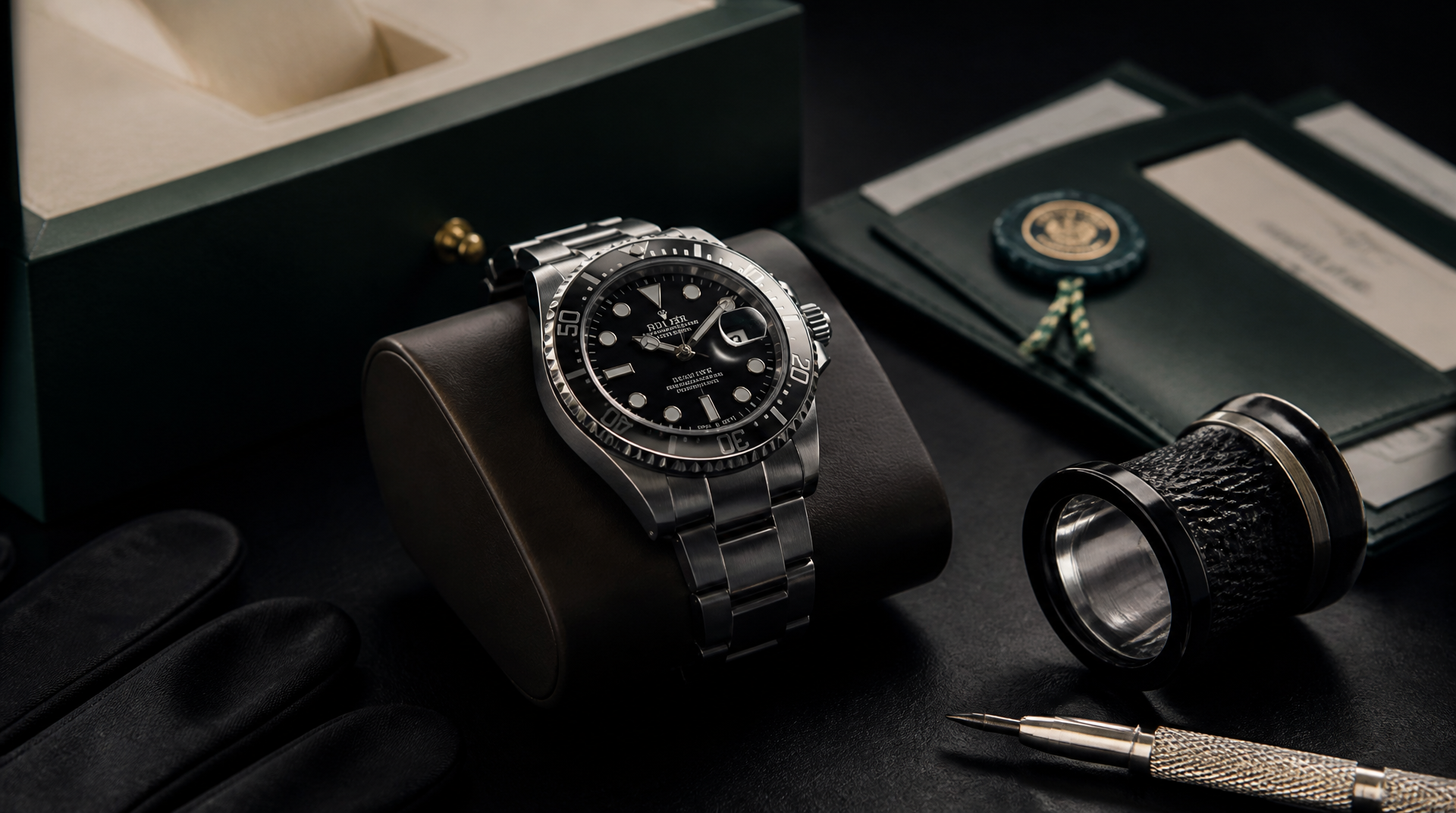
Authenticating a watch means verifying that three things align: the serial number traces back to the correct factory record, the physical details match how that reference left production, and any paperwork ties specifically to that piece. Start with the serial number and a 10× loupe before you trust a warranty card. If the serial check or the visual inspection uncovers a mismatch, pause the deal and get a second opinion before money changes hands.
Gather Your Baseline Evidence Before You Start
You need three items in front of you to do this right: the watch itself, any paperwork the seller provides, and a way to see small details.
- The watch: Remove the bracelet or strap if it blocks the lug engravings. Place the case on a soft mat so it doesn’t get scratched.
- A loupe or macro lens: A 10× triplet loupe costs under $40 and reveals dial printing flaws that a phone camera misses. A recent smartphone with macro mode can capture enough detail for a first pass, but a loupe is faster for evaluating date alignment and hand stack.
- The seller’s photos and listing: Save every image the seller posted. Open them on a separate screen so you can compare the claimed year, reference number, and bracelet codes to what’s on the watch in your hand.
If the seller hasn’t shared clear shots of the case back, the clasp code, and a straight-on dial view, request those before you start. A seller who stalls on basic photos is a friction point worth taking seriously.
Work the Serial Number in the Right Order
A serial number alone proves nothing. Counterfeiters copy real numbers from auction archives and engrave them onto fake cases. What matters is whether the number sits in the correct location for that brand and era, and whether it matches across the case, movement, and paperwork.
1. Locate the Serial and Reference Number
Where to look depends on the brand.
- Rolex (modern): The serial is engraved on the rehaut ring between the dial and crystal at 6 o’clock, and between the lugs at 6 o’clock. The reference number sits between the lugs at 12 o’clock.
- Omega: The 8-digit serial is on the case back for most modern models. Vintage Omegas often have it on the movement bridge, visible only with the case back removed.
- Cartier: Many models hide the serial on the case back in a small, deeply stamped font. Fakes often use shallow laser etching instead.
- Vintage pieces generally: Assume the serial is on the movement until proven otherwise. A pristine case back engraving on a 1960s watch is a warning sign, not a comfort.
2. Decode the Production Range
Cross-reference the serial against known production windows. For Rolex, a random serial (8 mixed characters) appeared around 2010; an older letter-prefix serial on a claimed 2015 Submariner doesn’t work. Omega serials can be checked through an authorized dealer, though the brand doesn’t publish a public database. Independent sites offer rough year estimates, but treat those as one data point, not a verdict.
Branch point — what the serial check tells you next: If the serial and reference align with the claimed year and the engravings show crisp, deep stamping rather than shallow laser etching, move on to the paperwork and physical inspection. If the serial produces a date that conflicts with the reference’s production run by more than a year, or the font looks thin and sandblasted compared to known genuine examples of the same era, stop here. Do not proceed to paperwork verification; escalate directly to a brand service center or a vintage specialist who can open the case and compare the movement serial. A mismatched serial isn’t a negotiation point—it’s a dealbreaker unless a factory service record can explain a re-case.
3. Check Movement Serial vs. Case Serial
If you or a watchmaker can open the case back, the movement serial should match the case serial on many Swiss brands. On a vintage Patek Philippe, the movement number drives the archive record; the case back engraving is secondary. A movement that carries a different serial than the case, with no factory service receipt explaining a replacement, is a red flag that should kill the sale.
Match the Papers to the Watch, Not the Other Way Around
Factory paperwork confirms a watch’s origin only when every detail matches. Counterfeiters print warranty cards, hang tags, and even fake archive extracts that look convincing on a screen but fall apart under close inspection.
- Cross-check the serial on every document: The warranty card, chronometer certificate, and any service invoice must show the identical serial number as the watch. A blank or partially filled-in card with mismatched handwriting is a shortcut fraudsters take.
- Inspect paper and print quality: Genuine Panerai warranty booklets use textured paper stock and a hologram sticker with a boat logo that shifts when tilted. Misspelled brand names, off-center stamps, or holograms that stay static at an angle are cheap giveaways you can spot without magnification.
- Weigh the impact of missing accessories by price tier: For a pre-owned watch under $3,000, a missing box or hang tag is common and not suspicious by itself. For a modern Rolex Daytona or a highly collectible reference, missing outer box and hang tag cuts 10–20% off resale value and raises provenance questions that demand a closer physical inspection.
Decision criterion that changes the recommendation: If you’re buying a vintage watch priced below $3,000, absent papers are normal and you shift your authentication weight to physical inspection and movement verification. For any modern luxury piece above $5,000, missing factory papers should redirect you from self-authentication to a paid third-party verification or an authorized dealer review. The reason is simple: without papers, resale liquidity drops sharply, and the cost of a professional opinion ($50–$150) is negligible against a five-figure counterfeit loss.
Inspect the Physical Details That Replicas Still Get Wrong
High-end replicas have narrowed the gap, but they still fail on specific points you can check with a loupe and basic handling. Work through these items in order; if two or more raise doubts, stop and escalate.
Dial Printing and Date Alignment
On a genuine Omega Seamaster, the “Swiss Made” text maintains a consistent gap from the minute track. Fakes crowd the lettering or misalign the date window inside its frame. A Rolex Cyclops should magnify the date 2.5×; many replicas use 1.5× magnification that you can evaluate by comparing the date window to a known-genuine photo of the same reference.
Hand Stack and Crown Feel
On modern GMT-Master II models, the hour hand sits above the GMT hand on the pinion. A reversed stack order is visible from a side angle and doesn’t require opening the case. The crown should unscrew with distinct threads and wind smoothly; gritty or loose collar action points to a poorly machined tube that no replica has fully solved.
Bracelet Codes and End-Link Fit
Real Rolex bracelets carry a clasp code and blade code matching the watch’s production era. A 2023 GMT on a clasp code from 2018 signals a bracelet swap at best, a fake at worst. End links should sit flush against the case with no visible gap. Over-polished chamfers that blur the transition between brushed and polished surfaces are a tell that the bracelet didn’t come from the factory.
Weight and Acoustic Check
A modern Submariner in Oystersteel weighs noticeably more than a hollow-link replica. Tap the bracelet lightly against a wooden surface; genuine solid links produce a dull thud, while hollow fakes ring with a tinny high-frequency ping. If you can hold a known genuine piece of the same reference alongside the watch you’re checking, a few seconds of side-by-side comparison resolves most doubts faster than any checklist.
When a Clean Bezel Is Not Enough
Ceramic bezel inserts on top-tier replicas now replicate the platinum-filled engravings of genuine Rolex bezels with alarming accuracy. A clean bezel alone does not clear the watch. Triangulate the bezel inspection with the serial number check and paperwork verification before you conclude anything.
Why “It Feels Right” Fails: A Common Failure Pattern
The most expensive authentication mistake happens when a buyer checks one pillar—usually the serial number or the bracelet weight—and lets confirmation bias carry the rest. The watch feels heavy, the serial returns a plausible date, and the seller seems trustworthy, so the buyer skips the movement check or ignores a subtle dial misalignment.
Symptom: Everything passes the first glance, but six months later a service center opens the case and finds a cloned movement with non-factory finishing or a mismatched rotor.
Likely cause: Replicators now invest heavily in external accuracy while cutting corners inside the case, where most buyers never look. A counterfeit movement that runs well for a year can still have incorrect jewel counts, stamped rather than machined bridges, or a balance assembly that a watchmaker identifies instantly.
Safer next move: Even if every external check passes, budget for a movement inspection when the watch costs more than $3,000. A local independent watchmaker can open the case and photograph the movement for a small bench fee. If the seller refuses to allow that step and the transaction is a private sale with no platform protection, walk away. The one deal you pass on is cheaper than the counterfeit you keep.
Know When to Stop and Escalate
Self-authentication has a hard limit. You’ve reached it and need a professional when:
- The serial number falls outside known ranges but the seller insists it’s a rare transition model with no documentation to prove it.
- Papers show inconsistencies—a different country code than the seller claims, a warranty date that predates the watch’s production, or a service center not listed in the brand’s official network.
- The seller won’t provide a movement photo and the case back isn’t transparent. In a private sale above $5,000, a legitimate seller almost always cooperates on a watchmaker inspection because they want the deal to close.
- The transaction involves international shipping with a short return window. Use an authentication service like eBay’s Authenticity Guarantee or a local watchmaker who opens the case on your behalf before you finalize payment.
- You’re buying a vintage piece with replacement parts. A sympathetic restoration is not a fake, but it changes the value. Only an experienced watchmaker can tell you whether the dial, hands, and crown are age-correct for that serial range.
Stop threshold — this is your concrete line: If the seller won’t allow an independent third-party watchmaker to open the case on a watch priced above $5,000, or if two of the three pillars (serial number, physical details, paperwork) show unresolved inconsistencies, stop the DIY process. Do not proceed based on a partial pass. Escalate to a brand service center, a third-party authentication service with a guarantee, or walk away from the deal entirely. A $150 inspection fee is always cheaper than a counterfeit that can’t be returned.
Frequently Asked Questions
Can a fake watch have a real serial number?
Yes. Scammers copy genuine serial numbers from online listings or auction archives and engrave them onto counterfeit cases. Cross-check the serial with physical details and paperwork rather than treating a matching database entry as proof.
Does a missing box mean the watch is fake?
No. Many honest sellers discard boxes, but for modern collectible pieces a missing box reduces resale value and can indicate the watch moved through unauthorized channels, which warrants a closer physical inspection.
Are open or blank warranty papers a dealbreaker?
Warranty cards left blank or partially filled in are a significant red flag. Genuine paperwork is completed at the point of sale, and a blank card makes it impossible to verify the original purchase date or authorized dealer.
How accurate are online serial number databases?
They give a rough production window but are never definitive proof. Some brands do not publish serial ranges, and replicas can spoof numbers pulled from those databases, so treat the result as one data point among several.
Should I self-authenticate a watch from a reputable online marketplace?
If the platform offers an in-house authentication program such as eBay Authenticity Guarantee, that adds a meaningful layer of protection. For private forum sales without platform backing, always budget for a post-purchase inspection and confirm the seller allows a return window long enough to complete it.
Explore This Topic
- Back to General
- Back to Authentication
Related guides in this cluster:
- Automatic vs Quartz vs Manual: Watch Movements Explained for Beginners
- How Much Does Watch Service Cost? Complete Brand-by-Brand Breakdown
- Watch Size Guide: How to Choose the Right Case Diameter, Thickness & Fit

The We Know Watches editorial team brings together over 40 years of combined watch collecting, trading, and repair experience. Our editors have owned and handled watches from every major brand — from entry-level Seiko 5s to Rolex, Omega, Patek Philippe, and independent Swiss watchmakers. We’ve bought and sold at auction, worked with authorized dealers, visited manufacturing facilities in Switzerland and Japan, and serviced hundreds of movements ranging from the Seiko 7S26 to the Longines L888. Every guide and review we publish is based on hands-on experience, original research, and consultation with professional watchmakers. We do not accept payment for reviews, and we clearly disclose when we use affiliate links.