
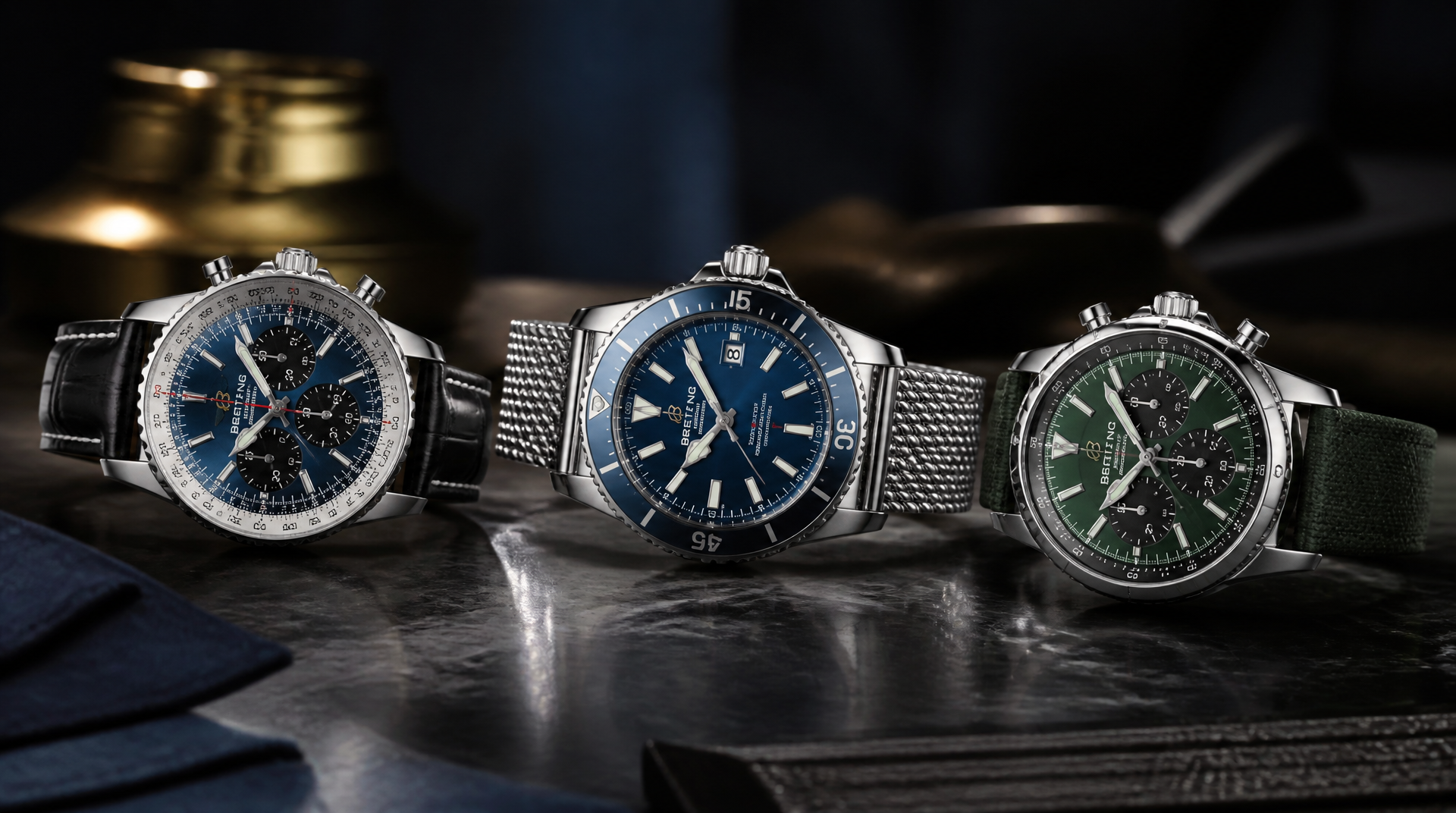
Breitling built its name on precision chronographs for pilots and robust dive watches that professionals used without hesitation. The two watches most people think of first are the Navitimer, with its recognizable slide-rule bezel, and the Superocean, a capable diver that often gets more wrist time than competitors at similar prices. This guide gives you a clear view of every current collection worth considering, what you realistically pay at each tier, and the single most expensive mistake buyers make when purchasing a pre-owned Breitling — so you can spot the warning signs before you commit.
Breitling’s Core Collections at a Glance
Breitling organizes its catalog around distinct jobs, not just aesthetics. The table below strips things down to the essentials so you can narrow your choices before digging into the details.
| Collection | Representative Model | Approx. Price (New) | Movement | Water Resistance | What Makes It Different |
|---|---|---|---|---|---|
| Navitimer | B01 Chronograph 41 | $9,400+ | In-house automatic chronograph (B01) | 30m | Circular slide-rule bezel for aviation math |
| Superocean | Automatic 44 | $4,700+ | Breitling Caliber 17 (ETA base) | 500m | Bright ceramic dive bezel, oversized numerals |
| Chronomat | B01 42 | $8,800+ | In-house B01 | 200m | Rouleaux bracelet, rider tabs on the bezel |
| Premier | B01 Chronograph 42 | $8,600+ | In-house B01 | 100m | Dress-chronograph, tachymeter scale, no dive bezel |
| Endurance Pro | Endurance Pro 44 | $3,550 | SuperQuartz (thermocompensated) | 100m | Ultra-light Breitlight case, pulsometer scale |
| Avenger | Avenger B01 Chronograph 44 | $5,500+ | B01 or ETA-based | 300m | Overbuilt military styling, glare-proof crystal |
These prices reflect new watches at authorized dealers; pre-owned figures vary depending on condition, completeness, and service history.
Navitimer: The Pilot’s Chronograph That Earned Its Place
The Navitimer has been around since 1952, long before GPS. Its circular slide rule lets you multiply, divide, compute speed, or convert units — functions most owners rarely use, but that create one of the most distinctive dial layouts in watchmaking.
Today’s lineup splits into a few clear paths:
- B01 automatic chronograph (41mm, 43mm, 46mm): In-house column wheel, vertical clutch, roughly 70 hours of power reserve.
- B09 manual-wind chronograph (40mm): Hand-wound movement derived from the B01 architecture, appealing to purists who appreciate a thinner case and the winding ritual.
- Three-hand Navitimer 41: Keeps the slide rule but drops the chronograph, resulting in a cleaner dial.
A Navitimer wears larger than the diameter suggests because the bezel and short lugs push presence outward. The dial is intentionally busy; if you want a quiet pilot’s watch, look elsewhere.
The Water-Resistance Limitation That Catches New Owners
A critical trade-off hides in the spec sheet: 30 meters of water resistance means splash protection only — hand washing, light rain, no swimming or showering. The slide-rule bezel and the chronograph pushers create multiple water-ingress paths that seal far less aggressively than a dive watch. Submerge a Navitimer even briefly and moisture can reach the movement quickly. A repair after water damage often costs more than a routine service, and if corrosion sets in, you may face a long parts wait. If you need a chronograph you can take into the pool or ocean, the Chronomat or Avenger is a far safer choice.
Superocean: A Dive Watch That Earns Its Depth Rating
Introduced in 1957, the Superocean was originally built for professional use. Modern versions preserve that tool-watch identity with a screw-down crown, a solid steel case, and a 120-click unidirectional bezel with a ceramic insert. Water resistance starts at 300m on the 36mm models and reaches 500m on the 44mm Automatic.
What separates the Superocean from many dive watches in its price bracket:
- High-contrast dials (bright blue, yellow, green, white) with oversized numerals and sword hands. Legibility underwater and on deck is better than on subtler designs.
- Closed caseback on most references, which keeps manufacturing costs lower and hides the ETA-based automatic caliber (Caliber 17). Only special editions get a display back.
- Overbuilt feel: The crown, bezel action, and steel bracelet give a sense of substance that few dressier divers match.
The Superocean Heritage sub-line offers a plongeur minute hand, a vintage-profile bezel, and mesh bracelet options that compete directly with the Tudor Black Bay Fifty-Eight in style, but with significantly higher depth ratings.
How to Confirm the Movement Before You Buy
Not every Superocean uses an in-house engine, and assumptions here cause disappointment. The 44mm Automatic runs on the ETA-based Caliber 17, which is reliable and easy to service but not proprietary. The Superocean Heritage B20 Automatic 42, however, carries the Breitling B20 movement (sourced from Tudor’s manufacture). You can verify which engine a given reference holds by checking the model number engraved on the caseback: for example, A173… signals Caliber 17, while A233… indicates the B20 in a Heritage II model. When you can’t inspect the watch in person, cross-reference the full reference on Breitling’s website or in the current catalog before paying.
Verify the Crown and Water Resistance Before Submersion
A dive watch that isn’t sealed correctly can flood in seconds. Run this quick sequence before trusting any Superocean in the water:
1. Unscrew the crown fully, then screw it back down until it stops. If you can see exposed threads or the crown sits at an angle, the tube gasket may be compromised.
2. Check the caseback. A visible gap or any movement when you press lightly indicates the gasket needs attention.
3. Pressure test annually. Many service centers offer rapid pressure testing for a small fee or free with a service visit. While a static pressure test doesn’t replicate dynamic forces, it’s the best early warning you have against a slow leak.
If any step raises doubt, keep the watch out of the water and have it inspected by a watchmaker who can replace seals and verify the rating.
Other Collections Worth Knowing
Premier – Breitling’s dressiest chronograph. Arabic numerals, a symmetrical layout, and no bulky bezel mean it slips under a cuff easily. The B09 manual-wind version in pistachio green has gained a quiet following among collectors who want the in-house movement without the rotor noise.
Chronomat – The all‑rounder. Its rouleaux bracelet and raised rider tab bezel are unmistakable. With 200m water resistance and a choice of 36mm, 42mm, and 44mm sizes, it functions as a genuine sports chronograph without looking out of place in business settings.
Avenger – The most aggressively styled Breitling. Notched bezel, large numerals, and military‑strap aesthetic. If you prefer a three‑hand watch with a GMT complication, the Avenger Automatic GMT gives you a rugged alternative to a Superocean without the dive-specific bezel.
Endurance Pro – A quartz watch aimed at active users. Its Breitlight composite case weighs almost nothing, and the thermocompensated SuperQuartz movement holds roughly 10 seconds a year of deviation. At about $3,550 new, it’s the most affordable path into the brand with genuine tool‑watch credentials.
Colt (pre‑owned) – A discontinued entry-level series that often appears on the secondary market below $2,000 for quartz versions and under $3,000 for automatics. Simple dials, 41‑44mm size, 200m water resistance. Early Colt automatics frequently show bracelet stretch and missing service records; budget for that.
Buying a Breitling: New vs. Pre‑Owned and What You’ll Pay
New Breitling prices range from roughly $3,550 (Endurance Pro) to over $10,000 for precious‑metal chronographs. Mechanical models start around $4,500 for a Superocean Automatic on rubber, and in‑house chronographs (B01‑based) sit above $8,500. The least expensive Rolex at retail currently exceeds $6,000, so Breitling offers a lower entry point into Swiss luxury — but with steeper depreciation.
Pre‑owned figures drop sharply: a five‑year‑old Superocean Automatic can be found for $2,800–$3,200, and a Navitimer B01 from the mid‑2010s often trades between $5,000 and $6,500. You’re trading better value retention for access to distinctive designs and complications without the same scarcity‑driven markups.
Channels to consider:
- Authorized Dealers/Boutiques: Full warranty, highest price, zero authenticity risk.
- Trusted pre‑owned sellers: Verified authenticity, short return window, moderate premium.
- Private sales: Lowest prices, but you assume full responsibility for verification and service history.
Regardless of where you buy, insist on the original warranty card, hang tags, and at least one clear photo of the movement if the caseback is transparent.
The Most Expensive Mistake When Buying Pre‑Owned (and How to Catch It)
The mistake that costs buyers the most isn’t a scratched bezel or a missing box — it’s a movement that has been neglected, incorrectly serviced, or swapped without documentation. A chronograph that performs perfectly during a quick handoff may start stuttering, resetting incorrectly, or stopping within weeks because old lubricants have hardened or a non‑spec component was installed during a past repair.
External condition photographs beautifully, so listings focus on polish and visual appeal. Internally, the watch can be a ticking time bomb. A factory service for an in‑house B01 chronograph through Breitling runs roughly $600–$800 and can take several weeks. An independent watchmaker may charge $400–$600 for an ETA‑based chronograph, but parts for older references can be difficult to source.
Red Flags That Should Make You Pause
- No service history and no box/papers: A watch without provenance almost always carries hidden costs.
- Rotor noise louder than a whisper: A grinding or rattling sound often points to worn ball bearings, especially on ETA 2824‑based movements in some older Superocean and Colt models.
- Chronograph seconds hand hesitates or stutters when starting or resetting. It should snap instantly and land dead-on-zero.
- Crown winding feels gritty or inconsistent: Smooth, even tension is normal; catching suggests dirt or damaged gearing.
A 4‑Step Pre‑Purchase Check You Can Perform
1. Ask for the service history and full set (box, papers, warranty card). If the seller cannot produce records from the last 5–7 years, mentally budget for a full service immediately.
2. Inspect the bezel action and crown threading. A dive bezel must click crisply with no backward play. A slide-rule bezel should rotate bidirectionally without scraping the dial.
3. Test the chronograph three times in sequence. Start, stop, and reset. Watch the minute subdial jump exactly. If possible, film the reset on your phone and replay in slow motion — any stutter is a warning.
4. Listen to the rotor and tap the case gently. In a quiet room, tilt the watch near your ear. A smooth whir is fine; a loose rattle or scraping sound often means bearing trouble.
Stop point: If any step raises doubt, walk away — unless the price leaves enough room for a factory service (budget $700 for a chronograph). Always use a trusted escrow service and have the watch inspected by a Breitling‑certified watchmaker inside the return window.
FAQ
Is Breitling a good investment?
Most Breitlings do not appreciate like in‑demand Rolex or Patek Philippe models. Treat them as durable mechanical tools or luxury purchases, not financial assets. A handful of limited editions may hold value better, but buying primarily for resale often disappoints.
How often should I service a Breitling?
Breitling suggests a service every 4 to 6 years for mechanical chronographs and every 2 to 3 years for quartz models to check gaskets. Many owners stretch mechanical intervals to 7–8 years if the watch keeps accurate time, but regular pressure testing is wise for dive models.
Are quartz Breitlings worth buying?
Yes, especially the Endurance Pro and earlier Aerospace models. Their SuperQuartz movements deliver accuracy within seconds per year, need minimal maintenance beyond battery changes, and represent the most affordable way to own a Breitling without losing the brand’s identity.
How do Breitling and Rolex compare in terms of value retention?
Breitling depreciates more steeply. A steel Rolex Professional model frequently sells near or above retail on the secondary market, whereas most Breitlings trade at 30–50% below retail after three years. That means you can get more watch for your dollar buying pre‑owned Breitling, but you will recoup less if you sell.
Explore This Topic
- Back to Breitling
- Back to Breitling Brand Hub
Related guides in this cluster:
- Breitling Watch Buying Guide: Are They Worth It in 2026?
- Omega Watches: The Complete Brand Guide — Speedmaster, Seamaster & More
- Christopher Ward Watches: Complete Brand Guide & Review

The We Know Watches editorial team brings together over 40 years of combined watch collecting, trading, and repair experience. Our editors have owned and handled watches from every major brand — from entry-level Seiko 5s to Rolex, Omega, Patek Philippe, and independent Swiss watchmakers. We’ve bought and sold at auction, worked with authorized dealers, visited manufacturing facilities in Switzerland and Japan, and serviced hundreds of movements ranging from the Seiko 7S26 to the Longines L888. Every guide and review we publish is based on hands-on experience, original research, and consultation with professional watchmakers. We do not accept payment for reviews, and we clearly disclose when we use affiliate links.