A Tag Heuer serial number won’t tell you everything, but it’s the fastest way to separate a watch worth investigating from one that raises immediate red flags. The number itself is not a guarantee of authenticity—counterfeiters copy serials every day—but when you know where to find it, how to decode the era it points to, and when to stop trusting the paperwork, you’re already ahead of most buyers who overpay for a fake with a matching sticker. This guide walks you through the exact locations, a practical decoding approach, a step-by-step verification flow, and the one failure mode that catches people who only check the serial against the warranty card.
Where to Find the Serial Number on a Tag Heuer
The serial number location depends on the model and production era. Knowing the right spot saves you from assuming a watch is fake just because you didn’t find it in the first place you looked.
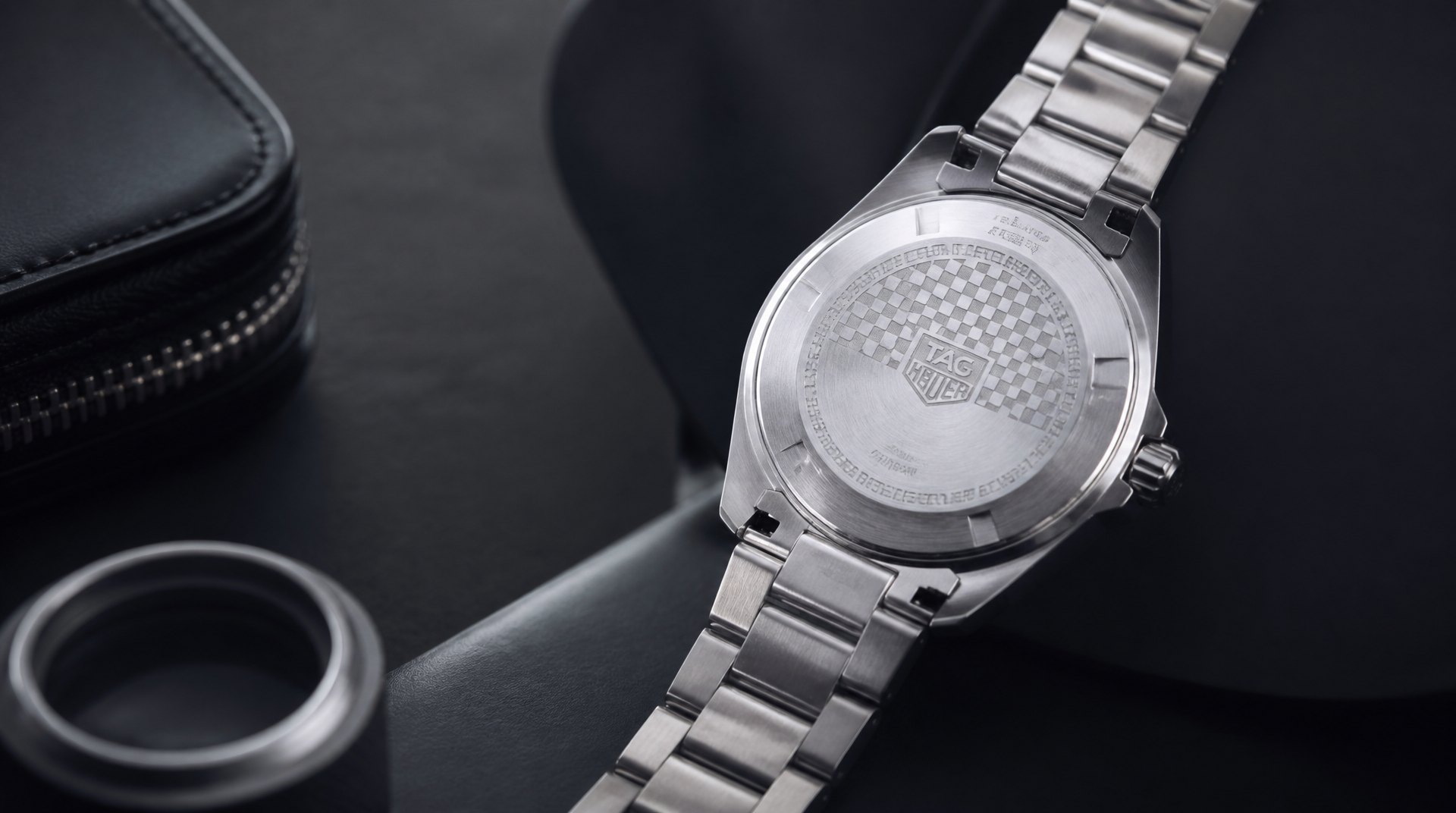
- Modern models (from the 2000s onward): The serial is laser-engraved on the flat case back, usually near the edge. You’ll see a string of letters and numbers that typically starts with a two-letter prefix followed by five or six digits (e.g., `RGR1234`). Don’t confuse it with the model reference number, which is often printed elsewhere or on the price tag.
- Older models (late 1980s to mid-1990s): Many watches carry the serial between the lugs at 12 o’clock or 6 o’clock, stamped into the metal underneath the bracelet. You’ll need to remove the strap to read it clearly. Some professionals refer to these as “case side” serials, and they can be shorter—often a single letter and numbers.
- Vintage Heuer and early Tag Heuer pieces: You may find the serial only on the movement or inside the case back. Don’t pry the back open yourself unless you have the right tools and know how to avoid damaging the gasket; photography from the seller showing the movement serial is the safer first step.
- Tag Heuer Connected and newer electronic models: The physical engraving may be replaced or supplemented by an electronic serial found in the watch settings or companion app. Check the “About” menu on the watch before assuming there is no serial.
One early checkpoint: once you locate the number, note whether the engraving is deep, crisp, and consistent with the overall watch condition. Fakes often have shallow laser etching that looks frosted but lacks sharp edges. If the serial is nearly invisible unless you tilt the watch under a bright light, stop and treat that as a sign to scrutinize further.
Decoding the Serial Number: What the Letters and Numbers Mean
Tag Heuer doesn’t publish an official public decoder, but the enthusiast and collector community has mapped the most common two-letter prefix systems used from the 1990s onward. You can use these patterns to place the watch in a production window and check if that window makes sense for the model you’re holding.
Modern Tag Heuer serials (post-1992) typically follow this structure: two-letter prefix + five or six digits. The prefix gives an approximate era, and the digits are a production sequence—not a date code down to the day. The following examples are based on widely cross-referenced owner databases and service-level corroboration:
- `WA` / `WB` / `WC` — early to mid-1990s
- `WW` / `WR` / `WS` — mid-1990s (around 1995–1996)
- `XE` / `XG` — late 1990s (1997–1998)
- `NC` / `ND` — late 1990s to early 2000s (1999–2000)
- `RGR` / `RGU` — mid-2000s (2004–2006)
These are not precise month-and-year stamps, but they are reliable enough to spot a serious mismatch. For example, a Tag Heuer Carrera Calibre 16 (a model introduced around 2007) paired with a `WW` serial should stop you immediately: that prefix points to a watch roughly a decade too old. The same logic applies to any reference. A serial that decodes to 1998 on an Aquaracer design that wasn’t released until 2004 is a clear flag.
If your watch uses an older single-letter-and-number format or an all-numeric serial, you’ll need more context. In those cases, the best move is to use the serial as a cross-reference tool rather than a standalone age identifier—check whether the number appears on original papers and then verify those papers independently.
How to Verify Authenticity Using a Serial Number (And When to Stop)
The biggest mistake buyers make isn’t failing to find a serial; it’s treating a matching serial-and-papers set as final proof. Counterfeiters now produce fake warranty cards and booklets that line up perfectly with the fake watch’s serial. The failure mode is simple: a clean match between the watch, the hang tag, and the card means nothing if the papers themselves weren’t issued by Tag Heuer.
Here’s the operator flow to move from “I have a serial number” to “I can make a sound decision.”
1. Compare the serial on the watch, the warranty card, and any other documentation. A mismatch is the easiest sign to walk away. If they match, don’t stop—move to step two.
2. Examine the documents themselves. Genuine Tag Heuer warranty cards have a specific texture, crisp UV printing, a unique card number, and often a hologram sticker. Fake cards frequently use thinner plastic, misaligned holograms, or generic font for the dealer stamp. If the card looks like it was printed on an inkjet or lacks the subtle raised printing of an authentic one, the matching serial is irrelevant.
3. Check the serial’s font and engraving method against a known-genuine example from the same era. This is where enthusiast forums and detailed listing photos become invaluable. Many fakes use a dot-matrix laser font that differs noticeably from the clean, solid engraving Tag Heuer used in a given period.
4. Ask an authorized dealer or service center to run the serial against their records. They may not offer a formal authenticity certificate without sending the watch in for service, but they can often confirm whether the serial number fits the model reference they see and whether it appears in any theft or warranty-void databases. If the seller refuses to let you have the serial checked or pressures you to close before verification, that’s your escalation signal: walk away.
5. When in doubt, have the movement inspected. Even a correct serial and convincing papers can hide a clone movement. An independent watchmaker who knows ETA and Sellita-based calibers can open the case, check the rotor engraving, jewel count, and finishing against what Tag Heuer supplied for that reference.
Friction point: some authorized dealers will decline to look up serials for a watch not bought through their network. If you hit this wall, your fallback is a well-regarded independent watchmaker or a pre-purchase inspection from a third-party authentication service that has access to Tag Heuer parts accounts.
Red Flags That Signal a Fake—Beyond the Serial Itself
The serial number is one data point in a larger authenticity picture. Combine it with these physical tells, and you’ll catch most counterfeits before money changes hands.
- Serial that decodes to an impossible year. As mentioned earlier, a model released in 2015 cannot wear a serial from the late 1990s. Check the model’s introduction year before buying.
- Repeating or suspiciously low serials. Numbers like `0000001` or a sequence that is simply `123456` are almost never legitimate on a production Tag Heuer. Similarly, a serial that is the same across multiple listings for different watches is a mass-produced fake.
- Misaligned or double-struck engraving. Real serials are applied with precision. Off-kilter numbers, letters that drift above or below the baseline, or signs of a second, partially erased engraving underneath point to tampering.
- Serial that is printed rather than engraved. Some fakes use a superficial black print that wipes away with moisture or looks like it was stamped on with cheap ink. Authentic modern Tag Heuer serials are engraved into the metal.
- Paperwork that includes typos or incorrect model descriptions. A warranty card that says “Carrera Calibre 16” when the watch back says “Calibre 5” is a simple mistake no genuine set should contain. Even if the serial matches, the paperwork is fabricated.
After you’ve run through location, decoding, and cross-verification, you’ll land in one of two places. If the serial era lines up with the model, the engraving looks correct, and you can verify the documents with a professional eye, you have enough to feel confident about the watch’s identity. If any piece of that chain breaks—especially if a dealer or independent watchmaker can’t confirm the serial—stop self-authenticating and don’t complete the purchase. The time and cost of a formal inspection are always less than buying a watch you’ll never trust.
Choosing the Right Authentication Path Instead of Guessing
When a serial number verification leaves you with doubt, don’t try to talk yourself into a deal. The alternatives are straightforward:
- Use a pre-purchase authentication service that specializes in luxury watches and can physically inspect the piece before funds are released.
- Park the watch at a Tag Heuer service center for an estimate. If a center declines the watch because the serial doesn’t match their system or because the movement is non-genuine, you’ll have your answer without subjective guesswork.
- Move on to a seller who provides full, verifiable provenance. A clean serial paired with an original receipt from an authorized retailer, where you can call the store and confirm the transaction, is a far stronger safety net than any online serial decoder.
The serial number is your first flashlight, not the full inspection report. Use it early, pair it with documentation scrutiny, and know exactly when to hand the watch to someone who can open the case back and tell you what’s inside.
Explore This Topic
- Back to Tag Heuer
- Back to Tag Heuer Authentication
Related guides in this cluster:
- Hamilton Pocket Watch Collector’s Guide: Serial Numbers, Models & Value
- How to Authenticate Any Watch: Serial Numbers, Papers, Red Flags & Expert Tips
- Breitling Watch Buying Guide: Are They Worth It in 2026?

The We Know Watches editorial team brings together over 40 years of combined watch collecting, trading, and repair experience. Our editors have owned and handled watches from every major brand — from entry-level Seiko 5s to Rolex, Omega, Patek Philippe, and independent Swiss watchmakers. We’ve bought and sold at auction, worked with authorized dealers, visited manufacturing facilities in Switzerland and Japan, and serviced hundreds of movements ranging from the Seiko 7S26 to the Longines L888. Every guide and review we publish is based on hands-on experience, original research, and consultation with professional watchmakers. We do not accept payment for reviews, and we clearly disclose when we use affiliate links.