
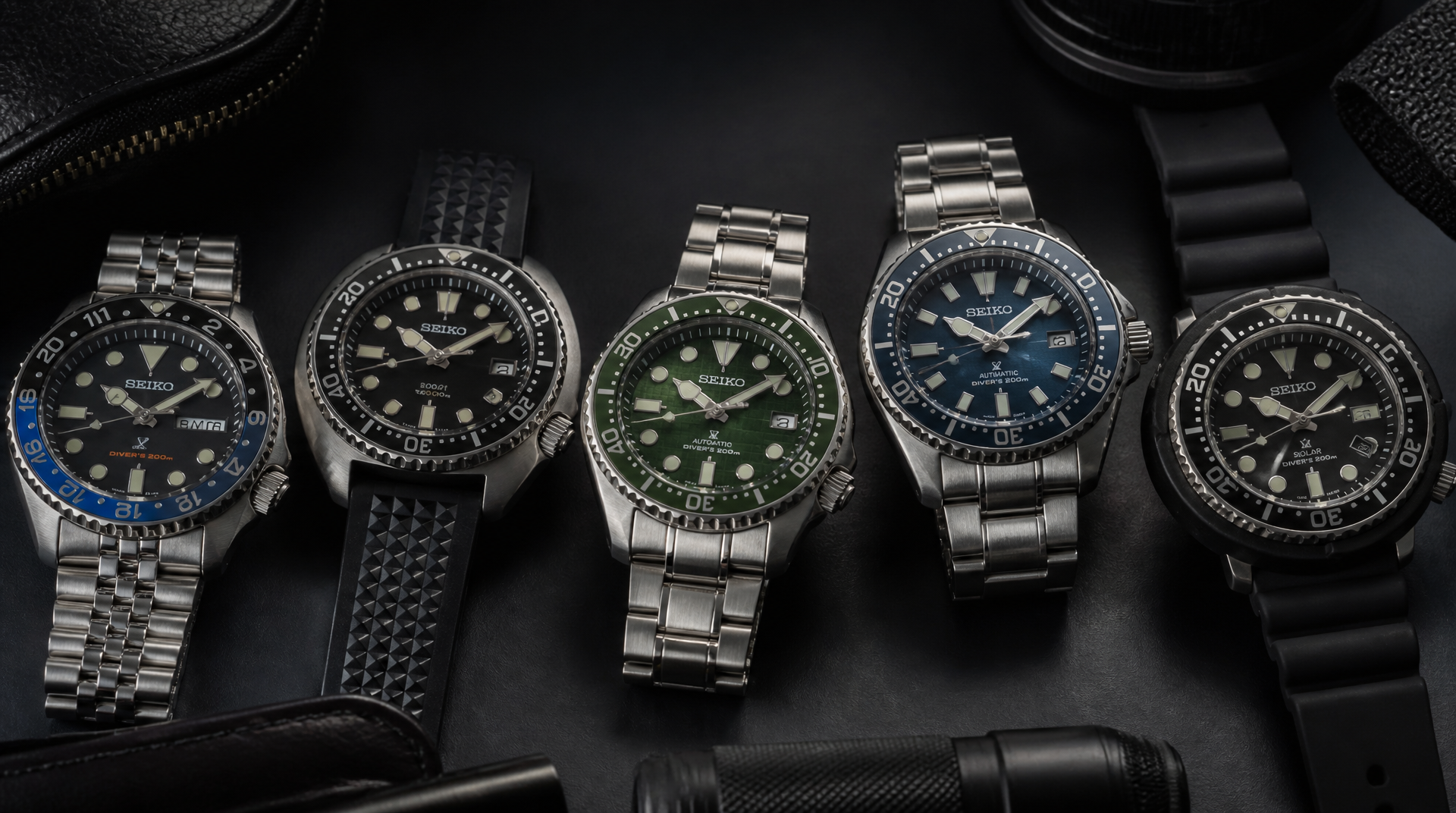
Seiko watch nicknames like “Batman,” “Willard,” “Turtle,” and “Samurai” are collector shorthand for specific case shapes, bezel colors, and historic references, but they are not a spec sheet. A single nickname can hide a 100‑m push‑pull crown watch next to a 200‑m ISO diver, and the difference changes what you can safely do with the watch — and whether you overpay. This guide shows exactly which models sit behind each nickname, what pitfalls trap buyers who trade on labels alone, and how to verify a watch before you click “buy” so that a community term leads you to the right watch instead of a mislabeled one.
Seiko Nickname Quick‑Reference Table
A nickname collapses a wide model range into a memorable word, but Seiko’s catalog keeps the same bezel colors and case silhouettes across price tiers. The table below gives hard reference points for the most common nicknames so you can tell a Turtle from a Sumo, a true dive‑rated Batman from a fashion variant, and a modern Willard reissue from a vintage piece you may not want.
| Nickname | Typical References | Movement (caliber / type) | Water Resistance | Crown Position | Key Visual Cue | Crystal | Common Pitfall |
|---|---|---|---|---|---|---|---|
| Turtle | SRP777, SRP773, SRP775, SBDY015 | 4R36 auto, 21,600 bph, ~41h | 200 m, screw‑down | 4 o’clock (right) | Cushion case, short downturned lugs | Hardlex | Often confused with Sumo; verify crown at 4, not 3 |
| Sumo | SBDC031, SPB101J1, SPB103J1 | 6R35 auto, 21,600 bph, 70 h | 200 m, screw‑down | 3 o’clock (right) | Tall slab‑sided case, 20 mm lugs | Sapphire | Mislabeled as Turtle, wearing heavier & taller |
| Samurai | SRPB49, SRPB51, SRPC93, SBDY041 | 4R35 auto, 21,600 bph, ~41h | 200 m, screw‑down | 3 o’clock (some 4) | Faceted blade‑like lugs, sharp edges | Hardlex | Lugs overhang small wrists; 3 o’clock crown can dig in |
| Willard (modern reissue) | SPB151, SPB153, SPB237 | 6R35 auto, 21,600 bph, 70 h | 200 m, screw‑down | 4 o’clock (left) | Asymmetrical cushion, left‑side crown guard | Domed sapphire | Vintage 6105‑based references cost much more; check SPB prefix |
| Batman (blue/black bezel) | SRPD73K1 (5 Sports), SNE435 (Solar diver) | 4R36 auto (SRPD), V157 solar quartz (SNE) | 100 m push‑pull (SRPD) / 200 m screw‑down (SNE) | 3.8 o’clock (SRPD), 4 o’clock (SNE) | SKX‑derived case, blue‑black insert | Hardlex (both) | Bezel color does not certify dive‑rated crown; always check crown type |
| Tuna | SBBN031 (quartz), SBDX001 (auto), SNE498 (Solar) | 7C46 quartz, 8L35 auto, V157 solar | 200 m / 1000 m, screw‑down | 4 o’clock | Shrouded case, prominent outer ring, thick profile | Hardlex or sapphire | Differentiate quartz Tuna from auto Marinemaster; shroud size varies |
| Monster | SRP307, SRPB01, SBDY015 (Dracula) | 4R36 auto | 200 m, screw‑down | 4 o’clock | Chunky case, aggressive teeth‑style bezel, unique dial | Hardlex | Bracelet quality feels cheap on some generations; bezel can be stiff |
| Pogue (vintage chronograph) | 6139‑600x series | 6139 automatic chronograph, 21,600 bph | 60 m, push‑pull | 3 o’clock | Yellow/gold dial, Pepsi bezel, chronograph pusher | Hardlex (acrylic on vintage) | Mostly vintage, service history unknown; avoid as a daily beater without a full check |
The table makes one thing obvious: a “Batman” could be a $300 5 Sports with a push‑pull crown or a $400 solar diver that survives pool time. A “Willard” might be a modern $1,200 reissue with a 70‑hour 6R35 or a vintage $3,000+ 6105‑8110 that needs a movement service before you wear it. The label only gets you to the right neighborhood, not the right house.
How to Identify Each Nickname in a Listing Photo
A single side‑profile shot answers the biggest question faster than any listing title. If you learn to scan for crown position, case flank shape, and bezel insert finish, you can spot a mislabeled watch in seconds.
- Crown position is the strongest differentiator. A Turtle always places the crown at 4 o’clock on the right side, and the case side drops sharply into short lugs. A Sumo feels thicker and sits its crown on the right at 3 o’clock, with nearly vertical slab sides. Willard reissues wear the crown on the left at 4 o’clock behind a pronounced guard; if you see a symmetrical crown at 3 o’clock, it is not a Willard regardless of what the dial says.
- Case geometry tells you a Samurai immediately: the lugs are faceted and blade‑like, with acute angles that catch reflections. A Turtle’s cushion case rounds the same visual space. Monsters look almost muscular with a thick mid‑case and a deeply notched bezel, and a Tuna’s protective shroud can’t be mistaken for anything else.
- Bezel and dial details distinguish the Batman variants. A blue‑black ceramic or anodized aluminum insert paired with a 100‑m marked dial (often “5 Sports” text) means a push‑pull crown that cannot be submerged. A blue‑black insert with “Diver’s 200m” and a screw‑down crown (usually an “X” or “Air” marker at 12) points to the Solar diver SNE435 or similar. The dial text at 6 o’clock or the case back engraving will carry the movement‑caliber code, which you can cross‑reference with the calibers listed in the table above.
- Movement tell becomes visible when a seller shows the case back. A see‑through back showing a rotor with Seiko’s standard 4R or 6R markings confirms an automatic; a solid case back with a solar medallion or “Solar” indication means quartz. The difference changes your accuracy expectations: the 4R36 runs typically -15 to +25 seconds per day, the 6R35 tightens that slightly and runs for nearly three days unworn, and the solar V157 quartz lands inside ±15 seconds per month — a completely different ownership experience.
The Sumo‑Turtle Trap: The Most Common Nickname Failure Mode
The most expensive single mistake in the nickname market is buying a Sumo at Turtle pricing, or worse, paying Turtle‑level money for a watch the seller listed as “Turtle” but the photos show a Sumo. The trap fires at least weekly on community sales platforms. A quick scan of sold listings shows SBDC031 Sumo watches that changed hands for $150–$200 more when the seller wrote “Turtle” in the title, because the nickname carries higher search volume and buyer demand. The only reliable way to spot the error early is to demand a side‑profile photo where you can count the crown.
A Turtle (SRP777) has its crown at 4 o’clock on the right side, with a sloping case back that follows the wrist. A Sumo (SBDC031) places the crown at 3 o’clock on a tall, straight slab case that measures nearly 14 mm thick and wears like a wall. The lug‑tip distance on a Sumo can reach 52 mm, and the watch feels top‑heavy on a bracelet. If the listing shows a “Turtle” with a 3 o’clock crown and a high case back, it is a Sumo, and you are likely being charged an extra $150 for a nickname. The cure is trivially simple: save a clean side‑profile image of an SRP777 and of an SBDC031 on your phone. Compare the crown position before you ever message the seller.
A second failure pattern lives in the Batman nickname. A Seiko 5 Sports SRPD73K1 with a blue‑black bezel gets labeled Batman by sellers because the aesthetic matches the Rolex GMT‑derived term, but its crown is push‑pull and the case is rated 100 m — safe for handwashing, not for swimming. A buyer who assumes “Batman” means a dive watch learns the difference when moisture condenses under the crystal after a pool day. The early detection check is to look for “Diver’s” on the dial. If you see “5 Sports” anywhere, the watch is not ISO‑rated and the crown does not screw down. Walk away unless you only want a desk diver.
Quick Verification Flow Before You Buy Any Nickname Watch
A nickname should trigger a two‑minute triage sequence, not a purchase. If a listing cannot pass these four checks, treat the watch as unidentified until the seller supplies what is missing.
1. Side‑profile shot (non‑negotiable). Identify crown location. Right‑side 4 o’clock = Turtle, Sumo impossible. Right 3 o’clock thick case = Sumo or a non‑Willard. Left 4 with guard = Willard. No crown visible in any photo? Do not proceed.
2. Dial‑text scan for reference range. Look at the 6 o’clock position for a code like 4R36, 6R35, V157, 7C46, or a full reference printed on the dial or case back. Match it to the expected calibers in the quick‑reference table. An SRPD73K1 dial confirms a 4R36‑equipped 5 Sports, not a diver.
3. Water‑resistance and crown type. Read the dial text: “Diver’s 200m” plus a screw‑down crown indicator (often a locking symbol on the crown itself) signals a true diver. “5 Sports” or “100m” alone means push‑pull. If the watch will see water, treat this check as your kill switch.
4. Movement accuracy and service state. For automatics, ask if the watch is running within typical 4R/6R tolerances and when it was last regulated. A 6R35 that gains 45 seconds per day is not a feature; it is a service signal. For solar quartz watches, confirm the capacitor still holds charge and the second hand jumps in two‑second intervals (low‑power warning) or runs smoothly.
If any of these four items is missing after one polite follow‑up, the purchase is not ready. No crown photo, no deal. The nickname advantage evaporates the moment you guess about a critical spec.
When to Skip Nicknames and Search by Reference Number
Nicknames serve enthusiast hunting, not precision buying. You should skip the nickname shortcut entirely and search by exact reference when any of these conditions must be met:
- You need a true diver, not a fashion piece. If you plan to swim, dive, or even shower with the watch, stop typing “Batman” and start typing “SNE435” or “SRPD73” (and then rule out the 5 Sports). The term “Batman” cannot guarantee a screw‑down crown, and a single pull‑up crown failure destroys the watch. Search by reference and confirm “Diver’s 200m” on the dial.
- Your wrist circumference is under 6.5 inches. Many Samurai models have an effective lug‑span over 50 mm, and the faceted lugs visually widen the watch. A Sumo sits even taller. A Turtle’s cushion case often fits smaller wrists better, but a Willard reissue (SPB151) with its shorter lug‑top and left‑side crown often wears dramatically smaller than its 44‑mm diameter suggests. Searching by reference and checking lug‑to‑lug measurements is the only safe path.
- You are buying in the $500–$1,200 bracket where movements change meaningfully. An SPB151 Willard gives you a 6R35 with a 70‑hour power reserve and a domed sapphire crystal; a second‑hand Turtle in the same price range gets you aftermarket mods, not a movement upgrade. If you want the better movement, compare the reference, not the shape. The “Turtle” nickname alone won’t tell you whether you are getting a 4R36 or a base 7S26 in an older Micro‑Turtle, and that difference determines how often you’ll be resetting the time.
- You dislike the cost of after‑sale crystal replacements. Most Turtles and Samurais ship with flat Hardlex, which scratches more readily than sapphire. The nickname doesn’t tell you the crystal material; the reference does. An SPB101 Sumo includes sapphire; an SRP777 Turtle does not. If you want to avoid a $80–$120 crystal swap later, verify the spec before paying.
Bottom Line
Seiko nicknames are a genuine hunting filter for collectors who already know how Turtle, Sumo, Samurai, Willard, Batman, and the surrounding models differ at the crown, the crystal, the movement, and the case flank. For everyone else, they are a fast track to accidental overpayments and mis‑sized watches. The single rule that keeps a nickname search safe is to treat the label as a search keyword, not an identity. Enter the market on “Turtle,” but don’t commit until you’ve seen the crown at 4, read a reference that matches the expected calibers, and confirmed that the dial text and water‑resistance rating align with your intended use.
When a seller cannot deliver a side‑profile shot with a clear crown, the buy isn’t ready. Walk away and find a listing that shows you the engineering behind the name.
Explore This Topic
- Back to Seiko
- Back to Seiko Model Reference
Related guides in this cluster:
- Seiko Watch Movements Guide: 7S26, 4R35, 6R15, Spring Drive Explained
- Breitling Watch Buying Guide: Are They Worth It in 2026?
- Fossil Watch Battery Replacement: Complete Guide for All Models

The We Know Watches editorial team brings together over 40 years of combined watch collecting, trading, and repair experience. Our editors have owned and handled watches from every major brand — from entry-level Seiko 5s to Rolex, Omega, Patek Philippe, and independent Swiss watchmakers. We’ve bought and sold at auction, worked with authorized dealers, visited manufacturing facilities in Switzerland and Japan, and serviced hundreds of movements ranging from the Seiko 7S26 to the Longines L888. Every guide and review we publish is based on hands-on experience, original research, and consultation with professional watchmakers. We do not accept payment for reviews, and we clearly disclose when we use affiliate links.