
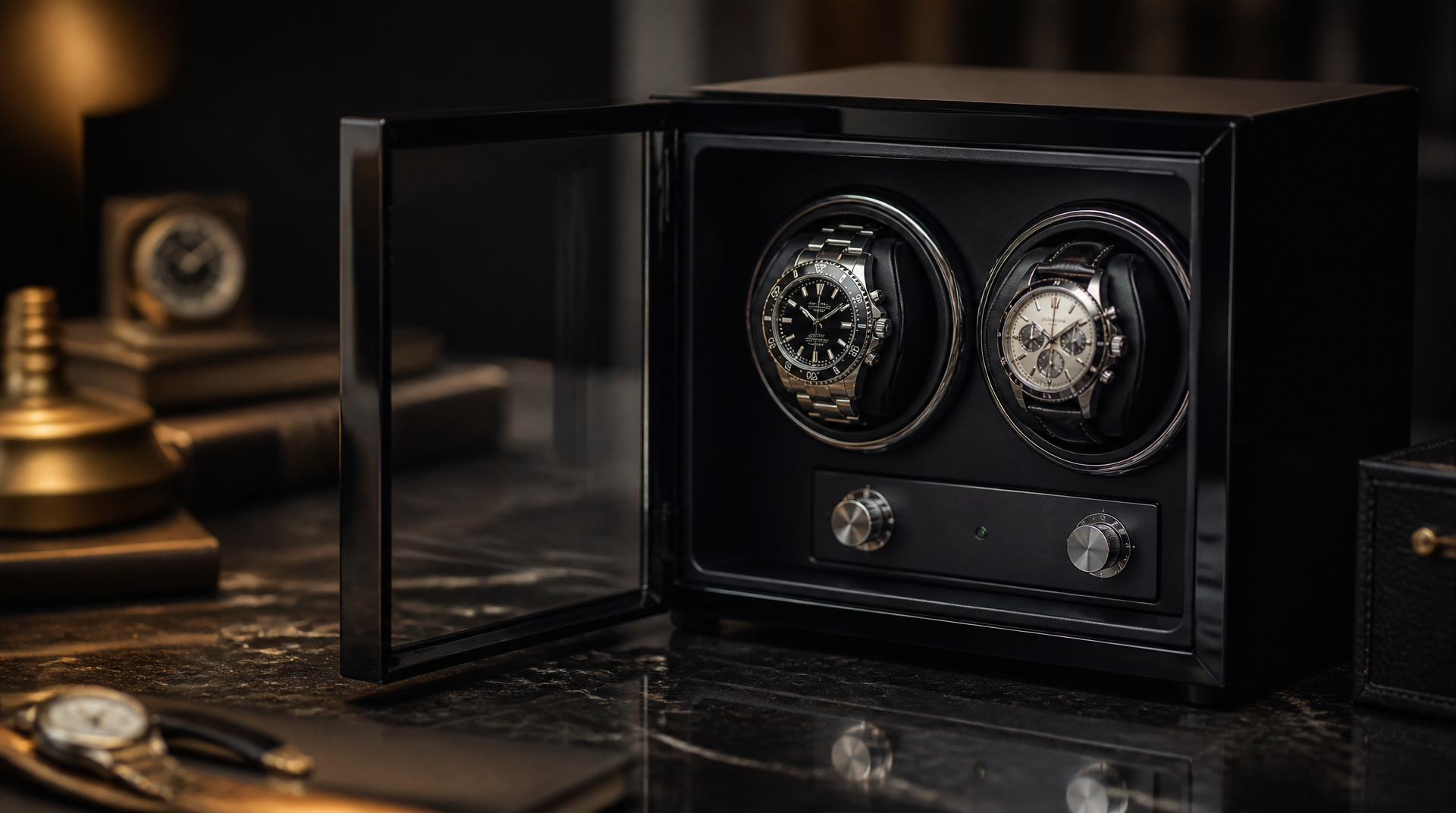
Watch Winder Guide: How They Work, Best Settings & Do You Actually Need One?
For most automatic watch owners, the honest answer is no—you do not need a winder. A winder becomes useful only when resetting a stopped watch turns into a genuine hassle, not a 30-second ritual. If you wear the same watch daily or rotate two simple time-and-date pieces, skip the winder. When a perpetual calendar, a deep collection, or a screw-down crown you dread touching enters the picture, a winder shifts from accessory to daily tool.
How a watch winder works
A watch winder is a motorized box or cradle that rotates your automatic watch, keeping the mainspring wound. Inside the movement, a weighted rotor swings with motion and transfers energy through a gear train. Once the watch sits still for its power reserve (typically 48 to 72 hours), the mainspring runs down and the movement stops.
The winder mimics wrist motion: it turns the watch through a set number of rotations per day (TPD) in one or both directions, with optional rest cycles. Because modern automatics use a slipping mainspring clutch, the winder cannot overwind the watch — the clutch disengages when full. The real long-term concern isn’t overwinding but unnecessary motion that adds rotor bearing hours without benefit.
The right settings for your automatic watch
Getting the settings right prevents wasted rotation and keeps the watch truly ready to wear. You adjust three things.
Turns per day (TPD)
TPD is how many full rotations the winder completes in 24 hours. Setting it too low leaves the watch under-wound; setting it far too high and running it nonstop can, over years, accelerate rotor bearing wear on some movements.
Common TPD ranges for mainstream calibers:
- ETA 2824-2, Sellita SW200: 650–800 TPD, bidirectional
- Rolex 31xx series (Submariner, Datejust): 650–800 TPD, bidirectional
- Omega Co-Axial 8500/8900: 650–800 TPD, bidirectional
- Miyota 9015: 800–900 TPD, unidirectional clockwise
- Valjoux 7750 chronograph: 800 TPD, unidirectional clockwise
When uncertain, start at 650–800 TPD bidirectional. If the watch stops after a full wrist wind and a night on the winder, increase TPD to the upper end of its range or check the winding direction. Confirm the official figure in your watch manual or on the manufacturer’s site.
Rotation direction
Match the rotor’s winding direction, or the winder will spin the watch without delivering any energy:
- Bidirectional (CW + CCW): Most Rolex, Omega, ETA, Seiko automatics.
- Unidirectional clockwise: Miyota 9015, many 7750-based chronographs.
- Unidirectional counterclockwise: Rare; a few vintage or specialty calibers.
You can verify direction without a manual. Hold the watch vertically, crystal facing you, and gently rotate your wrist side to side. A smooth buzz means bidirectional winding. A sharp click-ratchet sound in only one direction means unidirectional — set the winder to that direction exclusively.
Most quality winders let you select clockwise, counterclockwise, or a combined cycle. Choose bidirectional unless you know the movement requires one direction. If you get it wrong, the watch will stop despite the winder moving, and you’ll assume a mechanical fault when it’s just a setting error.
Rest cycles and power reserve management
Running a winder 24/7 at maximum TPD subjects the movement to constant motion. While the slipping clutch prevents overwinding, continuous spinning adds rotational hours that, over several years, can wear rotor bearings faster than normal wrist use. Cheap winders with warm motors make this worse.
A good winder delivers the required TPD in two or three daily sessions with 4- to 8-hour rest windows in between. That mimics natural wear and extends motor life. If your winder only runs continuously, at least choose a model with a quiet, cool motor, and consider unplugging it one day a week — just long enough that the power reserve doesn’t hit zero.
Setting up a winder: a quick checklist
- Look up the manufacturer’s TPD and direction. Don’t guess based on brand.
- Set direction to bidirectional; fine-tune to unidirectional if needed.
- Set TPD at the low end of the recommended range (usually 650 or 800).
- Program rest windows if available. If not, plan a short daily off cycle.
- Place the watch cuff or pillow so the watch sits firmly. It shouldn’t wobble or slide.
- Paper-check the fit: close the lid with a sheet of standard printer paper placed between the watch crystal and the lid. If you feel resistance or the paper binds, the clearance is too tight and the crystal or caseback may scuff over time.
- Plug in and check after 12 hours: does the watch still run and show correct time? If not, adjust TPD or direction.
If the watch reads correctly after a full day and stays wound through your normal wear cycle, the settings work. If it stops, wrong direction or TPD set too low are the usual culprits — recheck both before assuming a movement problem.
Do you need a watch winder?
The value of a winder comes down to how much friction resetting a dead watch adds to your routine.
When a winder saves you real time
- Perpetual calendar or annual calendar: Setting these can be tedious or risky, sometimes requiring a tool or a trip to a service center if you make a mistake. A winder prevents that costly reset.
- Screw-down crowns used in rotation: Threading and unthreading a large screw-down crown every day accelerates wear on the crown tube threads. Keeping the watch on a winder during off days reduces that mechanical stress.
- Rotation of 5+ high-complication watches: When each watch has day, date, moonphase, or GMT, resetting takes minutes. A winder eliminates that daily ritual.
- Hand mobility issues: Winding and setting a screw-down crown can be uncomfortable or impossible for someone with arthritis or reduced dexterity. A winder removes that barrier.
When you can safely skip it
- You wear the same automatic daily. It never stops.
- You own one or two simple time-and-date automatics. Resetting takes under 30 seconds.
- Your watch is manual-wind. A winder cannot wind a watch without a rotor.
- The watch is rarely worn. Keeping it spinning for months adds motor noise and wear with no payoff.
- The winder will live in a bedroom. If your budget can’t stretch to a near-silent brushless model, skip it — hand-wind instead and save the noise.
If you’re on the fence, try a two-week test: each time a rotating watch stops, note how long setting takes. If it’s over a minute and happens several times a week, a winder starts justifying its cost and counter space.
Best watch winders for different needs
A good winder runs quietly, gives you separate control over TPD and direction, and holds the watch securely without scratching the case.
| Model | Approx. price | Capacity | TPD settings | Direction control | Motor type | Noise note |
|---|---|---|---|---|---|---|
| Wolf Heritage Single Winder | $200–$300 | 1 | 300–1,200 programmable | Bi-directional, CW, CCW | Japanese Mabuchi | Near-silent; excellent rest programs |
| Barrington Single Winder | $160–$220 | 1 | 650, 750, 850, 1,000 preset | Bi-directional, CW, CCW | Japanese brushless | Quiet; compact footprint |
| JQUEEN Double Winder | $100–$140 | 2 | 4 TPD modes (650, 750, 850, 1,000) | CW, CCW, alternating | Chinese motor, quiet when new | Acceptable noise; budget option for two watches |
| Orbita Sparta Open Series | $450–$600 | 1 | 650 or 950 preset, on/off cycles | Rotorwind (automatic) | Swiss-made motor | Ultra-quiet; no belts; built for high-value pieces |
| Wolf Viceroy 2.7 Double Winder | $550–$750 | 2 | 300–1,200 programmable | Bi-directional, CW, CCW | Japanese Mabuchi | Luxury finish; near-silent; storage drawer |
| Versa Elite Quad Winder | $1,200+ | 4 | Programmable touchscreen | Independent per rotor | Japanese silent drive | Very quiet; for larger collections |
Check current pricing on the manufacturer’s site. Choose based on how many watches you’ll wind, whether silence matters, and how much you value preset versus fully customizable TPD. If you own a perpetual calendar, invest in the quietest programmable model you can afford — the peace of mind outweighs the cost.
Trade-offs to know
Added wear vs. convenience
Continuous motion, even at low TPD, adds rotational hours to the rotor bearing. It’s a slow-motion trade-off, not a sudden failure, but it’s real for watches worn infrequently. Buy a winder with rest cycles to get the best of both worlds.
Noise pollution
Cheap winders with loud DC motors can hum or vibrate enough to disturb light sleepers. If the winder sits in a bedroom, test it under load before committing — many manufacturers post noise ratings, but real-world noise with a watch inside can be louder.
Magnetic fields
Low-quality motors can emit enough magnetic interference to magnetize the hairspring, causing erratic timekeeping. You can test this at home: place a mechanical compass flat next to the running winder. If the needle deflects more than a few degrees, the magnetic field is strong enough to affect a watch. If your watch suddenly runs fast after a month on the winder, demagnetize it and upgrade to a shielded model.
Case contact and fit
An ill-fitting pillow can let the watch head rub against the winder interior, scuffing polished surfaces. Always check clearance with the paper test described earlier. If the bracelet is forced into an awkward angle, the clasp can scratch the caseback over repeated cycles.
Masking a weak mainspring
A winder that constantly tops off the mainspring can hide a failing mainspring that would stop within hours off the wrist. Once every few months, let the watch run down completely, then hand-wind and observe how long it runs. If it falls short of its rated power reserve, the issue needs a watchmaker, not a winder.
Related questions
Will a watch winder overwind my automatic watch?
No. Modern automatic movements have a slipping mainspring clutch that disengages when fully wound, so the winder cannot add more tension. The larger risk is unnecessary continuous motion, not overwinding.
Can I use a watch winder for a manual-wind watch?
No. Manual-wind movements lack a rotor, so the winder simply spins the watch without transferring energy to the mainspring. You must hand-wind manual watches.
What TPD is right for a Rolex Submariner?
Rolex 31xx series movements typically need 650–800 TPD in bidirectional mode. Start at 650 bidirectional and increase to 800 if the watch stops between wear rotations. Confirm with Rolex’s technical documentation for your specific caliber.
Does a winder damage the watch?
A well-designed winder with rest cycles and correct settings does not cause immediate damage. A cheap winder that lacks magnetic shielding, runs hot, or forces the watch against the inner surfaces can contribute to long-term issues. Choose a model with a proven quiet motor and check for magnetic interference with a simple compass test.
How many turns per day should I set for an Omega Seamaster with an 8500 movement?
Omega’s Co-Axial calibers such as the 8500 fall into the 650–800 TPD bidirectional range. Set the winder accordingly and verify with the watch manual. If your winder only has preset TPD values, 650 or 800 will both work, but 800 may keep the power reserve at its maximum with less risk of a stoppage.

The We Know Watches editorial team brings together over 40 years of combined watch collecting, trading, and repair experience. Our editors have owned and handled watches from every major brand — from entry-level Seiko 5s to Rolex, Omega, Patek Philippe, and independent Swiss watchmakers. We’ve bought and sold at auction, worked with authorized dealers, visited manufacturing facilities in Switzerland and Japan, and serviced hundreds of movements ranging from the Seiko 7S26 to the Longines L888. Every guide and review we publish is based on hands-on experience, original research, and consultation with professional watchmakers. We do not accept payment for reviews, and we clearly disclose when we use affiliate links.