
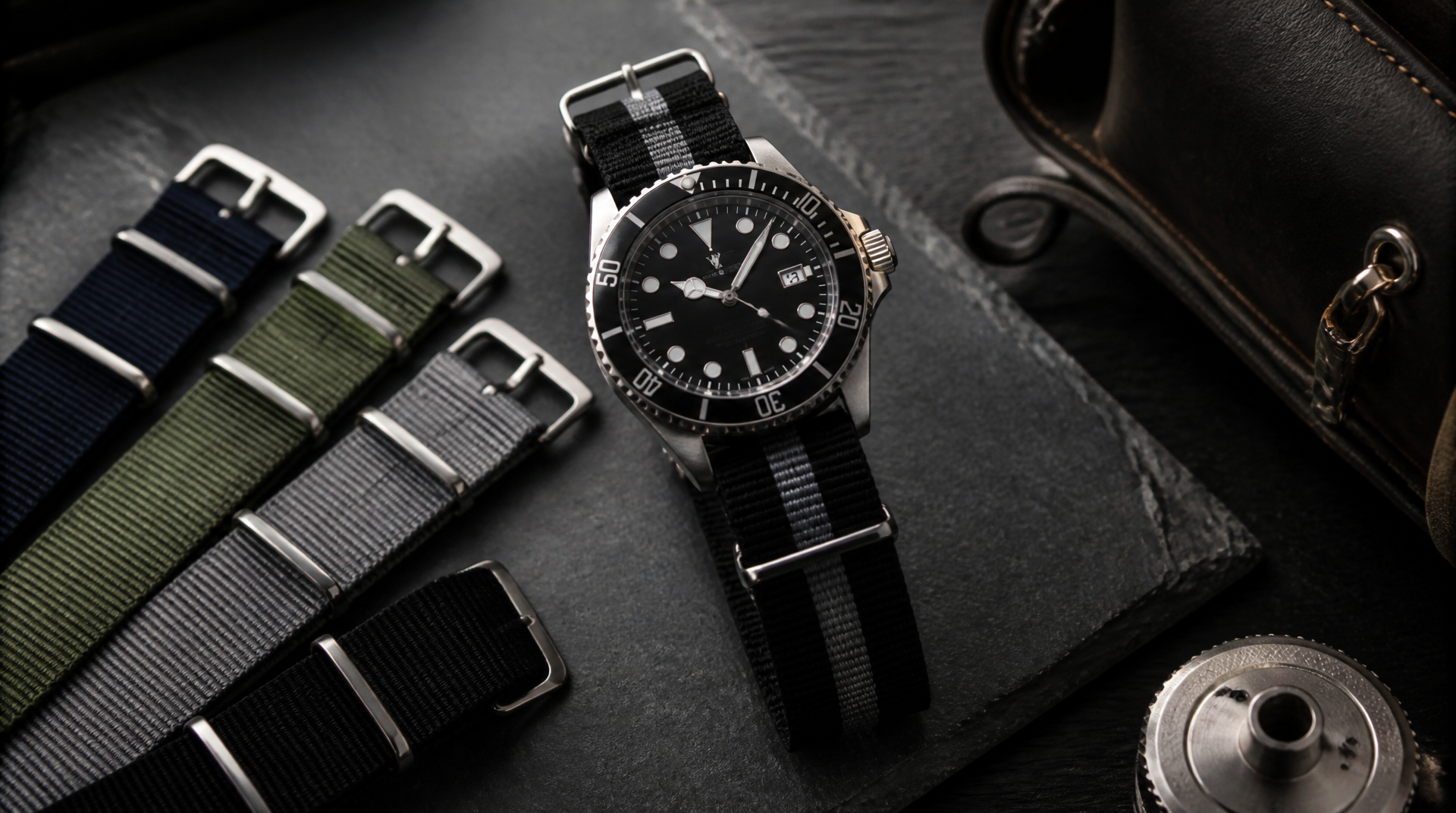
NATO Strap Guide: Best Options, Installation & Style Tips
A quality nylon NATO strap under $20 installs without tools in about two minutes and fits nearly any watch with the right lug width. The single biggest decision—whether you need an open-ended or a standard closed-loop strap—comes down to one thing: can you remove the spring bars? If yes, a standard NATO threads behind both bars. If the bars are fixed, you must buy an open-ended strap that attaches like a two-piece. Get that right, and the rest is choosing a material, width, and color that match how you’ll actually wear the watch.
When the standard NATO doesn’t fit your watch (and what to do instead)
This guide assumes your watch has removable spring bars and a lug width between 18 mm and 22 mm—the range that covers most modern field, dive, and dress watches. The moment your situation deviates, the whole strap choice changes.
If your watch has fixed, non-removable spring bars (common on some military-issue field watches and older divers), a normal one-piece NATO cannot be threaded under both bars. You need an open-ended strap—often labeled “RAF-style” or “single-pass” by reputable brands. Open-ended straps have a buckle at one end and a keeper at the other; they loop around the bar at 12 o’clock, route through a floating keeper under the case, and then buckle near 6 o’clock. Nothing passes under the fixed 6 o’clock bar, so the strap doesn’t get jammed.
Another boundary is lug clearance. If the distance between the spring bar and the case is under 1.2 mm, a thick 1.5 mm bonded nylon NATO can bind, push the bars outward, and eventually bend them. On a vintage dress watch or a thin profile case, stick to a Perlon or a 1.0–1.2 mm seatbelt nylon. Check clearance: after removing the strap, hold the watch face-down and slide a piece of paper between the spring bar and the caseback; if you have to force it, assume only thin straps will fit.
Material and hardware choices at a glance
Strap thickness and buckle type matter as much as material. Use the table as a starting point, then match your choice to the wear conditions below.
| Material | Typical hardware | Best for | Durability signal | Price range |
|---|---|---|---|---|
| Bonded nylon (1.2–1.5 mm) | Brushed stainless steel, sandblasted buckle | Daily wear, desk diving | Tight weave, sealed edges resist fraying | $12–25 |
| Seatbelt nylon (smooth weave) | Polished stainless steel | Dressier casual wear, lighter feel | Smooth surface traps less dust | $15–30 |
| Herringbone nylon (ribbed) | PVD or bead-blasted hardware | Tool watches, field watches | Ribbed texture hides wear marks | $15–35 |
| Heavy-duty nylon (thick webbing) | Matte steel with rounded keepers | Dive watches, thick lugs, wet conditions | Thicker weave, often reinforced holes | $20–40 |
| Perlon (woven synthetic) | Slim polished buckle | Vintage watches, hot weather, small wrists | Open weave breathes, no holes needed | $15–30 |
| Leather NATO (Chromexcel, etc.) | Brushed or gold-tone hardware | Casual dress watches | Adds bulk, can crack if soaked | $25–60 |
The right NATO for the job
Daily desk-to-dinner wear
A seatbelt nylon in a solid color (olive, navy, grey) with polished hardware reads as intentional, not as a budget swap. The smooth weave looks sharper on a 40‑mm watch than a ribbed herringbone, and a 20‑mm width on a 40‑mm case maintains proportion. Most bonds in this category cost $15–20 and hold up through daily typing and occasional rain.
Diving and water sports
Choose a heavy-duty nylon strap with a long tail you can fold under the case for a security wrap. Look for heat-sealed holes and marine-grade 316L stainless hardware—salt water will eat through plated buckles within a season. You need at least 1.5 inches of excess strap beyond the buckle to make the fold without bulging. Expect to spend $20–35; straps in this range from BluShark or ZuluDiver usually include a second floating keeper to lock the fold in place.
Watches with fixed spring bars
Open-ended NATO is non-negotiable. Popular options include the Haveston Canvas series or open-ended straps from Crown & Buckle. Measure lug width with a caliper—tolerance is tighter because the strap lacks the second spring bar to keep it centered. If your measurement sits between two sizes, go down 1 mm and gently stretch the strap to fit; a strap that’s too wide rides up onto the bezel and looks careless.
Vintage and thin dress watches (34–38 mm)
Perlon straps solve the NATO bulk problem. They have no sizing holes, so you get an infinite micro-adjust fit, and the open weave breathes in heat. A 16 or 18 mm Perlon in a muted tone (charcoal, taupe) with a slim polished buckle slips between dress‑watch lugs without forcing them apart. At $15–25, it’s a low-risk way to modernize a vintage piece without altering its character.
Install a NATO strap without tools in 3 minutes
Before you start
- Verify lug width with a caliper—do not guess. A 20‑mm strap in a 19‑mm gap will bunch and make the watch wobble. A strap that’s 0.5‑mm undersized can slide, accelerating spring bar wear.
- Check spring bar type. Push one end of a bar with a spring bar tool or toothpick. If the bar compresses and releases, it’s removable. If it doesn’t budge, stop and get an open‑ended strap.
- Test lug gap clearance. If a standard sheet of printer paper will not slide freely between the spring bar and the caseback, avoid straps thicker than 1.2 mm. Forcing a thick strap through a tight gap bows the spring bar and can snap it under impact.
- Remove the old strap but leave the spring bars seated. No spring bar tool is needed for threading; you’ll work entirely by hand.
Step 1: Thread the long end from below
Lay the watch face down. Take the longer section of the NATO (the end with the buckle) and pass it from the 12‑o’clock side underneath the case, then up through the gap between the spring bar and the case. Pull until about 2 inches of strap extends out the top.
Step 2: Bring the short end through and connect the buckle
Take the short end (the part with sizing holes) and thread it from the 6‑o’clock side underneath the case, then up through the metal keeper that sits on the long end. Pull the short end forward and thread it through the buckle. The buckle should land near the 6‑o’clock side of your wrist. Check that any printed text faces outward; if not, you’ve reversed the strap. If the hardware digs into your skin, flip the strap—the buckle and keepers must ride on the outer side of your wrist.
Step 3: Adjust and tuck the excess tail
Slide the watch onto your wrist and pull the short end through the buckle to a comfortable fit. Fold the remaining tail backward and tuck it through the floating keeper. For a lower profile, fold the tail under itself before sliding the keeper over it. If the tail is too short to tuck securely, the strap is undersized for your wrist—measure before ordering. Most standard‑length straps (about 280 mm) accommodate wrists up to roughly 7.5 inches.
Confirm the install is safe and comfortable
- The watch sits centered on the back of your wrist without twisting.
- The strap runs flat between the lugs; no webbing is pinched or visibly bulging.
- The tucked tail stays put and doesn’t catch on shirt cuffs.
- Escalation: if the strap refuses to lay flat because the weave is too thick for the lug gap, switch to a 1.0–1.2 mm option. If the spring bars start to bow outward, stop and replace them with curved shoulder spring bars; they relieve pressure and give the strap extra room to pass cleanly.
Dressing a NATO so the watch looks intentional, not like an afterthought
Three profile tricks that cut bulk
A standard NATO adds roughly 2‑3 mm of stack height because it sits between the caseback and your wrist. Single‑pass method reduces that: thread the strap under only the 12‑o’clock spring bar, run it over the 6‑o’clock bar, and fold the excess back underneath. The watch lays flatter and the arrangement works especially well on slabsided dive cases. You can also remove the second floating keeper entirely if it adds bulge—it’s only there for tuck‑tidy.
Color‑pairing that reads as a full look
Match one stripe or accent color in the strap to a detail on the dial. A “Bond” NATO with a thin red stripe complements a red seconds hand, creating visual coordination without being matchy. Avoid an all‑black strap on an all‑black dial—the watch disappears. Instead, pick olive, grey, or a brushed steel‑toned weave to create contrast that defines the case shape.
Match hardware finish to the case
Mismatched hardware is the fastest way to make a NATO look like a cheap afterthought. A fully brushed case demands a brushed or sandblasted buckle. A polished case needs polished hardware. A PVD‑coated or black‑ionized case pairs best with bead‑blasted or PVD‑coated buckles, not standard silver‑tone steel. Spend the extra $5 to get the right finish—swapping a polished buckle onto a matte tool watch undermines the entire look.
Trade-offs that matter after a few days of wear
- Thickness vs. presence. Straps under 1.0 mm feel insubstantial and can stretch, letting a heavier watch slide. Above 1.5 mm, the strap pushes the watch high enough that it won’t fit under a shirt cuff. Reserve thick webbing for dive watches where cuff clearance isn’t a factor.
- Sweat and odor. Nylon holds moisture. Wash the strap weekly in warm water with mild soap, and let it air‑dry completely to prevent a sour smell. Perlon dries faster and resists odor longer because the open weave doesn’t trap sweat.
- Keeper quality. Stamped flat‑steel keepers slide easily but develop sharp edges that fray the strap over months. Rolled‑edge or rounded keepers protect the webbing. If a keeper starts to fray the strap, replace it or swap to a different brand.
- Length is a safety variable, not a style tweak. A strap that’s too short won’t tuck; a strap that’s too long creates a flapping tail. Standard 280 mm straps fit wrists roughly 6.5–7.5 inches. Under 6.5 inches, buy a “short” NATO (≈260 mm) or commit to a single‑pass fold that uses less material. Over 7.5 inches, look for extra‑long straps (310 mm and up).
Related questions
Can I wear a NATO strap with a formal suit?
A thin seatbelt nylon in a dark, solid color and polished hardware can work if the watch is slim and the occasion is business‑casual. Anything wider than 20 mm or with a ribbed texture reads as tool watch gear, not tailoring. A leather strap remains the safer choice for true formal dress.
Do NATO straps damage spring bars?
Careless threading can bend thin spring bars, especially on a watch with tight lug gaps. If you feel resistance, stop and re‑approach. Shouldered spring bars with a wider center section resist flex, and curved bars give thick straps more room to pass without binding.
How often should I replace a NATO strap?
Replace the strap when fraying or elongated holes prevent a secure fit. With daily wear, a bonded or seatbelt strap typically lasts 12–18 months. Perlon straps often outlast standard woven nylon because they lack holes that can tear, but the weave can stretch over years, causing the watch to shift.

The We Know Watches editorial team brings together over 40 years of combined watch collecting, trading, and repair experience. Our editors have owned and handled watches from every major brand — from entry-level Seiko 5s to Rolex, Omega, Patek Philippe, and independent Swiss watchmakers. We’ve bought and sold at auction, worked with authorized dealers, visited manufacturing facilities in Switzerland and Japan, and serviced hundreds of movements ranging from the Seiko 7S26 to the Longines L888. Every guide and review we publish is based on hands-on experience, original research, and consultation with professional watchmakers. We do not accept payment for reviews, and we clearly disclose when we use affiliate links.