
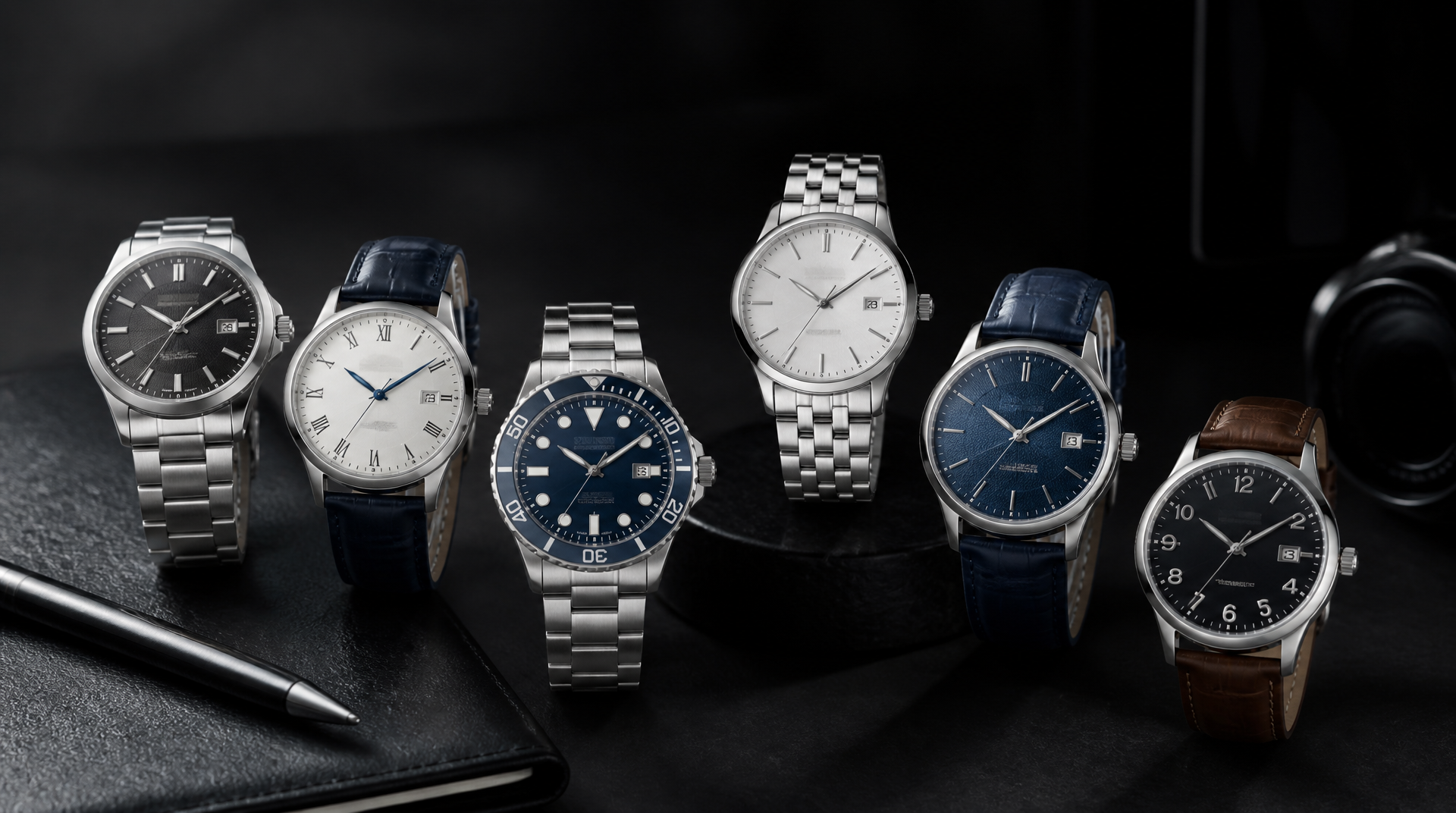
Best Entry-Level Luxury Watches Under $1000: A Complete Buying Guide
You can buy a genuine luxury watch for less than $1000—one with a mechanical movement, sapphire crystal, and case finishing that feels far more expensive than the price tag suggests. This guide cuts the marketing noise and gives you the decision logic to land on the right watch, not just another list of names.
Quick answer
The best entry-level luxury watch under $1000 depends on how you weight dress versatility, tool-watch toughness, and dial refinement. For a balanced mix of integrated-bracelet design, Swiss automatic movement, and the ability to slide under a cuff, the Tissot PRX Powermatic 80 is the most complete daily package. When dressy dial finishing matters more than anything else, the Seiko Presage Sharp Edged Series delivers a dial that rivals pieces costing three times as much. And when everyday durability and clear military-inspired legibility are the priority, the Hamilton Khaki Field Auto 38mm or the cult-favorite Seiko Prospex Alpinist SPB121 take over.
This shortlist assumes you want a mechanical watch with sapphire crystal and a case size under 42 mm. If quartz accuracy is non‑negotiable, the Tissot PRX Quartz and Citizen Chronomaster enter the conversation, but they trade the sweeping seconds hand for to‑the‑second precision, and that changes the luxury feel. The table below gives you a side‑by‑side look at the top automatic contenders, including the compromises you actually need to know about.
Comparison framework
The table pairs each watch with its real‑world trade‑offs—not marketing bullet points, but what you gain and what you give up the moment you strap it on.
| Watch | Approx. Price | Movement | Case (mm) | Water Resistance | Key Strength | Watch Out For |
|---|---|---|---|---|---|---|
| Tissot PRX Powermatic 80 | $675–$725 | Swiss automatic, 80h power reserve | 40 mm | 100 m (330 ft) | Waffle-dial finishing, slim 10.9 mm profile, bracelet quality that resets the bar | Integrated bracelet prevents strap swaps; clasp offers only two micro‑adjust positions |
| Seiko Presage Sharp Edged SPB165/167 | $1,000 | Seiko 6R35 auto | 39.3 mm | 100 m (330 ft) | Faceted “Asanoha” dial and Zaratsu‑polished hands; true dress presence | Stock leather strap feels hard and plasticky; will likely need a $60 replacement |
| Hamilton Khaki Field Auto 38 mm | $600–$645 | H-10 auto (80h reserve) | 38 mm | 100 m (330 ft) | Legible military dial, anti‑reflective sapphire, slim case that disappears on wrist | Lume fades quickly; OEM leather strap runs stiff and takes a week to break in |
| Seiko Prospex Alpinist SPB121 | $700–$750 | Seiko 6R35 auto | 39.5 mm | 200 m (660 ft) | Sapphire crystal, compass bezel, screw‑down crown; robust build and cult status | Cyclops magnifier splits opinions; green dial doesn’t suit every outfit; 19 mm lug width limits strap choices |
| Baltic Aquascaphe (microbrand) | $800–$850 | Miyota 9039 auto | 39 mm | 200 m (660 ft) | Vintage diver proportions, double‑domed sapphire, beads‑of‑rice bracelet | Miyota rotor noise can be audible in quiet settings; servicing paths are less established |
| Lorier Neptune IV (microbrand) | $499–$549 | Miyota 90S5 auto | 39 mm | 200 m (660 ft) | Acrylic crystal with warm distortion, slim midcase, fully articulating bracelet | Acrylic scratches easier than sapphire; no date option |
Before you buy: avoid the biggest fit regret
No amount of dial finishing saves a watch that doesn’t sit right on your wrist. Fit problems are the most common reason a well‑reviewed watch ends up resold at a loss. Run through this quick check before you commit, especially if you can’t try the watch on in person.
1. Measure your wrist, the right way.
Wrap a tailor’s tape (or a strip of paper and a ruler) around your wrist just above the bone, snug but not tight. That measurement—typically 6.25 to 7.75 inches for most buyers—is your baseline. If your wrist is under 6.5 inches, 40 mm cases can still work, but only if the lug‑to‑lug distance stays under 47 mm.
2. Ignore case diameter until you know the lug‑to‑lug.
A watch’s case diameter tells you almost nothing about how it wears. The dimension that matters is lug‑to‑lug tip. A 38 mm Hamilton with a 47 mm lug‑to‑lug wears comfortably on a 6.25‑inch wrist; a 44 mm diver with a 50 mm span overhangs and twists on the wrist, making the watch feel cheap even if it isn’t. Find the lug‑to‑lug spec on the manufacturer’s site, not the retailer’s summary.
3. Test the clasp’s micro‑adjustment.
Bracelet‑only watches without true micro‑adjust can drive you crazy by mid‑afternoon. The Tissot PRX gives you only two small extension holes inside the clasp—enough for mild daily swelling, but if your wrist fluctuates more than a quarter inch between morning and evening, you will end up with a loose bracelet that flops around by 3 PM. A strap‑based watch lets you swap to a perforated leather or NATO with infinite adjustment; an integrated bracelet like the PRX locks you in. Try the watch on a warm afternoon if you can, or buy from a dealer with a no‑penalty return window.
4. Order online with a “wear it indoors” return policy.
Wind the watch, wear it for an afternoon inside, and check for rotor noise and lume fade. Rotor whir on a Miyota‑powered microbrand can be charming or annoying—you won’t know until you sit in a quiet room with it. If the retailer doesn’t allow a brief indoor trial, pass or buy from one that does. A rushed purchase without a fit check usually means selling the watch within three months at a 30–40% loss.
5. Budget for the strap swap you’ll probably need.
Seiko Presage and Hamilton Khaki Field leather straps often feel stiff and cheap. Setting aside $50–$80 for a replacement suede or perforated leather strap before you even open the box prevents disappointment. Factor that into the all‑in cost; a watch that makes a poor first impression on your wrist rarely recovers.
Best‑fit picks by use case
A single decision criterion reshuffles the rankings: does the watch need to double as the piece you wear with a suit, or can it stay firmly on the sporty side? That answer drives everything.
The all‑day piece that works with a suit and a T‑shirt
Top pick: Tissot PRX Powermatic 80 (40 mm) or the 35 mm automatic version if your wrist is under 6.5 inches.
The PRX slips under most shirt cuffs, and the integrated bracelet gives it a jewelry‑like presence without being flashy. Before you commit, verify the clasp’s micro‑adjust: the two small extension holes cannot fix a bracelet that’s either too tight in summer or too loose in an air‑conditioned office. If your wrist swells visibly during the day, you’ll constantly fight the fit. The trade‑off is that you are locked into the steel bracelet—no quick strap changes for a leather dress look unless you track down a custom adapter. For many, the bracelet is so good that this doesn’t matter, until summer heat makes you crave a perforated rubber strap. If that reality bothers you, the Hamilton with its standard 20 mm lugs gives you infinite options instead.
The dress‑forward choice that owns the formal side
Top pick: Seiko Presage Sharp Edged (SPB165/167).
The dial carries a level of texture and facet‑work that eclipses any other watch on this list. You are paying for a dial you’ll still stare at ten years from now. The failure mode is entirely in the strap: the supplied leather feels shiny and rubbery, picking up ugly creases within weeks and cheapening the dial every time you close the buckle. Confirm the lug width is 20 mm, then budget $50–$80 for a suede or shell cordovan replacement. Without that swap, the whole experience tips from “luxury” to “I regret not spending more on the Hamilton.” Once the strap is upgraded, the watch transforms, and the Zaratsu‑polished hands catch light like a far more expensive piece.
The everyday tool watch that handles abuse
Top pick: Hamilton Khaki Field Auto 38 mm.
If your typical day includes airports, leaning over engine bays, or hiking, the Khaki Field is the one to pick. The 80‑hour power reserve means you can set it down Friday evening and grab it Monday morning without resetting. The anti‑reflective sapphire is a genuine usability gain outdoors. The practical down‑check is lume: after 30 minutes in a dark theater or a night drive, you cannot read the minute hand without tilting toward a light source. If that sounds like a dealbreaker, the Tissot PRX has better‑filled hands, though its indices aren’t luminous either. Test the lume indoors by charging it under a bright light and timing the fade; if you need to read the time in full darkness after midnight, the Alpinist’s lumed numerals are a safer bet.
The diver that earns its “luxury” tag without a dive‑computer price
Top pick: Baltic Aquascaphe or Lorier Neptune IV.
Both sacrifice some case‑finishing finesse for pure vintage charm, but the double‑domed sapphire and tight bezel action on the Baltic feel like they belong on a $1,500 watch. The mismatch you can’t fix is Miyota rotor noise. In a quiet office or a bedroom, the spinning rotor whirs clearly. Some owners call it character; others return the watch within days. If that will bother you, stick with the near‑silent ETA‑based movements in the Tissot or Hamilton. Go with the Lorier if you want the warm distortion of an acrylic crystal and a lower outlay; pick the Baltic if you refuse to worry about scratches, because acrylic will pick up fine marks that require polishing.
Where the usual recommendations fall short
- The Seiko 5 Sports “5KX” is often thrown into “luxury” lists, but the Hardlex crystal and pressed clasp pull it out of contention—it’s a great beater, not a luxury starting point.
- Entry‑level Tissot quartz models like the PR 100 are accurate tools but miss the mechanical heartbeat and hand‑finishing that define the category here.
- The Bulova Lunar Pilot has history, but the base version measures 45 mm and wears like a wall clock; it won’t fit most readers shopping for an everyday luxury piece.
Trade‑offs to know
Automatic vs. quartz under $1000
Half the luxury experience is the mechanical sweep. A Swatch Group ETA or Seiko 6R movement keeps time within −10 to +25 seconds per day. That isn’t COSC, but it’s authentic. You trade accuracy for engagement. If seconds‑a‑month precision is non‑negotiable, the Citizen Chronomaster quartz sits near the top of the bracket but lands outside the mechanical luxury window. If you prize the emotional connection of winding a movement and seeing the seconds hand glide, automatic is the right call—just accept that you’ll reset the time once a week.
Bracelet quality is where money quietly leaks out
A rattly stamped clasp can tank the feel of a watch with an otherwise stellar dial. The PRX bracelet resets the bar under $800; many Seiko models at this price use friction‑only adjustments or clasps that feel stamped. Budget as if a strap upgrade is likely—especially on Presage watches and the Hamilton Khaki Field. A $40 aftermarket leather strap changes the entire wearing experience, so treat it as part of the purchase, not an optional extra.
Brand cachet versus the finishing you actually get
Hamilton and Tissot carry Swiss heritage that matters if coworkers or clients notice watches. The Seiko Presage’s dial is objectively better finished, but in a business meeting the response may be “Nice Seiko” instead of “That’s a beautiful watch.” Only you can weigh that. Microbrands like Baltic and Lorier deliver fantastic value to hobbyists but won’t impress anyone who equates luxury with a recognizable Swiss logo. If external validation is part of why you’re buying, the Swiss name on the dial earns a nod; if you care more about what you see when you glance down, Seiko and the microbrands pull ahead.
Resale value reality
None of these watches are investments. Expect to sell a Tissot PRX or a Seiko Alpinist for 50–70% of what you paid within the first year. A scratched acrylic crystal on the Lorier can drop that further unless you polish it first. If holding value matters, buy pre‑owned from a reputable dealer—you’ll absorb the first depreciation hit and often find a watch that’s already had the strap upgraded. Buying new means you pay for the unboxing experience and the warranty, not for future resale.
Related questions
Is $1000 really enough to buy a luxury watch?
Yes, if you define luxury as mechanical engineering, sapphire crystal, and deliberate case design rather than precious‑metal bezels. You won’t get a manufacture movement or gold hands, but the watches above prove that $1000 buys a piece you can wear with pride for a decade.
Quartz or automatic in this price bracket?
For an entry‑level luxury piece, automatic is the better story. The Tissot PRX Quartz costs around $375 and is a solid daily grab‑and‑go, but the mechanical Powermatic version sustains the luxury feel long after the unboxing. If you hate resetting the time and only want accuracy, the quartz path saves money but doesn’t scratch the same itch.
Which watch under $1000 does a watch nerd actually buy with his own money?
Often the Seiko Alpinist SPB121 or a Hamilton Khaki Field Auto. They’re watch‑enthusiast lingua franca—spare parts are easy to source, mods are well‑documented, and resale buyers exist when you’re ready to move up. The Alpinist’s 19 mm lug width limits strap variety, but the loyal community has already solved most aftermarket problems.
Can I wear the PRX or the Alpinist with a suit?
The PRX works better with a suit than the Alpinist because of its thinner 10.9 mm case and integrated bracelet that slides under a cuff. The Alpinist’s compass crown and 13.2 mm thickness tend to catch on shirt cuffs; it’s happier with a field jacket or a rolled‑up sleeve. If you wear suits five days a week, the PRX is the safer one‑watch choice.

The We Know Watches editorial team brings together over 40 years of combined watch collecting, trading, and repair experience. Our editors have owned and handled watches from every major brand — from entry-level Seiko 5s to Rolex, Omega, Patek Philippe, and independent Swiss watchmakers. We’ve bought and sold at auction, worked with authorized dealers, visited manufacturing facilities in Switzerland and Japan, and serviced hundreds of movements ranging from the Seiko 7S26 to the Longines L888. Every guide and review we publish is based on hands-on experience, original research, and consultation with professional watchmakers. We do not accept payment for reviews, and we clearly disclose when we use affiliate links.