
A dead Michael Kors watch doesn’t require a trip to the mall jewelry counter. Most Michael Kors quartz models run on a standard button cell battery that a careful owner can swap in 10–15 minutes with the right tools. The cost difference is significant: a jewelry store or watch repair shop will typically charge $15–$45 for a battery replacement, while a single 371 or SR920SW battery costs $3–$8 online.
The catch is that Michael Kors cases are not all built the same. Some models have snap-off case backs that pop open with a blade or a specialized case knife. Others use a screw-down back that requires a case wrench or a friction ball. Opening the wrong style with the wrong tool is the most common way owners scratch the case, bend the back, or damage the gasket that keeps moisture out.
This guide covers both case-back styles, the exact battery codes used across Michael Kors models, and the verification steps that confirm the job is actually done right.
What You Need Before You Start
Michael Kors watches use standard quartz movements—most commonly the Ronda 763, Ronda 715, or a Miyota equivalent—and the battery requirements follow the movement, not the case design. The table below shows the batteries you are most likely to encounter:
| Movement | Battery Code | Alternate Code | Diameter × Height |
|---|---|---|---|
| Ronda 763 | 371 | SR920SW | 9.5 × 2.1 mm |
| Ronda 715 | 377 | SR626SW | 6.8 × 2.6 mm |
| Miyota 2035 | 371 | SR920SW | 9.5 × 2.1 mm |
| Ronda 751 | 364 | SR621SW | 6.8 × 2.1 mm |
The battery code is stamped on the movement itself, not on the case back. If you open the watch and the battery you purchased does not match what is inside, the code on the movement is the authority. Do not force a battery that is too thick into the clip, and do not use a thinner battery as a substitute—either can cause poor contact and intermittent stopping.
Tools required:
- Case back opener — a case knife for snap backs, or a case wrench / friction ball for screw backs
- Case holder — a rubber ball or padded holder that grips the case without scratching it
- Tweezers — plastic or brass-tipped, not steel, to avoid shorting the battery
- New battery — verify the code before you open the case
- Latex or nitrile gloves — skin oils accelerate corrosion on battery contacts
A note on tools: flat screwdrivers and kitchen knives are the wrong instruments for this job. They slip, and a slip on a polished Michael Kors case leaves a permanent gouge. A dedicated case knife with a short, angled blade or a case wrench with adjustable pins costs $10–$20 and removes the risk of cosmetic damage.
Identify Your Case-Back Type First
Turn the watch over and examine the back. The method you use to open it depends entirely on what you see.
Snap-back case: The back is a solid disc with no notches, no indentations, and no visible screws. There may be a small lip or recess at one edge where a blade can be inserted. This is the most common style on Michael Kors fashion models like the Bradshaw Gold-Tone Women’s Watch and the Lexington.
Screw-back case: The back has six or eight small notches around its circumference, or a central indentation with a hexagonal or slotted shape. This style is more common on water-resistant models and some chronograph versions. The notches are for a case wrench, not for a knife.
If you are unsure, look at the case back engraving. Michael Kors models with a screw-down back typically list “Water Resistant” with a depth rating (e.g., 5 ATM or 50M) more prominently, and the back will have a visible seam where it meets the case. Snap backs often have a continuous, flush surface.
Open the Case Back
For Snap-Back Cases
1. Place the watch face-down in a case holder or on a soft cloth.
2. Locate the small gap between the case back and the case—usually at the 6 o’clock or 12 o’clock position.
3. Insert the tip of a case knife into the gap at a slight angle.
4. Apply firm, steady pressure downward and outward. The back should pop free with a small click.
5. If the back does not release, rotate the watch and try the opposite edge. Do not pry harder at the same spot—this bends the back and breaks the seal.
For Screw-Back Cases
1. Select the correct pin size on your case wrench, or use a friction ball for a firm grip.
2. Place the wrench pins into the notches on the case back.
3. Turn counterclockwise. The back should release with moderate resistance.
4. If the back is seized, apply light downward pressure while turning. Do not use a hammer or impact force.
Early checkpoint: Once the back is off, inspect the rubber gasket that sits in a groove on the case or the back. If it is brittle, cracked, or stretched, stop and order a replacement gasket before reassembly. A damaged gasket is the number one cause of moisture damage after a battery change.
Remove the Old Battery
Inside the watch, you will see the movement—a small metal disc with gears and a battery clip holding a silver button cell.
1. Identify the battery clip. It is a small metal tab holding the battery against the movement.
2. Use plastic tweezers to lift the clip slightly and slide the battery out from under it.
3. Do not touch the movement’s exposed gears or the coil with your tools or fingers.
4. Note the battery code printed on the battery itself and compare it to what you purchased.
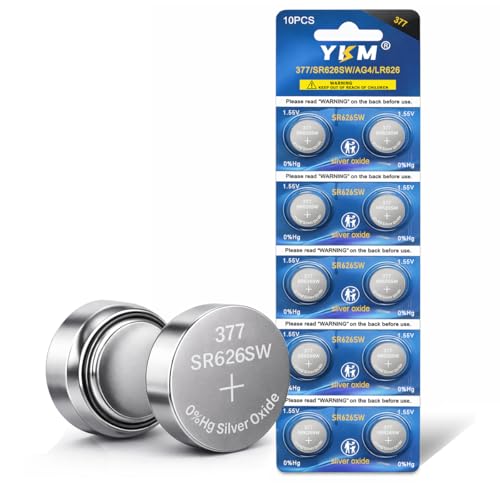 10 Pack SR626SW 377 Watch Batteries 1.55V Silver Oxide Button Cell Battery | 376 AG4 LR626, Long-Lasting and Leak-Resistant for CalculatorsCheck price on AmazonWe may earn a commission
Friction point: If the battery is stuck to the movement, it may have leaked or corroded. White or green residue around the battery is a leak. Stop here and take the watch to a professional—corrosion on the movement’s contact points requires disassembly and cleaning, and attempting to scrape it off with a tool will likely damage the circuit.
Install the New Battery
1. Put on gloves or wash your hands thoroughly.
2. Remove the new battery from its packaging. Handle it by the edges only.
3. Slide the battery under the clip, positive side up (the side with the “+” marking facing you).
4. Press down gently until the clip snaps over the edge of the battery.
5. Verify the battery is seated flat against the movement—a raised edge indicates it is not fully seated.
Verification checkpoint: Before you close the case, check that the movement is running. Look at the balance wheel (the small spinning disc) or the seconds hand. If the watch has a quartz movement, the seconds hand should begin ticking immediately. If it does not, the battery may be upside down, the clip may not be making contact, or the movement may be damaged. Do not close the case until the watch is running.
Reassemble and Test
1. Check the gasket. If it is in good condition, seat it evenly in its groove.
2. Align the case back with the case. For snap backs, press firmly around the entire circumference until it clicks into place. For screw backs, turn clockwise until snug—do not overtighten.
3. Set the time using the crown.
4. Pull the crown out to the time-setting position, set the time, and push the crown back in.
Success check: After reassembly, the watch should run continuously for at least 24 hours without stopping. If the seconds hand stops within a few hours, the battery is likely not seated properly, or the crown was left in the pulled-out position, which stops the movement on many quartz calibers.
When to Stop and Call a Professional
A battery replacement is a safe DIY job when the case opens cleanly and the movement is undamaged. Escalate to a watch repair professional in these situations:
- Corrosion or battery leakage — visible residue on the movement or battery contacts
- A seized case back — if the back will not open with reasonable force, forcing it will damage the case
- A damaged gasket — if the rubber seal is cracked, brittle, or stretched
- The watch does not run after a new battery is installed — this indicates a movement issue, not a battery issue
- Water resistance matters to you — if you wear the watch swimming or in the rain, a professional can pressure-test the watch after reassembly. A DIY battery change without a new gasket and pressure test can compromise the stated water resistance.
The cost of a professional battery replacement is $15–$45, which includes a new gasket and often a pressure test. If your watch is a higher-value model or you are not confident in your ability to open the case without scratching it, that price is a reasonable trade for the peace of mind.
Frequently Asked Questions
What battery does a Michael Kors watch take?
Most Michael Kors quartz watches use a 371 (SR920SW) or 377 (SR626SW) battery, depending on the movement. The exact code is stamped on the movement inside the watch, not on the case back.
How much does it cost to replace a Michael Kors watch battery?
A DIY replacement costs $3–$8 for the battery plus $10–$20 for tools if you do not already own them. A professional replacement typically costs $15–$45.
Can I replace a Michael Kors watch battery myself?
Yes, if the case back opens cleanly and the movement shows no signs of corrosion or damage. The job takes 10–15 minutes with a case knife or wrench and a new battery.
Will replacing the battery myself ruin the water resistance?
It can, if the gasket is damaged or not reseated properly. If water resistance is important, replace the gasket and have the watch pressure-tested by a professional after the battery change.
How do I know if my Michael Kors watch needs a new battery?
The most common signs are a seconds hand that ticks in two-second jumps instead of smooth one-second steps, a watch that runs slow, or a watch that has stopped entirely. These symptoms can also indicate a movement issue, so a battery replacement is the first diagnostic step.

The We Know Watches editorial team brings together over 40 years of combined watch collecting, trading, and repair experience. Our editors have owned and handled watches from every major brand — from entry-level Seiko 5s to Rolex, Omega, Patek Philippe, and independent Swiss watchmakers. We’ve bought and sold at auction, worked with authorized dealers, visited manufacturing facilities in Switzerland and Japan, and serviced hundreds of movements ranging from the Seiko 7S26 to the Longines L888. Every guide and review we publish is based on hands-on experience, original research, and consultation with professional watchmakers. We do not accept payment for reviews, and we clearly disclose when we use affiliate links.