
If you’re after a Swiss-made watch that punches above its price, Hamilton is one of the strongest contenders at $500–$1,000. The short answer: the Khaki Field Mechanical is the best value for rugged everyday wear; the Jazzmaster wins for dressier versatility; and the American Classics line offers the best vintage-inspired style for collectors on a budget. Your next step is to match your use case to the right line, then pick the specific reference that fits your wrist and lifestyle. Don’t default to the Khaki just because it’s the most famous — the Jazzmaster is a better one-watch solution for many buyers.
The Three Lines at a Glance
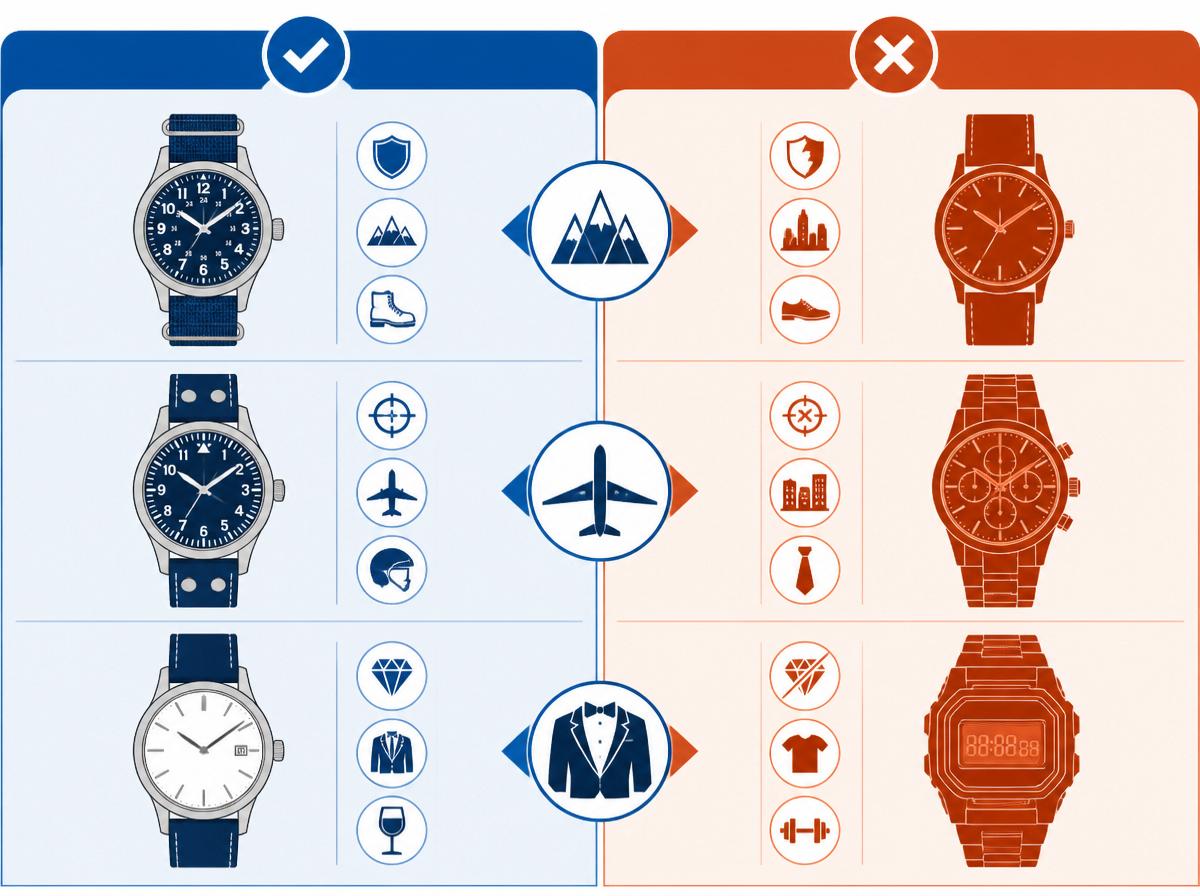
Hamilton’s lineup breaks into three clear buckets. Each serves a different purpose, and mixing them up is the most common buying mistake.
| Line | Best For | Typical Size | Movement | Water Resistance | Price Range |
|---|---|---|---|---|---|
| <strong>Khaki Field</strong> | Tool watches, outdoor/field use, casual | 38mm–42mm | Hand-wind or automatic (H-10/H-30) | 50m–100m | $495–$845 |
| <strong>Jazzmaster</strong> | Everyday wear, office, dress-down smart | 38mm–42mm | Automatic (H-10, H-21, Valjoux) | 50m–100m | $625–$1,195 |
| <strong>American Classics</strong> | Vintage reissues, unique dials, collectors | 36mm–40mm | Automatic (H-10, H-50) | 30m–50m | $495–$795 |
Counter-intuitive angle: Most guides tell you the Khaki is the “do-everything” watch. In reality, the Jazzmaster often fits more daily situations better than the Khaki — especially if you work in an office or need something that doesn’t scream “field watch.” The Khaki’s highly legible field dial and canvas strap can look out of place with a blazer. The Jazzmaster’s polished case and more refined dial make it the true one-watch solution for many buyers. If your week involves a mix of jeans and dress shirts, the Jazzmaster is the safer bet.
Khaki Field: The Rugged Standard
The Khaki line is Hamilton’s icon. The Khaki Field Mechanical (38mm) is the purest expression: hand-wind, no date, clear cathedral hands, and a NATO or textile strap. It’s the watch you can wear hiking, camping, or on a workshop bench without worrying about scratching it. The H-50 movement (a modified ETA 2801-2) runs at 21,600 bph with an 80-hour power reserve.
Applicability boundary: The 38mm Khaki Field Mechanical wears small. If your wrist is 7.25 inches or larger, this model will look like a dress watch rather than a field watch — the case diameter and short lug-to-lug (47mm) make it feel compact. In that situation, look at the Khaki Field Auto 42mm or skip to the Jazzmaster Day/Date 42mm for a better visual balance.
Verification step: Before buying, trace the 38mm case outline on paper at 100% scale or compare it to a watch you already own that fits well. If the 47mm lug-to-lug overhangs your wrist, the watch will wear uncomfortably and look undersized.
Khaki Field Mechanical Comparison (38mm)
| Model | Dial | Strap | Price | Rating | Best For |
|---|---|---|---|---|---|
| Hamilton Khaki Field Mechanical Black Dial | Black | Textile | $495 | 4.5/5 | Pure field watch style, maximum legibility |
| Hamilton Khaki Field Mechanical White Dial | White | Textile | $495 | 4.5/5 | Better contrast in low light, vintage military look |
| Hamilton Khaki Field Mechanical Green Dial | Green | Canvas | $495 | 4.5/5 | Subtle color accent, less common than black/white |
Top Pick: Hamilton Khaki Field Mechanical Men’s Watch, 38mm, Black Dial, Textile Strap – The black dial is the most versatile, pairs with any strap, and is the reference that started the modern revival. It’s also the easiest to resell if you change your mind.
What to watch out for: The hand-wind movement requires daily winding (about 20 turns) — that’s a pro for enthusiasts who enjoy the ritual, but a real hassle if you prefer set-and-forget. Also, 50m water resistance means splash-proof, not swimming. Do not submerge this watch. If you need water resistance beyond that, step up to the Khaki Navy line (200m+).
Realistic mismatch: The biggest mistake is buying the Khaki Field for a primarily dress-shirt environment. Its highly legible field dial and thick textile strap will clash with a suit or even a blazer. In contrast, the Jazzmaster’s polished case and clean dial work in those settings but look ordinary on a hiking trail. Know your primary wearing context before choosing.
Jazzmaster: The Versatile All-Rounder
The Jazzmaster line is Hamilton’s answer to the “everyday Swiss automatic.” It has a polished bezel, applied indices, and options for day/date or open-heart displays. The Jazzmaster Viewmatic (40mm) is the sweet spot: H-10 movement with 80-hour power reserve, sapphire crystal, and a clean dial that works with suits or jeans. It’s the line most often overlooked by buyers who tunnel on the Khaki.
- Why you’d pick it: You need one watch for work, weekends, and date nights. The Jazzmaster’s polished case catches light without being flashy, and its thinner profile slips under a cuff better than the Khaki’s taller field case. If you already own a dedicated tool watch, the Jazzmaster fills the dress-up gap without overlapping.
- Trade-offs: Water resistance is still 50m, same as the Khaki — not a weakness, but don’t expect dive-watch durability. The H-10 movement is accurate but has no chronometer certification. Some owners report the crown feels slightly small for its size, making it harder to grip when setting the time.
- Best reference: Jazzmaster Viewmatic H32515555 (black dial, 40mm) — around $625. It’s the closest thing to a “no-brainer” in the lineup. If you want a day/date display, the H32505881 (42mm) adds practical functionality at $745.
- Decision implication: If you’re torn between the Khaki Field and the Jazzmaster, your choice hinges on whether you prioritize rugged legibility (Khaki) or refined versatility (Jazzmaster). There’s no wrong answer, but buying the Khaki for office wear or the Jazzmaster for hiking is the most common source of buyer’s remorse.
American Classics: Vintage Flavor Without the Vintage Headaches
The American Classics line draws from Hamilton’s U.S. heritage (pre-1969). Models like the Intra-Matic (chronograph or auto) and Boulton replicate mid-century designs with modern Swiss movements. The Intra-Matic Auto 38mm is the standout: domed sapphire crystal, boxed mineral crystal vibe, and a hand-winding H-50 movement that looks period-correct.
- Why you’d pick it: You want a watch that starts conversations. The American Classics line has the most distinct dials (panda, sector, sterling silver) and the smallest case sizes (36–38mm), which appeals to collectors tired of 42mm+ monsters. The panda dial Intra-Matic is one of the best-looking watches under $1,000.
- Trade-offs: Water resistance is only 30m (hand-wash okay, rain okay, but no swimming). The vintage-look crystals can scratch easier than flat sapphire — you’ll want a protective film or careful storage. And some models (like the Boulton) use a quartz movement that feels less premium. Always check the movement type before buying: quartz American Classics are FIPS (fairly inexpensive, but not Swiss mechanical), and they don’t hold resale value.
- Best reference: Intra-Matic Auto 38mm H38455151 (panda dial) — about $795. It’s the most desirable Hamilton under $1,000 on the secondary market and retains 70–80% of its retail value.
Trade-offs to Know Before Buying
- Movement type: hand-wind vs. automatic. The Khaki Field Mechanical is hand-wind (80h power reserve). The Jazzmaster and most American Classics are automatic (also 80h). If you wear a watch only 1–2 times a week, the automatic will stop and need resetting anyway — so hand-wind isn’t a penalty. But if you want to grab and go, automatic is easier. No movement in this price range is COSC-certified.
- Size vs. wrist — verification method. Hamilton’s 38mm watches wear small. If your wrist is 7.25 inches or larger, the 38mm versions will look like a dress watch, not a field watch. To confirm fit, measure your wrist circumference and compare the watch’s lug-to-lug distance (usually 47mm for 38mm cases). If the lug-to-lug is shorter than the flat top of your wrist, the watch will wear well. If it overhangs, size up to 40mm or 42mm.
- Water resistance — concrete limits. None of these models are dive watches. 50m is fine for washing hands, rain, and accidental splashes. 30m (American Classics) is rain-safe and hand-wash-safe but no swimming. Do not shower, swim, or snorkel with any of them. If you need real water resistance, step up to the Khaki Navy line (200m+). Ignoring this limit is the fastest way to kill the movement — water damage is not covered under warranty if the seal is compromised.
- Strap options and hidden costs. The Khaki Field Mechanical comes on textile or canvas — fine for casual, but you’ll likely want to swap to a leather or bracelet. Factor in $30–$80 for a quality strap. The Jazzmaster’s polished bracelet is worth the extra cost ($100–$150 premium over leather). If you buy the Khaki on textile and later add a bracelet, the total cost can exceed the Jazzmaster on bracelet, making the Jazzmaster the better value.
Related Questions
Which Hamilton retains value best?
The Khaki Field Mechanical (black dial) holds about 70–80% of retail in the pre-owned market because it’s the entry-level Swiss mechanical that enthusiasts always want. Jazzmasters lose more value (50–60%) because there are more variations and less collector demand. American Classics with panda dials sit between 60–75%, depending on condition.
Is the Khaki Field Mechanical worth the price at $495?
Yes. It’s the cheapest Swiss-made mechanical with an 80-hour power reserve, sapphire crystal, and a brand with genuine military history. Comparable watches from Longines or Tissot cost $200–$400 more for similar specs, making the Khaki Field Mechanical a clear value leader at $495.

The We Know Watches editorial team brings together over 40 years of combined watch collecting, trading, and repair experience. Our editors have owned and handled watches from every major brand — from entry-level Seiko 5s to Rolex, Omega, Patek Philippe, and independent Swiss watchmakers. We’ve bought and sold at auction, worked with authorized dealers, visited manufacturing facilities in Switzerland and Japan, and serviced hundreds of movements ranging from the Seiko 7S26 to the Longines L888. Every guide and review we publish is based on hands-on experience, original research, and consultation with professional watchmakers. We do not accept payment for reviews, and we clearly disclose when we use affiliate links.